LIC Arogya Rakshak Plan 906 Calculator
Plan withdrawn—benefit illustration for existing policies only.
Enter Policy and Claim Details
ADB Calculation
Benefit Result
This is an educational illustration based on UIN 512N318V01. It does not confirm claim eligibility. Waiting periods, listed procedures, exclusions, remaining annual/lifetime limits, medical evidence and LIC's decision apply.
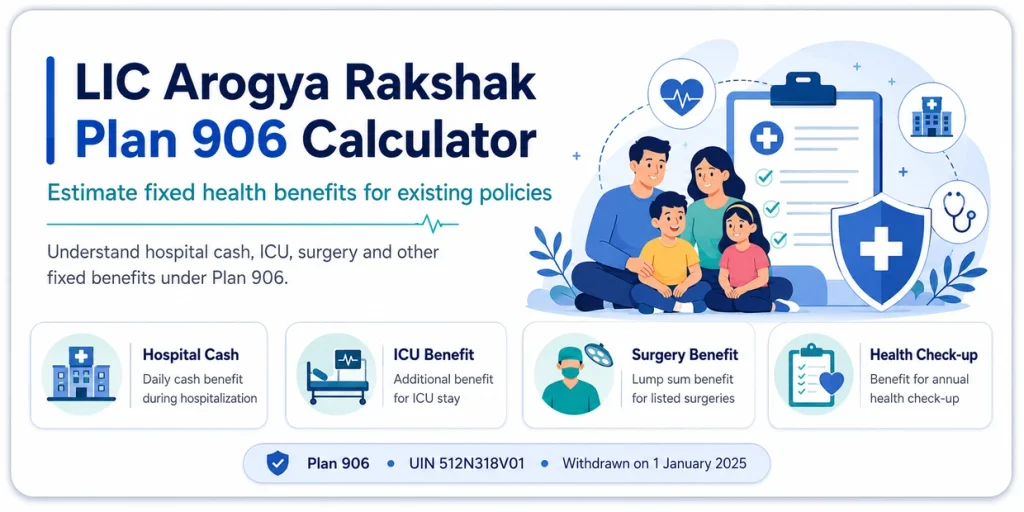
LIC Arogya Rakshak Plan 906 was a health insurance policy that paid fixed amounts for certain hospital stays, surgeries and listed treatments. It did not repay the complete hospital bill like a normal mediclaim policy.
The LIC Arogya Rakshak Calculator uses the daily benefit selected when the policy started and the policy year to estimate the amount available for an eligible medical event. It can calculate hospital cash, ICU benefit, surgery benefit, day care benefit and other benefits included in the plan.
LIC launched Plan 906 on 19 July 2021 and withdrew it on 1 January 2025. It is no longer available for a new purchase. The calculator is mainly useful for understanding an existing policy and does not approve a claim.
Table of Contents
What Is the LIC Arogya Rakshak Calculator?
The calculator explains the fixed-benefit structure of Plan 906 in rupees. The starting point is the Initial Daily Benefit shown in the policy schedule. This was the daily amount selected when the policy began.
The daily benefit could increase after every three policy years through an automatic increase and an additional increase for a claim-free period. The amount available in the selected year is called the Applicable Daily Benefit, or ADB. In simple words, it is the daily benefit currently used for calculation.
After calculating the current daily benefit, the calculator applies the formula for the selected hospital stay, surgery or treatment. The result is an estimate because payment depends on policy status, waiting periods, medical need, previous claims, yearly limits, lifetime limits and LIC’s claim checking.
Also Check:
Calculator Highlights
The calculator can estimate the daily benefit for a selected policy year and show the automatic and claim-free increases separately. It can calculate normal ward and ICU payments, all four major surgery categories, listed day care procedures, other surgeries, five listed medical conditions, extended hospital stays and the health check-up limit.
It can also check basic entry-age limits and show when a selected benefit crosses an important yearly limit. It does not calculate an exact family premium or decide whether a treatment is covered.
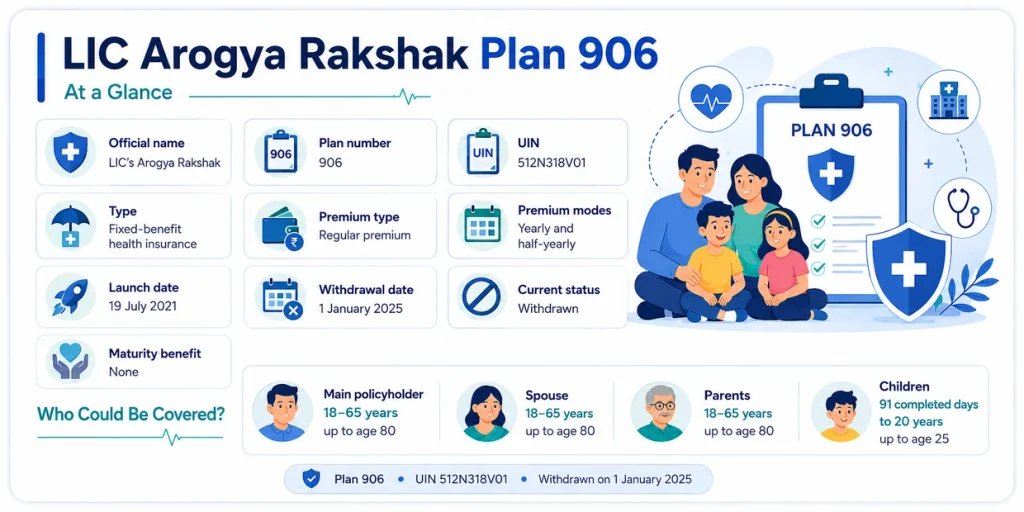
Quick Fact of LIC Arogya Rakshak Plan 906
| Detail | Information |
|---|---|
| Official name | LIC’s Arogya Rakshak |
| Plan number | 906 |
| UIN | 512N318V01 |
| Type | Fixed-benefit health insurance |
| Premium type | Regular premium |
| Premium modes | Yearly and half-yearly |
| Launch date | 19 July 2021 |
| Withdrawal date | 1 January 2025 |
| Current status | Withdrawn |
| Maturity benefit | None |
The plan was not linked to the share market and did not earn a bonus. It was meant for health protection, not savings.
What is LIC Arogya Rakshak?
One policy could cover the main policyholder, spouse, eligible children and parents of the main policyholder. The policy used the term Principal Insured for the main person holding the policy.
The payment did not depend on the complete hospital invoice. For example, if the current daily benefit was ₹5,000, an accepted normal ward stay could pay ₹5,000 for each eligible day. An accepted ICU stay could pay ₹10,000 per eligible day. The fixed payment could be lower or higher than the actual medical expense.
The plan included hospital cash, surgery benefits, day care benefit, support for five listed medical conditions, an extra payment for a long hospital stay, ambulance support, health check-up support and premium waiver in certain cases.
Who Could Be Covered?
| Covered person | Entry age | Normal cover limit |
| Main policyholder | 18 to 65 years | Up to age 80 |
| Spouse | 18 to 65 years | Up to age 80 |
| Parents | 18 to 65 years | Up to age 80 |
| Children | 91 completed days to 20 years | Up to age 25 |
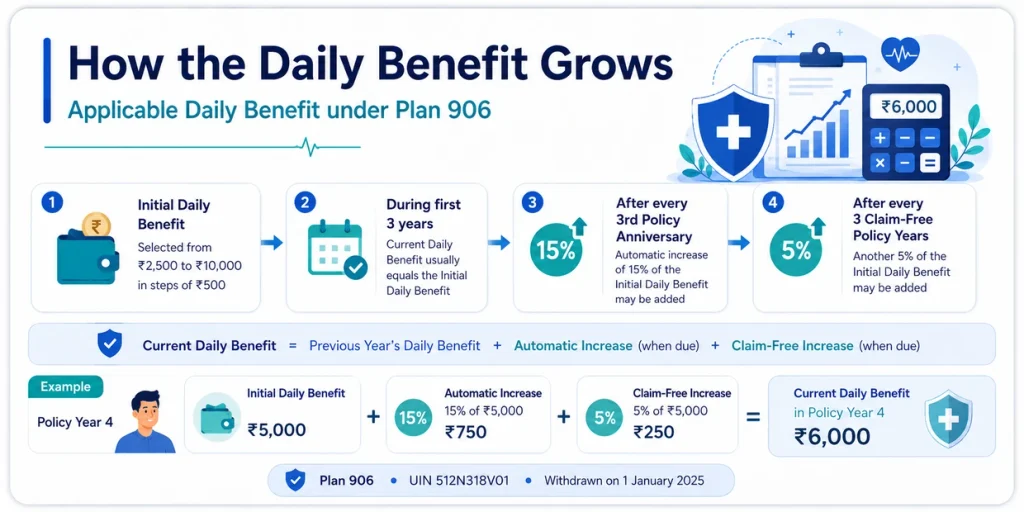
The Initial Daily Benefit could be selected from ₹2,500 to ₹10,000 in steps of ₹500. The total Initial Daily Benefit under all Plan 906 policies for one person could not exceed ₹10,000.
The spouse’s selected benefit could not be higher than that of the main policyholder. Included parents had to receive equal benefits, and included children also had to receive equal benefits. Other family limits applied according to the policy schedule.
How to Use the Calculator
First, select the family member whose benefit is being checked. Enter the age when that person’s cover began and choose the Initial Daily Benefit printed on the policy schedule.
Next, select the policy year. Enter the number of completed three-year periods in which no covered family member made a claim. If any member made a claim during a three-year period, that period should not be counted as claim-free.
Select the benefit to calculate and enter the extra details requested. These may include normal ward days, ICU days, surgery category, other surgery days or health check-up expense.
Press Calculate Benefit to see the estimated result. The Reset button clears the entered details.
The surgery category must match the official surgery list. Only hospital days accepted under the policy should be entered. When a new family member was added later or Auto Health Cover applied, the daily benefit may need a year-by-year check from the policy record.
Formula Used in the Calculator
Current Daily Benefit
During the first three years of a person’s cover, the current daily benefit normally remained equal to the Initial Daily Benefit.
After every third policy anniversary, an automatic increase equal to 15% of the Initial Daily Benefit could be added. This automatic increase continued according to the policy rule until the daily benefit reached the stated level of 1.5 times the Initial Daily Benefit under this feature.
After every three claim-free policy years, another 5% of the Initial Daily Benefit could be added. For this increase, the whole policy had to remain claim-free. A claim by any covered member could affect it. The policy did not state a lifetime maximum for the claim-free addition.
Current Daily Benefit
= Previous Year’s Daily Benefit
+ Automatic Increase, when due
+ Claim-Free Increase, when due
Both increases affect the same daily benefit. Therefore, the calculator should work through the policy history in order instead of multiplying the number of three-year blocks without checking claims, joining dates and Auto Health Cover.
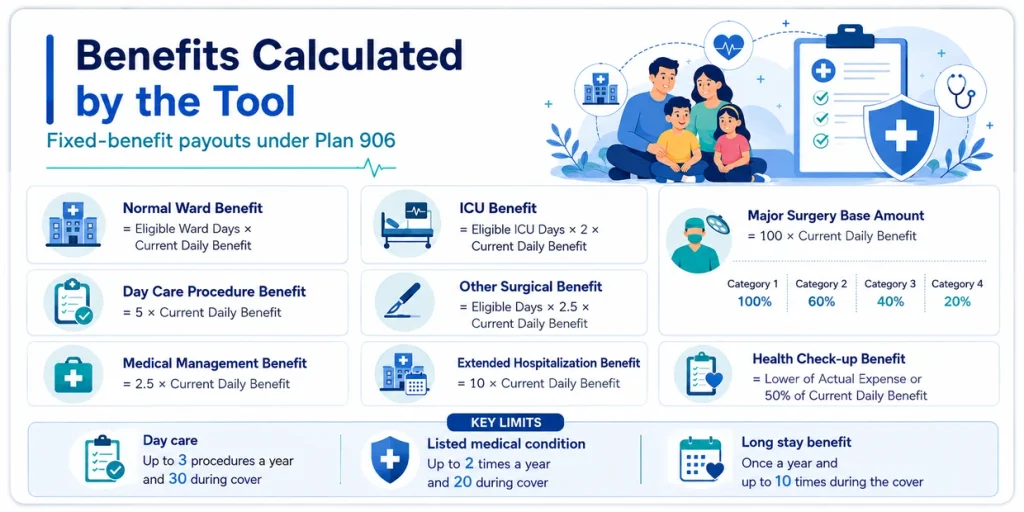
Main Benefit Formulas
Normal Ward Benefit
= Eligible Ward Days × Current Daily Benefit

ICU Benefit
= Eligible ICU Days × 2 × Current Daily Benefit

Major Surgery Base Amount
= 100 × Current Daily Benefit

Day Care Procedure Benefit
= 5 × Current Daily Benefit

Other Surgical Benefit
= Eligible Days × 2.5 × Current Daily Benefit

Medical Management Benefit
= 2.5 × Current Daily Benefit

Extended Hospitalization Benefit
= 10 × Current Daily Benefit

Health Check-up Benefit
= Lower of Actual Expense or 50% of Current Daily Benefit
For a major surgery, Category 1 paid 100% of the surgery base amount, Category 2 paid 60%, Category 3 paid 40% and Category 4 paid 20%.
Benefits Calculated by Arogya Rakshak Plan 906 Calculator
| Benefit | Estimated payment | Important limit |
| Normal ward | 1 × daily benefit for each eligible day | 30 days in year one; 90 days a year later |
| ICU | 2 × daily benefit for each eligible day | Included within the hospital-day limit |
| Major surgery | 20%, 40%, 60% or 100% of 100 × daily benefit | Depends on the listed surgery and available limit |
| Day care procedure | 5 × daily benefit | Up to 3 procedures a year and 30 during the cover |
| Other surgery | 2.5 × daily benefit for each eligible day | 15 days in year one; 45 days a year later |
| Listed medical condition | 2.5 × daily benefit | Up to 2 times a year and 20 during the cover |
| Stay longer than 30 days | 10 × daily benefit | Once a year and up to 10 times during the cover |
The five conditions included under Medical Management Benefit were dengue, malaria, pneumonia, pulmonary tuberculosis and viral hepatitis A.
Hospital Cash could be paid with an eligible Major Surgical, Other Surgical or Medical Management Benefit. Hospital Cash was not normally paid for a day care procedure, except under the special rules for haemodialysis and radiotherapy.
An accepted Category 1 or Category 2 major surgery could also provide a ₹1,000 ambulance benefit when the required emergency ambulance expense was incurred. One year’s policy premium could be waived from the relevant due date when the premium-waiver conditions were met.
Arogya Rakshak Plan 906 Real Calculation Example
Consider a policy with an Initial Daily Benefit of ₹5,000. The calculation is for policy year four, and no covered family member made a claim during the first three policy years.
Automatic Increase
= ₹5,000 × 15%
= ₹750

Claim-Free Increase
= ₹5,000 × 5%
= ₹250

Current Daily Benefit
= ₹5,000 + ₹750 + ₹250
= ₹6,000
Suppose an eligible hospital stay included five normal ward days and two ICU days.
Normal Ward Benefit
= 5 × ₹6,000
= ₹30,000

ICU Benefit
= 2 × 2 × ₹6,000
= ₹24,000

Total Hospital Cash
= ₹30,000 + ₹24,000
= ₹54,000
If an eligible Category 2 surgery was performed during the same stay:
Major Surgery Base Amount
= 100 × ₹6,000
= ₹6,00,000

Category 2 Surgery Benefit
= ₹6,00,000 × 60%
= ₹3,60,000

Combined Estimate
= ₹54,000 + ₹3,60,000
= ₹4,14,000
This example is mathematically correct only when all days and the surgery are accepted under the policy. It does not include the ambulance benefit or premium waiver because those need separate checks.
Daily Benefit Increases
The automatic increase and claim-free increase were different benefits. The automatic increase was linked to every third anniversary of each covered person. A family member added later could therefore have a different automatic-increase date.
The claim-free increase was linked to the policy as a whole. All covered members had to remain claim-free during the required three-year period. For this reason, the calculator result can be wrong when only one person’s claim history is entered.
During Auto Health Cover, both increases stopped and the daily benefit stayed at the level applicable when the original main policyholder died. Special rules applied when Auto Health Cover ended.
Auto Health Cover
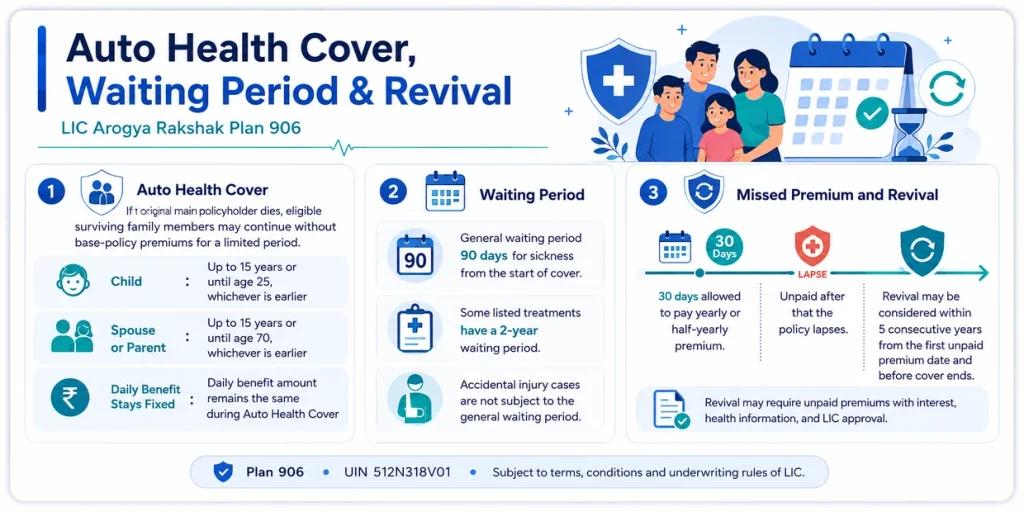
If the original main policyholder died while the policy was active, eligible surviving family members could continue under the base policy without paying its premium for a limited period.
For a covered child, this free-cover period could continue for up to 15 years or until age 25, whichever came first. For a covered spouse or parent, it could continue for up to 15 years or until age 70, whichever came first.
The period started from the policy anniversary falling on or immediately after the original main policyholder’s death. The policy had to remain active until this period began. Rider premiums were not waived.
The daily benefit remained fixed during Auto Health Cover. After the free-cover period, eligible members could continue for the remaining cover period by paying the required premium. This feature applied only after the death of the original main policyholder, not after the death of a person who later became the new main policyholder.
Waiting Period, Missed Premium and Revival
A general waiting period of 90 days normally applied to sickness from the start of each person’s cover. It did not apply when an eligible hospital stay or surgery resulted from an accidental injury occurring after cover began.
Some listed treatments had a two-year waiting period. These included cataract, piles, hernia, gallstones, kidney stones, certain joint conditions and other treatments named in the policy.
Plan 906 allowed 30 days to pay a yearly or half-yearly premium. If the premium remained unpaid after this period, the policy lapsed and benefits stopped.
A lapsed policy could be considered for revival within five consecutive years from the first unpaid premium date and before the relevant cover ended. LIC could ask for unpaid premiums with interest, health information and medical reports. Cover returned only after LIC approved the revival.
When revival was requested within 90 days from the first unpaid premium, a 45-day general waiting period applied from revival. A later request could bring a new 90-day general waiting period and a new two-year period for listed treatments.
Important Points for Existing Policyholders
Plan 906 paid fixed benefits and did not promise to clear the full hospital bill. It was not a replacement for every type of hospital-expense insurance.
Treatment generally had to take place in India and meet the policy definition. Routine outpatient care, normal pregnancy and childbirth, cosmetic treatment without medical need, experimental treatment and treatment of an undisclosed or unaccepted earlier illness were among the situations that could be excluded.
The policy did not provide a maturity amount, surrender value, paid-up value or loan. Stopping premiums did not create a smaller continuing cover.
The calculator cannot confirm policy status, remaining yearly limits, previous claims or whether a medical procedure appears in the official list. The policy schedule, claim records and LIC’s decision remain final.
Frequently Asked Questions
What does the Plan 906 calculator calculate?
It estimates the current daily benefit and applies it to an eligible hospital stay, ICU stay, surgery, day care procedure, listed medical condition, extended stay or health check-up.
How is the current daily benefit calculated?
It starts with the Initial Daily Benefit shown in the policy schedule. An automatic increase may apply after every third policy anniversary, and a separate increase may apply after three claim-free policy years.
Does Plan 906 pay the complete hospital bill?
No. It pays fixed amounts using the policy formula. The payment can be lower or higher than the actual hospital expense.
Can an existing policy continue after withdrawal?
Withdrawal stopped new sales but did not automatically cancel an existing policy. Continuation depends on premium payment, cover dates and the conditions in the issued policy.
What happens after the original main policyholder dies?
Eligible surviving family members may receive Auto Health Cover without base-policy premiums for up to 15 years or the relevant age limit. The policy must meet all conditions for this benefit.
Conclusion
The LIC Arogya Rakshak Plan 906 Calculator helps explain the fixed benefits available under an existing policy. It can estimate the current daily benefit and show how that amount is used for hospital cash, ICU care, surgery and other listed benefits.
Plan 906 was withdrawn on 1 January 2025 and is not available for a new purchase. Calculator results are useful for understanding the benefit formula, but they do not confirm a claim. Policy status, medical records, previous claims, waiting periods and LIC’s final checking decide the actual payment.

Amit Kushwaha is a financial content creator and SaaS tool developer based in Lucknow, Uttar Pradesh. He has more than seven years of experience creating insurance-related content, online calculators, and practical digital tools for LIC policyholders, insurance buyers, and LIC agents.
Through LICPolicyCalculator.com, he focuses on simplifying complex LIC policy information into easy-to-understand guides and calculators. His work covers LIC premium estimates, maturity calculations, surrender value tools, policy return calculations, term insurance planning, and plan-specific calculator pages.