LIC Paid Up Value Calculator
Estimate the reduced death and maturity benefits of a traditional LIC policy after premiums are stopped.
Paid-up value is different from surrender value. It normally continues under the policy and becomes payable on death, maturity or another applicable benefit date.
Enter Policy Details
| Estimated Benefit Summary | |
|---|---|
| Vested Bonus Entered | — |
| Accrued Guaranteed Additions Entered | — |
| 105% of Total Base Premiums Paid | — |
| Estimated Gross Death Benefit | — |
| Estimated Gross Maturity Benefit | — |
| Loan and Interest Deduction | — |
| Estimated Net Death Benefit | — |
| Estimated Net Maturity Benefit | — |
| Money-Back Adjustment | |
|---|---|
| Total Scheduled Survival Benefits | — |
| Survival Benefits Already Paid | — |
| Formula Used | [(Maturity SA + Scheduled Survival Benefits) × Paid-Up Ratio] − Benefits Already Paid |
| Future Survival Benefits | Included in the displayed maturity calculation; not shown separately |
| Calculation Details | |
|---|---|
| Premium-Paying Term | — |
| Premium Period Completed | — |
| Minimum Full Years Required | — |
| Paid-Up Formula | Benefit Sum Assured × Premium Period Completed ÷ Original Premium-Paying Term |
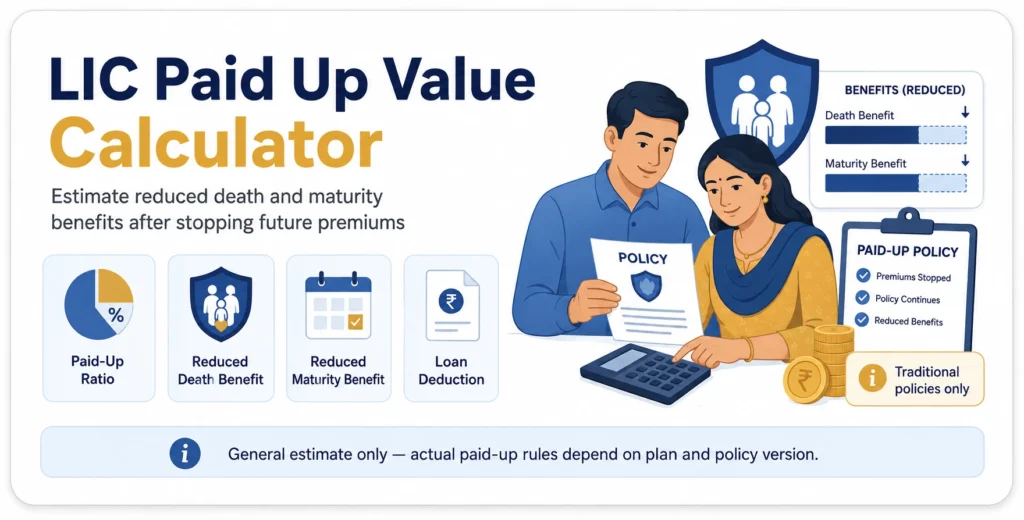
An LIC policy is usually purchased for a long period. However, continuing every future premium may not always be possible. When the required minimum premiums have already been paid, an eligible traditional policy may continue as a reduced paid-up policy instead of ending immediately.
The LIC Paid Up Value Calculator helps estimate the reduced death and maturity benefits that may continue after future premiums are stopped. It uses details such as the premium-paying term, premium period completed, Basic Sum Assured, Sum Assured on Death, Sum Assured on Maturity, vested bonus, Guaranteed Additions and outstanding policy loan.
Accuracy note: Paid-up rules differ across LIC plans and policy versions. Some policies reduce only selected benefits, while others use separate conditions for bonuses, Guaranteed Additions, survival benefits or minimum death benefits. This calculator gives a general estimate and cannot replace the policy bond or LIC’s official paid-up record.
The calculator is mainly suitable for traditional, non-linked LIC savings policies. The final value may differ according to the plan number, UIN, policy version and conditions stated in the issued policy document.
Table of Contents
What Is LIC Paid-Up Value?
LIC paid-up value is the reduced policy benefit that may continue when future premiums are stopped after the policy has completed the minimum premium-payment requirement.
A paid-up policy normally remains active with lower death and maturity benefits. The policy does not provide the full original benefit because the complete premium-paying term was not finished.
Under many traditional policies, the reduced basic benefit is broadly linked to the proportion of premiums paid compared with the total premiums originally payable. However, the exact formula may differ according to the plan, benefit type and policy version.
Paid-up value is different from surrender value. A paid-up policy continues with reduced benefits, while surrender normally ends the policy and pays the available surrender amount.
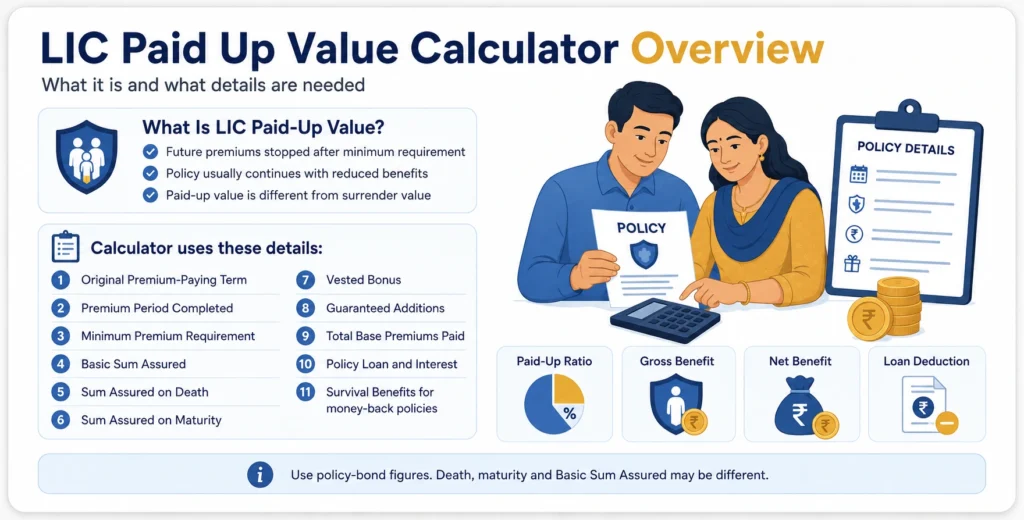
What Is the LIC Paid Up Value Calculator?
The LIC Paid Up Value Calculator is an online estimation tool that calculates possible reduced policy benefits after future premiums are stopped.
The calculator works out the paid-up ratio and applies it to the entered policy benefits. It may separately estimate:
- Paid-Up Basic Sum Assured
- Death Paid-Up Sum Assured
- Maturity Paid-Up Sum Assured
- Estimated death benefit after vested bonus or additions
- Estimated maturity benefit after vested bonus or additions
- Net benefit after policy-loan deductions
- Money-back policy adjustment, where applicable
The result is useful for an initial comparison before deciding whether to continue premiums, revive the policy, keep it paid-up or request an official surrender quotation.
Also Check:
- LIC Pre Maturity Calculator
- LIC Endowment Plan Calculators
- LIC Pension Plan Calculator
- LIC Policy Calculator
Highlights of the LIC Paid Up Value Calculator
- Calculates the estimated paid-up ratio
- Shows separate death and maturity paid-up amounts
- Supports vested bonus and Guaranteed Additions
- Includes an optional money-back adjustment
- Checks the entered minimum premium requirement
- Supports an optional policy-specific death-benefit floor
- Deducts outstanding policy loan and interest
- Gives a clear gross and net benefit breakdown
Why Use the LIC Paid Up Value Calculator?
The calculator helps policyholders understand how stopping future premiums may reduce the original benefits. Many people know the original Sum Assured but do not know how much death or maturity cover may remain after the policy becomes paid-up.
It is useful while comparing premium continuation, revival, paid-up status and surrender. The estimate can also be compared with LIC’s official policy record before making a final decision.
The calculator also helps avoid a common misunderstanding: stopping premiums does not usually mean that the full original Sum Assured continues.
Details Required for Calculation
Keep the policy bond, benefit illustration or latest policy statement available before using the calculator.
Original Premium-Paying Term: Enter the total period for which premiums were originally payable.
Do not automatically enter the full policy term unless the policy term and premium-paying term are the same.
Premium Period Completed: Enter the completed premium period in the same format required by the calculator and policy formula.
Do not convert monthly or quarterly instalments into decimal years unless the policy terms and calculator specifically use that method.
Minimum Premium Requirement: Enter the minimum premium-payment period required for paid-up status according to the policy document.
The calculator can compare the entered period with this requirement, but it cannot independently confirm official paid-up eligibility.
Basic Sum Assured: Enter the Basic Sum Assured shown in the policy bond.
Sum Assured on Death: Enter the original Sum Assured on Death from the policy document.
Do not assume it is equal to the Basic Sum Assured.
Sum Assured on Maturity: Enter the original Sum Assured on Maturity from the policy document.
This amount may differ from both the Basic Sum Assured and Sum Assured on Death.
Vested Simple Reversionary Bonus: Enter only the bonus already vested under the policy.
Do not estimate future bonuses because future bonus declarations are not guaranteed.
Accrued Guaranteed Additions: Enter only the Guaranteed Additions already accrued according to the policy terms.
Their treatment after paid-up conversion can differ by plan.
Total Base Premiums Paid: Enter total base premiums only when the policy-specific minimum death-benefit condition needs to be checked.
Exclude taxes, rider premiums and extra underwriting premiums unless the policy wording specifically includes them.
Outstanding Policy Loan and Interest: Enter the unpaid loan principal and accrued interest.
The calculator deducts the entered amount for estimation. The actual deduction depends on LIC’s records on the benefit date.
Survival Benefits Already Received: For a money-back plan, enter survival benefits already paid only when the plan-specific calculation requires this information.
How to Use the LIC Paid Up Value Calculator
- Select the calculation type.
- Enter the original premium-paying term.
- Enter the completed premium period.
- Enter the minimum requirement for paid-up eligibility.
- Enter the Basic Sum Assured.
- Enter the Sum Assured on Death.
- Enter the Sum Assured on Maturity.
- Add vested bonus and accrued Guaranteed Additions, if available.
- Enter total base premiums paid only when required.
- Add outstanding policy loan and interest.
- Add survival benefits already received for an applicable money-back policy.
- Select where the entered bonus and additions should be included.
- Select Calculate Paid-Up Value.
Copy all benefit figures from the policy bond or official illustration. Do not assume that the death, maturity and Basic Sum Assured amounts are equal.
How Paid-Up Value Is Calculated
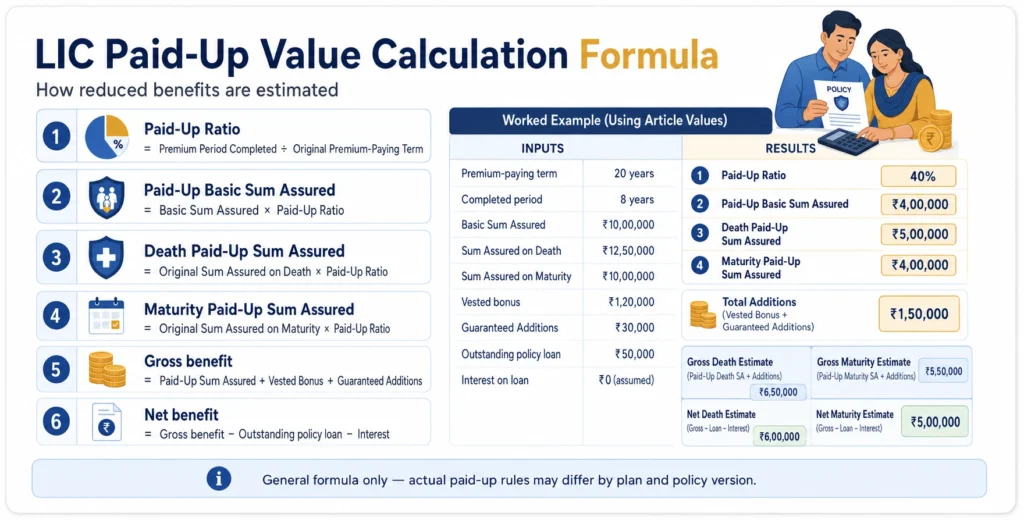
The general paid-up ratio is:
Paid-Up Ratio = Premium Period Completed ÷ Original Premium-Paying Term
The reduced Basic Sum Assured is estimated as:
Paid-Up Basic Sum Assured = Basic Sum Assured × Paid-Up Ratio
The death paid-up amount may be estimated as:
Death Paid-Up Sum Assured = Original Sum Assured on Death × Paid-Up Ratio
The maturity paid-up amount may be estimated as:
Maturity Paid-Up Sum Assured = Original Sum Assured on Maturity × Paid-Up Ratio
Eligible vested bonus and Guaranteed Additions may then be included according to the policy conditions.
Outstanding policy loan and interest may be deducted from the final payable amount.
Important: These are general formulas. Some policies may use different ratios, separate benefit rules, special Guaranteed Addition treatment, future reduced survival benefits or policy-specific minimum death-benefit conditions.
Optional Minimum Death-Benefit Floor
Some LIC policies contain a minimum death-benefit condition linked to total premiums paid.
Apply this option only when the issued policy document clearly contains such a condition. It should remain disabled by default.
The calculator should not apply a 105% premium floor to every LIC policy because this is not a universal paid-up rule.
Paid-Up Value for Money-Back Policies
Money-back policies may not follow the same simple calculation as a standard endowment policy.
Survival benefits already paid, future reduced survival benefits, maturity Sum Assured and bonus treatment may require separate calculations.
The calculator should be used for a money-back plan only when the applicable policy rules are known. A general paid-up ratio alone may not provide an accurate result.
Real LIC Paid-Up Value Calculation Example
Assume the following policy details:
| Detail | Value |
|---|---|
| Premium-paying term | 20 years |
| Premium period completed | 8 years |
| Basic Sum Assured | ₹10,00,000 |
| Sum Assured on Death | ₹12,50,000 |
| Sum Assured on Maturity | ₹10,00,000 |
| Vested bonus | ₹1,20,000 |
| Accrued Guaranteed Additions | ₹30,000 |
| Total base premiums paid | ₹3,60,000 |
| Outstanding policy loan | ₹50,000 |
Step 1: Calculate the Paid-Up Ratio: 8 ÷ 20 = 40%
Step 2: Calculate Paid-Up Basic Sum Assured: ₹10,00,000 × 40% = ₹4,00,000
Step 3: Calculate Death Paid-Up Sum Assured: ₹12,50,000 × 40% = ₹5,00,000
Step 4: Calculate Maturity Paid-Up Sum Assured: ₹10,00,000 × 40% = ₹4,00,000
Step 5: Add Vested Bonus and Guaranteed Additions: ₹1,20,000 + ₹30,000 = ₹1,50,000
Estimated gross death benefit: ₹5,00,000 + ₹1,50,000 = ₹6,50,000
Estimated gross maturity benefit: ₹4,00,000 + ₹1,50,000 = ₹5,50,000
Step 6: Deduct the Policy Loan
Estimated net death benefit: ₹6,50,000 − ₹50,000 = ₹6,00,000
Estimated net maturity benefit: ₹5,50,000 − ₹50,000 = ₹5,00,000
| Calculation | Estimated result |
| Paid-up ratio | 40% |
| Paid-Up Basic Sum Assured | ₹4,00,000 |
| Death Paid-Up Sum Assured | ₹5,00,000 |
| Maturity Paid-Up Sum Assured | ₹4,00,000 |
| Total entered additions | ₹1,50,000 |
| Gross death estimate | ₹6,50,000 |
| Gross maturity estimate | ₹5,50,000 |
| Net death estimate | ₹6,00,000 |
| Net maturity estimate | ₹5,00,000 |
This example assumes that the same paid-up ratio applies to the entered death and maturity sums assured and that all entered bonus and additions are payable with both benefits. Actual LIC rules may differ.
Paid-Up Policy vs Surrender
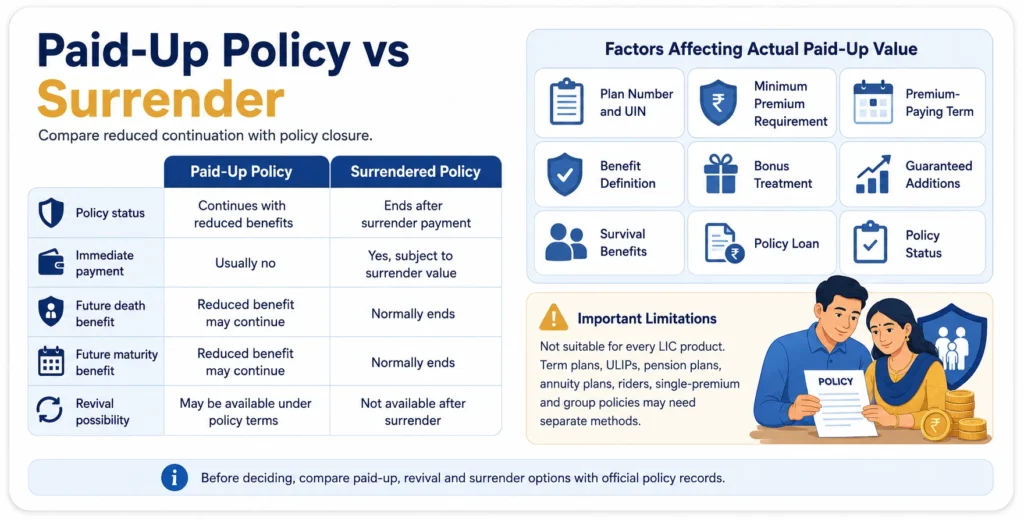
A paid-up policy and a surrendered policy are not the same.
| Point | Paid-Up Policy | Surrendered Policy |
| Policy status | Continues with reduced benefits | Ends after surrender payment |
| Immediate payment | Usually no | Yes, subject to surrender value |
| Future death benefit | Reduced benefit may continue | Normally ends |
| Future maturity benefit | Reduced benefit may continue | Normally ends |
| Revival possibility | May be available under policy terms | Not available after surrender |
Before surrendering, check whether keeping the policy paid-up or reviving it may provide better long-term value.
Factors That Affect the Actual Paid-Up Value
Plan Number and UIN: Paid-up conditions differ between LIC plans and policy versions.
Minimum Premium Requirement:A policy must complete the required premium-payment period before it can acquire paid-up value.
Premium-Paying Term: The paid-up ratio depends on the premiums completed compared with the original premium-paying requirement.
Benefit Definition: Basic Sum Assured, Sum Assured on Death and Sum Assured on Maturity may be different.
Bonus Treatment: Vested bonus may continue under some plans, but its treatment on death, maturity, surrender or revival can differ.
Guaranteed Additions: Guaranteed Additions may stop, continue at a reduced rate or follow a separate plan-specific rule.
Survival Benefits: Money-back survival benefits already paid or payable later may affect the calculation.
Policy Loan: Outstanding principal and interest may reduce the amount payable.
Policy Status: In-force, lapsed, paid-up and revived policies can produce different benefits.
Important Limitations
The calculator gives an approximate value and cannot confirm whether a policy has officially acquired paid-up status.
It cannot automatically identify:
- the exact plan formula;
- the applicable UIN version;
- separate death and maturity paid-up rules;
- bonus treatment;
- Guaranteed Addition rules;
- future survival benefits;
- current loan balance;
- revival conditions;
- rider treatment; or
- LIC’s official policy record.
Future bonuses should not be treated as guaranteed.
Pure term plans may not provide paid-up value. ULIPs, pension plans, annuity plans, riders, single-premium policies and group policies generally require separate calculation methods.
Frequently Asked Questions
What is paid-up value in LIC?
Paid-up value is the reduced policy benefit that may continue after future premiums are stopped, provided the policy has completed the required minimum premium period.
When does an LIC policy become paid-up?
A policy may become paid-up after the minimum number of required premiums has been paid. The exact requirement depends on the plan and policy version.
Is paid-up value the same as surrender value?
No. A paid-up policy normally continues with reduced benefits, while surrender ends the policy and pays the available surrender amount.
Does the full bonus remain after a policy becomes paid-up?
Not always. Vested bonus and Guaranteed Additions may have separate treatment according to the policy conditions.
Can a paid-up policy be revived?
Some paid-up policies may be revived during the permitted revival period, subject to LIC’s conditions, unpaid premiums, interest and evidence of insurability where required.
Is an outstanding loan deducted from paid-up benefits?
Yes, outstanding loan principal and accrued interest may be deducted from the amount payable.
Can this calculator be used for every LIC plan?
No. It is mainly intended for traditional non-linked savings policies. Special plans may require separate formulas.
Conclusion
The LIC Paid Up Value Calculator helps estimate how stopping future premiums may reduce the death and maturity benefits of an eligible traditional policy.
It calculates a general paid-up ratio and applies it to the entered policy benefits. However, bonus treatment, Guaranteed Additions, survival benefits, loan deductions and minimum death-benefit conditions can differ by plan.
Before making a final decision, compare the calculator result with the policy bond and LIC’s official paid-up record.