LIC Jeevan Azad Calculator
Optional Existing Policy Details
Premium & Benefit Details
| Policy Summary | |
| Selected Plan | — |
| Basic Sum Assured | — |
| Policy Term | — |
| Premium Paying Term | — |
| Maturity Age | — |
| Premium Estimate | |
| Annualized Base Premium | — |
| Selected-mode Instalment | — |
| Premiums per Year | — |
| Estimated Total Base Premium | — |
| Guaranteed Benefits | |
| Sum Assured on Maturity | — |
| Base Sum Assured on Death | — |
| 105% Premium Floor Used | — |
| Death Benefit Estimate | — |
Paid-Up Value
| Paid-Up Eligibility | — |
| Premiums Paid / PPT | — |
| Maturity Paid-Up Sum Assured | — |
| Death Paid-Up Sum Assured | — |
Surrender Value
| Surrender Eligibility | — |
| Applicable GSV Factor | — |
| Total Base Premiums Paid | — |
| Guaranteed Surrender Value | — |
| Special Surrender Value | Not calculated |
Policy Loan
| Loan Eligibility | — |
| Applicable Maximum % | — |
| GSV Used for Estimate | — |
| Estimated Maximum Loan | — |
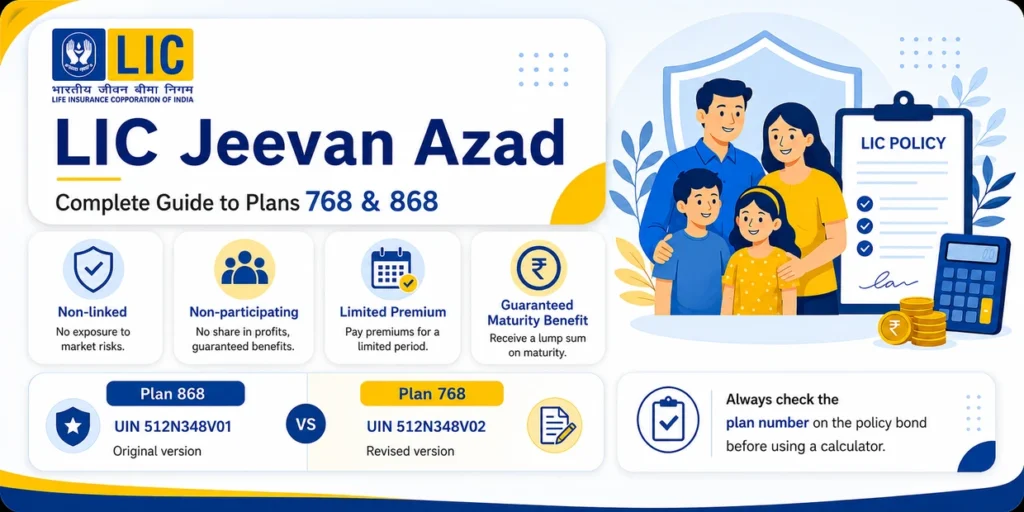
LIC Jeevan Azad is a limited-premium endowment plan that combines life insurance protection with long-term savings. Premiums are paid for fewer years than the full policy term, while life cover continues during the term as long as the policy remains eligible. If the life assured survives to maturity, LIC pays the guaranteed maturity benefit stated under the policy.
Jeevan Azad has been issued in two versions: Plan 868 and Plan 768. The product purpose is similar, but the plan number, UIN and some conditions may differ. Before checking eligibility, benefits or calculator results, first confirm which plan number is printed on the policy bond. An existing Plan 868 policy should not be calculated using Plan 768 rules.
Table of Contents
What Is LIC Jeevan Azad?
LIC Jeevan Azad is a non-participating, non-linked, individual savings plan. It provides life cover during the policy term and a guaranteed lump-sum benefit on survival to maturity, subject to the policy conditions.
“Non-linked” means the policy benefits are not directly connected to stock-market units. “Non-participating” means the policy does not share in LIC’s profits. Therefore, Simple Reversionary Bonus and Final Additional Bonus are not added to the maturity amount.
It is also a limited-premium plan. The premium-paying period ends before the policy term. This can be useful for someone who wants to complete premium payments earlier but keep the policy protection until maturity.
Purpose of LIC Jeevan Azad
The plan is designed for people who want a fixed maturity benefit along with life insurance protection. The maturity amount may be used for a future family need such as education, marriage, home improvement or another planned expense.
If the life assured dies during the policy term after the risk has started, the nominee may receive the applicable death benefit. If the life assured survives, the maturity benefit becomes payable. Since the policy is non-linked and non-participating, its core benefits do not depend on stock-market movement or future bonus declarations.
Jeevan Azad should not be treated as a high-return investment. It is mainly a protection-and-savings policy with fixed benefits and a long-term premium commitment.
How Does LIC Jeevan Azad Work?
At the start, the proposer selects the Basic Sum Assured and an available policy term. The premium depends on factors such as age, term, Basic Sum Assured, payment mode, purchase channel, rider selection and underwriting.
Premiums can be paid in the permitted yearly, half-yearly, quarterly or monthly mode. The premium-paying term is shorter than the full policy term. Under Plan 768, for example, the Premium Paying Term is the Policy Term minus eight years.
If all due premiums are paid, life cover continues during the policy term. Death during the term is handled according to the applicable Sum Assured on Death rules. On survival to maturity, the Sum Assured on Maturity becomes payable. No bonus is added because the policy is non-participating.
Why Does Jeevan Azad Have Two Plan Numbers?
LIC sometimes revises an insurance product to meet updated regulations or product requirements. The name may remain the same even when the plan number and UIN version change.
Plan 868 was the original Jeevan Azad version with UIN 512N348V01. Plan 768 is the revised version with UIN 512N348V02. Their broad protection-and-savings purpose is similar, but an existing policy continues under the version issued to it. Always use the plan number and UIN shown on the policy schedule.
LIC Jeevan Azad Plan 768
LIC Jeevan Azad Plan 768 carries UIN 512N348V02. It is the revised version of Jeevan Azad and retains the non-participating, non-linked, individual savings structure. Its official brochure describes it as a limited-premium endowment plan offering financial protection during the term, a loan facility for liquidity and a guaranteed lump sum on survival to maturity.
LIC’s withdrawn-plan records list Plan 768 among plans withdrawn during FY 2025–26. New purchase availability should therefore not be assumed. An existing policy, however, continues according to its issued terms and present status.
For exact eligibility, rider conditions, premium details and estimates, use the LIC Jeevan Azad Plan 768 calculator and complete guide.
LIC Jeevan Azad Plan 868
LIC Jeevan Azad Plan 868 carries UIN 512N348V01. LIC launched this original version on 19 January 2023 and withdrew it on 1 January 2025. It is no longer available for a new purchase.
The withdrawal of Plan 868 does not automatically cancel policies issued before the withdrawal date. Existing policies remain governed by their original contract, premium status and applicable policy conditions. Plan 868 policyholders should not use the revised Plan 768 rules without checking whether the same condition applies to their policy.
Read the LIC Jeevan Azad Plan 868 calculator and policy details for version-specific information.
LIC Jeevan Azad Plan 768 vs Plan 868
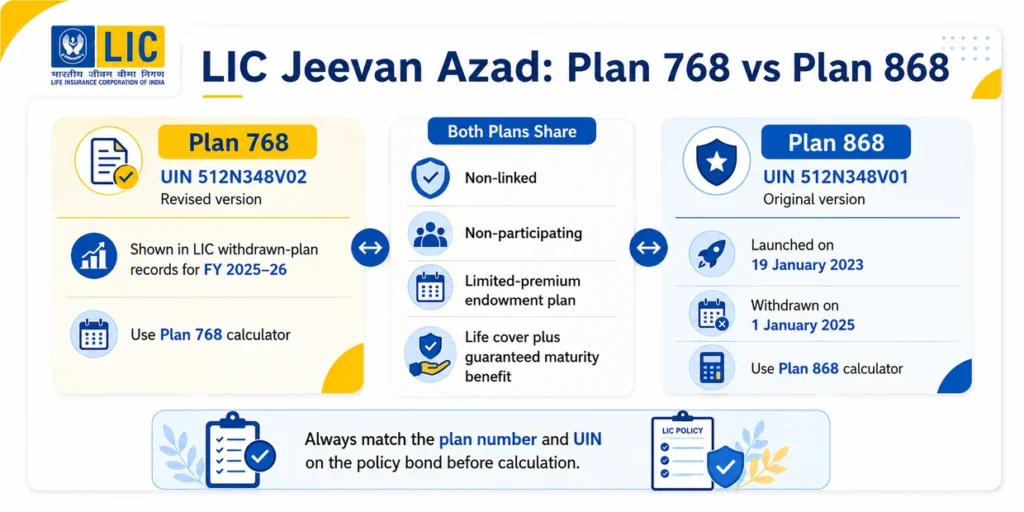
| Detail | Plan 768 | Plan 868 |
|---|---|---|
| UIN | 512N348V02 | 512N348V01 |
| Product version | Revised version | Original version |
| Status | Listed as withdrawn in FY 2025–26 | Withdrawn on 1 January 2025 |
| Correct calculator | Plan 768 calculator | Plan 868 calculator |
Both versions are now shown in LIC’s withdrawn records. Existing policyholders should follow the policy document matching their own plan number and UIN.
Key Features of LIC Jeevan Azad
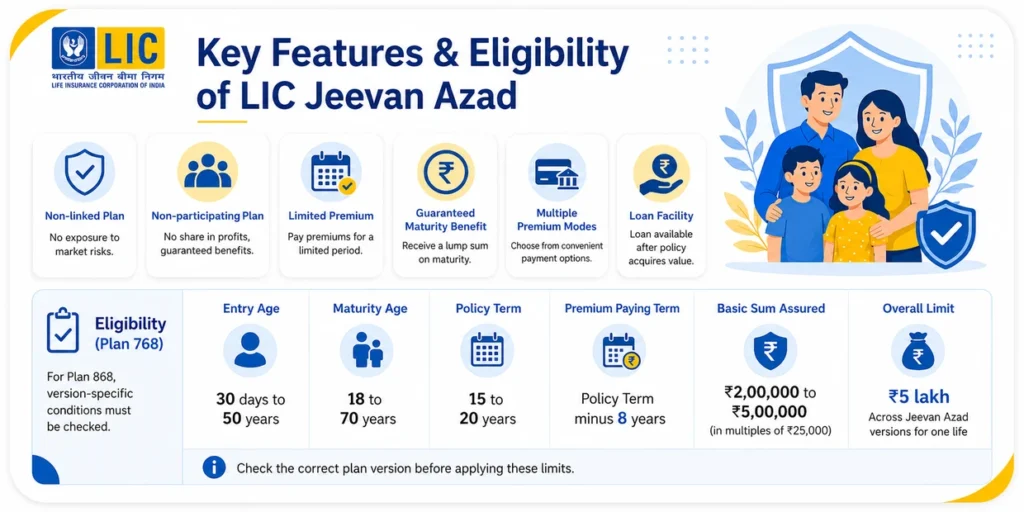
Jeevan Azad combines life cover with a guaranteed maturity benefit. Premiums are payable for a shorter period than the full policy term. The policy is non-linked, so its benefits are not based on market value. It is also non-participating and does not earn bonuses.
Depending on the selected version and purchase channel, other facilities may include multiple premium-payment modes, settlement of maturity benefits in instalments, optional riders and a policy loan after the required conditions are met.
LIC Jeevan Azad Eligibility
Eligibility must be checked under the correct plan version. For Plan 768, LIC’s official brochure states that the entry age starts from 30 completed days and goes up to 50 years. The minimum maturity age is 18 years and the maximum is 70 years. Special limits apply when the policy is purchased through POSP-LI or CPSC-SPV.
Plan 768 offers policy terms from 15 to 20 years. Its Premium Paying Term is the Policy Term minus eight years. The Basic Sum Assured ranges from ₹2,00,000 to ₹5,00,000 in multiples of ₹25,000. LIC also applies an overall ₹5 lakh limit across Jeevan Azad versions for one life.
These figures should not be transferred to Plan 868 without checking its own brochure. Age, term, sum assured, purchase channel and underwriting may affect whether a proposal is accepted.
Benefits Under LIC Jeevan Azad
Death Benefit
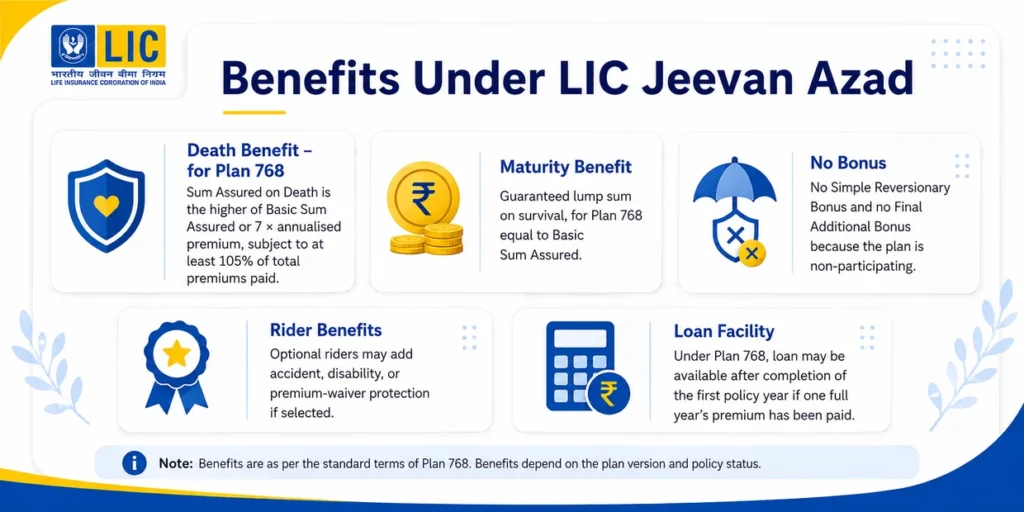
The death benefit depends on the plan version, policy status and date on which risk begins. Under an in-force Plan 768 policy, the Sum Assured on Death is the higher of the Basic Sum Assured or seven times the annualised premium. It cannot be less than 105% of total premiums paid up to the date of death, as defined in the policy.
For a child below eight years at entry, the risk-start rules are different. If death occurs before the commencement of risk, the applicable refund of premiums is paid according to the policy conditions. Rider benefits are additional only when the rider was actually selected and remained in force.
Maturity Benefit
If the life assured survives to the maturity date and the policy is in force, Plan 768 pays a Sum Assured on Maturity equal to the Basic Sum Assured. This amount is guaranteed under the policy conditions.
No Simple Reversionary Bonus or Final Additional Bonus is added. The Basic Sum Assured and Sum Assured on Maturity should still be checked in the policy schedule because an old policy must follow its own version.
Rider Benefits
Optional riders may add accidental death, disability or premium-waiver protection after payment of an additional premium. Their availability depends on age, outstanding premium term, purchase channel and other rider rules. Riders are not available automatically with every policy.
Loan Facility
A loan may become available after the policy meets the required conditions. Under Plan 768, a policy loan can be taken after completion of the first policy year if one full year’s premium has been paid. The maximum loan depends on surrender value, policy status and premiums paid. Outstanding loan and interest are deducted from claim or exit proceeds.
What is LIC Jeevan Azad Calculator
The LIC Jeevan Azad Calculator is an online estimation tool covering Plan 868 and Plan 768 in one place. The plan number is selected first, after which the calculator applies the eligibility checks and calculation rules connected with that version. This reduces the risk of using revised Plan 768 conditions for an old Plan 868 policy.
The calculator can estimate the Premium Paying Term, annual or modal premium, total scheduled base premium, maturity benefit and death benefit. Existing policy details can also be entered to estimate paid-up maturity and death benefits, Guaranteed Surrender Value and possible policy-loan eligibility.
Where complete official premium data is unavailable, the result is identified as an estimate. A known annualised premium from an LIC quotation or policy document can be entered for better accuracy. The calculator does not treat its output as an official quotation, surrender statement, loan approval or claim decision.
Main Calculator Highlights
The tool supports both Jeevan Azad versions, validates age, maturity age, policy term and Basic Sum Assured, and calculates the shorter premium-paying period automatically. It supports yearly, half-yearly, quarterly and monthly premium modes and can consider the selected purchase channel.
Results are separated into premium, maturity, death, paid-up, surrender and loan sections. This makes it easier to understand which amount is guaranteed, which is formula-based and which depends on policy-specific LIC factors.
How to Use the LIC Jeevan Azad Calculator
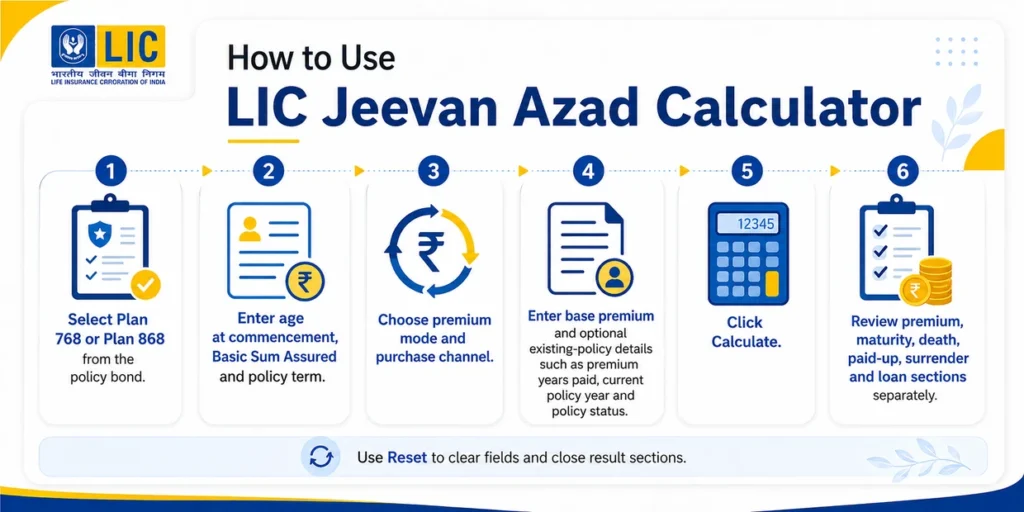
Start by selecting Plan 768 or Plan 868 as printed on the policy bond. The calculator then displays the UIN, plan status and eligibility guidance for that version.
Enter the age at policy commencement, Basic Sum Assured and policy term. For the plan rules used by the combined calculator, the Basic Sum Assured should be within ₹2,00,000 and ₹5,00,000 in the prescribed multiples, while the available policy term is generally 15 to 20 years. The calculator checks the entry age and maturity age before continuing.
Next, choose yearly, half-yearly, quarterly or monthly premium mode and select the purchase channel. Enter the base premium from the LIC quotation or policy record where requested. Taxes, rider premiums and underwriting extras should not be included in the annualised base premium.
For an existing policy, open the optional details section and enter the known annualised premium, number of full premium years paid, current policy year and policy status. These details help estimate paid-up value, Guaranteed Surrender Value and loan eligibility.
Select Calculate and review the maturity, death and policy-status results separately. Use Reset to clear the fields and close the result sections. Final figures should be compared with the policy schedule or an official LIC statement.
Formula Used in the Calculator
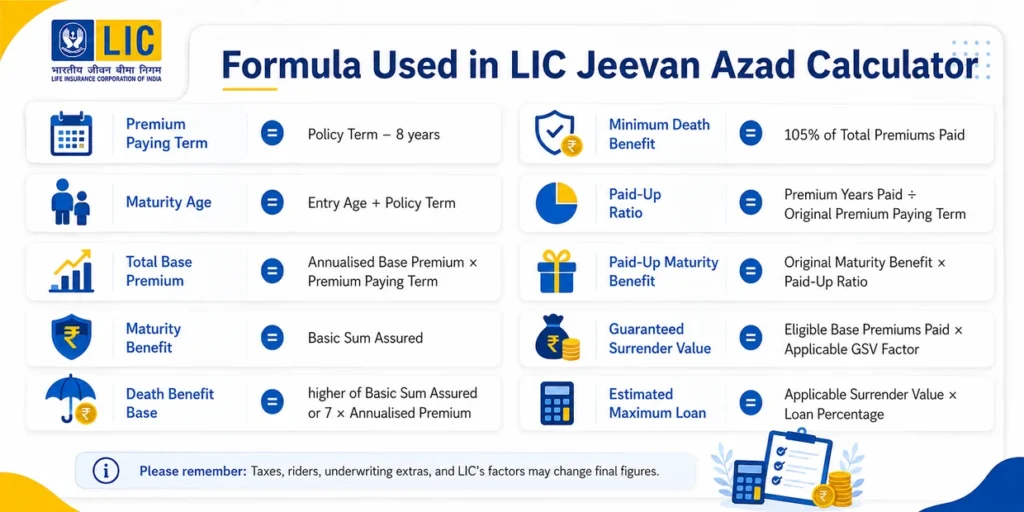
The calculator switches its validations and applicable conditions according to the selected plan. Its main calculations are explained below.
Premium Paying Term and Maturity Age
The Premium Paying Term is eight years shorter than the policy term:
Premium Paying Term = Policy Term − 8 years
For an 18-year policy, premiums are normally payable for 10 years.
The calculator also checks:
Maturity Age = Entry Age + Policy Term
Premium Calculation
The annualised premium is based on the selected payment frequency. The total scheduled base premium is then estimated as:
Total Base Premium = Annualised Base Premium × Premium Paying Term
Taxes, rider premiums, modal loadings and underwriting extras are kept separate. If an exact LIC premium is unavailable, the displayed premium remains an estimate.
Maturity Benefit
For the plan rules used by the calculator:
Maturity Benefit = Basic Sum Assured
Therefore, a Basic Sum Assured of ₹5,00,000 produces a guaranteed maturity component of ₹5,00,000, provided the policy remains eligible. No bonus is added because Jeevan Azad is non-participating.
Death Benefit
The base Sum Assured on Death is the higher of:
Basic Sum Assured or 7 × Annualised Premium
The calculator then checks the applicable minimum condition:
Minimum Death Benefit = 105% of Total Premiums Paid
For example, if the Basic Sum Assured is ₹5,00,000 and annualised premium is ₹50,000, seven times the premium is ₹3,50,000. The Basic Sum Assured is higher, so ₹5,00,000 becomes the base amount before checking the 105% condition.
Paid-Up Benefits
After the policy acquires paid-up value, the benefits reduce according to the proportion of premiums completed:
Paid-Up Ratio = Premium Years Paid ÷ Original Premium Paying Term
Paid-Up Maturity Benefit = Original Maturity Benefit × Paid-Up Ratio
Paid-Up Death Benefit = Original Death Benefit × Paid-Up Ratio
If the Basic Sum Assured is ₹5,00,000, the Premium Paying Term is 10 years and premiums were paid for five years, the paid-up ratio is 50%. The estimated paid-up maturity benefit becomes ₹2,50,000, subject to the policy conditions.
Guaranteed Surrender Value
Where the policy qualifies for surrender value:
GSV = Eligible Base Premiums Paid × Applicable GSV Factor
The factor changes with the completed policy year and term. If eligible premiums are ₹2,00,000 and the applicable factor is 50%, the estimated GSV is ₹1,00,000. Special Surrender Value is not presented as a guaranteed amount because it depends on LIC’s applicable basis.
Policy Loan
Where the policy has acquired loan eligibility:
Estimated Maximum Loan = Applicable Surrender Value × Loan Percentage
For an eligible surrender value of ₹1,00,000 and an 80% loan limit, the estimate is ₹80,000. Actual eligibility may differ if LIC uses a different surrender value or policy status.
Real Calculation Example
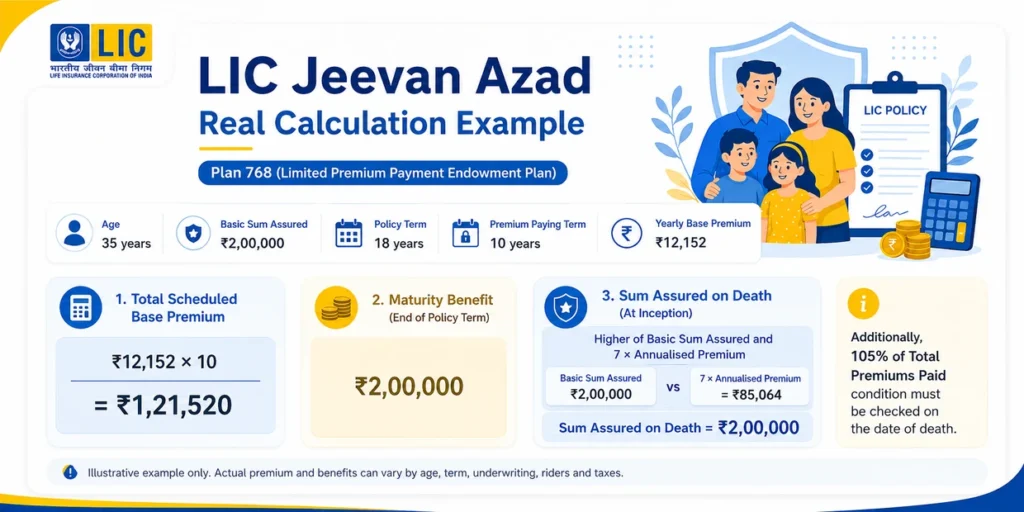
LIC’s official Plan 768 illustration gives an example for a 35-year-old standard life with a Basic Sum Assured of ₹2,00,000 and a policy term of 18 years. The Premium Paying Term is 10 years. The illustrated yearly base premium, excluding GST, is ₹12,152.
The scheduled base premium over ten years is:
₹12,152 × 10 = ₹1,21,520
The Sum Assured on Maturity is ₹2,00,000. At inception, the illustrated Sum Assured on Death is also ₹2,00,000 because this is higher than seven times the annualised premium of ₹85,064. The 105% of total-premiums-paid condition must also be checked at the date of death.
This example is based on LIC’s official illustration for a standard life. The actual premium can change with age, term, purchase mode, underwriting, riders and taxes.
Why the Calculator Is Useful
The combined calculator reduces the chance of using the wrong version and removes the need to apply several formulas manually. It shows how policy term affects the Premium Paying Term and maturity age, while presenting maturity and death benefits separately.
For an existing policy, it helps explain what may happen if premiums stop after paid-up value is acquired. It can also provide an approximate Guaranteed Surrender Value and loan limit when sufficient details are entered.
Manual entry of a known LIC premium improves accuracy when a complete official rate table is unavailable. This is more reliable than presenting an unsupported premium as an official quotation. The tool is therefore useful for policy planning and understanding, while the LIC quotation, policy bond and branch records remain the final authority.
Paid-Up Policy
A policy becomes paid-up only after the minimum required premiums are completed. If later premiums stop, life cover and maturity benefits reduce according to the paid-up ratio. A paid-up policy continues with reduced benefits; a surrendered policy ends after the surrender amount is paid.
Surrender Value
The surrender value can be the higher of Guaranteed Surrender Value and Special Surrender Value, subject to the applicable rules. It depends on premiums paid, completed duration and LIC factors. Any outstanding loan and interest reduce the final payment.
Revival
A lapsed policy may be revived within the period and conditions allowed by LIC. Revival can require unpaid premiums, interest, health evidence and LIC’s approval. The revival is effective only after LIC accepts it and issues confirmation.
Who Should Consider LIC Jeevan Azad?
Jeevan Azad may suit someone who prefers a non-market-linked policy, wants a guaranteed maturity benefit and can maintain the limited premium commitment. It may also suit a person who wants basic life cover with a planned future amount.
It may not suit someone who needs maximum life cover at the lowest premium, expects bonuses, wants market-linked growth or requires easy access to money. Pure term insurance may provide higher protection for the same premium, while other savings products may offer different liquidity or return possibilities.
Advantages and Limitations
The main advantages are a guaranteed maturity structure, limited premium-paying period, life cover during the term, simple non-linked design and possible loan and rider facilities. Its benefits are easier to understand because no bonus projection is required.
The limitations are equally important. The policy does not participate in LIC’s profits, early surrender may give a lower value and loan interest can reduce the final proceeds. It requires a long-term commitment and has lower liquidity than a regular savings account. Both versions are now shown as withdrawn, so new purchase should not be assumed.
Tax Rule
Tax deductions on premiums and taxation of policy proceeds depend on the Income-tax Act, issue date, premium-to-sum-assured conditions and other applicable rules. Do not assume that every premium or benefit is automatically tax-free. Current rules or qualified tax advice should be checked where required.
How to Identify the Correct Plan Version
Open the policy bond and find the policy schedule near the first few pages. Look for the plan number and UIN beside the product name. Plan 768 should show UIN 512N348V02, while Plan 868 should show UIN 512N348V01. Use only the matching guide and calculator.
Frequently Asked Questions
What is LIC Jeevan Azad?
It is a non-participating, non-linked limited-premium endowment plan providing life cover and a guaranteed maturity benefit.
Is LIC Jeevan Azad still available?
Both Plan 768 and Plan 868 are shown in LIC’s withdrawn-plan records. New purchase availability should not be assumed. Existing policies continue according to their terms.
What is the difference between Plan 768 and Plan 868?
Plan 868 with UIN V01 is the original version. Plan 768 with UIN V02 is the revised version. Each policy must follow its own document.
Does LIC Jeevan Azad provide bonuses?
No. Jeevan Azad is non-participating, so Simple Reversionary Bonus and Final Additional Bonus are not added.
Is the maturity benefit guaranteed?
Yes, the Sum Assured on Maturity is guaranteed under the policy conditions. For Plan 768, it equals the Basic Sum Assured.
What happens if premiums are stopped?
The policy may lapse or continue with reduced paid-up benefits depending on how many premiums were paid and the applicable version’s conditions.
Is the calculator result an official LIC quotation?
No. It is an estimate. LIC’s policy records determine the official premium, surrender value, loan eligibility and claim amount.