LIC Annuity Calculator
Annuity Details
| Selected Policy | |
| LIC Plan | — |
| UIN | — |
| Annuity Type | — |
| Purchase Price | — |
| Annuitant Age | — |
| Second Annuitant Age | — |
| Deferment Period | — |
| Vesting Age | — |
| Annuity Option | — |
| Annuity Calculation | |
| Applicable Rate | — |
| Payment Mode | — |
| Payment Each Mode | — |
| Payments per Year | — |
| Annualised Annuity | — |
| Effective Annual Payout | — |
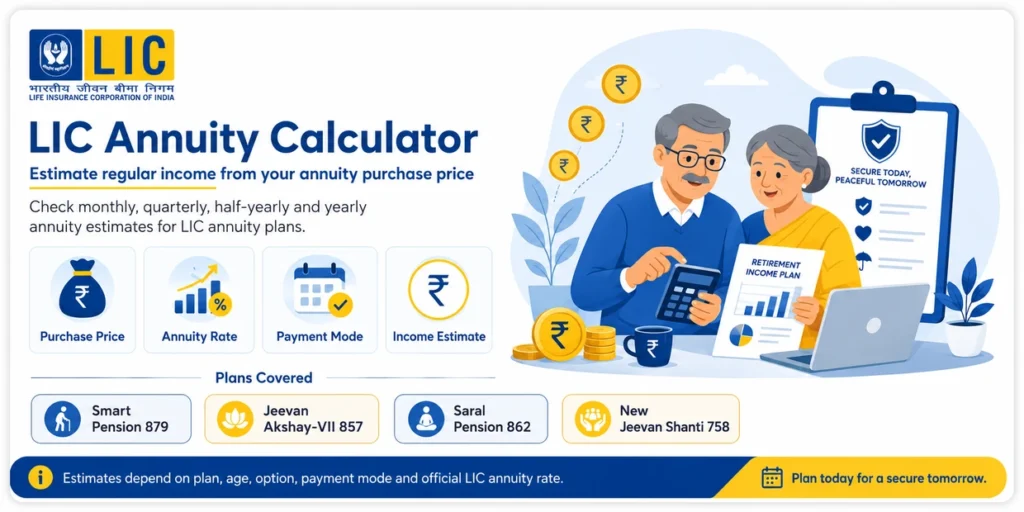
The LIC Annuity Calculator is an online tool that estimates the regular income that may be received after investing a lump-sum amount in an LIC annuity plan. It can show an estimated monthly, quarterly, half-yearly or yearly annuity based on the purchase price and annuity rate entered.
An annuity can be useful after retirement when a person wants to convert savings, retirement benefits or part of an NPS corpus into regular income. LIC offers immediate and deferred annuity plans with options for single life, joint life and return of purchase price.
The amount shown by this calculator is only an estimate. Actual annuity depends on the plan, age, purchase price, payment mode, selected option and LIC’s rate applicable on the date of purchase.
Table of Contents
What Is an LIC Annuity Plan?
An LIC annuity plan is an insurance contract that provides regular income in exchange for a purchase price. The purchase price is normally paid as a lump sum. LIC then pays the agreed annuity according to the selected option and payment mode.
The person whose life is covered for annuity payments is called the annuitant. A single-life option covers one annuitant, while a joint-life option covers two eligible annuitants. Under a joint-life option, income may continue for the second annuitant after the first annuitant’s death, according to the policy conditions.
Annuity payments may be received monthly, quarterly, half-yearly or yearly.
Some annuity plans start payments soon after the purchase price is paid. These are called immediate annuity plans. Other plans start income after a selected waiting period. These are known as deferred annuity plans.
Annuity options also differ in what happens after the annuitant’s death. Under some options, payments stop. Under others, the applicable purchase price is returned to the nominee. Some options continue income for a guaranteed period or for the surviving joint annuitant.
Difference Between LIC Annuity and Pension
Pension and annuity are closely related, but they are not exactly the same.
A pension is the regular income received after retirement. It may come from an employer, the government, the National Pension System, a retirement fund or an insurance plan.
An annuity is a financial contract used to generate regular income. A person generally pays a purchase price to an insurer, and the insurer pays an income according to the selected annuity option.
| Point | Pension | Annuity |
|---|---|---|
| Basic meaning | Regular retirement income | Contract that produces regular income |
| Source | Employer, government, NPS or retirement product | Purchased from an insurance company |
| Funding | Employment benefit or accumulated retirement fund | Usually a lump-sum purchase price |
| Payment calculation | Depends on the pension scheme | Depends on age, plan, option and annuity rate |
| Starting time | Usually after retirement | Immediately or after deferment |
In simple words, pension is the income received, while an annuity is one of the arrangements that can provide that income. This is why “LIC pension calculator” and “LIC annuity calculator” are sometimes used for the same search, even though their technical purposes can differ.
What Is the LIC Annuity Calculator?
The LIC Annuity Calculator estimates how much regular income a purchase price may provide under an LIC annuity plan.
It can calculate estimated annual annuity, simple monthly income equivalent, quarterly income, half-yearly income, purchase price required for a target pension, immediate-annuity income, deferred-annuity income and single-life or joint-life illustrations.
For example, if an official LIC quotation provides an annuity rate, that rate can be entered with the purchase price. The calculator applies the rate and displays the estimated income for different payment modes.
The tool should not automatically describe an assumed rate as the current LIC rate. Annuity rates can change and may vary by plan, age, purchase-price band and selected option.
Is the LIC Pension Calculator the Same as the Annuity Calculator?
No, they are related but not always the same.
An LIC annuity calculator mainly estimates how much regular income can be generated from a given purchase price. It may also calculate how much purchase price would be needed to receive a desired pension.
An LIC pension calculator can have a wider purpose. It may calculate the retirement fund that could be accumulated before retirement, the possible amount available at vesting and the pension that may later be purchased from that fund.
For example, LIC Smart Pension, Jeevan Akshay-VII and Saral Pension use immediate-annuity calculations. New Jeevan Shanti requires a deferred-annuity calculation. LIC New Pension Plus works differently because it is a unit-linked pension accumulation plan used to build a retirement fund.
Therefore, a combined pension and annuity calculator must change its fields and formulas according to the selected product. One general formula cannot accurately cover every LIC pension product.
LIC Annuity Plans Covered by the Calculator
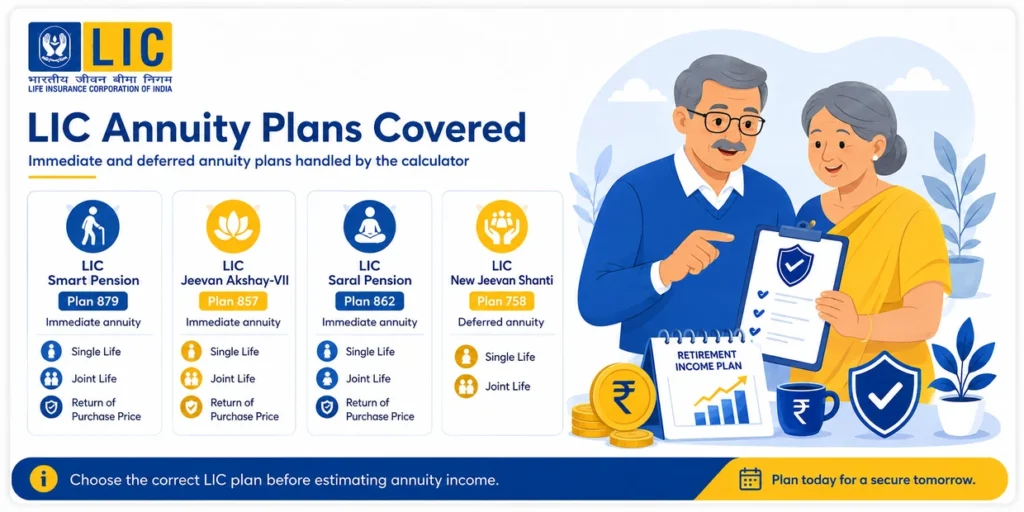
The dedicated annuity calculator can focus on these plans:
| LIC plan | Plan number | Annuity type |
| LIC Smart Pension | 879 | Immediate annuity |
| LIC Jeevan Akshay-VII | 857 | Immediate annuity |
| LIC Saral Pension | 862 | Immediate annuity |
| LIC New Jeevan Shanti | 758 | Deferred annuity |
LIC currently lists these plans in its official pension category along with New Pension Plus. New Pension Plus is better handled through a separate pension-fund calculator because it builds a market-linked retirement corpus rather than directly estimating a fixed annuity from a purchase price. LIC Pension Plans
LIC Smart Pension
LIC Smart Pension is a non-participating, non-linked immediate annuity plan. It offers multiple single-life and joint-life annuity choices. LIC introduced Plan 879 on 18 February 2025.
The pension depends on the age of the annuitant, purchase price, annuity option and payment mode. Some choices provide income only during the annuitant’s lifetime, while others include a guaranteed period, joint-life continuation or return of purchase price.
LIC Jeevan Akshay-VII
LIC Jeevan Akshay-VII is an immediate annuity plan purchased by paying a lump-sum amount. The annuity starts according to the chosen payment mode and continues under the conditions of the selected option.
The plan provides different choices, including life annuity, guaranteed-period options, joint-life arrangements and options connected with return of purchase price. LIC states that the annuity rate is guaranteed at the beginning of the policy for the selected option.
LIC Saral Pension
LIC Saral Pension is an immediate annuity plan with a standardised structure. It is designed for people who want regular lifetime income after paying a purchase price.
Its available options and calculations should be checked separately rather than applying the larger option sets of Jeevan Akshay-VII or Smart Pension.
LIC New Jeevan Shanti
LIC New Jeevan Shanti is a deferred annuity plan. It is purchased through a single premium, but income begins only after the selected deferment period.
It offers single-life and joint-life deferred-annuity choices. The calculator must therefore ask for the deferment period and, for joint life, the second annuitant’s age. LIC states that the applicable annuity rate is guaranteed at the beginning of the policy.
How Do LIC Annuity Plans Work?
The buyer first selects an LIC annuity plan and pays the applicable purchase price. A suitable annuity option is then selected based on income and family-protection requirements.
LIC calculates the annuity using factors such as the annuitant’s age, purchase price, payment mode and chosen option. In an immediate annuity, payments begin shortly after the policy starts. In a deferred annuity, payments begin after the agreed deferment period.
The selected option also determines what happens after death. Income may stop, continue for a guaranteed period, continue for the second annuitant or be followed by return of the applicable purchase price.
Because the chosen option affects both regular income and the death benefit, the option offering the highest pension may not provide the required protection for a spouse or nominee.
Types of LIC Annuity
A life annuity pays regular income while the annuitant is alive. Payments normally stop after death unless another benefit is included.
An annuity certain provides payments for a guaranteed period such as 5, 10, 15 or 20 years, depending on the plan. If the annuitant survives beyond that period, payments may continue for life. If death occurs during the guaranteed period, payments may continue to the nominee for the remaining period.
A joint-life annuity covers two eligible annuitants. Income may continue for the second annuitant after the first annuitant’s death according to the selected percentage and policy conditions.
An annuity with return of purchase price pays income during the applicable lifetime and returns the defined purchase price after death under the chosen option.
An increasing annuity starts with a particular amount and increases according to the terms of the option. The starting income may be lower than a level annuity because future increases are built into the benefit.
A deferred annuity begins after a chosen waiting period. This is suitable for someone who does not require income immediately.
LIC Annuity Rates
The annuity rate is the rate used to convert a purchase price into regular income. A higher annuity rate produces a higher income for the same purchase price, subject to the selected payment mode and plan rules.
LIC annuity rates can depend on the age of the annuitant, purchase price, selected plan, annuity option, single or joint life, return-of-purchase-price benefit, guaranteed payment period, deferment period, payment frequency, applicable incentives, method of purchase and NPS-related conditions.
There is no single LIC annuity rate applicable to every buyer. Rates shown for one plan, age or option should not be applied to another.
LIC Annuity Rate vs Interest Rate
People searching for the LIC annuity plan interest rate are usually looking for the annuity rate used to calculate regular income. However, an annuity rate is not the same as a bank deposit interest rate.
A fixed-deposit interest rate represents interest earned on a deposit. The original deposit normally remains subject to the deposit’s withdrawal and maturity conditions.
An annuity rate reflects a lifetime or option-based income commitment. Its calculation may account for age, expected payment duration, joint-life continuation, guaranteed periods and death benefits.
For this reason, comparing an LIC annuity rate directly with an FD interest rate can be misleading. The annuity option and benefits after death must also be compared.
Details Required for Calculation
The calculator generally needs the selected LIC plan, purchase price, age of the annuitant, annuity option and payment mode.
For a joint-life calculation, it also requires the second annuitant’s age. A deferred-annuity calculation requires the deferment period. The applicable official annuity rate is needed for a reliable estimate.
Personal details such as name, address and mobile number are not required for a basic calculation.
How to Use the LIC Annuity Calculator
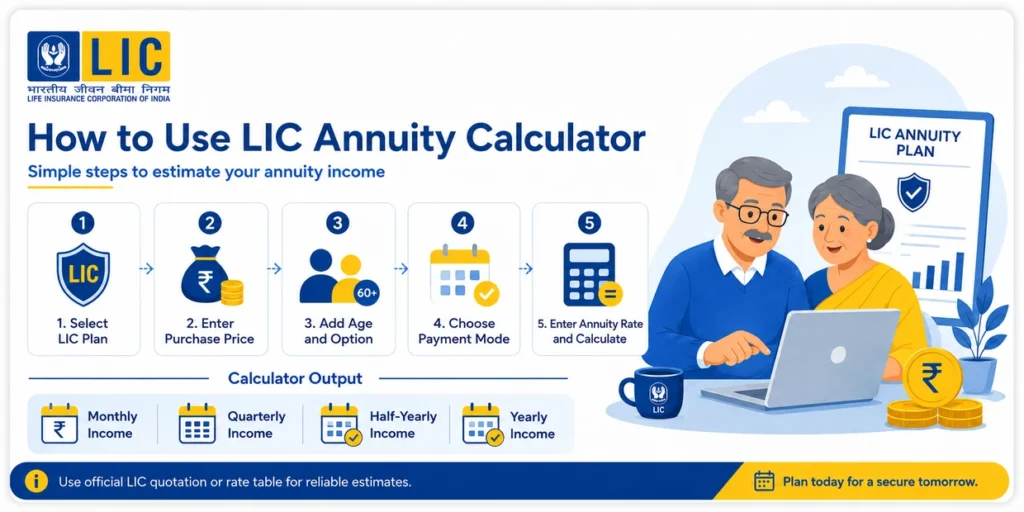
First, select the relevant LIC annuity plan. Enter the purchase price and age of the primary annuitant. Select single life or joint life and provide the second annuitant’s age when required.
Choose the annuity option and payment mode. If using New Jeevan Shanti, enter the deferment period. Enter the annuity rate shown in an official LIC quotation or applicable rate table.
Select Calculate to view the estimated annual, half-yearly, quarterly and monthly income. Review the option’s death-benefit conditions separately because two options producing similar income may provide very different benefits after death.
Formula Used in the LIC Annuity Calculator
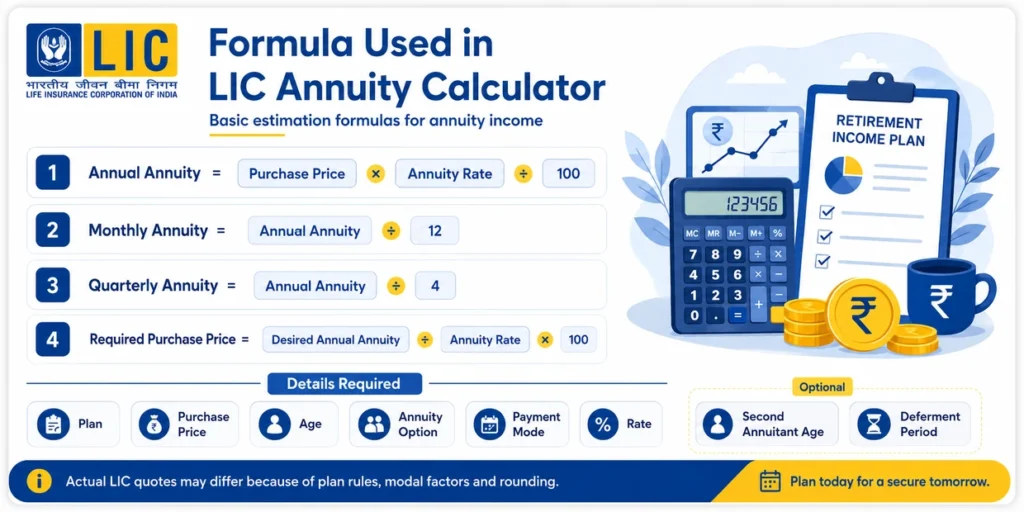
The basic annual estimation formula is:
Annual Annuity = Purchase Price × Annuity Rate ÷ 100
A simple monthly equivalent can be calculated as:
Monthly Annuity = Annual Annuity ÷ 12
Similarly:
Quarterly Annuity = Annual Annuity ÷ 4
Half-Yearly Annuity = Annual Annuity ÷ 2
The purchase price required for a target annual income may be estimated as:
Required Purchase Price = Desired Annual Annuity ÷ Annuity Rate × 100
These are general estimation formulas. LIC may apply product-specific annuity rates, modal factors, incentives, rounding rules and option conditions. Therefore, dividing the annual amount by 12 may not always reproduce LIC’s official monthly quotation exactly.
Real Calculation Example
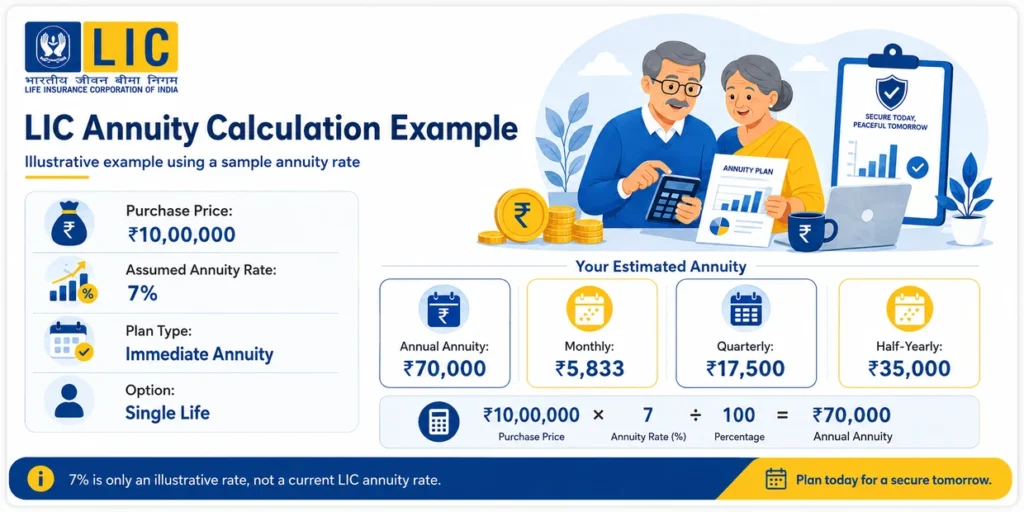
Suppose a purchase price of ₹10,00,000 is entered with an assumed annual annuity rate of 7%.
The estimated annual annuity would be:
₹10,00,000 × 7 ÷ 100 = ₹70,000
The simple payment-mode equivalents would be:
- Monthly: approximately ₹5,833
- Quarterly: ₹17,500
- Half-yearly: ₹35,000
- Yearly: ₹70,000
The 7% rate is used only to explain the formula. It is not presented as a current LIC annuity rate. The actual payment can be different depending on age, plan, option, payment mode and the official rate available at purchase.
How Is the LIC Annuity Calculator Useful?
The calculator makes it easier to understand the relationship between purchase price and regular income. It also allows different assumed rates and purchase prices to be compared without repeating every calculation manually.
It can help estimate income available from an existing retirement corpus, purchase price required for a target monthly pension, difference between payment modes, effect of choosing immediate or deferred income, difference between single-life and joint-life options, and possible impact of return-of-purchase-price protection.
The result is most useful for initial planning and comparing scenarios. It should be followed by an official LIC quotation before making a purchase decision.
Immediate Annuity vs Deferred Annuity
An immediate annuity is designed for someone who wants regular income to start shortly after making the lump-sum payment. It may be suitable at or after retirement when income is required without a long waiting period.
A deferred annuity begins after a selected deferment period. It may suit someone who has funds available now but wants pension to start at a future age.
A longer deferment does not automatically make a plan suitable. Liquidity, income requirements, family protection and policy conditions should be considered.
Single-Life vs Joint-Life Annuity
A single-life annuity is linked to one annuitant. It may offer a different rate from a joint-life option because LIC’s payment responsibility is based mainly on one life.
A joint-life annuity provides coverage for two eligible annuitants. After the first annuitant’s death, the annuity may continue for the second annuitant according to the selected option.
Joint-life conditions, permitted relationships and continuation percentages can differ between plans. These details should be checked in the applicable brochure and policy document.
Return of Purchase Price Explained
Under a return-of-purchase-price option, LIC pays regular annuity according to the policy and returns the applicable purchase price after death as specified in the chosen option.
This return is not an additional investment gain. It is part of the policy’s death-benefit design. Because LIC is required to return an amount after death, the regular annuity may be lower than an otherwise comparable option without return of purchase price.
Is LIC Annuity Taxable?
Regular annuity income should not automatically be treated as tax-free. Its taxability depends on the applicable tax law, the nature of the receipt and the recipient’s circumstances.
The Income Tax Department identifies contributions to qualifying annuity plans of LIC or another insurer under the provisions relating to Section 80CCC, subject to applicable conditions and the chosen tax regime. A deduction available at the contribution stage does not mean that every later annuity payment is tax-free. Income Tax Department guidance
Tax rules can also differ for regular annuity income, employer pension, family pension, commuted pension, return of purchase price, death benefits and NPS annuity payments.
The applicable rules should be checked for the financial year in which the amount is received.
LIC Annuity Income Is Taxable Under Which Head?
For an annuity personally purchased from LIC that is not a pension paid by a former employer, the income is generally considered separately from salary pension and is commonly reported under Income from Other Sources, depending on the facts and applicable tax provisions.
This should not be confused with an uncommuted pension received from a former employer, which the Income Tax Department describes as taxable under Salaries. Family pension is generally taxable under Income from Other Sources. Income Tax Department Pensioner Tax Guide
The correct classification can depend on how the annuity was purchased and why it is being paid. Current tax rules and the appropriate income-tax return should therefore be checked with a qualified tax professional.
Advantages and Limitations of LIC Annuity Plans
An LIC annuity can provide regular income without linking each payment directly to daily stock-market movements. It offers different income frequencies and may provide joint-life continuation or return of purchase price.
However, liquidity can be limited after the annuity is purchased. The chosen option may not be changeable, and fixed income may lose purchasing power because of inflation. Options offering greater benefits to a spouse or nominee may provide a lower regular annuity.
The decision should therefore be based on income needs, emergency funds, inflation, family protection and the exact policy conditions—not only the highest displayed annuity amount.
Frequently Asked Questions
What is an LIC annuity?
An LIC annuity is a contract that provides regular income after a purchase price is paid. Payments follow the selected plan, option and mode.
How does the LIC Annuity Calculator work?
It applies the entered purchase price and annuity rate to estimate annual and periodic income. It can also estimate the purchase price required for a target pension.
What are the main LIC annuity plans?
Current LIC pension listings include immediate annuity products such as Smart Pension, Jeevan Akshay-VII and Saral Pension, along with the deferred annuity plan New Jeevan Shanti.
What is the LIC annuity rate?
It is the rate used to calculate regular annuity from the purchase price. It varies according to the plan, age, option and other policy factors.
Is the LIC annuity rate the same as an interest rate?
No. An annuity rate is used for contractual income and reflects the selected lifetime and death benefits. It is not directly equal to a bank deposit interest rate.
Is LIC annuity income taxable?
Regular annuity income is not automatically tax-free. Taxability depends on the nature of the payment, applicable law and individual circumstances.
Can an annuity option be changed after purchase?
Annuity options are generally selected when purchasing the policy and may not be changeable afterwards. The applicable policy document should be checked before purchase.