LIC New Jeevan Anand Plan 915 Calculator
Estimate premium, maturity value, death benefit and lifelong cover after maturity.
Calculate Your Maturity And Premium
Enter policy details below for an estimated calculation.
Your Policy Illustration
Estimated values based on entered policy details.
Premium Snapshot
Policy Overview
Maturity Estimate
Death Benefit Estimate
Lifelong Cover After Maturity
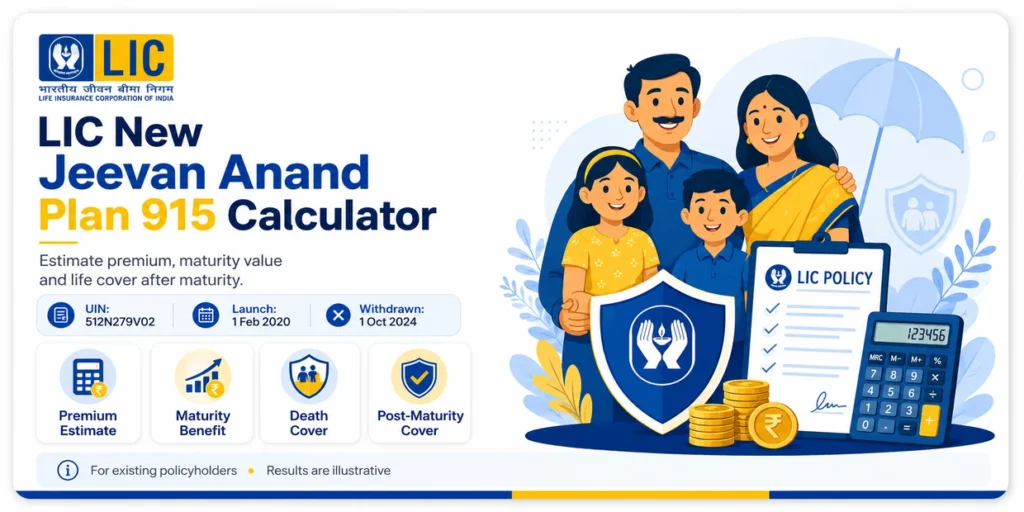
LIC New Jeevan Anand Plan 915 is a participating savings and life insurance policy with a special combination of benefits. It pays a maturity benefit at the end of the policy term and continues life cover even after maturity.
LIC launched Plan 915 on 1 February 2020 and withdrew it from new sales on 1 October 2024. It carries UIN 512N279V02 and is mainly relevant to existing policyholders. LIC later introduced New Jeevan Anand Plan 715 with UIN 512N279V03. The two versions should not be mixed while estimating premium or policy benefits.
The LIC New Jeevan Anand Plan 915 Calculator helps estimate the premium, maturity benefit, death benefit during the policy term and life cover available after maturity. Its results are illustrative. The policy bond, premium receipts, vested bonus record and official LIC statement remain the final references.
Table of Contents
What Is LIC New Jeevan Anand Plan 915?
Plan 915 is a non-linked, participating, individual life assurance savings plan. Non-linked means its benefits are not directly connected to stock-market performance or NAV. Participating means an eligible in-force policy can receive Simple Reversionary Bonuses declared by LIC.
Premiums are normally payable throughout the selected policy term. If the life assured survives to maturity and the policy remains in force, LIC pays the Basic Sum Assured along with vested bonuses and Final Additional Bonus, if any.
Unlike a normal endowment policy, the insurance cover does not completely end after maturity. After LIC pays the maturity benefit, the Basic Sum Assured remains payable on the life assured’s death. No further base premium is required after maturity.
LIC New Jeevan Anand Plan 915 at a Glance

| Feature | Plan 915 Rule |
|---|---|
| Plan number and UIN | 915; 512N279V02 |
| Launch and withdrawal | 1 February 2020; 1 October 2024 |
| Plan type | Non-linked, participating, individual savings life insurance plan |
| Entry age | 18 to 50 years, subject to LIC’s age basis |
| Policy term | 15 to 35 years |
| Maximum maturity age | 75 years |
| Basic Sum Assured | Minimum ₹1,00,000; no stated maximum |
| Sum Assured multiple | ₹5,000 |
| Premium modes | Yearly, half-yearly, quarterly, monthly through NACH, or salary deduction |
| Main feature | Maturity benefit plus continued life cover after maturity |
| Paid-up, surrender and loan eligibility | After at least two full years’ premiums |
| Revival period | Five consecutive years from the first unpaid premium |
The selected term must satisfy the maximum maturity-age limit. For example, a person entering at age 50 cannot select a term that takes the maturity age beyond 75.
What Does the Plan 915 Calculator Estimate?
The calculator can estimate the annual and instalment premium, projected maturity amount, Sum Assured on Death during the policy term and Basic Sum Assured payable after maturity. It may also explain paid-up benefits and surrender eligibility when the required policy details are entered.
The calculator should show the Basic Sum Assured separately from projected bonuses. Basic Sum Assured is the core guaranteed amount under an in-force policy, while future Simple Reversionary Bonus and Final Additional Bonus cannot be known in advance.
An online calculator cannot independently confirm underwriting, medical loading, rider premium, actual vested bonuses, policy assignments, outstanding loan or Special Surrender Value. Its result should therefore be used for understanding and planning, not as an official claim or surrender statement.
Also Check:
- LIC Jeevan Anand Calculator All in One
- LIC Jeevan Anand Plan 149 Calculator
- LIC Jeevan Azad Plan 768 Calculator
How to Use the LIC New Jeevan Anand Plan 915 Calculator
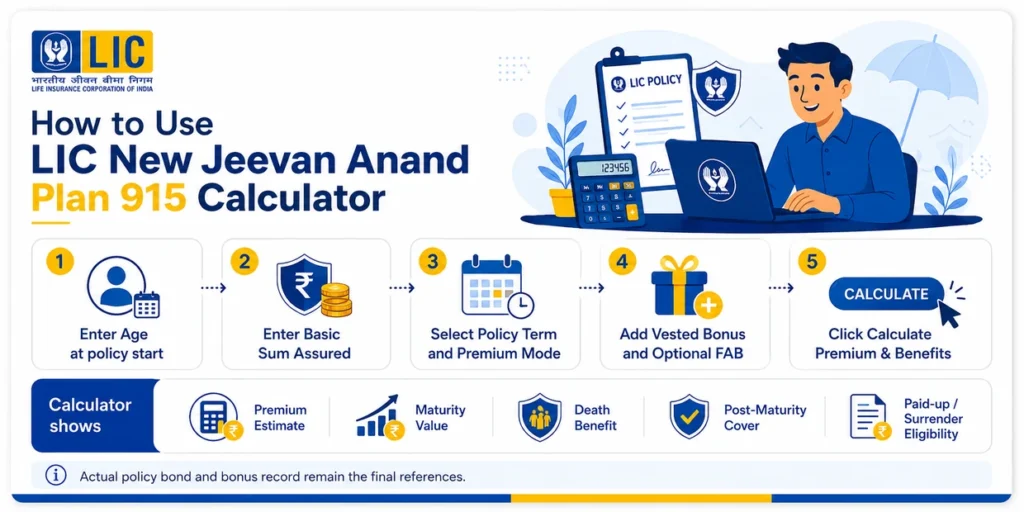
Enter the age of the life assured at the start of the policy. Next, enter the Basic Sum Assured printed on the policy bond and select the original policy term between 15 and 35 years.
Choose the premium-payment mode. The brochure allowed yearly, half-yearly, quarterly, monthly through NACH and salary deduction. Where available, enter the actual annual base premium shown in the policy records. This is more reliable than rebuilding the premium from a sample table.
For maturity estimation, enter the vested bonus already attached to the policy. If an assumed bonus rate is used instead, the result must be labelled as a projection. Final Additional Bonus should remain optional and may be left blank or set to zero because LIC may not declare it for every maturity or death claim.
To preview the death benefit, select the policy year in which death is assumed to occur. The calculator can estimate the vested bonus up to that year, but the result will remain illustrative unless the actual vested bonus record is entered.
Click Calculate Premium & Benefits to view the estimate. Use Reset to clear the entered values and start a new calculation.
Formulas Used in the Calculator
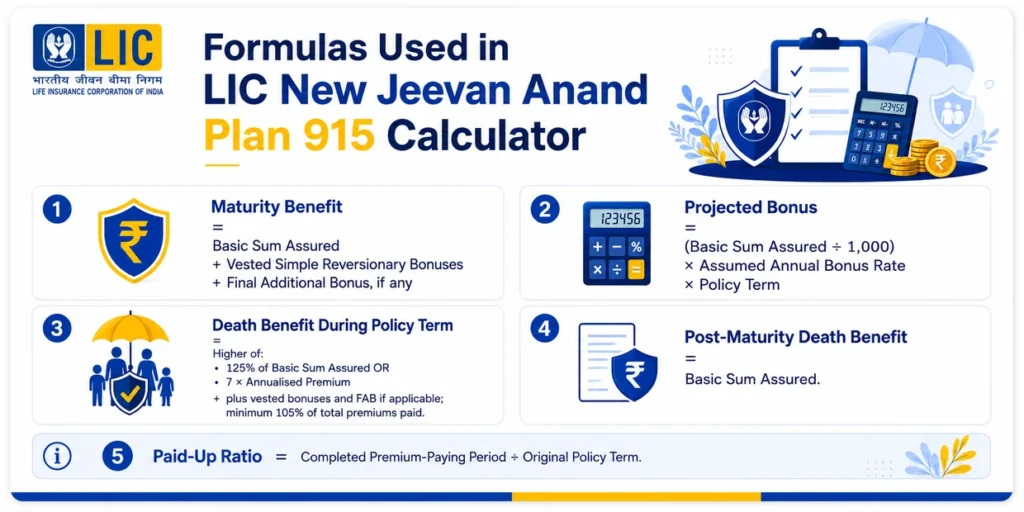
Maturity Benefit
For an in-force policy, the maturity formula is:
Maturity Benefit = Basic Sum Assured
                 + Vested Simple Reversionary Bonuses
                 + Final Additional Bonus, if any
Simple Reversionary Bonus is declared by LIC for eligible participating policies. Once declared, it becomes vested and remains attached to the policy. On surrender, however, the full vested bonus is not automatically paid. Only its surrender value is considered using the applicable bonus surrender factor.
Projected Bonus
Where the calculator uses an assumed bonus rate:
Projected Bonus =
(Basic Sum Assured ÷ 1,000)
× Assumed Annual Bonus Rate
× Policy Term
This formula is only an illustration. The actual bonus rate can change from year to year.
Death Benefit During the Policy Term
For an in-force policy, the Sum Assured on Death is:
Higher of:

1. 125% of Basic Sum Assured
2. Seven times Annualised Premium
The total death benefit also includes vested Simple Reversionary Bonuses and Final Additional Bonus, if declared. It cannot be less than 105% of total premiums paid up to death. Annualised Premium and Total Premiums Paid exclude taxes, rider premiums, underwriting extra premium and other items specified in the policy document.
Death Benefit After Maturity
Post-Maturity Death Benefit = Basic Sum AssuredThis cover continues after payment of the maturity benefit according to the policy terms.
LIC New Jeevan Anand Plan 915 Calculation Example
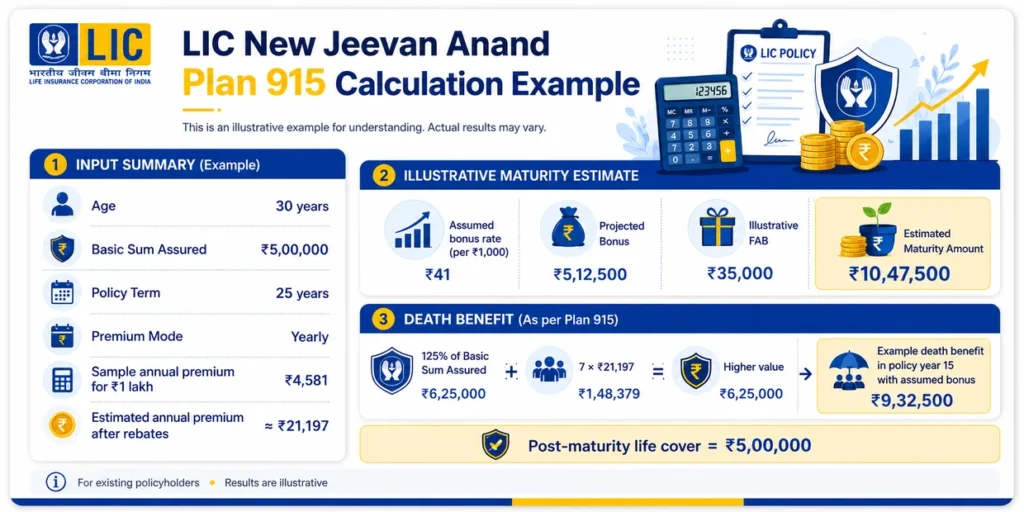
Consider a policy taken at age 30 with a Basic Sum Assured of ₹5,00,000, a policy term of 25 years and yearly premium mode.
LIC’s brochure provides a sample annual premium of ₹4,581 for a ₹1 lakh Basic Sum Assured at age 30 and a 25-year term. Scaling that sample to ₹5 lakh gives a starting tabular-premium estimate:
₹4,581 × 5 = ₹22,905For a Basic Sum Assured from ₹5 lakh to ₹9.95 lakh, the brochure shows a high-sum-assured rebate of ₹2.50 per ₹1,000:
₹5,00,000 ÷ 1,000 × ₹2.50 = ₹1,250The yearly-mode rebate is 2% of the tabular premium:
2% of ₹22,905 = ₹458.10The illustrative annual base premium is therefore:
₹22,905 − ₹1,250 − ₹458.10
= ₹21,196.90
Rounded to the nearest rupee, the estimate is approximately ₹21,197. This method scales LIC’s sample premium and applies brochure rebate assumptions. It may not reproduce the exact premium printed on an individual policy bond.
LIC’s sample figures exclude taxes. Do not apply a permanently fixed tax rate. Use the Tax Rule and amount shown in the actual premium receipt or renewal notice.
Illustrative Maturity Benefit
Assume a Simple Reversionary Bonus rate of ₹41 per ₹1,000 of Basic Sum Assured for illustration:
Projected Bonus =
₹5,00,000 ÷ 1,000 × ₹41 × 25
= ₹5,12,500
Assume an optional FAB rate of ₹70 per ₹1,000:
Illustrative FAB =
₹5,00,000 ÷ 1,000 × ₹70
= ₹35,000
The estimated maturity amount becomes:
₹5,00,000 Basic Sum Assured
+ ₹5,12,500 projected bonus
+ ₹35,000 illustrative FAB
= ₹10,47,500
The bonus and FAB in this example are assumptions, not promised amounts. FAB should be included only where LIC declares it and the policy satisfies the applicable claim conditions.
Illustrative Death Benefit in Policy Year 15
The calculator first compares the two Sum Assured on Death values:
125% of ₹5,00,000 = ₹6,25,000

Seven times ₹21,197 = ₹1,48,379
The higher amount is ₹6,25,000. If the same assumed bonus rate is applied for 15 years:
₹5,00,000 ÷ 1,000 × ₹41 × 15
= ₹3,07,500
Without assuming FAB, the illustrative death benefit is:
₹6,25,000 + ₹3,07,500
= ₹9,32,500
FAB may be added only if declared and applicable to that death claim. LIC must also apply the 105% minimum-benefit condition.
After maturity, the post-maturity death cover in this example is ₹5,00,000, which is equal to the Basic Sum Assured.
Premium Rebates Under Plan 915
The brochure provided a 2% rebate on tabular premium for yearly mode and 1% for half-yearly mode. Quarterly, monthly and salary-deduction modes did not receive a mode rebate.
The high-sum-assured rebate was nil for ₹1 lakh to ₹1.95 lakh, ₹1.50 per ₹1,000 for ₹2 lakh to ₹4.95 lakh, ₹2.50 per ₹1,000 for ₹5 lakh to ₹9.95 lakh and ₹3 per ₹1,000 for ₹10 lakh and above.
These rebate rules are useful for an indicative premium calculation. Existing policyholders should use the premium recorded in their own policy documents wherever possible.
Paid-Up Benefits When Premiums Stop
If fewer than two full years’ premiums have been paid and a later premium remains unpaid after the grace period, the policy lapses without acquiring paid-up value.
After at least two full years’ premiums have been paid, the policy can continue with reduced paid-up benefits. A simple paid-up ratio is:
Paid-Up Ratio =
Completed Premium-Paying Period ÷ Original Policy Term
The reduced benefits are:
Maturity Paid-Up Sum Assured =
Basic Sum Assured × Paid-Up Ratio
Death Paid-Up Sum Assured During the Policy Term =
Original Sum Assured on Death × Paid-Up RatioPost-Maturity Paid-Up Cover =
Basic Sum Assured × Paid-Up RatioVested bonuses already attached remain payable according to the paid-up policy conditions, but future bonuses stop. Final Additional Bonus is not payable under a paid-up policy, and riders do not acquire paid-up value.
Surrender Value and Policy Loan
The policy can be surrendered during the policy term after at least two full years’ premiums have been paid. LIC pays the higher of Guaranteed Surrender Value and Special Surrender Value.
Guaranteed Surrender Value includes eligible premiums multiplied by the applicable premium surrender factor and the surrender value of vested bonuses calculated using a separate bonus factor. Special Surrender Value is determined by LIC and may be more favourable.
No Guaranteed Surrender Value is available after the maturity benefit has been paid. Therefore, the continued post-maturity death cover should not be treated as an amount that can be surrendered.
During the policy term, a loan can be taken after at least two full years’ premiums have been paid. The maximum was up to 90% of surrender value for an in-force policy and up to 80% for a paid-up policy. LIC could recover outstanding loan and interest from policy proceeds according to the policy conditions.
Riders and Instalment Options
Plan 915 offered Accidental Death and Disability Benefit Rider, Accident Benefit Rider, New Term Assurance Rider and New Critical Illness Benefit Rider for an additional premium, subject to eligibility. Only one of the two accident riders could be selected, and a maximum of three riders could be attached.
The death benefit could be taken in instalments over 5, 10 or 15 years instead of entirely as a lump sum. The life assured had to choose this option during their lifetime. The nominee could not change the selected option after death.
The maturity benefit could also be received in instalments over 5, 10 or 15 years. The option could apply to the full or part of the maturity proceeds and had to be exercised at least three months before maturity. Minimum instalment amounts were ₹5,000 monthly, ₹15,000 quarterly, ₹25,000 half-yearly and ₹50,000 yearly.
Grace Period, Revival and Tax Rule
The grace period was 30 days for yearly, half-yearly and quarterly premiums and 15 days for monthly premiums. During the grace period, the policy remained in force. If death occurred before the overdue premium was paid, LIC could deduct the unpaid premium and applicable balance premium from the claim.
A lapsed policy could be considered for revival within five consecutive years from the first unpaid premium and before maturity. Revival required payment of arrears with applicable interest, evidence of continued insurability and LIC’s approval.
Taxes, if applicable, are governed by the Tax Rule in force at the relevant time. Tax paid on premiums is not included when calculating policy benefits. Eligibility for any deduction or exemption depends on the applicable law and individual policy conditions.
Frequently Asked Questions
Is LIC New Jeevan Anand Plan 915 still available?
No. LIC withdrew Plan 915 from new sales on 1 October 2024. Existing policies continue according to their original terms and policy status.
How is the maturity amount calculated?
For an in-force policy, the maturity benefit is the Basic Sum Assured plus vested Simple Reversionary Bonuses and Final Additional Bonus, if any.
Is the bonus guaranteed?
Future bonus and FAB are not guaranteed. Once a Simple Reversionary Bonus is declared, it becomes vested and remains attached according to the policy conditions.
What happens after maturity?
After payment of the maturity benefit, the Basic Sum Assured continues as life cover and becomes payable on the life assured’s death.
When does the policy acquire paid-up and surrender value?
After at least two full years’ premiums have been paid, subject to the policy conditions.
Is a loan available under Plan 915?
Yes. During the policy term, a loan can be taken after at least two full years’ premiums have been paid. The available amount depends on surrender value and policy status.
Is the calculator result exact?
No. The exact premium, vested bonuses, FAB, surrender value, loan balance and claim amount depend on LIC’s policy records and applicable conditions.
Final Words
LIC New Jeevan Anand Plan 915 combines maturity savings with continued life cover after maturity. Its benefit structure is useful but requires separate calculations for premium, projected bonuses, death cover, paid-up benefits and surrender value.
The LIC New Jeevan Anand Plan 915 Calculator makes these calculations easier to understand. Its results should be treated as estimates and verified against the policy bond, premium receipts, bonus record and official LIC servicing statement.