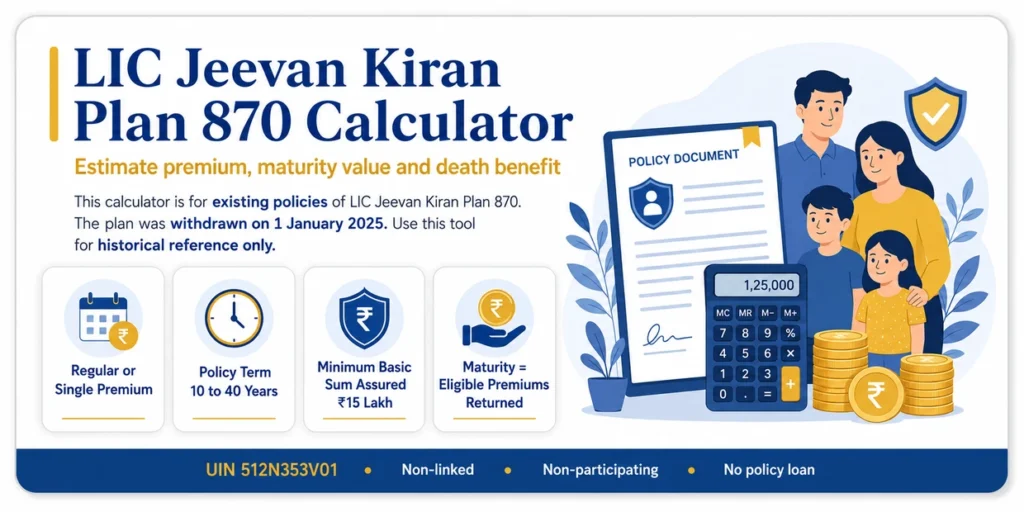
LIC Jeevan Kiran Plan 870 was a life insurance plan that returned eligible premiums at maturity. It provided life cover during the policy term and paid a maturity benefit if the life assured survived until the end of the term.
The LIC Jeevan Kiran Plan 870 Calculator helps estimate the premium, total eligible premiums, maturity benefit and death benefit. It can also show the effect of the premium payment option, payment mode and applicable rebates.
Important plan status: LIC Jeevan Kiran Plan 870 (UIN: 512N353V01) was withdrawn on 1 January 2025. It is no longer available for purchase. This calculator and guide are helpful for existing policyholders.
Table of Contents
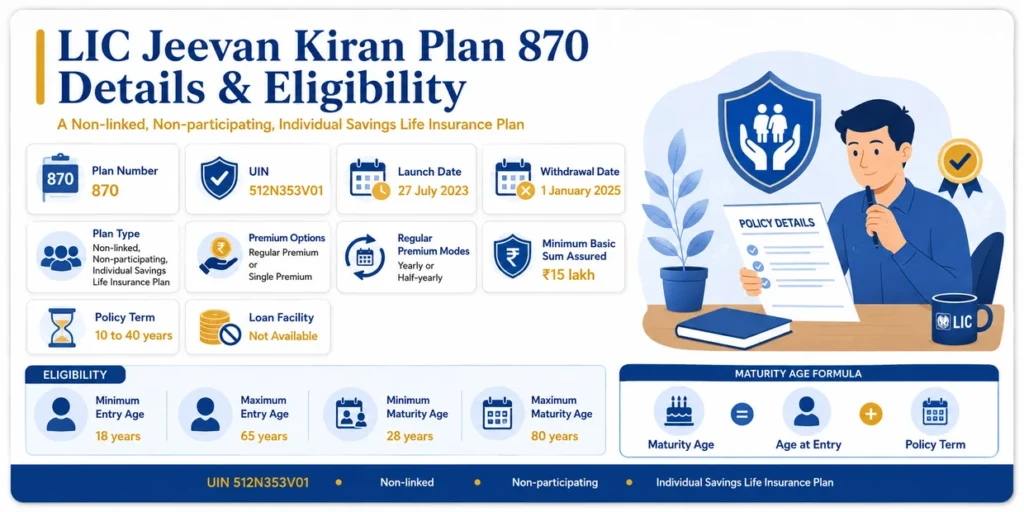
LIC Jeevan Kiran Plan 870 Details
| Particular | Details |
| Plan name | LIC Jeevan Kiran |
| Plan number | 870 |
| UIN | 512N353V01 |
| Launch date | 27 July 2023 |
| Withdrawal date | 1 January 2025 |
| Plan type | Non-linked, non-participating, individual savings life insurance plan |
| Premium options | Regular premium or single premium |
| Regular premium modes | Yearly or half-yearly |
| Minimum Basic Sum Assured | ₹15 lakh |
| Policy term | 10 to 40 years |
| Loan facility | Not available |
In simple terms, this plan provided life cover for a fixed period. If the life assured survived the entire term, LIC returned the eligible premiums paid. It did not provide a bonus, profit share, market-linked return or fund value.
What Is the LIC Jeevan Kiran Plan 870 Calculator?
The calculator is a simple tool for understanding the main values of LIC Jeevan Kiran Plan 870. After entering the policy details, it can estimate:
- Yearly, half-yearly or single premium
- Total scheduled base premium
- Maturity age
- Maturity benefit
- Death benefit
- High Sum Assured rebate
- Historical online sale rebate
- Half-yearly modal loading
The result separates the base premium from taxes, rider premiums and underwriting extra premiums. This distinction is important because these additional amounts are not returned as part of the maturity benefit.
Also Check:
- LIC Jeevan Shiromani Calculator
- LIC Jeevan Tarun Plan 934 Calculator
- LIC Jeevan Surabhi Maturity Calculator
- LIC Jeevan Utsav Calculator
- LIC Jeevan Azad Calculator
Calculator Highlights
- Supports regular and single premium options
- Covers policy terms from 10 to 40 years
- Uses separate smoker and non-smoker premium categories
- Checks the maximum maturity age
- Shows the premium calculation clearly
- Estimates maturity and death benefits separately
- Explains which amounts are excluded from policy benefits
- Helps existing policyholders understand the original plan structure
How to Use the Calculator
Enter the details from the policy bond or premium receipt wherever possible.
1. Enter the age at entry
Enter the age of the life assured when the policy began. LIC used age on a last-birthday basis.
For example, enter 40 if the life assured was 40 years old on the policy commencement date.
2. Select the policy term
Choose the original policy term, from 10 to 40 years. The calculator also checks the maturity age.
Maturity Age = Age at Entry + Policy TermIf the entry age was 40 and the term was 20 years:
Maturity Age = 40 + 20 = 60 yearsThe maturity age could not exceed 80 years.
3. Enter the Basic Sum Assured
Basic Sum Assured is the main life cover selected when the policy was purchased. The minimum amount under this plan was ₹15 lakh.
4. Select the premium payment option
Choose the option stated in the policy:
| Premium option | Meaning |
|---|---|
| Regular premium | Premiums are paid throughout the policy term |
| Single premium | One premium is paid at the beginning of the policy |
Under the regular premium option, the premium-paying term was the same as the policy term.
5. Choose the premium mode
Regular premium policies allowed yearly or half-yearly payments. Monthly and quarterly modes were not available. Single premium policies required only one payment.
6. Select the smoking category
LIC used separate premium rates for smokers and non-smokers. Non-smoker rates were subject to underwriting and a urinary cotinine test. Smoker rates could apply when the required conditions for non-smoker rates were not met.
7. Calculate the estimate
After all details are entered, select the calculate button. The result will show the estimated premium, total scheduled premium, maturity benefit and death benefit.
Eligibility Conditions
| Condition | Rule |
| Minimum entry age | 18 years |
| Maximum entry age | 65 years |
| Minimum maturity age | 28 years |
| Maximum maturity age | 80 years |
| Minimum policy term | 10 years |
| Maximum policy term | 40 years |
| Minimum Basic Sum Assured | ₹15 lakh |
| Minimum regular premium instalment | ₹3,000 |
| Minimum single premium | ₹30,000 |
There was no fixed maximum Basic Sum Assured, but the amount was subject to LIC’s underwriting decision.
The Basic Sum Assured had to be selected in LIC’s prescribed multiples:
| Basic Sum Assured range | Required multiple |
| ₹15 lakh to ₹37 lakh | ₹1 lakh |
| Above ₹37 lakh to ₹50 lakh | ₹25 lakh |
| Above ₹50 lakh to ₹80 lakh | ₹10 lakh |
| Above ₹80 lakh to ₹1 crore | ₹20 lakh |
| Above ₹1 crore to ₹1.5 crore | ₹25 lakh |
| Above ₹1.5 crore to ₹4 crore | ₹50 lakh |
| Above ₹4 crore | ₹1 crore |
These were LIC’s prescribed selection intervals. Therefore, every amount within a range was not necessarily available.
How the Premium Is Estimated
LIC did not use one simple premium formula for every policy. Premium rates depended on age, policy term, smoking category, Basic Sum Assured and premium payment option.
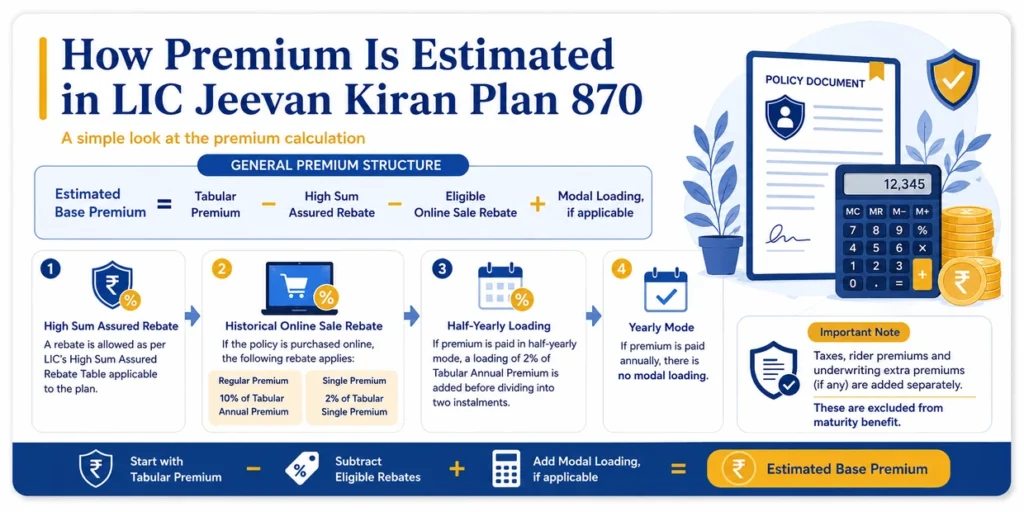
The calculator follows this general structure:
Estimated Base Premium
= Tabular Premium
− High Sum Assured Rebate
− Eligible Online Sale Rebate
+ Modal Loading, if applicable
Taxes, rider premiums and underwriting extra premiums are added separately when applicable.
High Sum Assured rebate
LIC offered a rebate for eligible higher Basic Sum Assured amounts. The rebate varied according to age band, premium payment option and selected cover. It was part of LIC’s pricing rules and was not an agent discount.
Historical online sale rebate
Proposals completed online without an agent or intermediary were eligible for the following rebate:
| Premium option | Historical online sale rebate |
| Regular premium | 10% of tabular annual premium |
| Single premium | 2% of tabular single premium |
This was a historical plan feature and is not a current purchase offer because Plan 870 has been withdrawn.
Half-yearly loading
Yearly mode had no modal loading. Under half-yearly mode, a loading equal to 2% of the tabular annual premium applied before the amount was divided into two instalments.
Maturity Benefit Formula
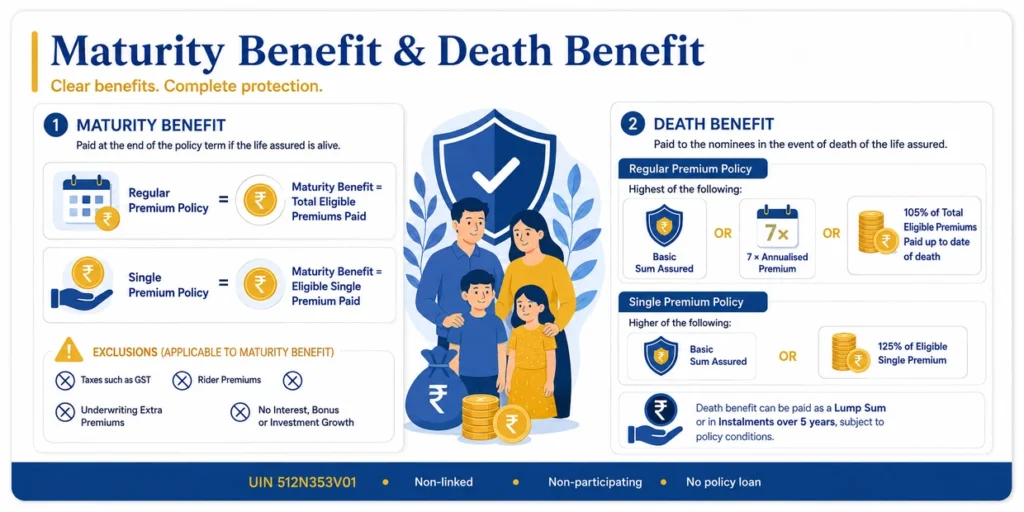
If the policy remained in force and the life assured survived until maturity, LIC paid the Sum Assured on Maturity.
For a regular premium policy:
Maturity Benefit = Total Eligible Premiums PaidFor a single premium policy:
Maturity Benefit = Eligible Single Premium PaidThe maturity benefit excluded:
- Taxes such as GST
- Rider premiums
- Underwriting extra premiums
The maturity amount was a return of eligible premium. It did not include interest, bonus or investment growth.
Death Benefit Formula
Regular premium policy
For an in-force regular premium policy, the Sum Assured on Death was the highest of:
Basic Sum Assured
OR
7 × Annualised Premium
OR
105% of Total Eligible Premiums Paid up to the date of death
Annualised Premium excluded taxes, rider premiums, underwriting extra premiums and modal loading.
Single premium policy
For an in-force single premium policy, the Sum Assured on Death was the higher of:
Basic Sum Assured
OR
125% of Eligible Single Premium
The death benefit could be paid as a lump sum. The plan also allowed all or part of it to be received in instalments over five years, subject to the policy conditions.
Real Calculation Example
The following example is based on LIC’s official benefit illustration for a standard non-smoker life under an offline regular premium policy.
| Input | Value |
| Entry age | 40 years |
| Smoking category | Non-smoker |
| Basic Sum Assured | ₹50,00,000 |
| Policy term | 20 years |
| Premium-paying term | 20 years |
| Premium mode | Yearly |
| Annual premium excluding tax | ₹48,004 |
The ₹48,004 amount is the premium used in this specific LIC illustration. It is not a universal rate for every policyholder.
Maturity calculation
Total Eligible Premiums Paid
= ₹48,004 × 20
= ₹9,60,080
If all premiums were paid and the policy remained in force until maturity:
Maturity Benefit = ₹9,60,080Taxes, rider premiums and underwriting extra premiums are not included in this amount.
Death benefit calculation
Suppose death occurred after 15 annual premiums had been paid.
Basic Sum Assured = ₹50,00,000

7 × Annualised Premium
= 7 × ₹48,004
= ₹3,36,028

Total Eligible Premiums Paid
= ₹48,004 × 15
= ₹7,20,060

105% of Total Eligible Premiums Paid
= ₹7,20,060 × 105%
= ₹7,56,063
Now compare the three amounts:
| Death benefit test | Amount |
| Basic Sum Assured | ₹50,00,000 |
| 7 × Annualised Premium | ₹3,36,028 |
| 105% of premiums paid | ₹7,56,063 |
The highest amount is ₹50 lakh. Therefore:
Death Benefit = ₹50,00,000Paid-Up and Revival Rules
These rules applied only to regular premium policies.
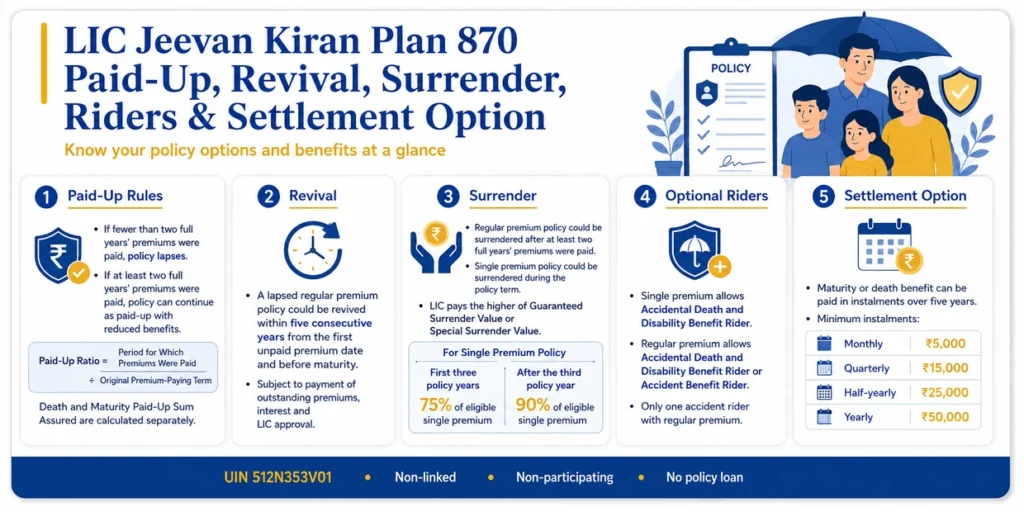
If fewer than two full years’ premiums were paid and a later premium remained unpaid after the grace period, the policy lapsed and its benefits stopped.
If at least two full years’ premiums were paid, the policy could continue as a paid-up policy with reduced benefits.
Paid-Up Ratio
= Period for Which Premiums Were Paid
÷ Original Premium-Paying Term
The death and maturity benefits were calculated separately:
Death Paid-up Sum Assured
= Sum Assured on Death × Paid-Up Ratio
Maturity Paid-up Sum Assured
= Sum Assured on Maturity × Paid-Up RatioFor example, if six annual premiums were paid under a 20-year premium-paying term:
Paid-Up Ratio = 6 ÷ 20 = 30%If the applicable Sum Assured on Death was ₹50 lakh:
Death Paid-up Sum Assured
= ₹50,00,000 × 30%
= ₹15,00,000
Riders did not acquire a paid-up value. Their benefits stopped when the base policy became lapsed or paid-up.
A lapsed regular premium policy could be revived within five consecutive years from the first unpaid premium date and before maturity. Revival required payment of outstanding premiums with interest and approval from LIC based on continued insurability.
Surrender Value and Policy Loan
A regular premium policy could be surrendered after at least two full years’ premiums had been paid. A single premium policy could be surrendered during the policy term.
LIC paid the higher of:
- Guaranteed Surrender Value
- Special Surrender Value
For a single premium policy, the Guaranteed Surrender Value was:
| Surrender timing | Guaranteed Surrender Value |
| During the first three policy years | 75% of eligible single premium |
| After the third policy year | 90% of eligible single premium |
For a regular premium policy, Guaranteed Surrender Value depended on eligible premiums paid and the factor applicable to the policy term and surrender year.
Rider premiums did not acquire surrender value. LIC Jeevan Kiran Plan 870 did not offer a policy loan.
Optional Riders
The following accident-related riders were available for an additional premium:
| Premium option | Available rider |
| Single premium | LIC’s Accidental Death and Disability Benefit Rider |
| Regular premium | LIC’s Accidental Death and Disability Benefit Rider or LIC’s Accident Benefit Rider |
Only one of the two available accident riders could be selected with a regular premium policy. Rider availability was subject to eligibility and the terms of the rider.
Settlement Option
The plan allowed all or part of the maturity or death benefit to be paid in instalments over five years instead of as one lump sum.
The available payment modes and minimum instalment amounts were:
| Instalment mode | Minimum amount |
| Monthly | ₹5,000 |
| Quarterly | ₹15,000 |
| Half-yearly | ₹25,000 |
| Yearly | ₹50,000 |
The maturity settlement option had to be selected at least three months before maturity. If the benefit was not sufficient to meet the minimum instalment requirement, LIC paid it as a lump sum.
Other Important Policy Conditions
Regular premium policies had a grace period of 30 days for yearly and half-yearly premiums. The policy remained in force during this period according to its terms.
The free-look period was 30 days from receipt of the policy document. A policy returned during this period was subject to deductions allowed under the policy, such as proportionate risk premium, medical examination expenses and stamp duty.
The policy also contained a suicide exclusion for the first 12 months from the commencement of risk or revival. The amount payable in such a case depended on the specific policy provision.
Tax Rule
Tax treatment depends on the law applicable to the policy and payment at that time. Taxes paid with the premium do not form part of the maturity or death benefit calculations described above. The individual policy details and applicable tax rules should be checked before calculating the net amount received.
Frequently Asked Questions
Is LIC Jeevan Kiran Plan 870 still available?
No. LIC withdrew Plan 870 on 1 January 2025. Existing policies continue according to their policy terms, but the plan is not available for a new purchase.
What does the LIC Jeevan Kiran Plan 870 Calculator show?
It estimates the premium, total scheduled base premium, maturity age, maturity benefit and death benefit. It may also show applicable historical rebates and modal loading.
How is the maturity benefit calculated?
For an in-force regular premium policy, the maturity benefit equals total eligible premiums paid. For a single premium policy, it equals the eligible single premium paid. Taxes, rider premiums and underwriting extra premiums are excluded.
What is the death benefit under a regular premium policy?
It is the highest of the Basic Sum Assured, seven times the annualised premium, or 105% of eligible premiums paid up to the date of death.
Is a policy loan available under LIC Jeevan Kiran Plan 870?
No. The plan did not provide a policy loan facility.
Conclusion
The LIC Jeevan Kiran Plan 870 Calculator helps existing policyholders understand the premium, maturity value and death cover under this withdrawn plan. Its main feature was straightforward: it provided life cover during the policy term and returned eligible premiums if the life assured survived until maturity.
The maturity amount did not include GST, rider premiums, underwriting extra premiums, interest or bonus. Calculator results should therefore be treated as estimates and checked against the policy bond and LIC’s official records when making a servicing or claim-related decision.