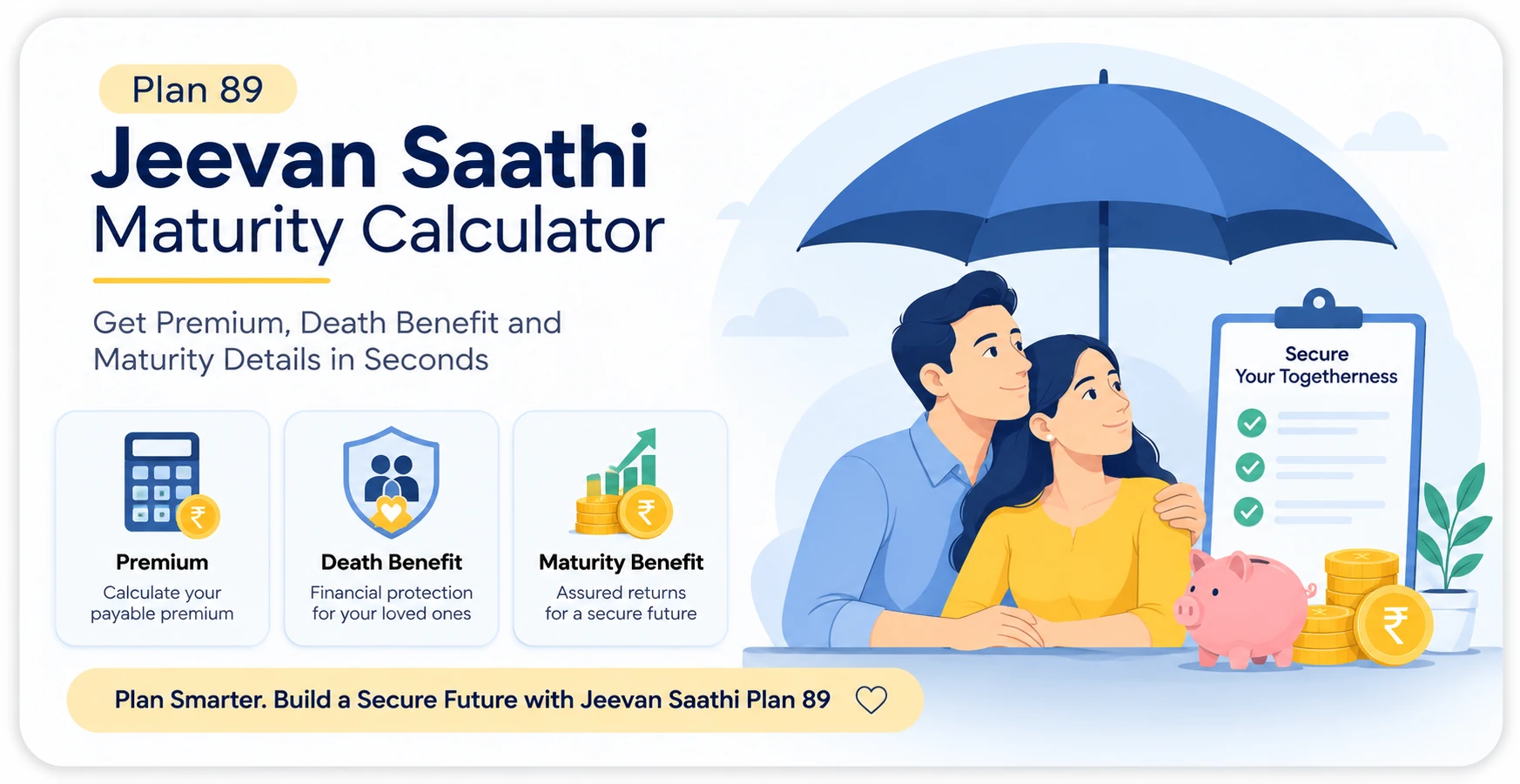
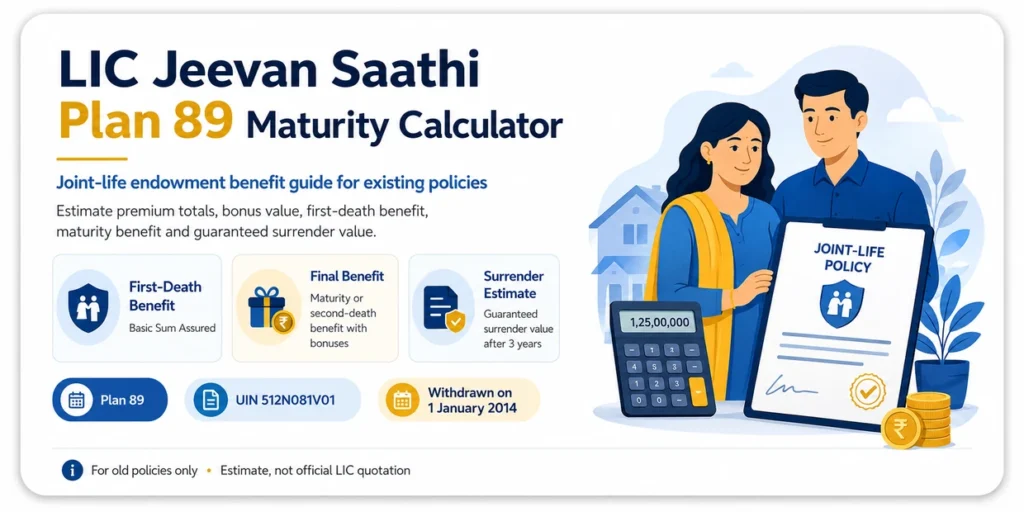
LIC Jeevan Saathi Plan 89 was a joint-life endowment policy for married couples. It covered the husband and wife under one policy. The plan provided life cover for both spouses, a maturity benefit and a share in LIC’s profits through bonuses.
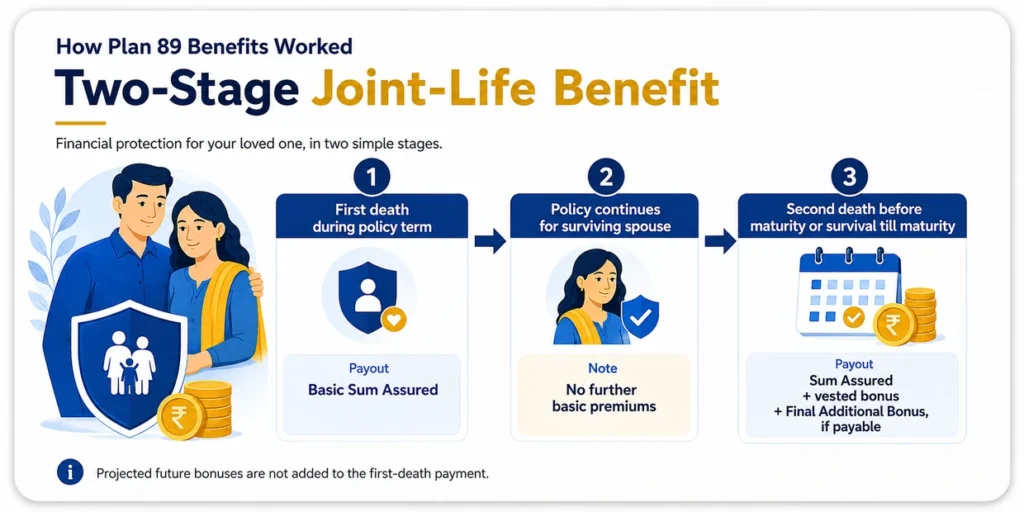
The plan had a special two-stage benefit. If either spouse died during the policy term, LIC paid the Basic Sum Assured. The policy then continued for the surviving spouse without further basic premiums. If the surviving spouse also died before maturity, LIC paid the Sum Assured again with applicable bonuses. If one or both spouses survived until maturity, the same final benefit was paid at maturity.
LIC Jeevan Saathi Plan 89 has UIN 512N081V01. LIC withdrew it on 1 January 2014, so it is not available for a new purchase. Old policies can continue according to their original terms.
The LIC Jeevan Saathi Plan 89 Maturity Calculator helps existing policyholders and nominees understand premiums paid, bonus value, first-death benefit, second-death benefit, maturity benefit and guaranteed surrender value.
What Is the LIC Jeevan Saathi Plan 89 Maturity Calculator?
The calculator is made for old Plan 89 policies. It uses the policy details entered from the original bond to explain the benefits.
The calculator should ask for:
- Basic Sum Assured
- Annual basic premium from the policy schedule
- Policy term
- Number of premiums paid
- Vested or assumed bonus rate
- Final Additional Bonus, only when known
It should not calculate the original premium from the ages of both spouses unless LIC’s complete historical premium table and equivalent-age method are included. The safest method is to enter the annual basic premium printed on the policy schedule.
Also Check:
- New Jeevan Sathi Plan 197 Calculator
- New Jeevan Sathi Plan 888 Calculator
- Jeevan Saathi Plan 889 Maturity Calculator
- LIC Jeevan Sathi Calculator
LIC Jeevan Saathi Plan 89 Overview
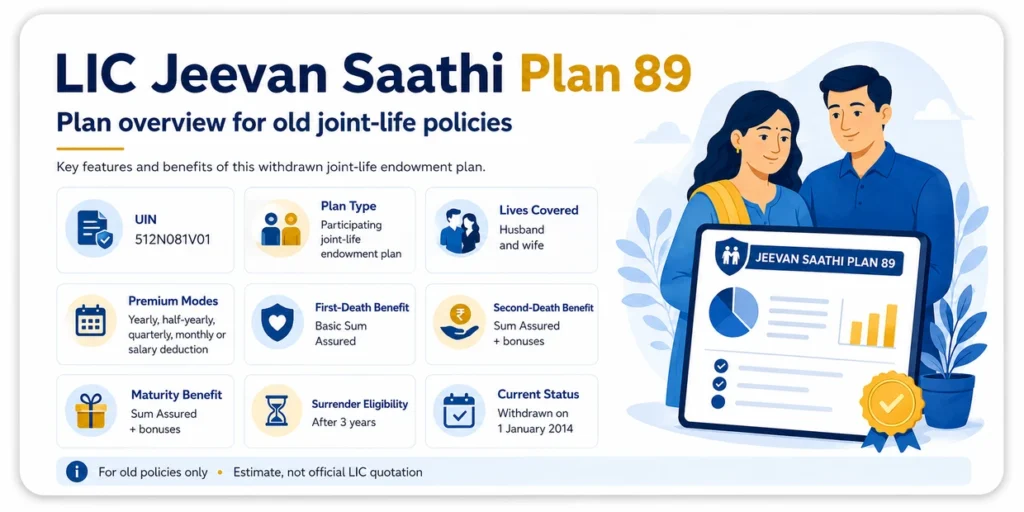
| Feature | Plan Details |
|---|---|
| Official plan name | LIC Jeevan Saathi |
| Plan or table number | 89 |
| UIN | 512N081V01 |
| Plan type | Participating joint-life endowment plan |
| Lives covered | Husband and wife |
| Premium modes | Yearly, half-yearly, quarterly, monthly or salary deduction |
| First-death benefit | Basic Sum Assured |
| Second-death benefit | Sum Assured plus applicable bonuses |
| Maturity benefit | Sum Assured plus applicable bonuses |
| Surrender eligibility | After the policy remained in force for at least three years |
| Current status | Withdrawn on 1 January 2014 |
LIC’s brochure describes Plan 89 as an endowment assurance plan issued on the lives of a husband and wife. It provided protection against the death of both lives and paid a maturity benefit if one or both spouses survived until the end of the term.
Highlights of the Calculator
- Uses the annual premium entered from the policy schedule.
- Shows total basic premiums paid.
- Keeps first-death benefit separate from the final benefit.
- Estimates Simple Reversionary Bonus.
- Allows vested bonus to be entered directly.
- Shows Final Additional Bonus separately.
- Estimates maturity and second-death benefits.
- Checks whether surrender-value eligibility has been completed.
- Calculates the guaranteed surrender value from eligible basic premiums.
- Clearly marks future bonus as non-guaranteed.
How LIC Jeevan Saathi Plan 89 Worked
First-death benefit
If either insured spouse died during the policy term, LIC paid the Basic Sum Assured in a lump sum.
First-Death Benefit = Basic Sum AssuredFor a Basic Sum Assured of ₹2,00,000, the first-death benefit would be ₹2,00,000.
Projected future bonuses should not be added to this payment. The first-death benefit and the later final benefit are separate.
Premiums after the first death
Premiums were payable during the policy term or until the first death, whichever happened earlier. After the first death:
- Further basic premiums stopped.
- The policy continued for the surviving spouse.
- The final benefit remained payable at the second death or maturity.
This continuation was an inbuilt part of the plan. It should not be shown as a separate optional rider.
Second-death benefit
If the surviving spouse also died during the remaining policy term, LIC paid another Sum Assured with the bonuses attached to the policy.
Second-Death Benefit =
Basic Sum Assured
+ Vested Simple Reversionary Bonus
+ Final Additional Bonus, if payable
The second-death benefit applied only when the surviving spouse died before the maturity date.
Maturity benefit
If one or both insured spouses survived until the end of the term, LIC paid the maturity benefit in a lump sum.
Maturity Benefit =
Basic Sum Assured
+ Vested Simple Reversionary Bonus
+ Final Additional Bonus, if payable
The Basic Sum Assured was fixed. Future bonuses were not guaranteed until LIC declared them.
Bonus Calculation Under Plan 89
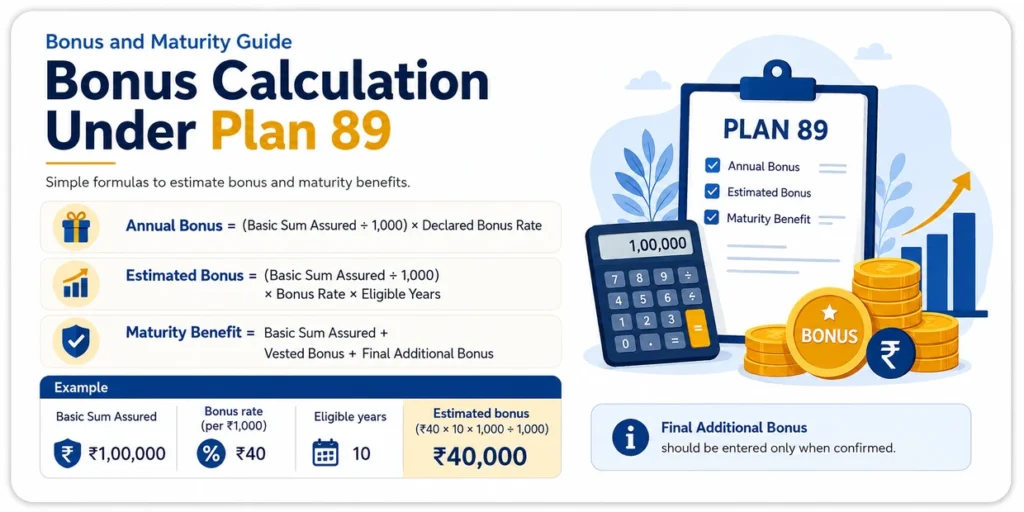
Plan 89 was a with-profit policy. It could receive a share in LIC’s profits through bonuses.
LIC declared Simple Reversionary Bonus for every ₹1,000 of Sum Assured. Once LIC declared and attached a bonus to the policy, that bonus became vested.
Annual Bonus =
(Basic Sum Assured ÷ 1,000) × Declared Bonus Rate
Estimated Bonus for Completed Years =
(Basic Sum Assured ÷ 1,000)
× Bonus Rate
× Number of Eligible YearsFor example, suppose:
- Basic Sum Assured: ₹1,00,000
- Bonus rate: ₹40 per ₹1,000
- Eligible years: 10
Annual Bonus =
₹1,00,000 ÷ 1,000 × ₹40
= ₹4,000
Estimated Bonus for 10 Years =
₹4,000 × 10
= ₹40,000This is only an example. Actual vested bonus should be taken from LIC’s policy records.
Final Additional Bonus
LIC’s brochure states that a Final Additional Bonus may be payable after the policy has run for a required minimum period. The brochure does not provide one fixed rate or formula.
The calculator should therefore keep this amount blank by default. Enter it only when it is confirmed in the policy record or an LIC quotation.
Formula Used in the Calculator
Total basic premiums paid
Total Basic Premiums Paid =
Annual Basic Premium × Number of Premiums Paid
Taxes, rider premiums and extra underwriting premiums should not be included in this basic-premium calculation.
Estimated final benefit
Estimated Final Benefit =
Basic Sum Assured
+ Vested or Estimated Bonus
+ Entered Final Additional Bonus
The same final-benefit structure applies at maturity or second death during the policy term.
Guaranteed surrender value
Eligible Basic Premiums =
Total Basic Premiums Paid − First-Year Basic Premium
Guaranteed Surrender Value =
Eligible Basic Premiums × 30%The policy had to remain in force for at least three years before this guaranteed surrender value became available.
How to Use the Calculator
- Check that the policy bond shows Plan or Table No. 89 and UIN 512N081V01.
- Enter the Basic Sum Assured from the policy bond.
- Enter the annual basic premium from the policy schedule.
- Select the original policy term.
- Enter the number of basic premiums actually paid.
- Enter the vested bonus amount when it is available.
- If only a bonus rate is available, enter the rate and eligible years.
- Enter Final Additional Bonus only when confirmed.
- Press Calculate to view the results.
- Use Reset before checking another policy.
Official LIC Calculation Example
LIC’s brochure provides a historical illustration using these details:
| Illustration Detail | Value |
| Equivalent age | 35 years |
| Policy term | 25 years |
| Premium mode | Yearly |
| Basic Sum Assured | ₹1,00,000 |
| Displayed annual premium | ₹5,261 |
| LIC cumulative premium at year 25 | ₹1,31,528 |
The brochure shows the following final values at the end of year 25:
| Benefit Component | Scenario 1 | Scenario 2 |
| Basic Sum Assured | ₹1,00,000 | ₹1,00,000 |
| Variable, non-guaranteed benefit | ₹69,500 | ₹1,89,500 |
| Total illustrated benefit | ₹1,69,500 | ₹2,89,500 |
LIC used assumed investment returns of 6% and 10% to prepare these two non-guaranteed scenarios. These are not annual bonus rates, current LIC returns or promised maturity amounts.
The displayed annual premium is rounded. Therefore:
₹5,261 × 25 = ₹1,31,525This is ₹3 lower than LIC’s illustrated cumulative premium of ₹1,31,528. Use ₹1,31,528 when referring to the official illustration, but use the exact premium printed on an actual policy schedule for a personal calculation.
First-death example
Suppose the first death happens during the eighth policy year in the official example.
First-Death Benefit = ₹1,00,000Further basic premiums stop, and the policy continues for the surviving spouse. Another benefit remains payable at second death during the remaining term or at maturity.
Maturity example
If one or both spouses survive until the end of the 25-year term:
Maturity Benefit =
₹1,00,000 + Actual Vested Bonuses
+ Final Additional Bonus, if payable
The actual amount depends on the bonuses LIC declared and attached to the policy. The brochure’s ₹1,69,500 and ₹2,89,500 figures are only historical illustration scenarios.
Surrender Value and Example
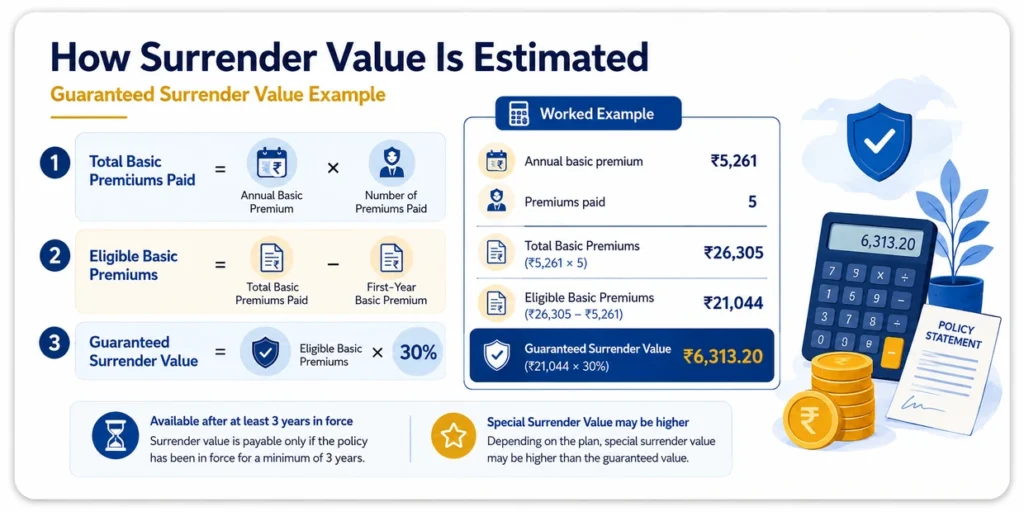
The policy could be surrendered after it remained in force for at least three years.
The guaranteed surrender value was 30% of eligible basic premiums paid, excluding the first-year basic premium.
Suppose:
- Annual basic premium: ₹5,261
- Premiums paid: 5
Total Basic Premiums = ₹5,261 × 5
                     = ₹26,305

Eligible Basic Premiums = ₹26,305 − ₹5,261
                        = ₹21,044

Guaranteed Surrender Value = ₹21,044 × 30%
                           = ₹6,313.20
This is only the guaranteed minimum based on the brochure formula. LIC may provide a Special Surrender Value that is equal to or higher than the guaranteed value. It depends on policy duration, premium history, bonuses and LIC’s applicable factors.
Early surrender may return less than the total premiums paid. Obtain an official surrender quotation from LIC before surrendering the policy.
Calculator Limitations
The calculator should not be treated as an original premium calculator because LIC’s complete equivalent-age method and old premium tables are not provided in the brochure. Enter the basic premium from the policy schedule.
Future bonuses cannot be predicted. A bonus estimate is useful for planning, but the actual maturity or second-death value depends on vested bonuses.
The calculator can apply the brochure’s guaranteed surrender formula. It cannot confirm the current Special Surrender Value without LIC’s applicable factors.
Policy status also matters. A lapsed, paid-up, surrendered or altered policy may not produce the same result as an active policy with all premiums paid.
Tax Rule
Tax treatment depends on the policy issue date, premiums, benefit type and tax rules applicable in the relevant financial year. Taxes and rider premiums should not be included in the basic-premium amount used for the guaranteed surrender formula.
Because tax laws can change, tax eligibility should be checked under the current rules or with a qualified tax professional.
Frequently Asked Questions
Is LIC Jeevan Saathi Plan 89 still available?
No. LIC withdrew Plan 89 on 1 January 2014. It is not available for a new purchase, but existing policies continue according to their original terms.
What is paid after the first death?
LIC pays the Basic Sum Assured after the first death during the policy term. Future projected bonuses are not added to this first payment.
Does the policy continue after the first death?
Yes. The policy continues for the surviving spouse without further basic premium payments. The final benefit remains payable at second death during the remaining term or at maturity.
How is the maturity benefit calculated?
The maturity benefit is the Basic Sum Assured plus vested Simple Reversionary Bonus and Final Additional Bonus, if payable. Future bonus is not guaranteed.
How is the guaranteed surrender value calculated?
After the required three-year period, the guaranteed surrender value is 30% of basic premiums paid excluding the first-year basic premium. Taxes, riders and extra premiums are not included.
Conclusion
LIC Jeevan Saathi Plan 89 provided joint-life cover for a husband and wife under one policy. Its main feature was the two-stage benefit. The Basic Sum Assured was paid after the first death, while the policy continued for the surviving spouse. At second death during the term or at maturity, another Sum Assured with applicable bonuses became payable.
The maturity calculator can make an old policy easier to understand. It can calculate total basic premiums, bonus estimates, final benefits and guaranteed surrender value. For the most reliable result, use details from the original policy bond and confirm vested bonus, surrender value and claim amounts with LIC.