
LIC Child Fortune Plus Plan 194 Calculator
Optional Details
| Fund & Charge Summary | |
|---|---|
| Selected UIN | — |
| Selected Fund / SFIN | — |
| Fund Management Charge | — |
| Current Units × NAV | — |
| Current Policy Administration Charge | — |
| Estimated Current Annual Risk Charge | — |
| Switch Charge This Year | — |
Benefit Details
| Benefit Estimate | |
|---|---|
| Immediate Death Payment | — |
| Future Premium Waiver / Outstanding Premium Amount | — |
| Death Scenario Note | — |
| Surrender Amount | — |
| Surrender Timing | — |
| Estimated Maximum Partial Withdrawal | — |
| Partial Withdrawal Rule | — |
Projection Details
| Projection Assumptions | |
|---|---|
| Gross Return Assumption | — |
| FMC Applied | — |
| Approx. Net Return Before Other Policy Charges | — |
| Total Future Premium Added | — |
| Total Allocation Charges | — |
| Total Future Admin Charges | — |
| Total Future Risk Charges | — |
| Total Future Top-ups | — |
| Planned Withdrawal | — |
| Year-wise Estimated Fund Projection | |
|---|---|
| Policy Year | Estimated Closing Fund Value |
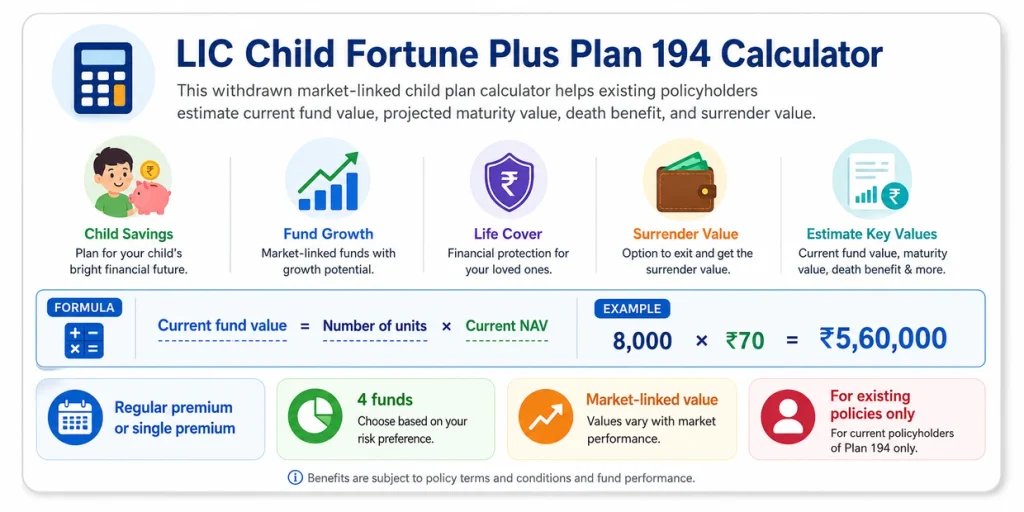
LIC Child Fortune Plus Plan 194 was a market-linked insurance plan made to build a fund for a child’s future. The premium was invested in units, so the policy value moved up or down with the NAV of the selected fund.
The plan has been withdrawn and cannot be purchased now. However, some old policies may still be active. The LIC Child Fortune Plus Plan 194 Calculator helps existing policyholders estimate the current fund value, maturity amount, death benefit and surrender value from the figures shown in the policy statement.
The calculator can also show how premiums and policy charges may affect the fund in the coming years.
What Does the Child Fortune Plus Calculator Show?
The calculator first finds the present value of the policy by multiplying the available units by the current NAV. It can then use the premium, remaining policy term, selected fund and an assumed return to prepare a future estimate.
It can show the current fund value, projected maturity value, premium amount invested after allocation charges, estimated policy charges, surrender value and benefits payable in different death situations. Separate calculations are used for regular-premium and single-premium policies.
The result is helpful for understanding the policy, but it is not an official LIC statement. The unit balance and NAV accepted by LIC will decide the actual payment.
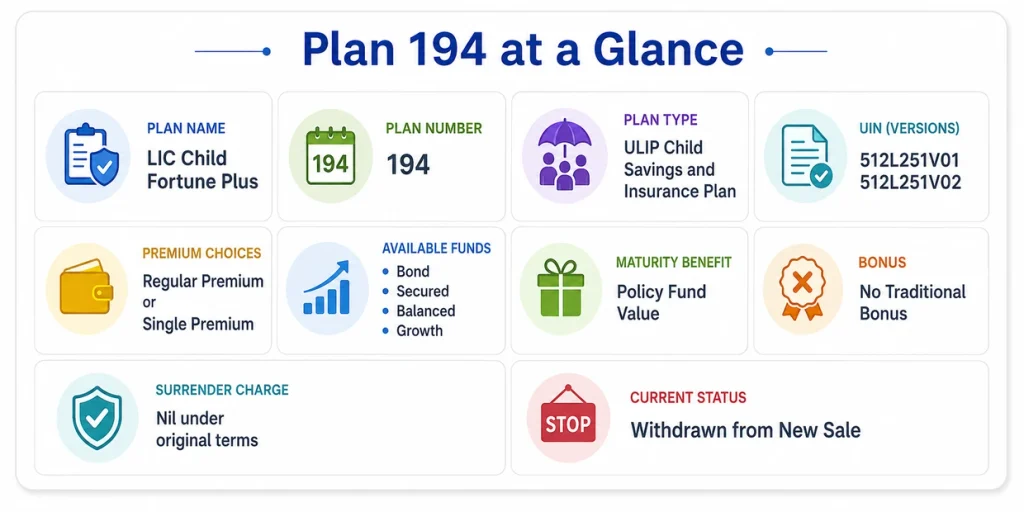
LIC Child Fortune Plus Plan 194 Quick Details
| Policy detail | Information |
|---|---|
| Plan name | LIC Child Fortune Plus |
| Plan number | 194 |
| Plan type | Unit-linked child savings and insurance plan |
| UIN versions | 512L251V01 and 512L251V02 |
| Premium choices | Regular premium or single premium |
| Available funds | Bond, Secured, Balanced and Growth |
| Maturity benefit | Policy fund value on the maturity date |
| Bonus | No traditional LIC bonus |
| Surrender charge | Nil under the original policy conditions |
| Current status | Withdrawn from new sale |
What Was LIC Child Fortune Plus Plan 194?
LIC Child Fortune Plus Plan 194 was a ULIP. In simple words, part of the premium was used to buy units in the selected investment fund after applicable charges were deducted. The value of those units changed with the fund’s NAV.
Unlike a traditional LIC plan, this policy did not calculate maturity using the Basic Sum Assured and bonus. The amount available at maturity was the value of all units remaining in the policy on that date.
The policy also provided life cover on the adult named as the Life Assured. Under a regular-premium policy, it included a premium-waiver benefit. This helped the policy continue for the child after the Life Assured’s death, subject to the policy being active and other conditions being met.
Also Check: LIC Endowment Plan Calculator
Key Highlights of LIC Child Fortune Plus Plan 194
- It combined a market-linked investment with life insurance.
- It allowed regular-premium and single-premium payment choices.
- Four funds were available with different levels of investment risk.
- The fund could be changed during the policy term under the switching rules.
- A regular-premium policy included a premium-waiver benefit.
- Partial withdrawal was available after the third policy anniversary, subject to the required balance.
- The maturity amount depended on the policy fund value and was not guaranteed.
- Both V01 and V02 must be supported because their Fund Management Charges were different.
Who Covered Under This Policy?
The child’s name in the plan can create confusion. The child was normally the nominee, while the parent or another eligible adult was the Life Assured. Life cover applied to that adult.
This difference matters when checking a death claim. If the Life Assured died while the child was alive, the Sum Assured was paid and the policy could continue for the child. The result was different if the child had already died or if the policy had stopped because premiums were not paid.
The names of the Life Assured, child nominee and appointee should be checked in the policy schedule before using the death-benefit calculator.
Main Features of the Calculator
The calculator supports both UIN versions and all four investment funds. Current value can be checked directly by entering the units and NAV from the latest statement. A future projection can be prepared by adding the remaining years, premiums, assumed return and applicable charges.
Policy status is also important. The calculator should provide separate choices for an active policy, a regular-premium policy stopped before three full years and a policy where at least three full years’ premiums were paid. These situations can produce different surrender and death benefits.
The calculation should keep the current value separate from the projected value. The current value comes from the unit balance and NAV. A future value is only an illustration based on assumptions.
How to Use LIC Child Fortune Plus Plan 194 Calculator?
First, select UIN 512L251V01 or 512L251V02 as written in the policy schedule. Next, choose the fund: Bond, Secured, Balanced or Growth.
Select regular premium or single premium and enter the original premium, Sum Assured, policy term and current policy year. For the most reliable current value, copy the number of units from the latest statement and enter the NAV for the same fund.
For a maturity projection, enter the years left until maturity and an assumed return before the Fund Management Charge. Include future premiums only when they are still payable. Any past or planned top-up and partial withdrawal must also be entered correctly.
Select the present policy status and enter whether the child is alive when checking a death benefit. After all details have been entered, press Calculate. The result should show the formulas and explain which amounts are fixed and which are only estimates.
Formulas Used in the Calculator
Current Fund Value
The most useful formula for an existing policy is:
Current fund value = Number of units × Current NAV
If the policy statement shows 8,000 units and the NAV is ₹70:
8,000 × ₹70 = ₹5,60,000
The estimated current fund value is ₹5,60,000. The NAV must belong to the same fund in which the units are held.
Premium Allocation Charge
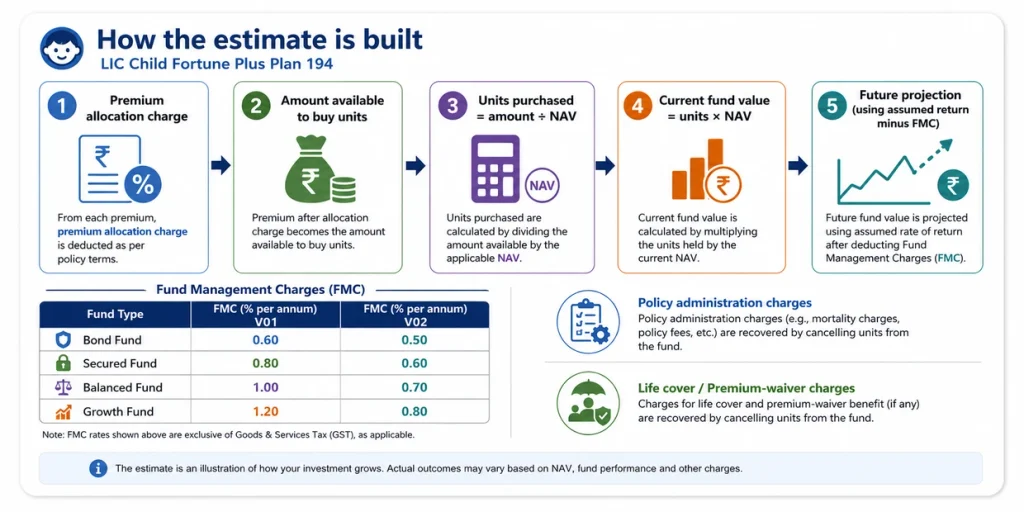
A part of each premium was taken as a Premium Allocation Charge. The remaining amount was used to buy units.
Allocation charge = Premium × Applicable charge rate
Amount available to buy units = Premium − Allocation charge
For a regular annual premium between ₹10,000 and ₹1,00,000, the original charge table showed 29% in the first year, 5% in the second and third years, and 2.50% from the fourth year onward.
| Annual regular premium | First year | Second and third years | Later years |
| ₹10,000 to ₹1,00,000 | 29.00% | 5.00% | 2.50% |
| ₹1,00,001 to ₹1,50,000 | 28.50% | 5.00% | 2.50% |
| ₹1,50,001 to ₹2,00,000 | 28.00% | 5.00% | 2.50% |
| Above ₹2,00,000 | 27.50% | 5.00% | 2.50% |
For a single premium, the charge was 4.25% up to ₹10 lakh and 4% above ₹10 lakh. The charge on a top-up was 1.25%.
Units Purchased
After the allocation charge was deducted, the remaining premium bought units at the applicable NAV.
Units purchased = Amount available for investment ÷ Applicable NAV
If ₹35,500 was available and the NAV was ₹10:
₹35,500 ÷ ₹10 = 3,550 units
Fund Management Charge
The Fund Management Charge, or FMC, was taken while calculating the NAV. V01 and V02 used different rates.
| Fund | V01 annual FMC | V02 annual FMC |
| Bond Fund | 0.60% | 0.50% |
| Secured Fund | 0.80% | 0.60% |
| Balanced Fund | 1.00% | 0.70% |
| Growth Fund | 1.20% | 0.80% |
The current NAV already reflects FMC charged up to that date. It must not be deducted again while finding the current fund value.
For a future illustration, the calculator can reduce FMC from an assumed return before FMC:
Estimated return after FMC = Assumed return before FMC − FMC
This is only a simple projection method. Actual NAV movement will be different.
Policy Administration Charge
The original policy charge was ₹60 per month in the first policy year and ₹20 per month in the second year. From the third year onward, the monthly amount increased by 3% each year.
These charges were taken by cancelling units. Therefore, the exact number of units removed depended on the NAV on each charge date.
Life Cover and Premium-Waiver Charges
The cost of life cover and, for regular-premium policies, the premium-waiver cover was also taken monthly by cancelling units.
The broad annual calculation was:
Annual risk charge = Sum at Risk ÷ 1,000 × Age-based rate
Approximate monthly charge = Annual risk charge ÷ 12
The Sum at Risk broadly included the Sum Assured and the remaining regular premiums that LIC might have to waive. The applicable rate changed with age and could also be affected by health, occupation or other policy conditions. The exact rate from the policy record should be used.
Maturity Benefit
If the policy continued until maturity and the Life Assured or child was alive as required under the policy, the remaining policy fund value became payable.
Maturity benefit = Units available on the maturity date × NAV on the maturity date
There was no guaranteed maturity amount and no traditional LIC bonus. A LIC Child Fortune Plus maturity calculator can show a possible future value, but the final payment cannot be known until the maturity-date NAV and final unit balance are available.
Death Benefits in Different Situations
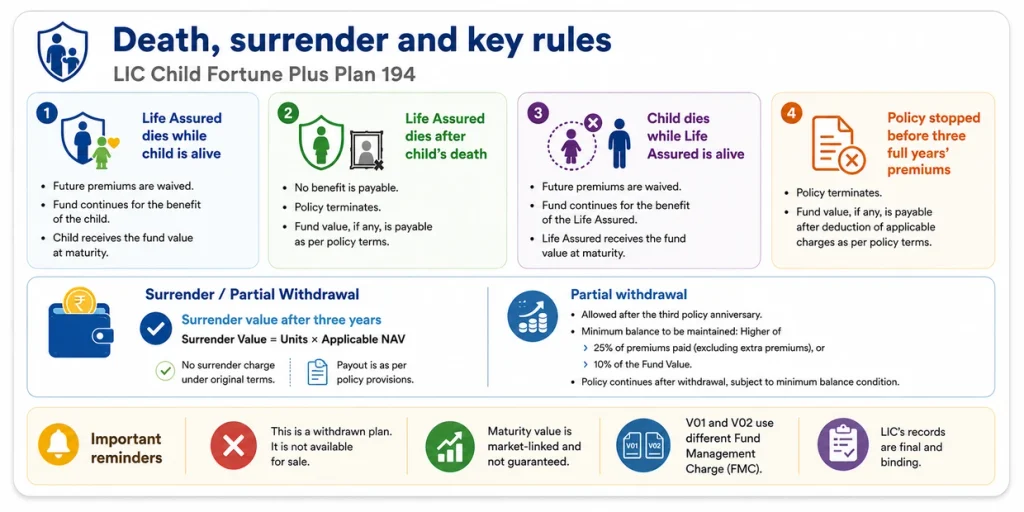
The death benefit cannot be shown as one common amount. It depends on who died first and whether the policy cover was active.
Life Assured Dies While the Child Is Alive
If the policy cover was active, the Sum Assured was paid to the child nominee or appointee. For a regular-premium policy, future premiums, including any outstanding premium covered under the terms, were waived. Units equal to those future premiums were added to the policy fund, and the policy continued for the child.
Life Assured Dies After the Child’s Death
If the child had already died and the cover was active, the Sum Assured, current policy fund value and an amount equal to the remaining regular premiums became payable. The policy then ended.
Child Dies While the Life Assured Is Alive
The policy continued until maturity or the earlier death of the Life Assured. The nominee details could be updated according to LIC’s process.
Child Dies After the Life Assured’s Death
The available policy fund value became payable to the legal heir of the Life Assured, and the policy ended.
Policy Stopped Before Three Full Years’ Premiums
If a regular-premium policy stopped before three full years’ premiums were paid, life cover and premium-waiver cover ended. If the Life Assured died during this period, only the applicable policy fund value was payable.
Surrender Value and Partial Withdrawal
The policy could be surrendered, and there was no surrender charge under the original terms. However, the surrender amount was payable only after the third policy anniversary.
After three years:
Surrender value = Units available on the surrender date × Applicable NAV
If surrender was requested before three years were completed, the units were converted into money using the applicable NAV. Further charges stopped, but the money was normally released only after completion of three policy years.
Partial withdrawal was allowed after the third policy anniversary. In a regular-premium policy, at least two annual premiums had to remain in the fund after withdrawal. In a single-premium policy, the remaining balance had to be at least ₹5,000 or 10% of the single premium, whichever was higher.
What Happens If Premiums Are Stopped?
The result depends on how many full years’ premiums were paid. If at least three full years’ premiums had been paid, life cover and premium-waiver cover could continue during the allowed revival period while applicable charges were taken from the fund.
If fewer than three full years’ premiums had been paid, these risk covers stopped. Other applicable charges could continue, and the available amount was handled according to the policy’s discontinuance and surrender rules.
Because old policy records can include missed premiums, revival, switches and withdrawals, LIC’s recorded status should be checked before relying on a calculator result.
Tax Benefits and Tax Rules
Premiums paid under the policy may have qualified for a deduction under Section 80C in the year of payment, subject to the conditions and overall limit that applied at that time.
Tax on maturity, surrender or death payments depends on the policy issue date, premium, Sum Assured and tax law applicable to the payment. Every maturity or surrender amount should not be described as automatically tax-free. For a large payment or an unclear case, confirmation from a tax professional is safer.
Calculation Example
Consider an active regular-premium policy with the following assumed details:
| Detail | Value |
| UIN | 512L251V02 |
| Selected fund | Growth Fund |
| Annual premium | ₹50,000 |
| Current units | 8,000 |
| Current NAV | ₹70 |
| Years left | 5 years |
| Assumed return before FMC | 8.00% a year |
| V02 Growth Fund FMC | 0.80% a year |
The present fund value is:
8,000 × ₹70 = ₹5,60,000
As the policy is beyond the third year, the assumed allocation charge on each future annual premium is 2.50%:
₹50,000 × 2.50% = ₹1,250
Amount available before other charges = ₹50,000 − ₹1,250 = ₹48,750
The simplified return after FMC is:
8.00% − 0.80% = 7.20% a year
If ₹48,750 is added at the beginning of each of the next five policy years, the estimated value before future administration and risk charges is approximately ₹10,94,532.
This is not the final maturity estimate. The calculator must still reduce monthly administration charges, life-cover charges, premium-waiver charges, applicable taxes on charges and any withdrawal. Actual NAV performance can also raise or lower the result. This example shows why a simple calculation of ₹5,60,000 × 1.08⁵ would be incomplete.
Important Points to Remember
- Plan 194 is withdrawn and is not available for a new purchase.
- Current fund value should be checked using units and NAV from the same fund.
- The latest policy statement is more useful than an old premium receipt.
- V01 and V02 have different Fund Management Charges.
- Maturity value is market-linked and is not guaranteed.
- The death benefit changes according to policy status and whether the child is alive.
- Past switches, top-ups and withdrawals can change the present unit balance.
- LIC records remain final for maturity, surrender and claim payments.
Frequently Asked Questions
Is LIC Child Fortune Plus Plan 194 still available?
No. The plan has been withdrawn from new sale. The calculator is mainly useful for understanding an existing policy.
How is the current fund value calculated?
Multiply the number of available units by the current NAV of the same fund. The actual value can change whenever the NAV changes.
What amount is paid at maturity?
The policy fund value available on the maturity date is paid. It depends on the remaining units and the maturity-date NAV, so it is not guaranteed in advance.
What happens if the Life Assured dies?
When the policy is active and the child is alive, the Sum Assured is paid. In a regular-premium policy, future premiums are also waived and added to the fund as units so that the policy can continue for the child.
Can the policy be surrendered or partially withdrawn?
Yes. Surrender and partial withdrawal were allowed under the policy conditions. Payment of surrender value and partial withdrawal generally became available after the third policy anniversary, subject to the required fund balance.
Conclusion
The LIC Child Fortune Plus Plan 194 Calculator helps explain an old market-linked policy through its units, NAV, premiums and charges. It can provide a useful current fund value and show how the amount may change before maturity.
The most important details are the correct UIN, current unit balance, selected fund, policy status and latest NAV. Future maturity values should always be treated as estimates. The final amount paid on maturity, surrender or death will depend on LIC’s policy records and the NAV applicable to the transaction.

Amit Kushwaha is a financial content creator and SaaS tool developer based in Lucknow, Uttar Pradesh. He has more than seven years of experience creating insurance-related content, online calculators, and practical digital tools for LIC policyholders, insurance buyers, and LIC agents.
Through LICPolicyCalculator.com, he focuses on simplifying complex LIC policy information into easy-to-understand guides and calculators. His work covers LIC premium estimates, maturity calculations, surrender value tools, policy return calculations, term insurance planning, and plan-specific calculator pages.