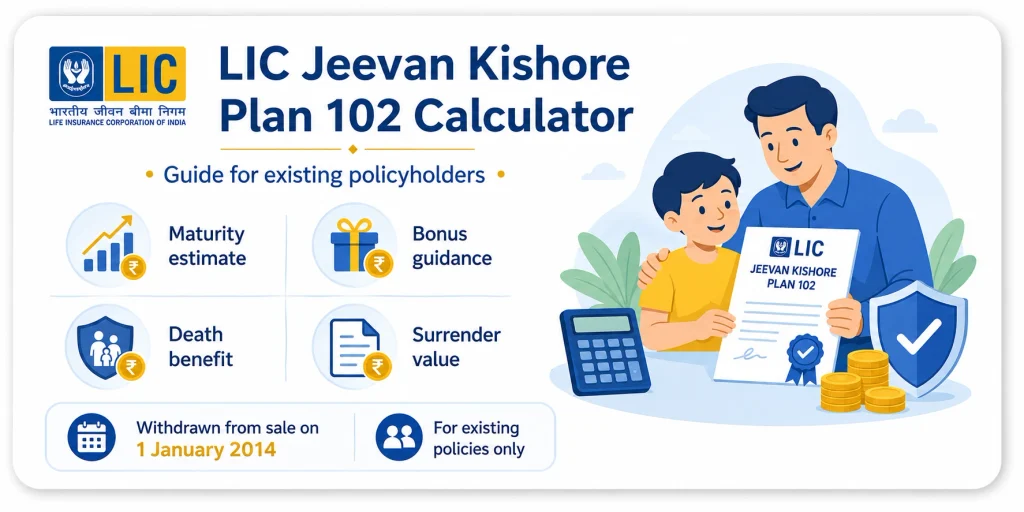
LIC Jeevan Kishore Plan 102 was a traditional child endowment policy designed to provide a lump-sum amount for a child’s future. It combined savings, life cover on the child, and participation in LIC’s declared profits through bonuses.
The plan is no longer available for new purchase. LIC records show that Plan 102, UIN 512N094V01, was withdrawn on 1 January 2014. This guide and calculator are therefore intended for existing policyholders who want to understand the maturity amount, bonus, death benefit, premiums paid or surrender value.
Also Check:
- LIC Insurance Plan Calculators
- LIC Jeevan Shagun Plan 826 Calculator
- LIC Jeevan Shikhar Plan 837 Calculator
What is LIC Jeevan Kishore Plan 102 Calculator?
The calculator uses the details entered from the policy bond to estimate the maturity date, risk commencement date, scheduled basic premiums, bonus and maturity amount. It can also explain the death benefit and calculate an illustrative Guaranteed Surrender Value.
The result is not an official LIC quotation. The final amount depends on the original policy conditions, premium history, policy status, vested bonuses and LIC’s records.
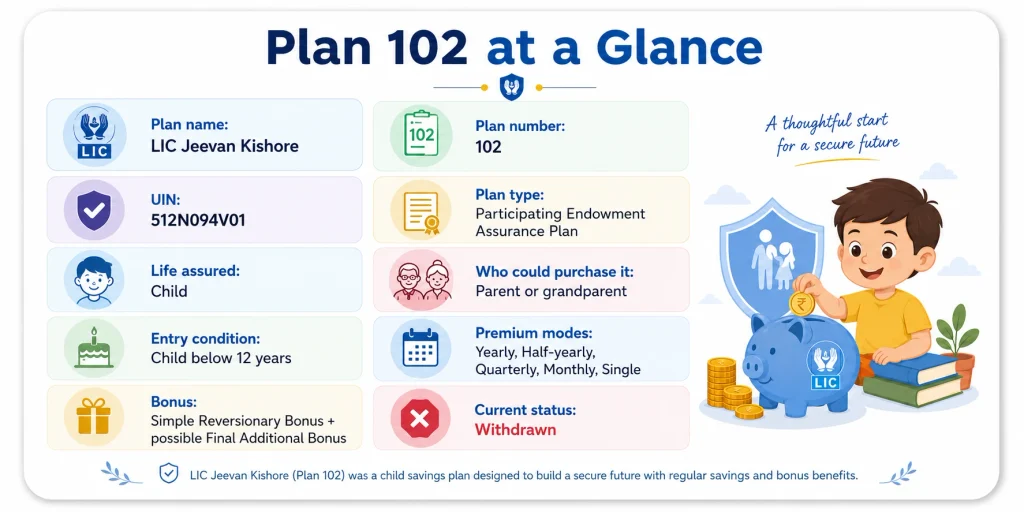
Quick Overview of LIC Jeevan Kishore Plan 102
| Particular | Details |
|---|---|
| Plan name | LIC Jeevan Kishore |
| Plan number | 102 |
| UIN | 512N094V01 |
| Plan type | Participating Endowment Assurance Plan |
| Life assured | Child |
| Who could purchase it | Parent or grandparent |
| Entry condition | Child below 12 years |
| Premium modes | Yearly, half-yearly, quarterly, monthly or single premium |
| Bonus participation | Simple Reversionary Bonus and possible Final Additional Bonus |
| Current status | Withdrawn from sale |
What is Jeevan Kishore Plan?
Jeevan Kishore was a with-profits endowment plan for a child below 12 years of age. A parent or grandparent could purchase the policy, while the child remained the life assured.
Premiums were paid throughout the selected policy term or until the earlier death of the child. A single-premium option was also available. If the child survived until the end of the term, LIC paid the Sum Assured plus applicable bonuses.
The plan was not market-linked. Its maturity value did not depend directly on stock-market prices. However, future bonuses were not guaranteed because LIC declared them according to its profit experience.
Key Highlights
- Life cover on the child’s life
- Lump-sum maturity benefit
- Entry for a child below 12 years
- Regular and single-premium options
- Participation in LIC’s declared profits
- Optional Premium Waiver Benefit
- Different death benefits before and after risk commencement
- Surrender facility after satisfying the required conditions
Entry Rules
In the LIC official brochure states that the child had to be less than 12 years old when the policy began. The proposer could be a parent or grandparent.
The original policy schedule should be used to check the exact policy term, Sum Assured, premium, and maturity date. These details should not be guessed from a general online chart because the official short brochure does not provide every available term or historical premium rate.
Premium Payment Options
| Premium option | Payments |
| Yearly | One payment in a policy year |
| Half-yearly | Two payments in a policy year |
| Quarterly | Four payments in a policy year |
| Monthly | Twelve payments in a policy year |
| Single premium | One lump-sum payment at the beginning |
For a regular-premium policy:
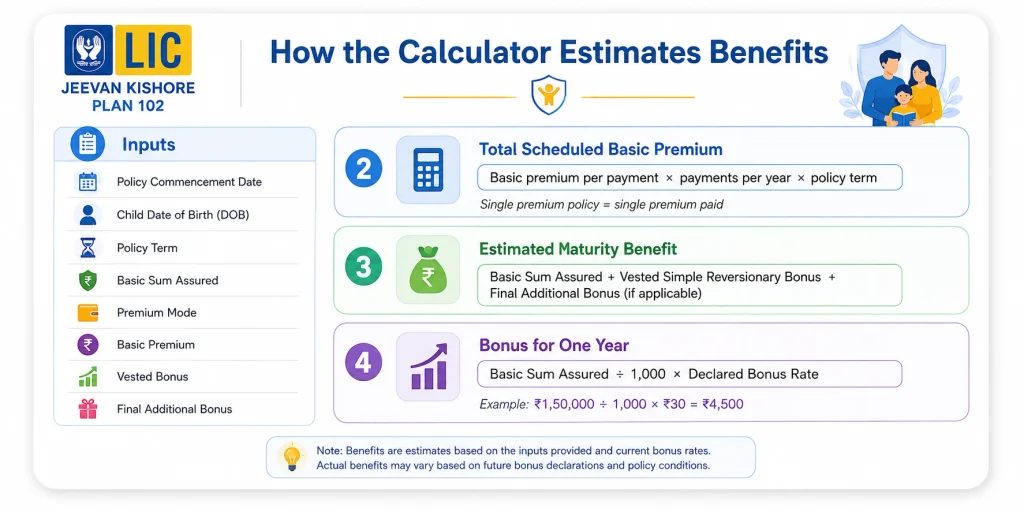
Total Scheduled Basic Premium
= Basic Premium Per Payment
× Payments Per Year
× Policy Term
For a single-premium policy:
Total Scheduled Basic Premium
= Single Premium Paid
Tax, late fees and Premium Waiver Benefit charges should remain separate from the basic premium used in the calculator.
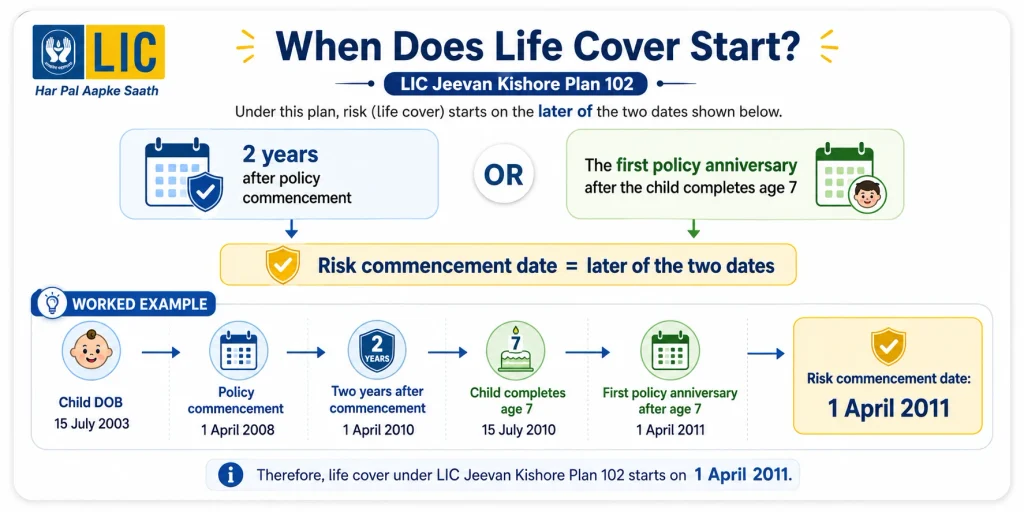
When Does Life Cover Start Jeevan Kishor Plan 102?
The child’s full risk cover did not always begin on the policy commencement date. It started on the later of:
- Two years after the policy commencement date; or
- The policy anniversary immediately following completion of age seven by the child.
Risk Commencement Date
= Later of:

Policy Commencement Date + 2 Years

OR

First Policy Anniversary After
the Child Completes Age 7
Correct Risk-Start Example
We use the following details in this calculation:
| Detail | Date |
| Child’s date of birth | 15 July 2003 |
| Policy commencement date | 1 April 2008 |
| Two years after commencement | 1 April 2010 |
| Child completes age seven | 15 July 2010 |
| First policy anniversary after age seven | 1 April 2011 |
The later relevant date is 1 April 2011. Therefore, the risk commencement date is 1 April 2011.
If the child had already completed age seven when the policy began, the two-year period after policy commencement would normally be the later condition.
Maturity Benefit
For an eligible in-force policy, the maturity benefit is:
Estimated Maturity Benefit
= Basic Sum Assured
+ Vested Simple Reversionary Bonus
+ Final Additional Bonus, if applicable
The Basic Sum Assured is the fixed starting amount printed in the policy schedule. Only bonuses already declared and attached by LIC are vested. A future or assumed bonus should not be presented as a confirmed part of the maturity amount.
The actual payment may also be affected by policy status and any amount recoverable by LIC.
Death Benefit
Before Risk Commencement
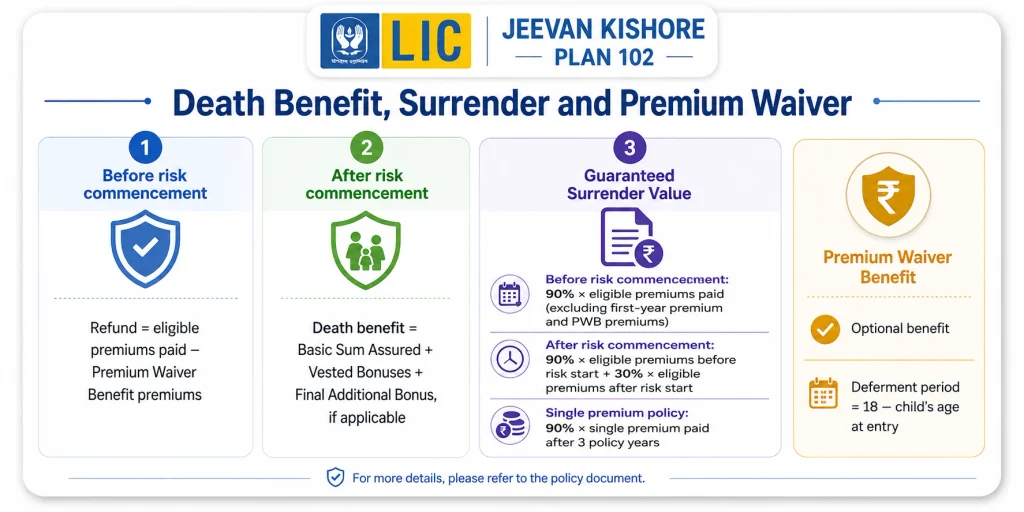
If the child dies before risk commencement, premiums paid are refunded after excluding Premium Waiver Benefit premiums, if any.
Refund Before Risk Commencement
= Eligible Premiums Paid
− Premium Waiver Benefit Premiums
For example:
Basic plan premiums paid: ₹18,000
Premium Waiver Benefit premiums: ₹1,200
Total amount paid: ₹19,200

Refund:
₹19,200 − ₹1,200 = ₹18,000
After Risk Commencement
After risk commencement, the benefit is:
Death Benefit
= Basic Sum Assured
+ Vested Bonuses
+ Final Additional Bonus, if applicable
The amount is payable as a lump sum, subject to the policy conditions and LIC’s claim decision.
How the Bonus Is Calculated
LIC generally declares Simple Reversionary Bonus as an amount for every ₹1,000 of Sum Assured.
Bonus for One Year
= Basic Sum Assured ÷ 1,000
× Declared Bonus Rate
If the Basic Sum Assured is ₹1,50,000 and the declared rate is ₹30 per ₹1,000:
₹1,50,000 ÷ 1,000 × ₹30
= ₹4,500
This is the bonus for one selected year. When rates differ, each year or rate period should be calculated separately and the results added.
An assumed average rate can provide only a projected bonus. It must not be called vested bonus. The total vested bonus shown in LIC records is more reliable.
Final Additional Bonus is different from the yearly bonus. It may apply only after the policy has completed the required duration and LIC has declared it for the relevant claim. It should not be added automatically.
Premium Waiver Benefit
Premium Waiver Benefit was optional and required an additional premium. If it was included and its conditions were satisfied, premiums falling due after the proposer’s death were waived until the end of the deferment period.
Deferment Period
= 18 − Child's Age at Entry| Child’s age at entry | Deferment period |
| 2 years | 16 years |
| 5 years | 13 years |
| 8 years | 10 years |
| 10 years | 8 years |
| 11 years | 7 years |
The policy schedule should be checked to confirm whether this benefit was included. The historical Premium Waiver Benefit charge should not be guessed.
Surrender Value
A regular-premium policy could be surrendered after it had remained in force for at least three years.
Before Risk Commencement
Guaranteed Surrender Value
= 90% × Eligible Premiums Paid
The first-year premium and Premium Waiver Benefit premiums are excluded.
After Risk Commencement
Guaranteed Surrender Value
= 90% × Eligible Premiums Paid Before Risk Start
+ 30% × Eligible Premiums Paid After Risk Start
The first-year premium and Premium Waiver Benefit premiums remain excluded.
Single-Premium Policy
Guaranteed Surrender Value became available after three policy years:
Guaranteed Surrender Value
= 90% × Single Premium Paid
Any extra premium is excluded from this single-premium formula.
LIC may calculate a Special Surrender Value that is equal to or higher than the Guaranteed Surrender Value. The calculator cannot reproduce that amount without LIC’s applicable factors.
How to Use LIC Jeevan Kishore Calculator?
- Enter the policy commencement date and the child’s date of birth.
- Enter the policy term and original Basic Sum Assured.
- Select the premium mode and enter the basic premium shown in the policy record.
- Enter the vested bonus or verified year-wise bonus rates, if available.
- Add a confirmed Final Additional Bonus only when it applies.
- For surrender calculations, enter the eligible premiums paid before and after risk commencement.
The calculator can then show the maturity date, age at entry, age at maturity, risk commencement date, total scheduled basic premiums, bonus estimate, maturity estimate and guaranteed surrender-value reference.
Complete Calculation Example
In this calculation, we use the LIC official brochure, which provides this historical example:
| Particular | Value |
| Child’s age at entry | 10 years |
| Policy term | 25 years |
| Age at maturity | 35 years |
| Premium mode | Yearly |
| Basic Sum Assured | ₹1,00,000 |
| Annual premium | ₹3,635 |
Total scheduled premium:
₹3,635 × 25
= ₹90,875
The brochure showed two non-guaranteed scenarios:
| Benefit | Case 1 | Case 2 |
| Guaranteed base | ₹1,00,000 | ₹1,00,000 |
| Projected variable benefit | ₹69,500 | ₹1,82,500 |
| Illustrated maturity amount | ₹1,69,500 | ₹2,82,500 |
Case 1:
₹1,00,000 + ₹69,500 = ₹1,69,500

Case 2:
₹1,00,000 + ₹1,82,500 = ₹2,82,500
The 6% and 10% assumptions used in the historical illustration were not guaranteed bonus rates. The projected variable amounts must not be treated as the actual vested bonus of another policy.
What If in Case Premiums Stopped?
If all required premiums were not paid, the full maturity and death-benefit formulas may not apply. The policy may have lapsed or acquired reduced paid-up benefits, depending on the payment history and policy conditions.
Do not use the full Basic Sum Assured as the confirmed maturity amount of a paid-up policy. The reduced benefit, revival amount and surrender value should be checked with LIC.
Tax Benefits and Tax Rules
Tax treatment depends on the policy issue date, premium, Sum Assured, applicable law and chosen tax regime. A deduction or exemption should not be promised without checking these details.
Premium Waiver Benefit charges, tax and late fees should remain separate from the basic premium used in calculator formulas. Current tax rules should be checked before claiming any deduction or exemption.
Important Points to Remember
- Use the original policy bond for the term, premium and Sum Assured.
- Enter the complete date of birth to calculate risk commencement correctly.
- Use LIC’s vested bonus amount whenever available.
- Label an assumed bonus as projected, not vested.
- Keep Premium Waiver Benefit charges separate.
- Do not show full maturity benefits for a lapsed or paid-up policy.
Frequently Asked Questions
How is the maturity amount calculated?
For an eligible in-force policy, maturity is generally the Basic Sum Assured plus vested Simple Reversionary Bonus and Final Additional Bonus, if applicable.
Is bonus rate fixed in Plan 102?
No. Future bonus is not fixed or guaranteed. Once LIC declares and attaches a bonus to an eligible policy, that bonus becomes vested.
What happens if the child dies before risk commencement?
LIC refunds eligible premiums paid after excluding Premium Waiver Benefit premiums, if any.
When can Plan 102 be surrendered?
A regular-premium policy could be surrendered after it had remained in force for at least three years. Guaranteed Surrender Value for a single-premium policy became available after three policy years.
Conclusion
LIC Jeevan Kishore Plan 102 was a participating child endowment policy with a maturity benefit, bonus participation and life cover on the child. Its most important features are the delayed risk commencement, different death benefits before and after risk start, optional Premium Waiver Benefit and special surrender formulas.
LIC Jeevan Kishore Plan 102 calculator has organised the policy details and provides helpful estimates. The original policy bond and LIC’s records remain final for maturity, surrender, revival and claim payments.

Amit Kushwaha is a financial content creator and SaaS tool developer based in Lucknow, Uttar Pradesh. He has more than seven years of experience creating insurance-related content, online calculators, and practical digital tools for LIC policyholders, insurance buyers, and LIC agents.
Through LICPolicyCalculator.com, he focuses on simplifying complex LIC policy information into easy-to-understand guides and calculators. His work covers LIC premium estimates, maturity calculations, surrender value tools, policy return calculations, term insurance planning, and plan-specific calculator pages.