LIC Anmol Jeevan II Plan 822 Calculator
Premium & Benefit Calculator
UIN: 512N285V01📊 Your Premium Details
LIC Anmol Jeevan Plan 822, officially called LIC’s Anmol Jeevan-II, was a simple pure term insurance policy. Its main purpose was straightforward: if the Life Assured died during the active policy term, LIC would pay the selected Sum Assured to the eligible claimant. Unlike savings-oriented life insurance plans, it did not offer maturity money, bonuses, surrender value, paid-up value, or a loan facility.
This is why many people still search for the LIC Anmol Jeevan II Plan 822 Calculator. Existing policyholders may want to verify the yearly premium, understand half-yearly payment loading, check the remaining policy term, or confirm the death benefit payable under the original policy conditions.
The calculator placed below this section helps estimate the historical premium using age, Sum Assured, policy term, premium payment mode, and applicable tax rate. It should be used as an estimate only because LIC’s brochure provides sample premium rates, not the complete historical rate chart for every age and term combination.
Important update: LIC’s Anmol Jeevan-II Plan 822 is a withdrawn plan. LIC lists Plan No. 822 with UIN 512N285V01 under withdrawn plans, with a withdrawal date of 01 February 2020. This guide is meant for existing policyholders, families checking an old policy, and people who want to understand historical premium calculations. It is not a plan available for fresh purchase.
Table of Contents
What is the Use Of LIC Anmol Jeevan II Plan 822 Calculator
The calculator is useful for checking:
- Estimated yearly premium before and after tax
- Half-yearly premium amount
- Total premium payable during the selected policy term
- Cover ceasing age
- Estimated death benefit
- Maturity benefit status
- Surrender value and loan availability
The output should not be treated as a fresh policy quotation. LIC Anmol Jeevan-II was withdrawn, and the actual premium of an existing policy depends on its original policy schedule, age proof, underwriting decision, extra premium if any, and tax rules applicable at the time of payment.
Also Check:
What Is LIC Anmol Jeevan-II Plan 822?
LIC Anmol Jeevan-II was a regular-premium protection plan. It was designed for people who wanted life cover without an investment or savings component. The policyholder paid premiums during the policy term. If the Life Assured died while the policy was active, the Sum Assured became payable. If the Life Assured survived till the end of the policy term, no maturity amount was payable.
This structure makes it a pure risk-cover plan. It was not meant for wealth creation, guaranteed maturity value, pension income, or money-back payments. The policy’s value was the financial protection it offered during the selected term.
LIC Anmol Jeevan Plan 822 Quick Facts
| Feature | Policy Detail |
|---|---|
| Official plan name | LIC’s Anmol Jeevan-II |
| Plan number | 822 |
| UIN | 512N285V01 |
| Plan category | Pure protection term plan |
| Current status | Withdrawn |
| Withdrawal date | 01 February 2020 |
| Minimum entry age | 18 years completed |
| Maximum entry age | 55 years nearest birthday |
| Minimum policy term | 5 years |
| Maximum policy term | 25 years |
| Maximum cover ceasing age | 65 years nearest birthday |
| Minimum Sum Assured | ₹6,00,000 |
| Maximum Sum Assured | ₹24,00,000 |
| Sum Assured multiple | ₹1,00,000 |
| Premium payment modes | Yearly and half-yearly |
| Maturity benefit | Nil |
| Surrender value | Not available |
| Paid-up value | Not available |
| Loan facility | Not available |
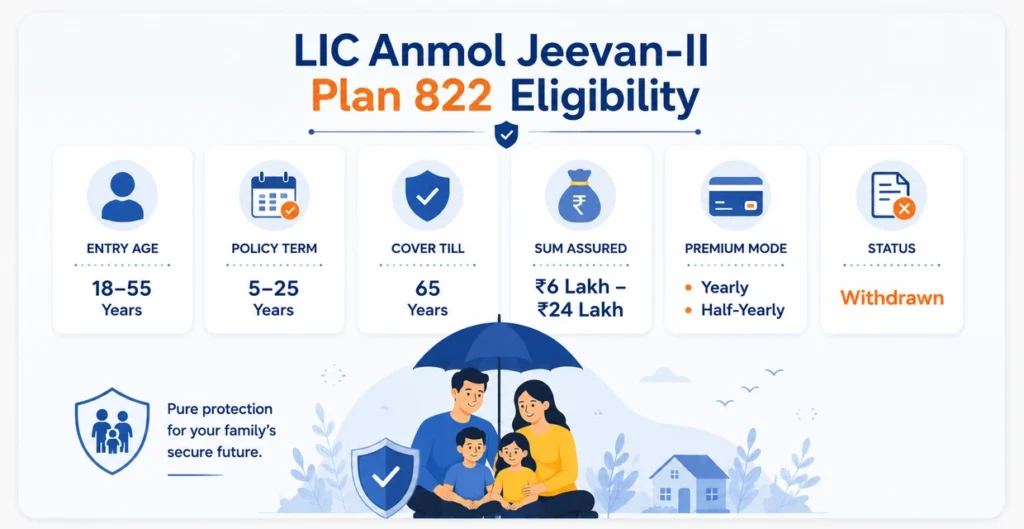
LIC’s official brochure confirms the entry-age limits, Sum Assured range, maximum cover age, premium modes and absence of maturity benefit.
LIC Anmol Jeevan Plan 822 Eligibility Conditions
The eligibility conditions were narrow and easy to understand. The minimum age at entry was 18 years completed. The maximum entry age was 55 years, calculated as nearest birthday. The policy term could be selected from 5 years to 25 years.
However, the final cover ceasing age could not exceed 65 years nearest birthday. This means the policy term had to fit within that age limit.
For example, a person entering at age 40 could choose a maximum term of 25 years because the cover would end at age 65. A person entering at age 50 could not select a 20-year term because cover would then end at age 70, which exceeded the permitted limit.
The Sum Assured had to be at least ₹6 lakh and could go up to ₹24 lakh. It had to be selected in multiples of ₹1 lakh. Therefore, ₹10 lakh and ₹15 lakh were valid choices, while ₹10.50 lakh was not valid under the brochure condition.
LIC Anmol Jeevan-II Death Benefit
The core benefit of LIC Anmol Jeevan Plan 822 was the death benefit. If the Life Assured died during the policy term while the policy was in force, the Sum Assured was payable according to the policy conditions.
For instance, if the policy had a Sum Assured of ₹12 lakh and the Life Assured died during the active term, the basic death benefit would be ₹12 lakh. This is why selecting an adequate Sum Assured was important. The amount should ideally be considered against financial responsibilities such as family expenses, education costs, outstanding loans, and income replacement needs.
The policy document also explains that if death occurred during the grace period, the policy could remain valid, but overdue premium and applicable future instalments due before the next policy anniversary could be deducted from the claim amount.
Does LIC Anmol Jeevan Plan 822 Give Maturity Benefit?
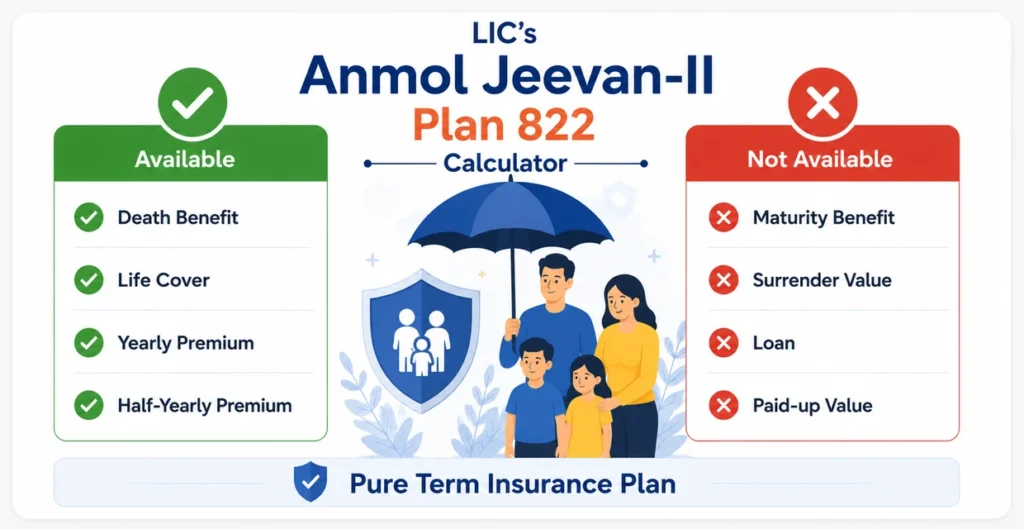
No. LIC Anmol Jeevan-II did not pay a maturity amount if the Life Assured survived until the policy term ended.
This point is important because some policyholders wrongly expect every life insurance plan to return premiums or provide a maturity amount. This was not a return-of-premium plan. It was a pure protection policy. The survival benefit was nil, even after paying premiums for the full policy term.
The calculator should therefore clearly show:
| Benefit Type | Amount |
|---|---|
| Death benefit during policy term | Selected Sum Assured |
| Maturity benefit | Nil |
| Surrender value | Nil |
| Paid-up value | Nil |
| Policy loan | Not available |
How to Use the LIC Anmol Jeevan Plan 822 Calculator
Using the calculator is simple. It is designed to help understand historical premiums and policy benefits without reading complicated premium tables.
Step 1: Enter age at entry
Enter the age when the policy was originally taken or the age for which the historical estimate is required. The valid age range is 18 to 55 years.
The entry age matters because premium rates increase with age. A younger applicant generally had a lower premium rate than an older applicant for the same Sum Assured and policy term.
Step 2: Select gender
Select the gender field as required by the calculator interface. The official brochure’s publicly available sample rate table is based on age and term, so the calculator result should still be treated as an estimate unless matched with the original LIC policy schedule.
Step 3: Enter Sum Assured
Enter the life cover amount. It must be between ₹6 lakh and ₹24 lakh, and it should be in multiples of ₹1 lakh.
For example:
- ₹6,00,000: valid
- ₹10,00,000: valid
- ₹18,00,000: valid
- ₹24,00,000: valid
- ₹10,50,000: not valid
Step 4: Choose policy term
Select the policy term from 5 to 25 years. The calculator should automatically ensure that the cover ceasing age does not go beyond 65 years.
For example, an applicant aged 48 can choose up to a 17-year policy term because 48 + 17 = 65.
Choose either yearly or half-yearly premium payment.
The official brochure allowed only yearly and half-yearly premium modes. Half-yearly payments attracted an additional premium of 2% of the tabular annual premium.
Step 6: Check the result
After clicking the calculate button, the calculator displays the estimated premium rate, base annual premium, tax amount, total yearly premium, half-yearly instalment where applicable, total estimated premium payable, and death benefit.
Keep in mind that the calculator gives an estimate. Where the exact age and policy term are not directly available in the official brochure sample table, the result should be compared with the original policy bond or LIC branch records.
LIC Anmol Jeevan Plan 822 Premium Rate Chart
LIC’s sales brochure provided sample annualised premium rates per ₹1,000 Sum Assured, excluding taxes.
| Age | 5 Years | 10 Years | 15 Years | 20 Years | 25 Years |
|---|---|---|---|---|---|
| 20 years | ₹2.09 | ₹2.09 | ₹2.09 | ₹2.16 | ₹2.31 |
| 30 years | ₹2.31 | ₹2.37 | ₹2.65 | ₹3.02 | ₹3.54 |
| 40 years | ₹3.48 | ₹4.10 | ₹5.07 | ₹6.03 | ₹7.05 |
| 50 years | ₹7.91 | ₹9.44 | ₹11.21 | Not shown | Not shown |
These figures are sample rates only and exclude taxes. They should not be used to claim an exact premium for every possible age and term.
LIC Anmol Jeevan Plan 822 Premium Calculation Formula
The calculator follows a simple premium formula:
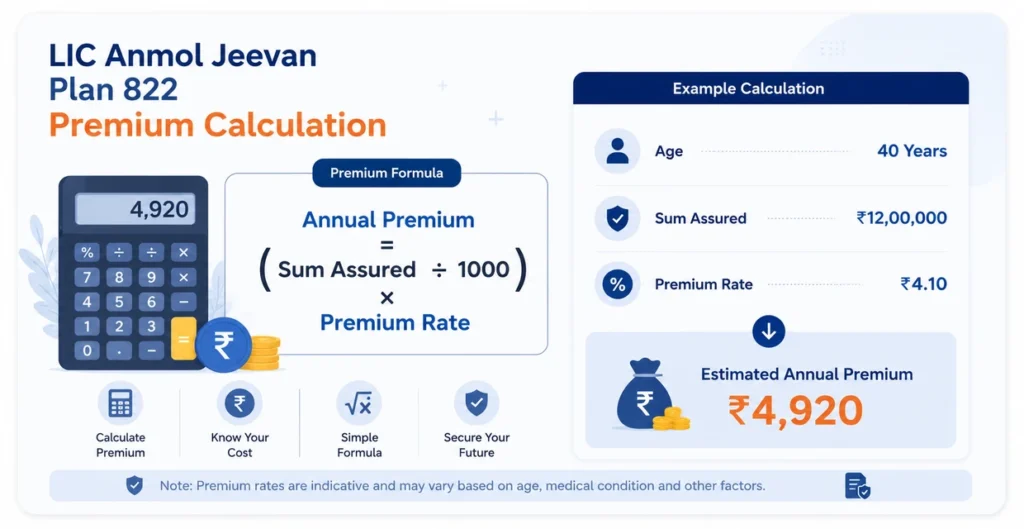
Annual Premium = (Sum Assured ÷ 1,000) × Premium Rate
For half-yearly mode:
Half-Yearly Premium for One Year = Annual Tabular Premium × 1.02
Each Half-Yearly Instalment = Half-Yearly Premium for One Year ÷ 2
The extra 2% was charged on the tabular annual premium for choosing half-yearly payment mode. Taxes were extra and applied as per the tax rules prevailing at the time.
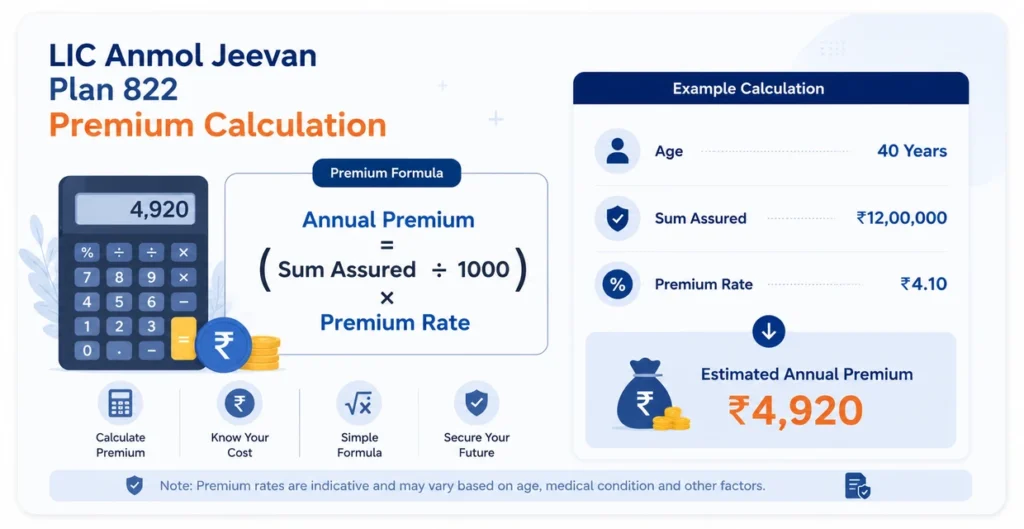
Real Calculation Example Using an Official Sample Rate
Consider a historical illustration based on an exact rate shown in LIC’s brochure.
| Input | Selected Value |
|---|---|
| Entry age | 40 years |
| Policy term | 10 years |
| Sum Assured | ₹12,00,000 |
| Premium payment mode | Yearly |
| Official brochure rate | ₹4.10 per ₹1,000 Sum Assured |
Step-by-step calculation
Sum Assured = ₹12,00,000
₹12,00,000 ÷ 1,000 = 1,200
Annual premium = 1,200 × ₹4.10
Annual premium = ₹4,920
So, the estimated annual tabular premium would be ₹4,920 before tax.
If an applicable tax rate is added, the final payable premium will be higher. The tax rate should not be fixed permanently inside the article because taxes can change. The official brochure states that taxes are payable by the policyholder and are not included while calculating the policy benefit.
Half-yearly example for the same policy
If the same policyholder selected half-yearly mode:
Annual tabular premium = ₹4,920
2% loading = ₹98.40
Total yearly premium before tax = ₹5,018.40
Each half-yearly instalment = ₹5,018.40 ÷ 2
Each half-yearly instalment = ₹2,509.20 before tax
This example shows why yearly mode was slightly cheaper than half-yearly mode. The half-yearly option divided the payment into two instalments, but included the 2% loading specified in the brochure.
Premium Payment, Grace Period and Policy Lapse
Premiums under LIC Anmol Jeevan-II could be paid yearly or half-yearly. LIC allowed a grace period of one month, but not less than 30 days, for payment of due premiums.
If the premium was not paid within the grace period, the policy lapsed. Since this was a pure term insurance plan with no paid-up value, stopping premiums could result in loss of cover unless the policy was revived within the allowed period.
A policyholder should not confuse the grace period with a free extension of policy benefits. It is only a limited period allowed for premium payment. When a claim occurs during the grace period, LIC may deduct pending premiums from the claim amount as per the policy conditions.
LIC Anmol Jeevan Plan 822 Revival Rules
A lapsed LIC Anmol Jeevan-II policy could be revived within two consecutive years from the date of the first unpaid premium, provided the policy term had not expired.
To revive the policy, LIC could require:
- All unpaid premiums
- Interest on overdue premiums
- Evidence of continued insurability
- Medical reports or special reports where required
- LIC’s approval of the revival request
Revival was not automatic. LIC reserved the right to accept revival on original terms, accept it with revised terms, or decline it. The revival became effective only after LIC approved it and communicated the decision to the policyholder.
Surrender Value, Paid-Up Value and Loan Facility
LIC Anmol Jeevan-II did not build a savings value because it was a pure protection policy.
There was no surrender value. This means a policyholder could not stop the policy midway and receive money back from LIC. There was also no paid-up value, so a reduced life cover did not continue after premiums stopped. The policy had no loan facility either.
This should be clearly displayed beside the calculator because users often search for “LIC Anmol Jeevan Plan 822 surrender value.” The correct answer is that no surrender value was available under this plan.
Suicide Exclusion Under LIC Anmol Jeevan-II
The policy contained a suicide exclusion. If the Life Assured died by suicide within 12 months from the commencement of risk or from the date of revival, the policy became void under the stated condition.
In such cases, LIC stated that 80% of premiums paid up to the date of death could be payable, excluding taxes and any extra premium, subject to the policy being in force. No other claim would be entertained under that condition.
This clause should be read together with the full policy document because claim outcomes depend on the original contract terms and facts of the case.
Nomination, Assignment and Claim Documents
A nominee should be registered carefully in every life insurance policy. LIC Anmol Jeevan-II allowed nomination under Section 39 of the Insurance Act and assignment under Section 38, subject to applicable rules.
For a death claim, LIC’s policy document lists common requirements such as the prescribed claim form, original policy document, NEFT mandate, proof of title, proof of death, medical treatment records where relevant, employer certificate where applicable, and proof of age if age had not been admitted earlier.
Keeping the policy bond, premium receipts, nomination records, identity documents and bank details organised can reduce delays when a family needs to raise a claim.
Free-Look Period
At the time this policy was issued, LIC allowed a 15-day cooling-off or free-look period from receipt of the policy bond. If the policyholder disagreed with the terms, the policy could be returned with the reason for objection.
LIC could refund the premium after deducting proportionate risk premium for the period on cover, stamp duty charges, medical examination expenses, and special-report expenses, where applicable. This was relevant only immediately after policy issuance and is mainly useful today for understanding old policy conditions.
Important Things to Remember Before Relying on the Calculator
The LIC Anmol Jeevan Plan 822 calculator is useful, but it has limitations.
First, LIC’s available brochure displays only sample premium rates for selected ages and terms. It does not show a complete rate chart for every entry age between 18 and 55 years.
Second, the tax amount can change over time. The calculator may use an editable tax field, but the final premium payable under an existing policy depends on tax rules applicable at the time of payment.
Third, the original policy schedule is the strongest document for confirming actual Sum Assured, premium mode, due dates, term, policy status, and nominee details.
Finally, this policy is withdrawn. The calculator should be used to understand old-policy data, not as a tool for buying a new LIC Anmol Jeevan-II policy.
LIC Anmol Jeevan Plan 822 FAQs
Is LIC Anmol Jeevan Plan 822 still available?
No. LIC withdrew Anmol Jeevan-II Plan 822 on 01 February 2020. It cannot be purchased as a new policy now. (Liferay DXP)
What is the maturity amount in LIC Anmol Jeevan-II?
The maturity benefit is nil. If the Life Assured survives until the end of the policy term, no amount is payable.
Does LIC Anmol Jeevan Plan 822 have surrender value?
No. The plan does not have surrender value, paid-up value, or a policy loan facility.
Can a lapsed LIC Anmol Jeevan-II policy be revived?
Yes, revival was permitted within two consecutive years from the first unpaid premium date, before the policy term ended, subject to LIC approval, arrears, interest, and continued insurability conditions.
Why does the calculator show an estimated premium?
LIC’s brochure gives sample rates for selected ages and terms rather than a complete public historical premium chart. For the most accurate figure, match the calculator output with the original policy schedule or LIC servicing records.
Final Thoughts
LIC Anmol Jeevan Plan 822 was a basic and focused term insurance policy. Its purpose was not to create savings or provide maturity value. It was designed to provide a defined death benefit during the policy term, subject to the policy being active and all conditions being met.
For existing policyholders, the most important details are the Sum Assured, premium due date, policy status, nomination, and revival window. The LIC Anmol Jeevan Plan 822 calculator can make these details easier to understand by estimating premiums and showing how yearly and half-yearly payments work.
Always verify the final information from the original policy bond, premium receipt, and LIC’s official servicing record before making any financial or claim-related decision.