LIC Final Settlement Calculator
Select the LIC plan and enter simple policy details to estimate the amount receivable at maturity.
| Estimated Settlement Summary |
|---|
| Estimate Range |
|---|
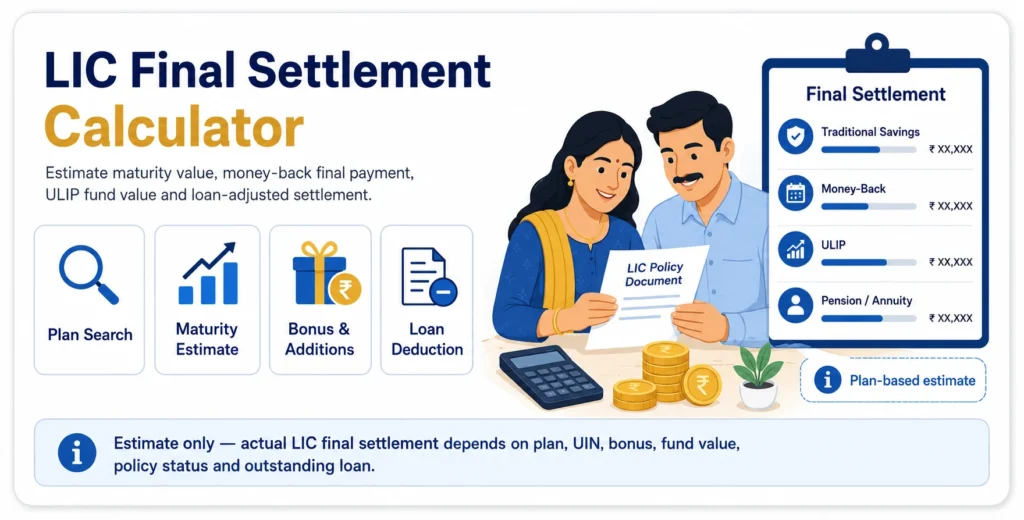
The LIC Final Settlement Calculator helps estimate the amount that may be payable when an LIC policy reaches the benefit stage applicable to that plan. Depending on the policy type, this may be a maturity benefit, final money-back payment, projected ULIP fund value or another end-of-term benefit.
Many policyholders remember their premium amount, policy start year and plan name but may not know technical details such as the UIN, bonus rate or exact benefit formula. This calculator starts with simple policy information and allows additional details to be entered when available.
The calculator can use the LIC plan name or number, policy start year, premium amount, payment mode, policy term, and premium-paying term. Optional details such as Basic Sum Assured, accumulated bonus, money-back already received, current fund value, and outstanding policy loan can improve the estimate.
Accuracy note: LIC does not use one common settlement formula for all plans. The actual payable amount depends on the exact plan, UIN, policy version, policy status, premiums paid, bonus, Guaranteed Additions, survival benefits, fund value, outstanding loan and other policy conditions. The calculator provides an estimate and not an official LIC quotation.
Table of Contents
What Is LIC Final Settlement?
“Final settlement” is used in this calculator as a simple general term for the amount or benefit that may become payable at the relevant stage of an LIC policy. LIC does not use one common final-settlement formula for all policies. The official benefit may instead be called a maturity benefit, survival benefit, fund value, annuity benefit or another plan-specific payment.
For a traditional savings policy, this may be the maturity benefit. In a money-back policy, it may be the final maturity payment after earlier survival benefits have already been paid. For a ULIP, the final value normally depends on the fund value at maturity.
Pension and annuity policies work differently. Some provide lifelong annuity and do not have a normal maturity lump sum. Other options may return the Purchase Price on death or provide another plan-specific benefit.
Pure term insurance plans usually do not provide a maturity benefit unless the particular plan includes a return-of-premium or similar feature.
Therefore, the meaning of final settlement depends on the LIC plan selected in the calculator.
What Is the LIC Final Settlement Calculator?
The LIC Final Settlement Calculator is a plan-based estimation tool that helps policyholders understand the possible end-of-policy value of a supported LIC plan.
The calculator changes its input fields according to the selected policy category.
A traditional savings plan may ask for premium, Basic Sum Assured and accumulated bonus. A money-back plan can include survival benefits already received. A ULIP may ask for the current fund value, while a pension or annuity plan may use the Purchase Price and applicable benefit option.
Single-premium policies require the one-time premium rather than a regular premium schedule.
Also Check:
Highlights of the LIC Final Settlement Calculator
- Search supported LIC plans by name or plan number
- Uses simple policy information for the basic estimate
- Shows plan-specific input fields
- Supports different LIC policy categories
- Provides optional fields for better accuracy
- Calculates projected total premium and maturity year
- Adjusts money-back benefits where applicable
- Includes outstanding policy-loan deductions
- Shows an illustrative range when exact policy data is unavailable
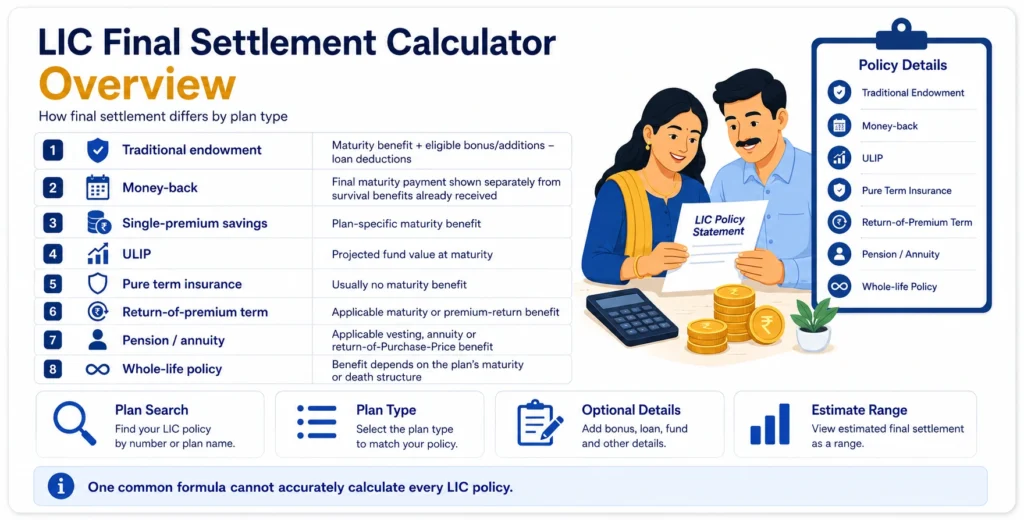
How Final Settlement Differs by LIC Plan Type
Different LIC policies need different calculation methods.
| Plan type | Calculator should estimate |
|---|---|
| Traditional endowment | Maturity benefit plus eligible bonus or additions, less deductions |
| Money-back | Final maturity payment separately from survival benefits already received |
| Single-premium savings | Plan-specific maturity benefit |
| ULIP | Projected fund value at maturity |
| Pure term insurance | Usually no maturity benefit |
| Return-of-premium term | Applicable maturity or premium-return benefit |
| Pension or annuity | Applicable pension, vesting or return-of-Purchase-Price benefit |
| Whole-life policy | Benefit according to the policy’s maturity or death structure |
The selected plan is important because one general formula cannot accurately calculate every LIC policy.
Why Policyholders Use This Calculator
The calculator helps policyholders compare the possible end-of-policy benefit with the total premium paid and understand how bonus, money-back payments, fund value or an outstanding loan may affect the final amount.
It can be useful when the maturity date is approaching, when an old benefit illustration is not easily available or when a policyholder wants a simple estimate before requesting the official maturity information from LIC.
The calculator can also help answer whether previously received money-back benefits are separate from the final maturity payment and whether a policy loan may reduce the amount finally received.
Details Required for Calculation
The exact fields depend on the selected LIC plan.
LIC Plan Name or Number
Search for the policy using its plan name or plan number.
For example, a user may search for Jeevan Labh, New Endowment or Money Back 820.
The calculator should include only supported current and withdrawn LIC plans rather than implying that every LIC policy ever issued is available.
Policy Start Year
Enter the year in which the policy commenced.
This helps estimate the expected maturity year when combined with the policy term.
Premium Amount
Enter the premium paid on each due date.
For example, enter the monthly premium when the policy is paid monthly and the annual premium when it is paid yearly.
Use the base premium unless the calculator specifically asks for tax, rider premium or extra premium.
Premium Payment Mode
Select the applicable payment mode:
- Monthly
- Quarterly
- Half-yearly
- Yearly
- Single premium
Policy Term
Enter the full policy duration.
For example, enter 21 years when the policy runs for 21 years.
Premium-Paying Term
Enter the number of years for which premiums are payable when it is shorter than the full policy term.
For example, a policy may run for 21 years while premiums are payable for 15 years.
Optional Policy Details
Additional details can improve the estimate.
Basic Sum Assured
Enter the Basic Sum Assured from the policy bond or benefit illustration.
Accumulated Bonus and Additions
Enter bonuses or additions already accumulated under the policy.
Do not enter an assumed future bonus as if it is guaranteed.
Money-Back Already Received
Enter survival benefits already received under a money-back policy.
These amounts should normally be shown separately from the final maturity payment to prevent double-counting.
Current ULIP Fund Value
For a ULIP, enter the latest available fund value.
Any future value calculated from this amount is only a projection.
Pension Purchase Price
For an applicable pension or annuity policy, enter the Purchase Price paid at policy commencement.
Outstanding Policy Loan
Enter the outstanding policy-loan principal and interest where applicable.
The actual deduction at settlement will depend on LIC’s records.
How to Use the LIC Final Settlement Calculator
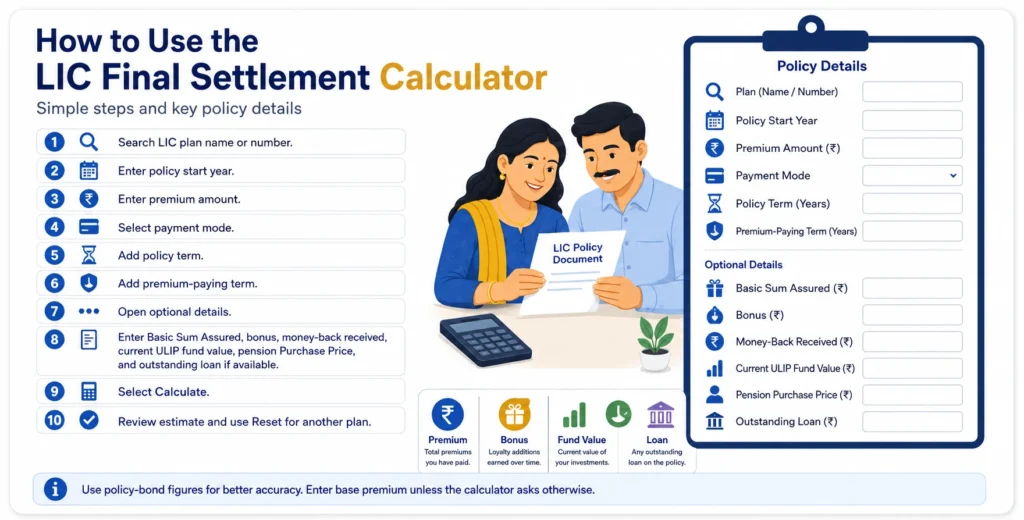
Start by searching for the LIC plan name or number and select the correct policy.
Enter the policy start year, premium amount and premium payment mode.
Add the full policy term. Enter the premium-paying term when premiums are payable for fewer years than the complete policy duration.
Open the optional accuracy section when additional information is available.
Depending on the selected plan, enter details such as:
- Basic Sum Assured
- accumulated bonus or additions
- survival benefits already received
- current ULIP fund value
- pension Purchase Price
- outstanding loan and interest
Select Calculate to view the estimated result.
Use Reset to clear the entered information before calculating another policy.
Total Projected Premium
For a regular-premium policy, the calculator may estimate the total base premium payable during the premium-paying term.
For example:
Yearly Premium × Premium-Paying Term
If the yearly base premium is ₹40,000 and premiums are payable for 15 years:
₹40,000 × 15 = ₹6,00,000
The calculated total may not equal the actual amount paid if GST, rider premium, extra premium or other charges are excluded.
It should therefore be labelled Projected Base Premium rather than total investment.
How the Final Settlement Is Estimated
The calculation method changes according to the selected policy type.
Traditional Savings Policies
A broad maturity calculation may be:
Estimated Maturity Value = Maturity Benefit + Eligible Bonus and Additions − Outstanding Loan and Other Deductions
When the Basic Sum Assured or actual maturity benefit is entered, the calculator can provide a more policy-specific estimate.
When these values are unavailable, the calculator can show only a broad illustrative range based on premium and term. Such a result should not be treated as a plan-specific maturity calculation.
Money-Back Policies
Money-back policies pay survival benefits during the policy term.
The calculator should show:
Final maturity payment
and
Survival benefits already received
as separate amounts.
Survival benefits already received should not automatically be added again to the amount shown as the final maturity settlement.
ULIPs
For a ULIP, the calculator should show a projected fund value rather than a guaranteed final settlement.
The projection may use:
- current fund value
- future premiums
- assumed growth
- remaining policy period
The actual maturity value depends on future NAV, policy charges, withdrawals and fund performance.
Term Insurance
For pure term insurance without return-of-premium benefits, there is generally no maturity amount.
A term plan with return-of-premium or another special maturity feature should be handled according to its own policy rules.
Pension and Annuity Plans
Pension and annuity plans do not always provide a conventional maturity settlement.
Depending on the selected option, a policy may provide lifelong annuity, a vesting benefit, return of Purchase Price on death or another plan-specific payment.
The calculator should display only benefits that apply to the selected plan and option.
Real LIC Final Settlement Calculation Example
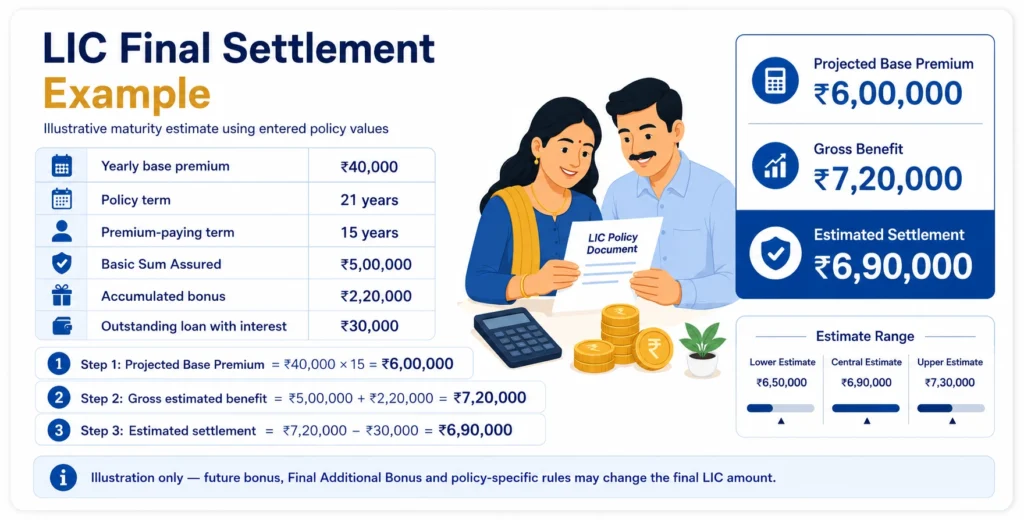
Suppose an LIC Jeevan Labh policy started in 2018 with these details:
| Detail | Value |
|---|---|
| Yearly base premium | ₹40,000 |
| Policy term | 21 years |
| Premium-paying term | 15 years |
| Basic Sum Assured | ₹5,00,000 |
| Accumulated bonus entered | ₹2,20,000 |
| Outstanding loan with interest | ₹30,000 |
Step 1: Calculate Projected Base Premium
₹40,000 × 15 = ₹6,00,000
The projected base premium over the premium-paying term is ₹6,00,000.
Step 2: Calculate Entered Maturity Benefits
₹5,00,000 + ₹2,20,000 = ₹7,20,000
Based only on the entered Basic Sum Assured and accumulated bonus, the estimated gross benefit is ₹7,20,000.
Step 3: Deduct Outstanding Loan
₹7,20,000 − ₹30,000 = ₹6,90,000
The calculator may therefore show an estimated settlement of ₹6,90,000 based on the values entered.
Example limitation: This example does not predict future Simple Reversionary Bonus, Final Additional Bonus or other benefits that may become applicable before maturity. ₹6,90,000 is therefore an illustration based on the entered values and not the final LIC maturity amount.
How to Check LIC Maturity Amount (Simple)
LIC usually sends a maturity intimation about 2 months before the policy matures.
It includes details and documents needed like discharge form, policy bond, bank details (NEFT), and KYC.
Steps to check the official maturity amount:
- Check your policy maturity date.
- Look for LIC maturity intimation.
- If not received, contact your LIC branch.
- Submit required documents.
- LIC will confirm the final maturity amount after adding bonus, deductions, loans, etc.
After verification, LIC sends the maturity amount to your bank account via NEFT.
Online calculators give only an estimate. The final amount from LIC is the official payout.
Frequently Asked Questions
What is LIC final settlement?
LIC final settlement generally means the amount payable at the benefit stage applicable to a policy. For a traditional savings plan, this is usually the maturity benefit, while other plans may have different end-of-policy benefits.
Is final settlement the same as maturity amount?
Not always. For a traditional endowment policy, final settlement may refer to the maturity amount. ULIPs, money-back plans, annuity policies and other policy types can have different settlement structures.
Can this calculator show the exact LIC maturity value?
No. It provides an estimate. The exact value depends on the policy plan, UIN, bonus, additions, policy status, loan and other conditions recorded by LIC.
Are future LIC bonuses included automatically?
They should not be treated as guaranteed. Only bonuses already declared or an explicitly labelled illustrative assumption should be used.
Are money-back benefits added to the final maturity amount?
Survival benefits already received should normally be shown separately from the final maturity payment so that the same benefit is not counted twice.
Is an outstanding LIC policy loan deducted from settlement?
Yes, outstanding loan principal and applicable interest may reduce the final amount payable. LIC’s records determine the actual deduction.
Can the calculator be used for ULIP and pension plans?
It can provide plan-specific guidance or projections when those categories are supported. A ULIP result should be treated as a projected fund value, while pension or annuity benefits depend on the exact option selected.
Conclusion
The LIC Final Settlement Calculator helps policyholders estimate the possible end-of-policy value using simple details such as the LIC plan, premium, policy start year, term and payment mode.
Entering policy-specific information such as Basic Sum Assured, accumulated bonus, survival benefits, current fund value and outstanding loan can improve the estimate.
However, there is no single settlement formula for every LIC plan. Traditional policies, money-back plans, ULIPs, term insurance and annuity policies can all work differently.
Use the calculator as a planning tool and compare the result with the policy bond, LIC statement or official maturity communication before relying on the estimated amount.