LIC Jeevan Labh Plan 836 Calculator
Calculate Premium, Maturity Value and Death Benefit | UIN: 512N304V01
Calculation Results
Maturity Benefit Breakdown
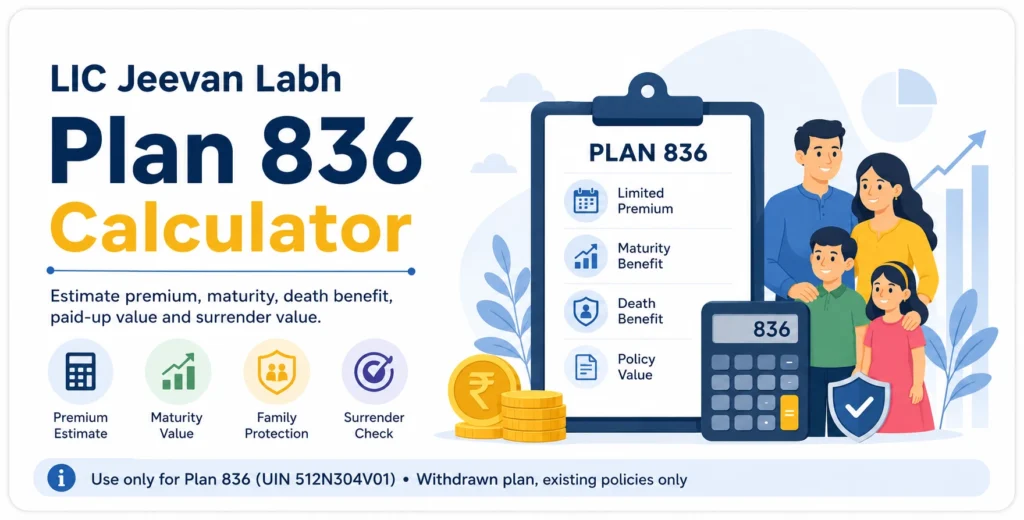
The LIC Jeevan Labh Plan 836 Calculator helps existing policyholders estimate premium payments, maturity benefits, death benefits, paid-up value and surrender value under LIC’s Jeevan Labh Plan 836.
LIC Jeevan Labh Plan 836, with UIN 512N304V01, is a withdrawn version of the Jeevan Labh policy. It is no longer available for new purchases. However, policies issued while the plan was available continue according to the terms printed in their policy documents.
The calculator is mainly useful for checking an existing Plan 836 policy. It can help estimate how many premiums remain, the possible maturity value, the effect of stopping future premiums and the approximate amount available on surrender.
Important version check: Use this calculator only when the policy document shows Plan Number 836 and UIN 512N304V01. Plan 836, Plan 936 and Plan 736 are different versions of LIC’s Jeevan Labh and should not be calculated using the same premium rates or surrender factors.
Table of Contents
What Is the LIC Jeevan Labh Plan 836 Calculator?
The LIC Jeevan Labh Plan 836 Calculator is an online estimation tool for existing policies issued under Plan 836. It combines the main policy calculations in one place so that policyholders can understand their premium commitment and possible benefits without performing each formula manually.
Depending on the information entered, the calculator may estimate:
- yearly or modal base premium;
- total scheduled base premium;
- premiums already paid and premiums remaining;
- projected maturity value;
- Sum Assured on Death;
- indicative death benefit;
- reduced paid-up maturity and death benefits;
- Guaranteed Surrender Value; and
- the possible effect of an outstanding policy loan.
The tool should not be treated as an official LIC quotation. Exact premium rates for every age are not included in the public sales brochure, and bonus rates are declared separately. A policy-specific surrender quotation may also be different because LIC can pay a Special Surrender Value when applicable.
Why Use the Jeevan Labh Plan 836 Calculator?
An existing Plan 836 policy may have been issued many years ago. Policyholders may not immediately know how many premiums remain, how the maturity value is built or what happens if premiums are discontinued.
The calculator can help answer practical questions such as:
- How much premium is payable during the limited premium-paying term?
- How many premiums have already been paid?
- What maturity amount may be received using an assumed future bonus?
- What happens if the policy becomes paid-up?
- How is surrender value calculated after the qualifying period?
- How can an outstanding loan reduce the final payable amount?
It also separates guaranteed policy components from assumption-based projections. This is important because the Basic Sum Assured may be fixed, but future bonuses and Final Additional Bonus are not guaranteed in advance.
LIC Jeevan Labh Plan 836 Overview
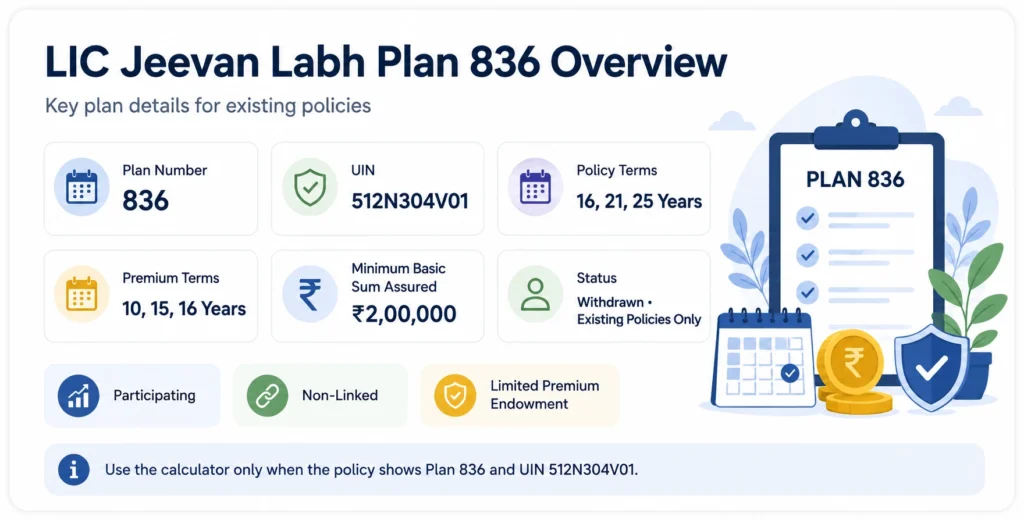
| Particular | Plan details |
|---|---|
| Plan name | LIC’s Jeevan Labh |
| Plan number | 836 |
| UIN | 512N304V01 |
| Plan type | Participating, non-linked, limited-premium endowment plan |
| Policy and premium terms | 16/10, 21/15 and 25/16 years |
| Minimum entry age | 8 completed years |
| Maximum entry age | 59, 54 or 50 years depending on policy term |
| Maximum maturity age | 75 years, nearest birthday |
| Minimum Basic Sum Assured | ₹2,00,000 |
| Sum Assured multiples | ₹10,000 |
| Premium modes | Yearly, half-yearly, quarterly, monthly through ECS and SSS |
| Current status | Withdrawn; existing policies only |
The premium-paying term was fixed according to the selected policy term:
- A 16-year policy term had a 10-year premium-paying term.
- A 21-year policy term had a 15-year premium-paying term.
- A 25-year policy term had a 16-year premium-paying term.
The maximum entry age was 59 years for the 16-year term, 54 years for the 21-year term and 50 years for the 25-year term.
Important Calculator Accuracy Note
The Plan 836 sales brochure published sample annual premium rates for selected entry ages. It did not publish the complete age-wise premium table required to reproduce an exact quotation for every possible age.
Therefore, premium results for an age not covered by the available sample rates may be based on interpolation or another estimation method. Such a result should be treated as indicative.
For the most reliable premium calculation, enter the instalment premium printed in the policy schedule whenever that information is available.
The following items can also cause the actual amount to differ from the calculator result:
- applicable tax;
- rider premium;
- underwriting extra premium;
- frequency of premium payment;
- actual vested bonuses;
- policy loan and accrued interest;
- Special Surrender Value; and
- policy-specific adjustments made by LIC.
Details Needed Before Using the Calculator
Most required details can be found in the policy bond, premium receipt or LIC policy statement.
Check the following before starting:
- plan number and UIN;
- age at commencement;
- date of commencement;
- policy term;
- premium-paying term;
- Basic Sum Assured;
- premium mode;
- instalment premium;
- number of premiums already paid;
- vested bonus already declared; and
- outstanding loan, if any.
Entering the actual instalment premium and vested bonus from policy records produces a more useful estimate than reconstructing the entire policy from sample rates.
How to Use the LIC Jeevan Labh Plan 836 Calculator
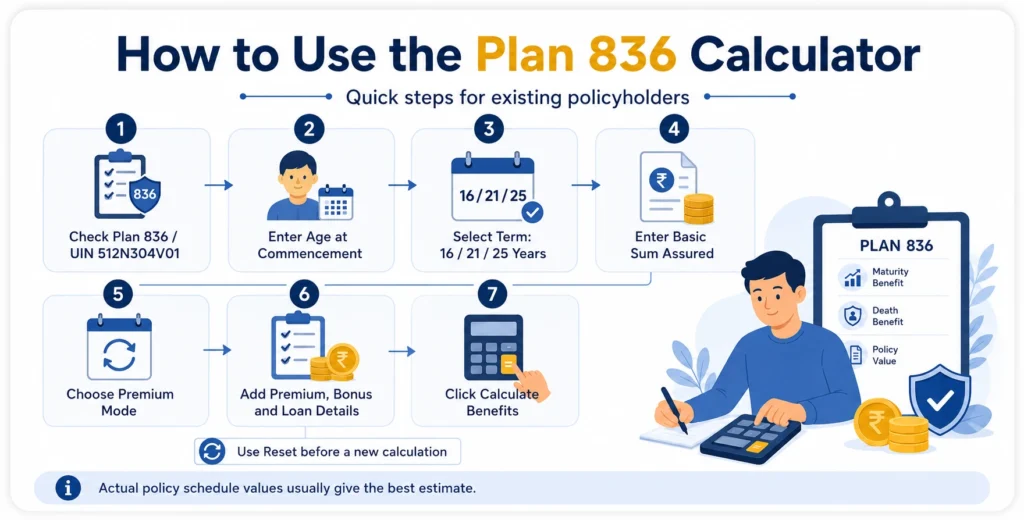
- Confirm that the policy document shows Plan 836 and UIN 512N304V01.
- Enter the age at policy commencement.
- Select the policy term of 16, 21 or 25 years.
- Enter the Basic Sum Assured in multiples of ₹10,000.
- Select the premium payment mode.
- Enter the policy commencement year or completed policy years.
- Enter the actual premium from the policy schedule when available.
- Add the vested bonus already recorded under the policy.
- Enter an assumed future bonus rate only when a maturity projection is required.
- Enter any outstanding loan and accrued interest, if known.
- Select Calculate Benefits to view the estimated results.
- Use Reset before starting another calculation.
How to Understand the Calculator Results
The calculator may display several figures, but they do not all have the same level of certainty.
Base Premium
The base premium is the estimated policy premium before tax, rider premium and underwriting extras. When the actual policy premium is entered, it should normally be preferred over a reconstructed estimate.
Total Scheduled Premium
The total scheduled premium is the estimated base premium payable during the complete premium-paying term.
It is not the same as the maturity benefit. Jeevan Labh is a participating endowment policy, so the maturity amount may include the Basic Sum Assured and declared bonuses.
Vested Bonus
A vested Simple Reversionary Bonus is a bonus already declared and attached to an eligible participating policy. Once vested, it remains subject to the policy terms.
The vested bonus shown in LIC records is more reliable than applying one assumed rate to all previous policy years.
Assumed Future Bonus
An assumed future bonus is used only for illustration. It estimates possible bonuses for the remaining policy years.
Future bonus rates are not known in advance and may differ from historical rates.
Projected Maturity Value
The projected maturity value may include:
Basic Sum Assured + vested bonus already earned + assumed future bonuses + assumed Final Additional Bonus
The Basic Sum Assured is the base maturity component. Bonus-related amounts depend on declaration and policy eligibility.
Surrender Value
The surrender value is an estimate of the amount payable when the policy is terminated before maturity after acquiring surrender value.
It is not equal to all premiums paid.
Paid-Up Value
Paid-up value is the reduced benefit that may remain when premiums stop after the minimum required premiums have been paid.
A paid-up policy remains in force for reduced benefits but generally stops participating in future profits.
How the Plan 836 Premium Is Estimated
The original brochure provided sample annual tabular premium rates per ₹1,000 of Basic Sum Assured.
| Entry age | 16-year term | 21-year term | 25-year term |
| 20 years | ₹85.20 | ₹54.50 | ₹45.95 |
| 30 years | ₹85.50 | ₹54.95 | ₹46.60 |
| 40 years | ₹86.80 | ₹56.80 | ₹48.90 |
| 50 years | ₹90.95 | ₹61.85 | ₹54.80 |
The basic premium formula is:
Annual tabular premium = Basic Sum Assured ÷ 1,000 × applicable tabular rate
The yearly mode received a rebate of 2% of the tabular premium, while the half-yearly mode received a rebate of 1%. Quarterly, monthly ECS and SSS modes did not receive a mode rebate.
A high Sum Assured rebate was also available:
- Nil for ₹2 lakh to ₹4.9 lakh;
- ₹1.25 per ₹1,000 for ₹5 lakh to ₹9.9 lakh;
- ₹1.50 per ₹1,000 for ₹10 lakh to ₹14.9 lakh; and
- ₹1.75 per ₹1,000 for ₹15 lakh and above.
The high Sum Assured rebate was calculated for every ₹1,000 of Basic Sum Assured. It was not a percentage rebate on the full Sum Assured.
LIC Jeevan Labh Plan 836 Maturity Calculation
For an in-force policy, the maturity benefit broadly consisted of:
Basic Sum Assured + vested Simple Reversionary Bonuses + Final Additional Bonus, if declared
A better calculator should separate bonuses already earned from bonuses assumed for future years.
Vested Bonus Calculation
The vested bonus already shown in LIC records can be entered directly.
When only an indicative historical rate is available, the calculation may be represented as:
Estimated vested bonus = Basic Sum Assured ÷ 1,000 × historical bonus rate × completed eligible years
This remains an estimate unless matched with the actual bonus record.
Future Bonus Projection
The assumed future bonus may be calculated as:
Assumed future bonus = Basic Sum Assured ÷ 1,000 × assumed bonus rate × remaining policy years
Therefore:
Projected maturity value = Basic Sum Assured + actual vested bonus + assumed future bonus + assumed Final Additional Bonus
Final Additional Bonus should normally be shown separately because it is not guaranteed and may depend on LIC’s declaration and applicable conditions.
Real Calculation Example
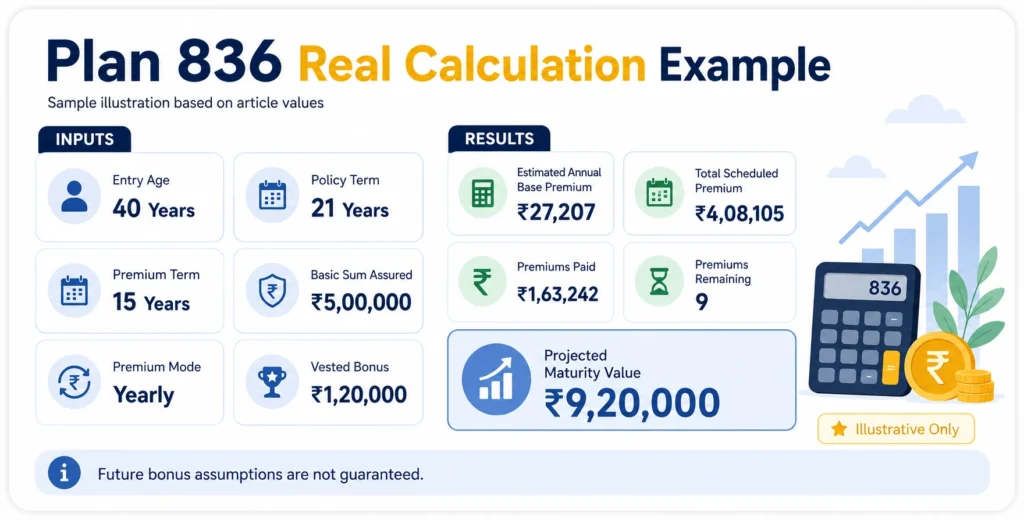
Consider an existing Plan 836 policy with the following details:
| Input | Selected value |
| Entry age | 40 years |
| Policy term | 21 years |
| Premium-paying term | 15 years |
| Basic Sum Assured | ₹5,00,000 |
| Premium mode | Yearly |
| Sample tabular rate | ₹56.80 per ₹1,000 |
| Completed policy years | 6 years |
| Vested bonus from records | ₹1,20,000 |
| Assumed future bonus rate | ₹40 per ₹1,000 per year |
| Final Additional Bonus | Not assumed |
Estimated Premium
The annual tabular premium is:
₹5,00,000 ÷ 1,000 × ₹56.80 = ₹28,400
The high Sum Assured rebate is:
500 × ₹1.25 = ₹625
The yearly mode rebate is:
2% × ₹28,400 = ₹568
Therefore:
Estimated annual base premium = ₹28,400 − ₹625 − ₹568
Estimated annual base premium = ₹27,207
The total scheduled base premium over the 15-year premium-paying term is:
₹27,207 × 15 = ₹4,08,105
This amount excludes tax, rider premium and underwriting extras.
Premiums Paid and Remaining
After six annual premiums:
Estimated base premiums paid = ₹27,207 × 6 = ₹1,63,242
The remaining number of premiums is:
15 − 6 = 9 premiums
The estimated remaining base premium commitment is:
₹27,207 × 9 = ₹2,44,863
These figures assume that each premium remained unchanged and exclude tax or other additions.
Projected Maturity Value
The policy has 15 remaining years until maturity:
21-year term − 6 completed years = 15 remaining years
The assumed future bonus is:
₹5,00,000 ÷ 1,000 × ₹40 × 15 = ₹3,00,000
The projected maturity value is:
₹5,00,000 Basic Sum Assured + ₹1,20,000 vested bonus + ₹3,00,000 assumed future bonus
Projected maturity value = ₹9,20,000
The result excludes Final Additional Bonus. The ₹3,00,000 future bonus component is an assumption and is not guaranteed.
LIC Jeevan Labh Plan 836 Death Benefit
For Plan 836, the Sum Assured on Death was defined as the higher of:
- Basic Sum Assured; or
- 10 times the annualised premium.
The death benefit also had to satisfy the contractual minimum of 105% of premiums paid, interpreted according to the policy conditions.
Using the example above:
10 × ₹27,207 = ₹2,72,070
The Basic Sum Assured of ₹5,00,000 is higher. Therefore, the indicative Sum Assured on Death is ₹5,00,000.
If the actual vested bonus is ₹1,20,000:
Indicative death benefit = ₹5,00,000 + ₹1,20,000
Indicative death benefit = ₹6,20,000
Final Additional Bonus may also be payable if declared and applicable.
For an existing policy, the annualised premium shown in the issued policy schedule should be used. An estimated yearly premium should only be treated as a proxy when the actual figure is unavailable.
Paid-Up Value Under Plan 836
After at least three full years’ premiums had been paid, discontinuing future premiums could cause the policy to continue with reduced paid-up benefits.
The maturity paid-up sum assured may be estimated as:
Maturity Paid-Up Sum Assured = Basic Sum Assured × premiums paid ÷ total premiums payable
The death paid-up sum assured may be estimated as:
Death Paid-Up Sum Assured = Sum Assured on Death × premiums paid ÷ total premiums payable
Using the example policy after six of 15 premiums:
Maturity Paid-Up Sum Assured = ₹5,00,000 × 6 ÷ 15
Maturity Paid-Up Sum Assured = ₹2,00,000
The vested bonus already attached to the policy may remain payable according to policy conditions, but the paid-up policy generally stops participating in future profits.
A paid-up policy does not provide the same benefit as a fully paid in-force policy. It preserves reduced benefits without requiring the remaining scheduled premiums.
LIC Jeevan Labh Plan 836 Surrender Value
Plan 836 could acquire surrender value after at least three full years’ premiums had been paid.
The Guaranteed Surrender Value was broadly calculated using:
GSV = eligible premiums paid × premium GSV factor + vested bonus × bonus GSV factor
The applicable factors depended on:
- selected policy term;
- completed policy year;
- eligible premiums paid; and
- vested bonuses.
Eligible premiums generally excluded tax, rider premiums and underwriting extra premiums.
The calculator can automatically select the appropriate Plan 836 factor after the policy term and completed policy year are entered. There is no need to display the complete factor schedule inside the article.
LIC could also pay a Special Surrender Value when it was more favourable than the Guaranteed Surrender Value. An online calculator cannot confirm the Special Surrender Value because it requires a policy-specific quotation.
Surrender Value Example
Assume a 21-year policy has completed five years and has:
- eligible premiums paid of ₹1,36,035;
- vested bonuses of ₹1,00,000;
- premium GSV factor of 50%; and
- bonus GSV factor of 16.58%.
The premium component is:
₹1,36,035 × 50% = ₹68,017.50
The bonus component is:
₹1,00,000 × 16.58% = ₹16,580
Therefore:
Estimated Guaranteed Surrender Value = ₹68,017.50 + ₹16,580
Estimated GSV = ₹84,597.50
The rounded estimate is ₹84,598.
The final payable surrender amount may be higher or lower after policy-specific adjustments, outstanding loan deductions and LIC’s Special Surrender Value calculation.
Paid-Up Policy or Surrender: What Is the Difference?
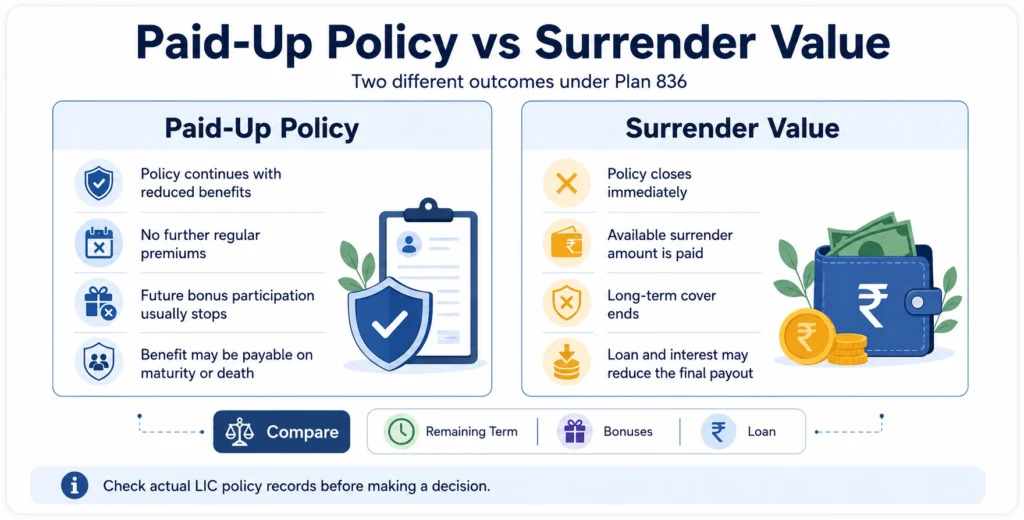
A paid-up policy continues until maturity or death with reduced benefits. No further regular premiums are required, but future bonus participation normally stops.
Surrender closes the policy and pays the available surrender value immediately.
Paid-up status may be considered when keeping reduced long-term protection is more important than receiving an immediate amount. Surrender may be considered when the policyholder requires the available value now and accepts that the policy will terminate.
The better option cannot be decided from one figure alone. Compare:
- current surrender quotation;
- paid-up maturity value;
- remaining policy term;
- vested bonuses;
- outstanding loan;
- remaining premiums; and
- immediate financial requirements.
Effect of a Policy Loan
A loan may have been available after the policy acquired surrender value.
An outstanding loan does not automatically close the policy, but the principal and accrued interest may be deducted from the amount payable on maturity, surrender or death.
An indicative net benefit can be shown as:
Estimated net benefit = Gross policy benefit − outstanding loan − accrued loan interest
The current loan balance and applicable interest should be obtained from LIC records. An old loan statement may not show the latest accrued interest.
Grace Period, Lapse and Revival
The grace period was one month but not less than 30 days for yearly, half-yearly and quarterly premiums. Monthly premiums received a grace period of 15 days.
The policy remained in force during the applicable grace period.
If the premium was not paid within the grace period, the policy could lapse or continue as paid-up depending on the number of full years’ premiums already paid and the applicable policy terms.
Plan 836 allowed revival within two consecutive years from the date of the first unpaid premium. Revival was subject to payment of arrears with interest, evidence of continued insurability and LIC’s approval.
A policy that is currently lapsed should not be calculated as fully in force unless revival is completed.
Optional Riders
Plan 836 offered LIC’s Accidental Death and Disability Benefit Rider, UIN 512B209V01, and LIC’s New Term Assurance Rider, UIN 512B210V01.
Rider premiums and benefits were separate from the base-plan premium, maturity and surrender calculations. Riders did not acquire paid-up value independently.
Plan 836, Plan 936 and Plan 736 Are Different
LIC has issued more than one version of Jeevan Labh.
Plan 836 carried UIN 512N304V01. Later versions used different plan numbers and UINs. Although the core product name remained Jeevan Labh, the premium rates, policy wording, available riders, surrender factors and regulatory version could differ.
Other Related Calculator
Frequently Asked Questions
Is LIC Jeevan Labh Plan 836 still available?
No. Plan 836 is a withdrawn version and is not available for new purchases. The calculator is intended for policies already issued under Plan 836.
How can the correct Jeevan Labh version be identified?
Check the plan number and UIN printed in the policy schedule. This calculator applies only when the document shows Plan 836 and UIN 512N304V01.
Is the premium shown by the calculator exact?
Not necessarily. The public brochure contains sample premium rates for selected ages. The actual instalment premium printed in the policy document should be used whenever available.
What is the maturity benefit under Plan 836?
The maturity benefit broadly consists of the Basic Sum Assured, vested Simple Reversionary Bonuses and Final Additional Bonus, if declared and applicable.
Is the bonus guaranteed?
No. Future Simple Reversionary Bonuses and Final Additional Bonus are not guaranteed in advance. Bonuses already vested under the policy should be entered separately from future assumptions.
Can Plan 836 be surrendered after two years?
No. The policy required at least three full years’ premiums before acquiring surrender value.
What happens when premiums stop after three full years?
The policy may continue as a reduced paid-up policy. Future bonus participation normally stops, while eligible vested bonuses remain attached according to the policy conditions.
Is surrender value equal to the premiums paid?
No. Surrender value is calculated using applicable factors and is usually not equal to the total premiums paid.
Can a loan reduce the maturity or surrender amount?
Yes. Outstanding loan principal and accrued interest may be deducted from maturity, surrender or death proceeds.
Disclaimer
The LIC Jeevan Labh Plan 836 Calculator and this article are provided for general educational purposes. They are not affiliated with or endorsed by Life Insurance Corporation of India.
The calculator does not provide an official premium quotation, bonus declaration, surrender quotation, loan statement, maturity settlement, claim decision or personalised financial advice.
Actual benefits depend on the issued policy bond, premium payment history, policy status, vested bonuses, outstanding loans, applicable interest, rider status and LIC’s assessment.

Amit Kushwaha is a financial content creator and SaaS tool developer based in Lucknow, Uttar Pradesh. He has more than seven years of experience creating insurance-related content, online calculators, and practical digital tools for LIC policyholders, insurance buyers, and LIC agents.
Through LICPolicyCalculator.com, he focuses on simplifying complex LIC policy information into easy-to-understand guides and calculators. His work covers LIC premium estimates, maturity calculations, surrender value tools, policy return calculations, term insurance planning, and plan-specific calculator pages.