LIC Jeevan Mangal Calculator
Plans 198, 819, 840 and 940
Estimated Policy Summary
Premium Summary
| Selected Plan | |
|---|---|
| Premium Type | |
| Premium per Instalment | |
| Tax per Instalment | |
| Total Instalment Payable | |
| Eligible Premium Paid | |
| Estimated Total Amount Paid | |
| Remaining Eligible Premium |
Maturity and Death Benefits
| Basic Sum Assured | |
|---|---|
| Estimated Maturity Benefit | |
| Normal Death Benefit | |
| Additional Accident Benefit | |
| Total Accidental Death Benefit |
Paid-up Value
| Paid-up Ratio | |
|---|---|
| Paid-up Maturity Value | |
| Paid-up Death Value | |
| Accident Benefit After Paid-up | Not included |
Surrender Estimate
| Eligible Premiums Paid | |
|---|---|
| GSV Factor Entered | |
| Estimated Guaranteed Surrender Value |
Important: This calculator gives an indicative estimate using details entered from the policy bond. Tax, extra premium and underwriting charges are excluded from maturity and benefit formulas. Actual premium, surrender value and claim payment are determined by LIC under the policy terms.
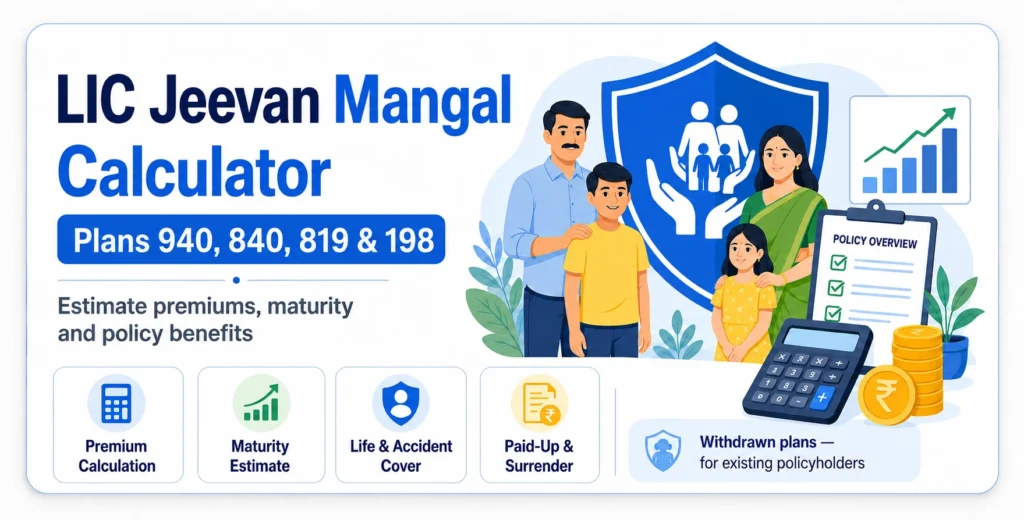
LIC Jeevan Mangal is a family of micro-insurance plans introduced in different versions. A policy bond may show Plan 940, 840, 819 or 198, even though each carries the Jeevan Mangal name. The plan number matters because their policy terms and benefit rules can differ.
The LIC Jeevan Mangal Calculator covers all four plans. It can estimate premiums paid, maturity return, death cover, accidental death cover and possible paid-up value. These withdrawn plans are no longer open for purchase, so the tool is mainly useful for existing policyholders and nominees.
Table of Contents
What Is LIC Jeevan Mangal?
LIC Jeevan Mangal is a micro-insurance product family designed to provide life cover through accessible premium and Sum Assured options. Later versions broadly combine term insurance, return of eligible premiums on maturity and an in-built accident benefit. Exact benefits depend on the version and policy status. A Plan 198 policy, for example, remains governed by Plan 198 rules.
LIC Jeevan Mangal Plans Covered
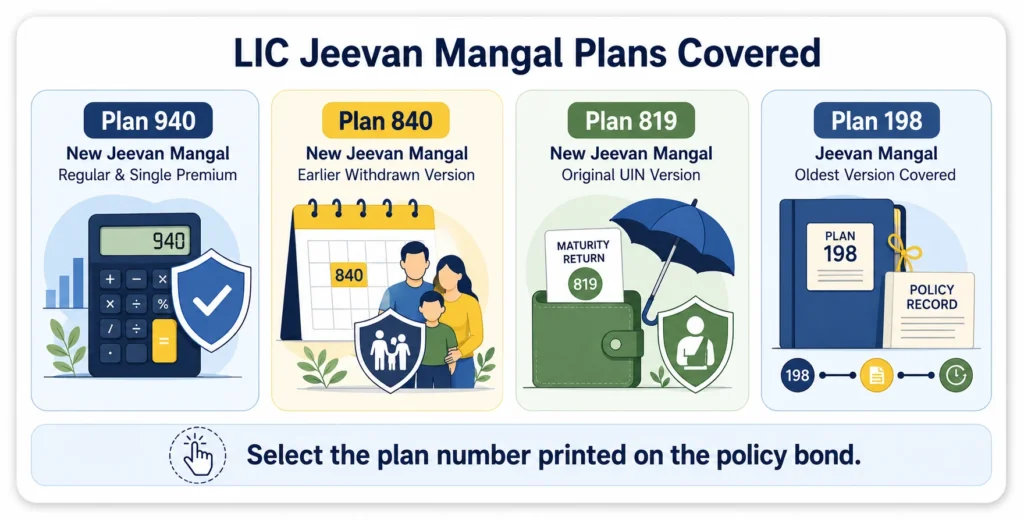
| Plan | Product name | UIN information | Calculator support |
|---|---|---|---|
| Plan 940 | LIC’s New Jeevan Mangal | 512N287 versions | Regular and single premium |
| Plan 840 | LIC’s New Jeevan Mangal | 512N287V02 | Regular and single premium |
| Plan 819 | LIC’s New Jeevan Mangal | 512N287V01 | Regular and single premium |
| Plan 198 | LIC’s Jeevan Mangal | 512N257V01 | Original plan rules |
Plan 198 was followed by Plans 819, 840 and 940. Similar names do not mean that every age limit, term, premium option or benefit formula is identical. Always select the number shown on the actual policy document.
How to Find the Correct Plan Version
Open the policy bond and check the policy schedule near the beginning. Look for Plan No., Table No. or UIN. The same information may also appear on a premium receipt or LIC policy statement.
Match the number with Plan 940, 840, 819 or 198 before using the calculator. If the document is unavailable, the servicing LIC branch can confirm the plan details. Do not select Plan 940 only because it is the latest number in this group.
Highlights of the LIC Jeevan Mangal Calculator
- Covers Plans 940, 840, 819 and 198 in one place.
- Supports regular and single-premium calculations where permitted.
- Uses the actual basic premium from the policy record instead of assuming a rate.
- Shows maturity, normal death and accidental death benefits separately.
- Estimates paid-up value for eligible regular-premium policies.
- Allows a surrender estimate when the correct GSV factor is known.
Details Required for Calculation
Keep the policy bond or premium receipt ready. The calculator requires the plan number, age at entry, premium type, policy term, Basic Sum Assured, payment mode, basic premium, instalments paid and present policy status. Enter the basic premium excluding tax and extra underwriting premium. Tax, extra premium and the GSV factor are optional.
How to Use the LIC Jeevan Mangal Calculator
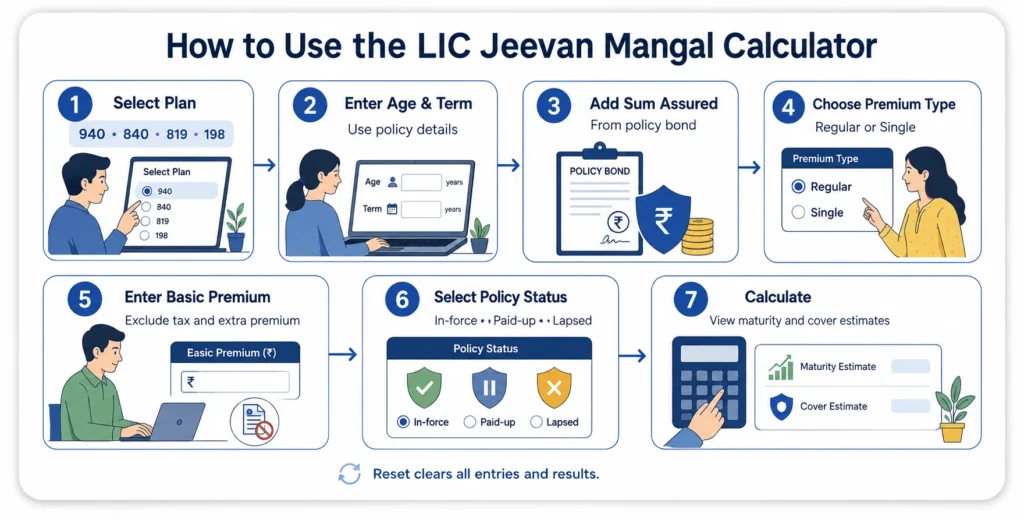
- Select the plan number printed on the policy bond.
- Enter the age at entry, premium type, term and Basic Sum Assured.
- For a regular-premium policy, choose the payment mode.
- Enter one basic premium instalment, excluding tax and extra premium.
- Enter the number of instalments paid and select the policy status.
- Add optional tax, extra premium or GSV details only when known.
- Select Calculate to view the estimate.
The Reset button clears all entries and hides the previous result.
How the Main Benefits Are Estimated
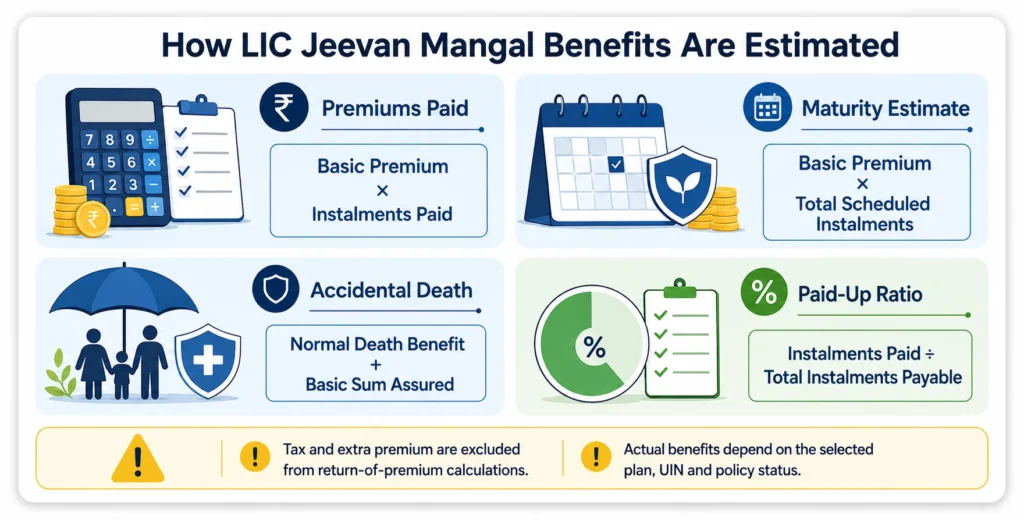
Premiums Paid and Maturity Benefit
The calculator uses the basic premium entered from the policy record:
Eligible premiums paid = Basic premium × Instalments paidFor a fully paid regular-premium policy, the indicative maturity return is:
Estimated maturity benefit =
Basic premium per instalment × Total scheduled instalments
Tax, extra underwriting premium and other ineligible charges are kept outside this calculation. The final maturity amount depends on the applicable plan conditions and the policy remaining eligible for the benefit.
Normal Death Benefit
The normal death benefit depends on the plan version and premium type. For example, under a Plan 940 version using the V03 formula, the regular-premium benefit is the highest of:
- Basic Sum Assured;
- seven times the annualised premium; or
- 105% of eligible premiums paid up to death.
For a single-premium policy under that version, it is the higher of the Basic Sum Assured or 125% of the single premium. Other versions follow their own policy wording.
Accidental Death Benefit
Where the in-built accident benefit applies, an additional amount equal to the Basic Sum Assured may be payable:
Total accidental death benefit =
Normal death benefit + Additional Basic Sum Assured
The event must meet the policy definition of accidental death and satisfy all conditions. This extra benefit should not be assumed for every death or for a lapsed policy.
Paid-Up Value
A regular-premium policy may acquire paid-up value after the required minimum premiums have been paid. If later premiums stop, reduced benefits may continue:
Paid-up ratio =
Premium instalments paid ÷ Total instalments payable
The calculator applies this ratio to the relevant full benefit. Accident cover is excluded. A policy that stopped too early may not receive paid-up benefits unless revived.
Surrender Value
Surrender rules vary by plan and policy year. When the correct Guaranteed Surrender Value factor is known, the estimate is:
Estimated GSV = Eligible premiums paid × GSV factorEligible premiums of ₹20,000 with an applicable factor of 50% give an indicative GSV of ₹10,000. The factor varies, and LIC may quote a different Special Surrender Value.
Short Guide to Each Plan
LIC New Jeevan Mangal Plan 940
Plan 940 is a non-linked, non-participating micro-insurance term plan with return of eligible premiums on maturity and an in-built accident benefit. Check its UIN because more than one version has existed. Read the Plan 940 calculator and complete guide.
LIC New Jeevan Mangal Plan 840
Plan 840 is an earlier withdrawn version. Existing policies continue under their original contracts and should not use Plan 940 rules. See the Plan 840 calculator and policy details.
LIC New Jeevan Mangal Plan 819
Plan 819 is a withdrawn version with return of eligible premiums on maturity and an in-built accident benefit, subject to its conditions. See the Plan 819 calculator and complete guide.
LIC Jeevan Mangal Plan 198
Plan 198 is the oldest version covered here. Its estimates must follow the conditions that applied when the policy was issued. Read the Plan 198 calculator and policy details.
LIC New Jeevan Mangal Plan 940 Advantages
Plan 940 offered life protection with a return-of-premium feature. Its main advantages included:
- Choice between regular premium and single premium, subject to the available policy term.
- Return of eligible premiums when the life assured survived to maturity and the policy conditions were met.
- Normal death cover based on the applicable formula, plus an additional Basic Sum Assured for an eligible accidental death while the policy was in force.
- Paid-up and surrender provisions after the required conditions were completed.
- Yearly, half-yearly, quarterly and monthly modes for regular premiums.
These features should be read as benefits of the withdrawn Plan 940 version, not as a recommendation to buy it. Existing policies remain subject to the UIN version and conditions printed in the policy bond.
LIC New Jeevan Mangal Plan Exclusions
The main Plan 940 exclusions relate to suicide and the additional accident benefit. The full death benefit is not payable when suicide occurs within the period specified in the policy. A limited amount may be payable depending on the premium type, policy status and whether death occurs within 12 months from commencement of risk or revival.
The additional accident benefit is generally excluded for intentional self-injury, attempted suicide, specified intoxicants, criminal activity, war, riots or listed hazardous activities. It is also excluded when death occurs more than 180 days after the accident or after the policy term. Check the policy bond because wording can differ between versions.
Tax Benefits under LIC New Jeevan Mangal Plan
Eligible premium may qualify for deduction under Section 80C when the old tax regime is used and the applicable conditions are satisfied. Its ₹1.5 lakh combined limit includes other eligible investments and payments. The allowed amount can also depend on premium-to-Sum-Assured rules.
Policy proceeds may qualify for exemption under Section 10(10D), subject to the applicable conditions. Tax charged with the premium is separate and is not included in the calculator’s maturity estimate. As tax rules and individual eligibility can differ, check the current Income Tax Department guidance before claiming a deduction or exemption.
Real Life Calculation Example
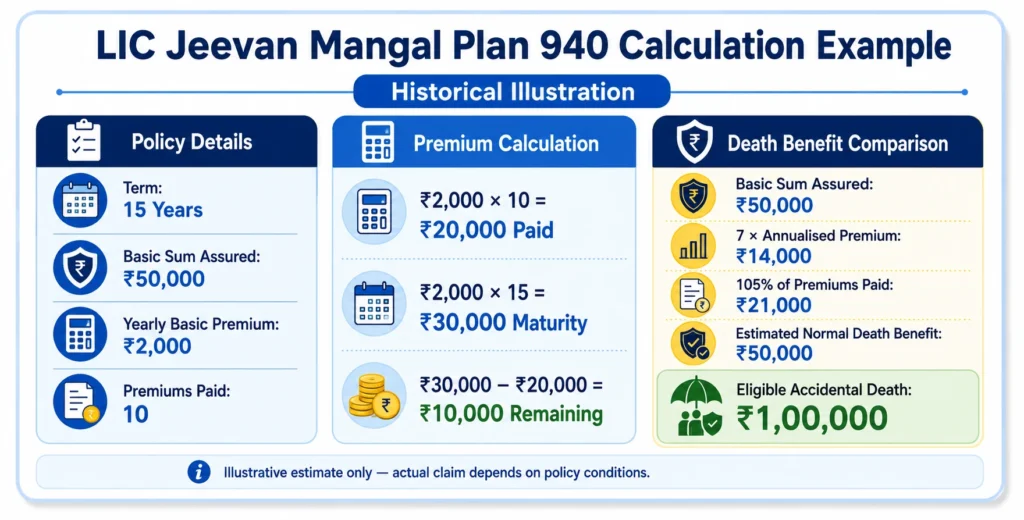
Consider a Plan 940 regular-premium policy with a 15-year term, ₹50,000 Basic Sum Assured and yearly basic premium of ₹2,000. Assume that 10 premiums have been paid and tax and extra premium are excluded.
Eligible premiums paid = ₹2,000 × 10 = ₹20,000

Estimated maturity return after all premiums =
₹2,000 × 15 = ₹30,000

Remaining eligible premiums =
₹30,000 − ₹20,000 = ₹10,000
Using the V03-style death-benefit illustration, the calculator compares ₹50,000 Basic Sum Assured, ₹14,000 as seven times the annualised premium and ₹21,000 as 105% of premiums paid. The highest amount is ₹50,000.
If an eligible accidental death occurs while the cover is in force, another ₹50,000 may be added, giving an estimated total of ₹1,00,000. The actual claim depends on the UIN version, policy status, cause of death and claim conditions.
Important Calculator Limitations
- The result is an estimate, not an official LIC quotation or claim decision.
- Accuracy depends on the selected plan, UIN, policy status and entered details.
- Revival interest, late fees and medical requirements are not included.
- Special Surrender Value requires the applicable LIC value or factor.
- Final maturity, surrender, paid-up and claim amounts must be confirmed through LIC.
Frequently Asked Questions
Can LIC Jeevan Mangal still be purchased?
No. Plans 940, 840, 819 and 198 covered here have been withdrawn from new sale. Existing policies can continue according to their original contracts.
Is tax returned at maturity?
The maturity benefit is generally based on eligible premiums under the applicable policy conditions. Tax and extra underwriting premium are kept separate because they are normally not part of the return-of-premium amount.
Does accidental death always provide double the Basic Sum Assured?
No. An eligible accident benefit may add one Basic Sum Assured to the normal death benefit. The final total depends on the normal death-benefit formula and whether all accident conditions are satisfied.
Can a lapsed policy receive a maturity benefit?
It depends on whether the policy acquired paid-up value and on the rules of the selected version. A policy that did not acquire paid-up value may not provide a maturity benefit unless it is revived.
Is the calculator result an official LIC amount?
No. It is an indicative estimate. The official amount must be confirmed from the policy bond, LIC records or the servicing branch.
Disclaimer
The LIC Jeevan Mangal Calculator provides an indicative estimate based on the information entered. It is not connected with or authorised by Life Insurance Corporation of India. Actual premium, maturity, paid-up, surrender and claim amounts are governed by the policy bond and LIC records.