LIC New Jeevan Nidhi Calculator Plan 818, 812, 169
Estimate benefits for an existing withdrawn Jeevan Nidhi policy
Estimated Result
Important: This is an estimate, not an LIC quotation. The final benefit depends on the exact policy bond, UIN, policy status, premiums paid, LIC-declared bonuses, surrender factors and annuity rates applicable at the relevant time.
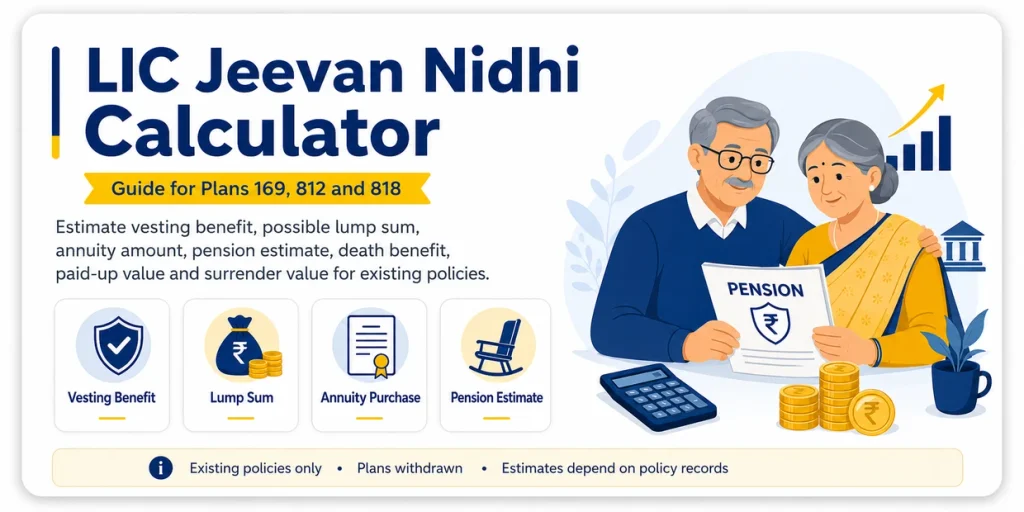
LIC Jeevan Nidhi was made to build a retirement fund over a fixed period. It was sold under Plan 169, Plan 812 and Plan 818. All three plans are now withdrawn, so they are not available for new purchase. Existing policies continue according to the conditions written in the policy documents.
The LIC Jeevan Nidhi Calculator helps estimate the benefits of an existing policy. It can show the amount available on the vesting date, the possible lump-sum amount, the balance for buying an annuity, estimated pension, death benefit, paid-up value, surrender value, and total basic premiums paid.
If you are searching for a Jeevan Nidhi maturity calculator. In a pension plan, vesting benefit is the better term. The full vesting amount is not normally paid in cash. A permitted part may be taken as a lump sum, while the remaining amount is generally used to buy an annuity for regular pension income.
Highlights of the LIC New Jeevan Nidhi Calculator
- Covers LIC Jeevan Nidhi Plans 169, 812 and 818.
- Uses separate rules for each plan version.
- Estimates Guaranteed Additions and recorded bonuses.
- Shows the vesting benefit and possible lump-sum amount separately.
- Estimates the amount available to buy an annuity.
- Gives an illustrative yearly or monthly pension.
- Calculates death, paid-up and surrender benefits when the required details are available.
- Shows a clear calculation instead of only a final amount.
Plans Covered by the Calculator
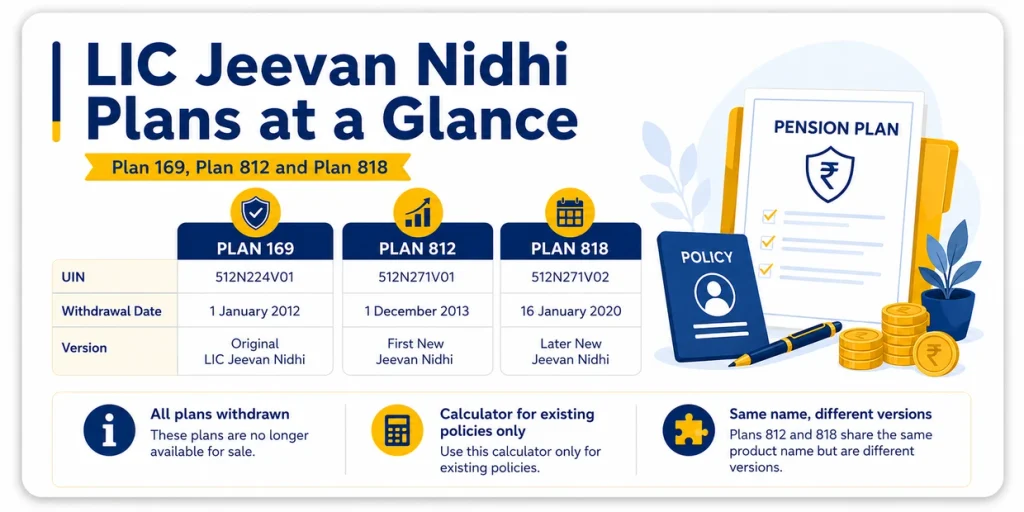
| Policy name | UIN | Withdrawal date |
|---|---|---|
| LIC Jeevan Nidhi Plan 169 | 512N224V01 | 1 January 2012 |
| LIC New Jeevan Nidhi Plan 812 | 512N271V01 | 1 December 2013 |
| LIC New Jeevan Nidhi Plan 818 | 512N271V02 | 16 January 2020 |
Plans 812 and 818 have the same product name, but they are different versions. Before using the calculator, check the plan number and UIN printed on the policy schedule. This prevents the rules of one plan from being used for another.
What is Jeevan Nidhi Plan?
LIC Jeevan Nidhi is a pension plan designed to help people save money for retirement. In this plan, policyholders pay a single premium or regular premiums for a fixed period of time. During this time, the policy could receive Guaranteed Additions and bonuses, based on the selected plan and LIC’s declarations. When the policy reached the vesting date, the total benefit became available. A permitted part could be taken as a lump sum, while the remaining amount was normally used to buy an annuity for regular pension income. LIC issued Jeevan Nidhi Plans 169, 812 and 818. All three plans are withdrawn, so they cannot be bought as new policies. Existing policies continue according to their terms, premium record, and current status.
Plan Versions Explained
LIC Jeevan Nidhi Plan 169
Plan 169 was the original plan in this group. It was a participating deferred pension policy. It helped build a retirement amount while providing life cover during the deferment period.
Because it is the oldest version, the calculator should use the Guaranteed Addition, bonus, death, paid-up and surrender details shown in the original policy bond or LIC statement. Rules of Plan 818 should not be applied to Plan 169.
LIC New Jeevan Nidhi Plan 812
Plan 812 was the first version sold as LIC New Jeevan Nidhi. It also built a retirement benefit during the deferment period. At vesting, the proceeds were used according to the commutation and annuity rules available under the policy.
For a correct estimate, enter the additions, vested bonus, surrender factors and policy status from the Plan 812 record. These details should not be copied from another version.
LIC New Jeevan Nidhi Plan 818
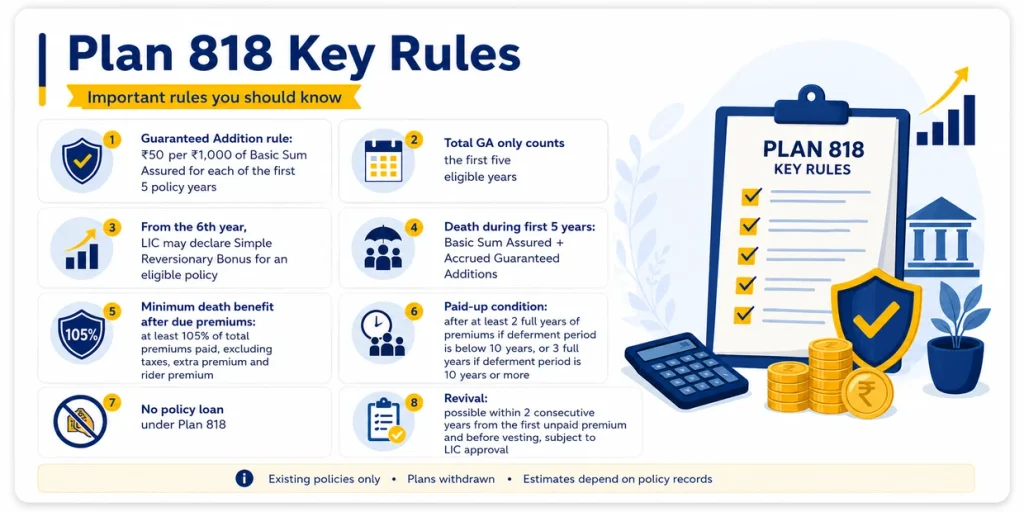
Plan 818 was the later version of New Jeevan Nidhi. For an eligible in-force policy, it provided a Guaranteed Addition of ₹50 per ₹1,000 of Basic Sum Assured for each of the first five policy years. From the sixth year, LIC could declare a Simple Reversionary Bonus for an eligible policy.
Plan 818 also had stated rules for death benefit, paid-up status, surrender and revival. The calculator can apply these rules after the correct premium and policy details are entered.
Important Pension Terms in Simple Words
- Deferment period: The time from the policy start date to the vesting date.
- Vesting date: The date on which the retirement benefit becomes available.
- Vesting benefit: The total policy amount available before commutation and annuity purchase.
- Commutation: Taking the permitted part of the vesting benefit as a lump sum.
- Annuity: A product bought with the remaining amount to receive regular pension income.
- Guaranteed Addition: An addition given according to the rate and period stated in the policy.
- Simple Reversionary Bonus: A bonus that LIC may declare for an eligible participating policy. Future bonus rates are not guaranteed.
- Final Additional Bonus: An extra bonus that may apply at death or vesting if LIC declares it and the policy qualifies.
How the Calculator Works for Each Plan
| Selected plan | Information used by the calculator |
| Plan 169 | Basic Sum Assured, recorded additions, vested bonus, premium history and plan-specific factors |
| Plan 812 | Basic Sum Assured, recorded additions, vested bonus, premium history and Plan 812 factors |
| Plan 818 | Basic Sum Assured, eligible GA years, vested bonus, premium history and Plan 818 rules |
For Plans 169 and 812, some values need to be entered manually from the policy record. This is safer than guessing old plan rates. For Plan 818, the calculator can apply the stated Guaranteed Addition rule automatically.
Formula Used in the LIC Jeevan Nidhi Calculator
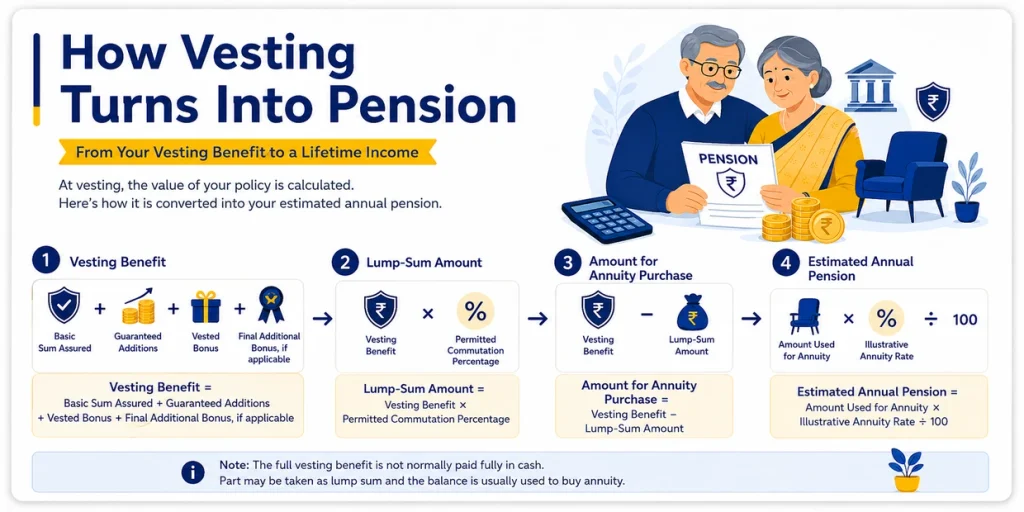
The broad vesting formula is:
Vesting Benefit
= Basic Sum Assured
+ Guaranteed Additions
+ Vested Simple Reversionary Bonus
+ Final Additional Bonus, if applicable
The exact parts included depend on the selected plan, policy status and eligibility.
Guaranteed Addition Formula for Plan 818
For an eligible in-force Plan 818 policy:
Guaranteed Addition for One Year
= Basic Sum Assured ÷ 1,000 × ₹50
Total Guaranteed Additions
= Guaranteed Addition for One Year × Eligible YearsOnly the first five eligible policy years are counted under this rule. For a regular-premium policy, the required premium must have been paid. Plan 169 and Plan 812 may follow different rules, so their actual additions should be entered from the relevant records.
Vesting, Lump Sum and Pension
The calculator should not show the full vesting benefit as a cash maturity payment. It first estimates the permitted lump-sum amount and then shows the balance for annuity purchase.
Lump-Sum Amount
= Vesting Benefit × Permitted Commutation Percentage
Amount for Annuity Purchase
= Vesting Benefit − Lump-Sum AmountThe permitted commutation percentage depends on the policy conditions and rules in force on the vesting date. It should not be treated as a fixed percentage in every case.
The estimated pension can be shown as:
Estimated Annual Pension
= Amount Used for Annuity × Illustrative Annuity Rate ÷ 100
Actual pension depends on age, annuity option, payment mode and the annuity rate available at that time. A monthly figure made by dividing the annual estimate by 12 is only a simple comparison. The actual monthly annuity may be different.
If the vesting proceeds are too small to buy the minimum annuity allowed under the applicable rules, the full amount may be payable as a lump sum, subject to the policy terms.
Death Benefit Before Vesting
For an in-force Plan 818 policy, death during the first five policy years broadly gives:
Death Benefit
= Basic Sum Assured + Accrued Guaranteed Additions
For death after the first five years but before vesting, eligible vested bonuses may also be added. When all due premiums have been paid, Plan 818 also provides a minimum of 105% of total premiums paid, excluding taxes, extra premium and rider premium.
The death-benefit rules for Plans 169 and 812 should be taken from their own policy documents. The calculator should use those plan-specific values instead of applying Plan 818 rules.
Paid-Up and Surrender Value
A regular-premium Plan 818 policy may become paid-up after the required minimum premiums have been paid:
- at least two full years of premiums for a deferment period below 10 years; or
- at least three full years of premiums for a deferment period of 10 years or more.
The reduced amount can be estimated as:
Paid-Up Sum Assured
= Basic Sum Assured × Premiums Paid ÷ Total Premiums Originally Payable
Additions and bonuses already earned may remain attached, but no future Guaranteed Additions or bonuses are earned after the policy becomes paid-up. Final Additional Bonus is not payable under a paid-up Plan 818 policy.
Surrender value depends on the plan, policy year, premium history and applicable factors. LIC may calculate a Guaranteed Surrender Value and a Special Surrender Value, and the eligible better value may be payable. An exact surrender amount cannot be found without the correct factors or an official quotation.
Plan 818 does not provide a policy loan. A lapsed regular-premium Plan 818 policy could be considered for revival within two consecutive years from the first unpaid premium and before vesting, subject to LIC’s conditions and approval.
How to Use the LIC Jeevan Nidhi Calculator
- Check the plan number and UIN on the policy schedule.
- Select Plan 169, 812 or 818.
- Choose the required calculation: vesting, death, paid-up, surrender or premiums paid.
- Enter the Basic Sum Assured, policy term and completed policy years.
- Enter the basic premium and number of premiums actually paid.
- Add the vested bonus, Final Additional Bonus and plan-specific factors from the policy record.
- For a pension estimate, enter an assumed annuity rate and payment frequency.
- Press Calculate and read the lump sum, annuity amount and pension separately.
Do not include tax, rider premium, extra premium, late fee or interest in the basic premium field unless the calculator asks for them separately.
Real Calculation Example for Plan 818
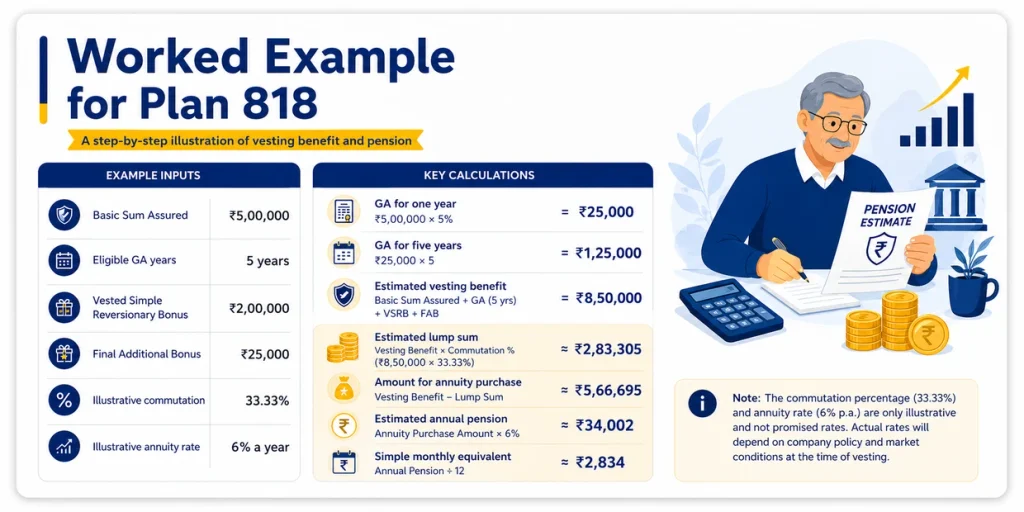
| Detail | Amount |
| Basic Sum Assured | ₹5,00,000 |
| Eligible GA years | 5 years |
| Vested Simple Reversionary Bonus | ₹2,00,000 |
| Final Additional Bonus | ₹25,000 |
| Illustrative commutation | 33.33% |
| Illustrative annuity rate | 6% a year |
First, calculate the Guaranteed Additions:
GA for One Year
= ₹5,00,000 ÷ 1,000 × ₹50
= ₹25,000

GA for Five Years
= ₹25,000 × 5
= ₹1,25,000
The estimated vesting benefit is:
₹5,00,000 + ₹1,25,000 + ₹2,00,000 + ₹25,000
= ₹8,50,000
If 33.33% commutation is permitted for this example:
Estimated Lump Sum: about ₹2,83,305
Amount for Annuity Purchase: about ₹5,66,695
At an illustrative annuity rate of 6%:
Estimated Annual Pension: about ₹34,002
Simple Monthly Equivalent: about ₹2,834
The 33.33% commutation and 6% annuity rate are used only to explain the calculation. They are not promised rates. The actual lump-sum limit and pension depend on the rules and annuity option available at vesting.
Tax Benefits
Tax rules may be different for the lump-sum amount and regular pension. The full vesting benefit may not be tax-free. Tax rules can also change, so check the latest rules or take help from a tax expert.
Frequently Asked Questions
Is LIC Jeevan Nidhi still available?
No. Plans 169, 812 and 818 are withdrawn. The calculator is meant for existing policies only.
What is the vesting benefit?
It is the total amount available when the deferment period ends. It may include Basic Sum Assured, Guaranteed Additions, vested bonus and Final Additional Bonus, where applicable.
Is the full vesting benefit paid in cash?
Not normally. A permitted part may be taken as a lump sum, and the remaining amount is generally used to buy an annuity. A full cash payment may apply if the proceeds are too small to buy the minimum allowed annuity, subject to the rules.
Does the calculator show the exact pension?
No. It shows an estimate. The final pension depends on the annuity amount, age, annuity option, payment frequency and rate available at vesting.
Can a Jeevan Nidhi policy become paid-up or be surrendered?
It may become paid-up or qualify for surrender after the required premium conditions are met. The exact rules and amount depend on the plan version, policy year, premium history and applicable surrender factors.
Conclusion
The LIC Jeevan Nidhi Calculator makes it easier to understand an existing Plan 169, 812 or 818 policy. It brings together the Basic Sum Assured, additions, vested bonuses and premium history to estimate the vesting, death, paid-up and surrender benefits.
The most useful part is the clear separation between the possible lump sum and the amount used to buy an annuity. This avoids treating the whole retirement fund as a cash maturity payment. For a reliable estimate, always select the correct plan number and use values from the policy schedule or LIC statement.