LIC Jeevan Shanti All Plan Calculator
Single premium annuity calculator for New Jeevan Shanti and old Jeevan Shanti options.
Policy Details
Annuity Rate Inputs
Calculation Result
Benefit Details
| Benefit | Amount / Rule | Remarks |
|---|
Year-wise Annuity Schedule
| Year | Annual Annuity | Installment | Note |
|---|
LIC Jeevan Shanti Calculator is an online tool that helps estimate annuity income under LIC Jeevan Shanti and New Jeevan Shanti plan options. It uses details such as the selected plan version, purchase price, entry age, deferment period, annuity option, payment mode and applicable annuity rate to show an estimated pension amount.
The calculator covers three important product generations: current LIC New Jeevan Shanti Plan 758, withdrawn New Jeevan Shanti Plan 858 and withdrawn Jeevan Shanti Plan 850. Plans 758 and 858 provide deferred annuity, whereas the older Plan 850 offered immediate as well as deferred annuity options.
LIC’s current New Jeevan Shanti is a single-premium deferred annuity plan. LIC describes it as a non-par, non-linked, individual savings deferred annuity plan. The annuity rate is guaranteed at policy inception, and the annuity becomes payable after the selected deferment period for the lifetime of the applicable annuitant or annuitants.
The result produced by this calculator is an estimate and not an official LIC quotation. Final annuity and policy benefits are governed by LIC’s applicable rate, official quotation, policy document, UIN and issued policy schedule.
Table of Contents
What Is LIC Jeevan Shanti Plan Calculator?
LIC Jeevan Shanti Plan Calculator estimates the pension-like income that may become payable after investing a one-time purchase price. The purchase price is the lump-sum amount paid to buy the annuity policy. It is also referred to as the single premium in LIC’s product documents.
Depending on the selected plan and option, the calculator can display the estimated yearly, half-yearly, quarterly or monthly annuity, vesting age, expected first payment date and relevant benefit information. Selecting the exact plan number and UIN prevents a historical rate or condition from being mistaken for a current one.
Also Check:
LIC Jeevan Shanti Plans Covered by the Calculator
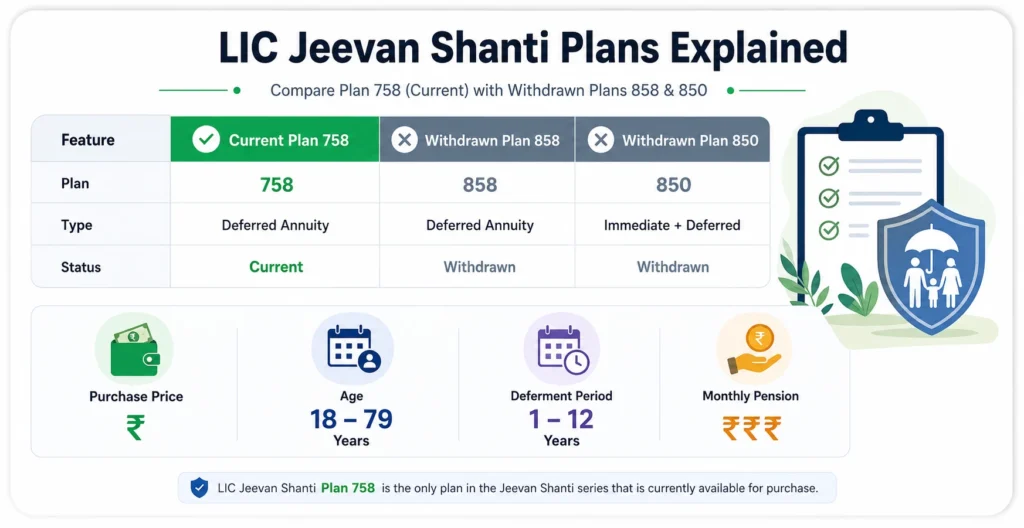
| Plan | Product | Annuity type | UIN | Status |
|---|---|---|---|---|
| 758 | LIC’s New Jeevan Shanti | Deferred annuity | 512N338V08 | Currently available |
| 858 | LIC’s New Jeevan Shanti | Deferred annuity | 512N338V01 to 512N338V06 | Withdrawn |
| 850 | LIC’s Jeevan Shanti | Immediate and deferred annuity | 512N328V01 and 512N328V02 | Withdrawn |
What is LIC New Jeevan Shanti Plan 758?
LIC New Jeevan Shanti Plan 758 is the current version of the product. Its UIN is 512N338V08. It is a non-par, non-linked, individual savings deferred annuity plan purchased by paying a single premium, referred to as the purchase price.
The plan provides two options:
- Deferred annuity for single life
- Deferred annuity for joint life
The annuity does not begin immediately. It becomes payable after the selected deferment period and continues for the lifetime covered under the chosen option. Annuity can be received yearly, half-yearly, quarterly or monthly.
Under the current brochure, the minimum entry age is 30 years and the maximum entry age is 79 years. The minimum vesting age is 31 years and the maximum vesting age is 80 years. The available deferment period is from one to five years, subject to the maximum vesting age.
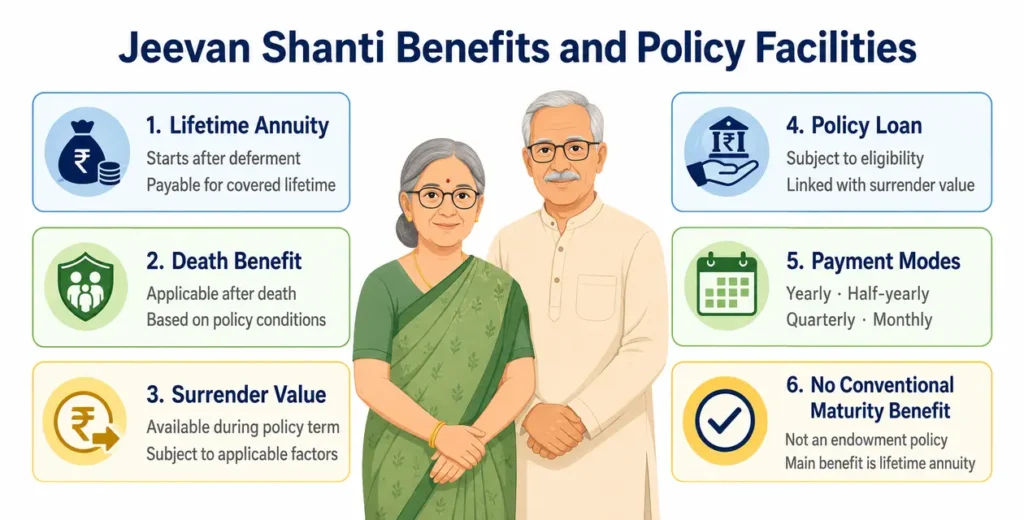
The normal minimum purchase price is ₹1,50,000, subject to the minimum annuity requirement and specified exceptions. Plan 758 does not provide a conventional maturity benefit. Its main benefits and facilities include lifetime annuity after deferment, death benefit, surrender value and policy loan.
What is LIC New Jeevan Shanti Plan 858?
LIC New Jeevan Shanti Plan 858 was the earlier version of New Jeevan Shanti. It was also a single-premium deferred annuity product with single-life and joint-life options.
Plan 858 was issued under UIN versions 512N338V01, V02, V03, V04, V05 and V06. For example, V04 was launched on 5 January 2023 and withdrawn on 7 February 2024. The plan is no longer available for new purchase. Existing policyholders should select the UIN printed on the policy schedule because conditions and rates can differ between versions.
What is LIC Jeevan Shanti Plan 850?
LIC Jeevan Shanti Plan 850 was the older product in the Jeevan Shanti series. Unlike Plans 758 and 858, it offered both immediate and deferred annuity.
Its choices included annuity for life, guaranteed-period options, return-of-purchase-price options, increasing annuity, joint-life arrangements and deferred annuity. UIN 512N328V02 was launched on 24 August 2019 and withdrawn on 21 October 2020. The calculator should display only the options available under the selected annuity category and UIN.
Highlights of LIC Jeevan Shanti Calculator
The calculator converts the purchase price and applicable annuity rate into an estimated payment amount. Different purchase prices, ages, deferment periods, annuity options and payment modes can be compared without repeating the calculation manually.
It supports yearly, half-yearly, quarterly and monthly modes and applies the relevant mode-specific rate or reduction. It can also separate the deferment period from the payment period and show when the annuity vests and when the first payment is expected.
How to Use LIC New Jeevan Shanti Plan Calculator
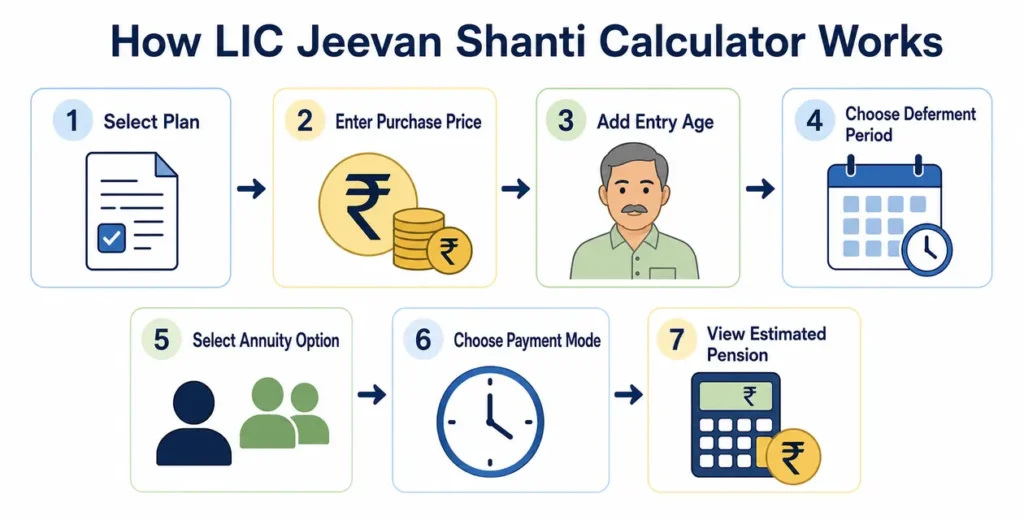
First, select the correct plan. Plan 758 should be selected for the current New Jeevan Shanti product. Plan 858 should be selected for an existing New Jeevan Shanti policy issued under that plan number. Plan 850 should be selected for an older Jeevan Shanti policy.
If Plan 858 or Plan 850 is selected, choose the UIN printed on the policy schedule. For Plan 850, also select whether the policy provides immediate or deferred annuity.
Next, choose the annuity option. Under current Plan 758, the choices are deferred annuity for single life and deferred annuity for joint life. Plan 850 contains additional historical immediate-annuity options.
Enter the purchase price excluding applicable taxes paid separately. Then enter the primary annuitant’s age. For joint life, enter the secondary annuitant’s age as well.
For a deferred annuity, select the deferment period. This is the period between policy commencement and the date of vesting. Choose yearly, half-yearly, quarterly or monthly as the annuity payment mode.
If the calculator permits manual rate entry, enter the annuity rate per ₹1,000 from the applicable LIC quotation or rate table. An old or assumed rate should be clearly identified as illustrative.
Press Calculate to view the estimated annuity, vesting information and applicable benefit details. Use Reset before starting another calculation.
How Is Jeevan Shanti Annuity Calculated?
When the rate is stated as an annual annuity amount for every ₹1,000 of purchase price, the formula is:
Annual annuity = (Purchase price ÷ ₹1,000) × applicable annual annuity rate per ₹1,000
For example, a purchase price of ₹10,00,000 contains 1,000 units of ₹1,000:
₹10,00,000 ÷ ₹1,000 = 1,000 units
If the applicable annual annuity rate is ₹86.10 per ₹1,000:
1,000 × ₹86.10 = ₹86,100
The estimated annual annuity would therefore be ₹86,100.
The applicable annuity rate can differ according to the plan version, age, deferment period, single-life or joint-life selection, payment mode, purchase-price slab, sales channel and available incentive.
Official LIC New Jeevan Shanti Calculation Example
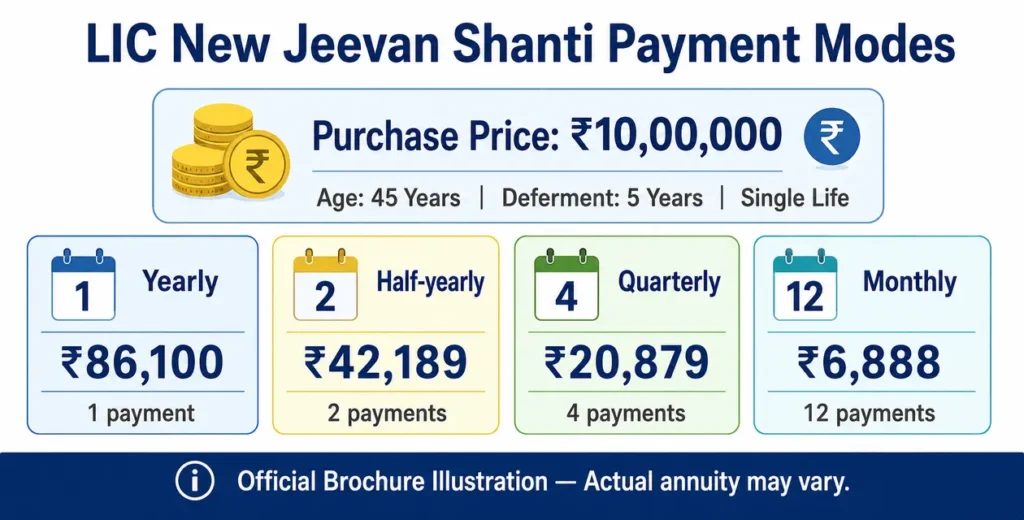
LIC’s current Plan 758 brochure contains an illustration for a purchase price of ₹10,00,000, an entry age of 45 years and a deferment period of five years. For the single-life deferred annuity option, the brochure shows the following annuity amounts:
- Yearly: ₹86,100
- Half-yearly: ₹42,189 per payment
- Quarterly: ₹20,879 per payment
- Monthly: ₹6,888 per payment
These figures illustrate why an annual amount should not always be divided directly by the number of payments. Under the current brochure, the annual annuity rate is reduced by 2% for half-yearly mode, 3% for quarterly mode and 4% for monthly mode.
For the yearly calculation:
₹10,00,000 ÷ ₹1,000 = 1,000 units
1,000 × ₹86.10 = ₹86,100 yearly annuity
The same official illustration shows ₹82,800 yearly for a joint-life deferred annuity where the primary annuitant is aged 45 and the secondary annuitant is aged 35, with the other stated details remaining applicable.
These are official brochure illustrations, not universal quotations. The annuity payable for an actual policy can differ according to the selected option, ages, purchase price, deferment period, mode and applicable incentives.
Understanding Vesting and the First Annuity Payment
The vesting date and first annuity payment date are not necessarily the same.
The vesting date is the date on which the deferment period ends. After vesting, the annuity is paid in arrears according to the selected payment mode. Under current Plan 758, the first monthly payment is due one month after vesting, the first quarterly payment after three months, the first half-yearly payment after six months and the first yearly payment after one year.
For an annuitant aged 45 who selects a five-year deferment period, the approximate vesting age is 50. If yearly mode is selected, the first yearly annuity is normally due one year after the vesting date, subject to the issued policy schedule.
A simplified schedule may therefore show:
- Policy years 1–5: Deferment period; no regular survival annuity is payable
- End of deferment: Annuity vests
- After vesting: First payment becomes due after the selected monthly, quarterly, half-yearly or yearly interval
- Later years: Annuity continues while the applicable annuitant or annuitants remain alive
- Applicable death: Annuity stops and the relevant death-benefit conditions apply
Any cumulative annuity shown by the calculator is only a mathematical projection. Lifetime annuity depends on survival and the terms of the selected option.
Single-Life and Joint-Life Deferred Annuity
Single-life deferred annuity covers one annuitant. After deferment, annuity is payable in arrears for as long as the annuitant remains alive. On death, payments stop, and the applicable death benefit becomes payable.
Joint-life deferred annuity covers a primary and secondary annuitant. Under current Plan 758, it can be taken between eligible family members, including spouses, siblings, and specified lineal ascendants or descendants. After deferment, the annuity continues while either annuitant is alive. The applicable death benefit becomes payable after the death of the last survivor.
Immediate annuity normally starts after the first applicable payment interval following purchase, whereas deferred annuity starts after the chosen deferment period. Current Plan 758 and withdrawn Plan 858 provide deferred annuity. Immediate-annuity options under the Jeevan Shanti name relate to historical Plan 850.
Jeevan Shanti Annuity Rate vs Interest Rate
“Jeevan Shanti interest rate” is a commonly used search phrase, but an annuity rate is not the same as a bank fixed-deposit interest rate.
Unlike bank interest, an annuity converts a lump-sum purchase price into payments designed to continue for the applicable lifetime. Its rate considers age, deferment period, option, purchase price and payment mode. The selected rate is fixed at policy inception and does not automatically increase when market rates rise. Any rate chart should identify the exact plan number, UIN and applicable period.
Death Benefit Under Plan 758
Under the current Plan 758 brochure, the death benefit for both deferred annuity options is the higher of:
- Purchase price plus accrued Additional Benefit on Death, less the total annuity amount payable up to the date of death, if any; or
- 105% of the purchase price.
The Additional Benefit on Death accrues at the end of each policy month during the deferment period only, according to the formula and conditions stated in the brochure.
For single life, the applicable death benefit is payable after the annuitant’s death. For joint life, it becomes payable after the death of the last surviving annuitant.
The plan provides options to receive the death benefit as a lump sum, through annuitisation or in instalments, subject to the applicable conditions.
Plan 858 and Plan 850 calculations must use their respective UIN-specific documents. The current Plan 758 death-benefit formula should not automatically be applied to every older policy.
Survival Benefit and Maturity Benefit
During the deferment period under current New Jeevan Shanti, no regular survival benefit is payable merely because the annuitant survives. After deferment, the annuity becomes the continuing survival payment.
Plan 758 does not provide a conventional maturity benefit. It is not an endowment policy that pays a fixed lump-sum maturity amount at the end of a specified term.
A Jeevan Shanti maturity calculator should therefore focus on the annuity, vesting age, first payment date, death benefit, surrender value and loan facility instead of showing a conventional maturity amount.
Surrender Value
Current Plan 758 can be surrendered at any time during the policy term. The surrender value payable is the higher of the Guaranteed Surrender Value and Special Surrender Value, subject to the policy conditions.
The Guaranteed Surrender Value is calculated as:
Guaranteed Surrender Value = (Applicable GSV factor × Purchase price) − total annuity amount payable up to the surrender date
The current brochure specifies GSV factors of 75% for policy years one to three and 90% from policy year four onwards.
Special Surrender Value is determined and reviewed by LIC on its applicable basis. Any outstanding policy loan, accrued interest or other recoverable amount is deducted from the surrender payment.
Surrender can involve a significant financial reduction. A calculator should therefore label surrender results as estimates. Historical Plan 858 and Plan 850 policies must use their respective provisions.
Policy Loan
Under current Plan 758, a policy loan may be allowed after three months from the date of policy issuance or after expiry of the free-look period, whichever is later. It can be available during and after the deferment period, subject to LIC’s terms and conditions.
The maximum loan is restricted so that the effective annual interest payable on the loan does not exceed 50% of the annual annuity. It is also subject to a maximum of 80% of the surrender value.
The applicable loan rate can change for newly sanctioned loans. A calculator should therefore not permanently use a historical loan rate.
Frequently Asked Questions
What does LIC Jeevan Shanti Calculator calculate?
It estimates annuity income, vesting age, expected first payment timing, payment-mode amounts, and relevant benefit information using the selected plan details and applicable rate.
Which LIC Jeevan Shanti plan is currently available?
The current product is LIC New Jeevan Shanti Plan 758 with UIN 512N338V08.
Is New Jeevan Shanti Plan 858 available for purchase?
No. Plan 858 is withdrawn. Its calculator option is intended for existing policies, old quotations and historical illustrations.
What is the difference between Plan 758 and Plan 858?
Both provide deferred annuity, but Plan 758 is the current plan number and Plan 858 is withdrawn. Their conditions and rates must be checked under the applicable UIN.
What is the difference between Plan 850 and Plan 758?
Plan 850 offered immediate and deferred annuity options. Current Plan 758 provides single-life and joint-life deferred annuity only.
Does LIC New Jeevan Shanti provide monthly pension?
Yes. Monthly annuity mode is available, subject to the plan’s eligibility conditions and minimum annuity requirement.
Can annual annuity be divided by 12 to find the monthly pension?
Not for an accurate Plan 758 estimate. The applicable mode-specific reduction or rate should be used. The current brochure specifies a 4% reduction in the annual annuity rate for monthly mode.
Does Plan 758 provide a maturity benefit?
No. Plan 758 does not provide a conventional maturity benefit. It provides a lifetime annuity after deferment along with the applicable death benefit and other policy facilities.
Is the calculator result an official LIC quotation?
No. It is an estimate. LIC’s official quotation, applicable annuity rate, UIN, policy document and issued policy schedule determine the final benefits.
Official Sources
Important Disclaimer
This is an independent estimation tool and not an official LIC quotation. It is not affiliated with or endorsed by the Life Insurance Corporation of India. Final annuity and other policy benefits depend on LIC’s official quotation, applicable UIN, policy document and issued policy schedule. Rates, tax treatment, loan terms and other conditions can change. Official documents should be checked before making a financial decision.
Conclusion
LIC Jeevan Shanti Plan Calculator helps estimate retirement income under current New Jeevan Shanti Plan 758 and withdrawn Plans 858 and 850. It explains how the purchase price, age, deferment period, annuity option, payment mode and applicable rate can affect the estimated pension.
The correct plan number and UIN must always be selected. Plan 758 is the current deferred annuity product, Plan 858 is a withdrawn deferred annuity plan and Plan 850 is an older product that offered immediate as well as deferred annuity.