
LIC New Jeevan Shanti Plan Calculator
Calculate deferred annuity, payment-mode pension, death benefit illustration, guaranteed surrender value and indicative loan limit for LIC New Jeevan Shanti UIN versions V01 to V08.
Calculation Result
Annuity Calculation
- Selected plan and UIN
- —
- Purchase price
- —
- Base tabular yearly rate
- —
- Higher purchase-price addition
- —
- Customer/channel incentive
- —
- Mode reduction
- —
- Pension starts
- After deferment
- Maturity benefit
- Not available under this plan
Death Benefit Illustration
- Additional Benefit on Death per month
- —
- Accrued Additional Benefit on Death
- —
- Purchase price + accrued benefit − annuity
- —
- 105% of purchase price
- —
- Illustrated death benefit
- —
Surrender and Loan Illustration
- Guaranteed surrender value factor
- —
- Guaranteed surrender value illustration
- —
- Indicative maximum policy loan
- —
Actual surrender value is the higher of Guaranteed Surrender Value and Special Surrender Value. This calculator does not estimate Special Surrender Value.
Important: This is an educational illustration based on official LIC brochure rules and the rate entered above. Final annuity and policy benefits are governed by LIC’s issued quotation, benefit illustration, policy schedule, underwriting decision and applicable rules.
What Is the LIC New Jeevan Shanti Plan Calculator?
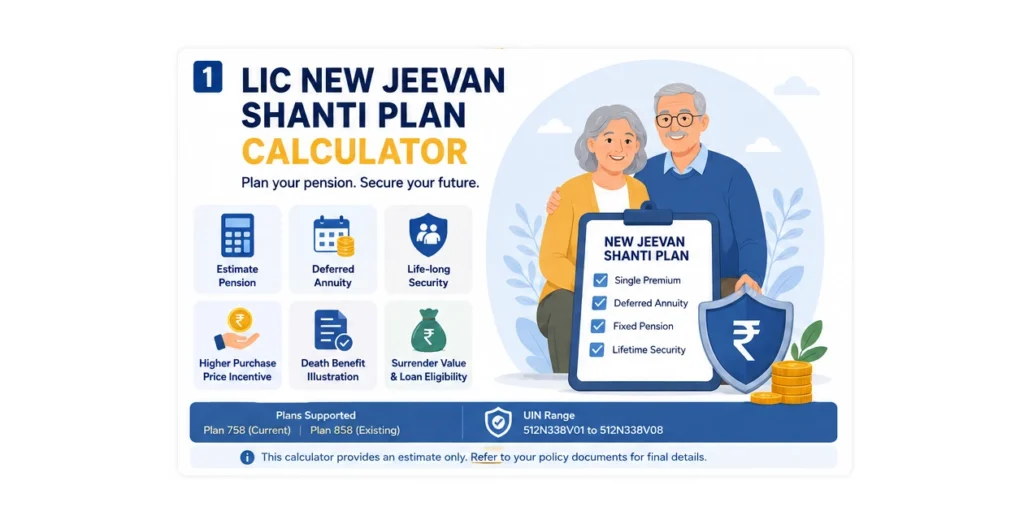
The LIC New Jeevan Shanti Plan Calculator helps estimate the pension available under LIC’s single-premium deferred annuity plan. It uses details such as purchase price, age, deferment period, annuity option and payment frequency to calculate an estimated yearly, half-yearly, quarterly or monthly pension.
The calculator supports the current LIC New Jeevan Shanti Plan 758 and existing policies issued under the older LIC New Jeevan Shanti Plan 858. The plans have a similar basic purpose, but their eligibility conditions and annuity rates may differ.
It supports different UIN numbers from 512N338V01 to 512N338V08. The calculator checks the selected plan, age, deferment period, purchase price, annuity option and payment mode.
It can calculate:
- Estimated yearly pension
- Monthly, quarterly or half-yearly pension
- Higher purchase-price incentive
- Death benefit illustration
- Guaranteed surrender value
For an accurate result, enter the official annuity rate given in the LIC quotation, policy document or benefit illustration.
Accuracy note: Use the rate from an official LIC quotation or policy schedule whenever available. A calculator result based only on sample rates should be treated as an illustration.
Table of Contents
How to Use This New Jeevan Shanti Calculator
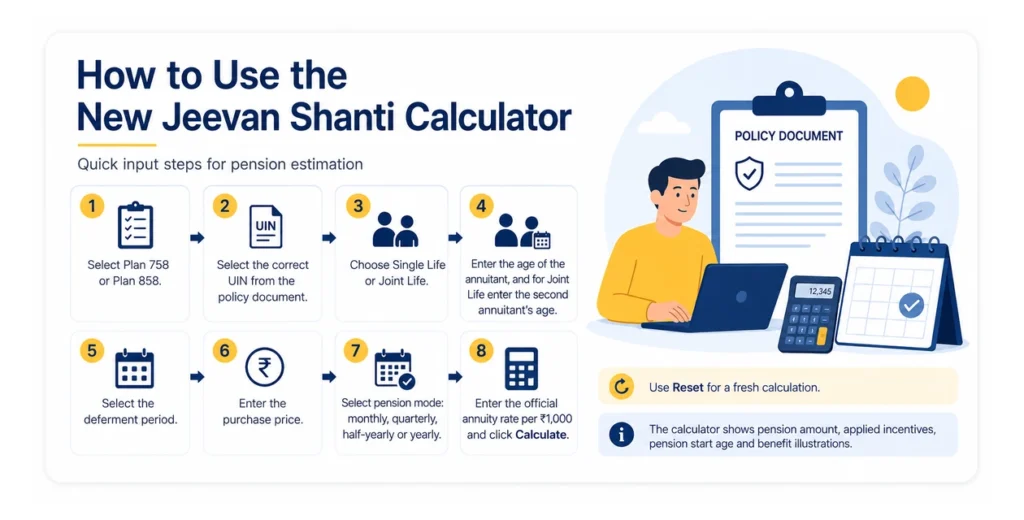
- Select Plan 758 or Plan 858.
- Select the correct UIN mentioned in the policy document.
- Choose Single Life or Joint Life.
- Enter the age of the annuitant.
- For Joint Life, enter the second annuitant’s age.
- Select the deferment period.
- Enter the purchase price.
- Select monthly, quarterly, half-yearly or yearly pension.
- Enter the official annuity rate per ₹1,000.
- Click Calculate.
The calculator will show the pension amount, applied incentives, pension start age and other benefit illustrations.
Use the Reset button to clear all entered details.
Also Check:
What Is LIC New Jeevan Shanti?
LIC New Jeevan Shanti is a single-premium deferred annuity plan.
A single premium means the purchase price is paid once when the policy begins. No yearly or monthly base premiums are required later.
A deferred annuity means pension does not start immediately. It begins after the selected deferment period.
The annuity rate is fixed when the policy is issued. After the deferment period, pension is paid for the lifetime of the annuitant according to the selected single-life or joint-life option.
The plan is non-linked, so pension is not connected to stock-market movements. It is also non-participating and does not receive a bonus or a share in LIC’s surplus.
Plans Under LIC New Jeevan Shanti
LIC New Jeevan Shanti Plan 758
LIC New Jeevan Shanti Plan 758 is the current version of the deferred annuity plan.
It allows a one-time purchase price and provides pension after a deferment period of one to five years. The policyholder may select deferred annuity for a single life or joint life.
The normal minimum purchase price is ₹1,50,000, subject to the minimum pension required for the selected payment mode. The normal entry-age range is 30 to 79 years, while pension must begin within the permitted vesting-age limit.
Plan 758 can be calculated using the current rate applicable to the selected age, purchase price, deferment period, option and payment mode.
LIC New Jeevan Shanti Plan 858
LIC New Jeevan Shanti Plan 858 is an older withdrawn version. It is no longer available as a new Plan 858 purchase.
Existing policies continue according to the terms and annuity rates fixed when they were issued. Because Plan 858 was issued in different versions over time, its pension should be checked from the original policy schedule.
The calculator can estimate an existing Plan 858 policy only when the issued annuity rate, pension amount or other policy-specific information is available.
LIC New Jeevan Shanti Plan 758 vs Plan 858
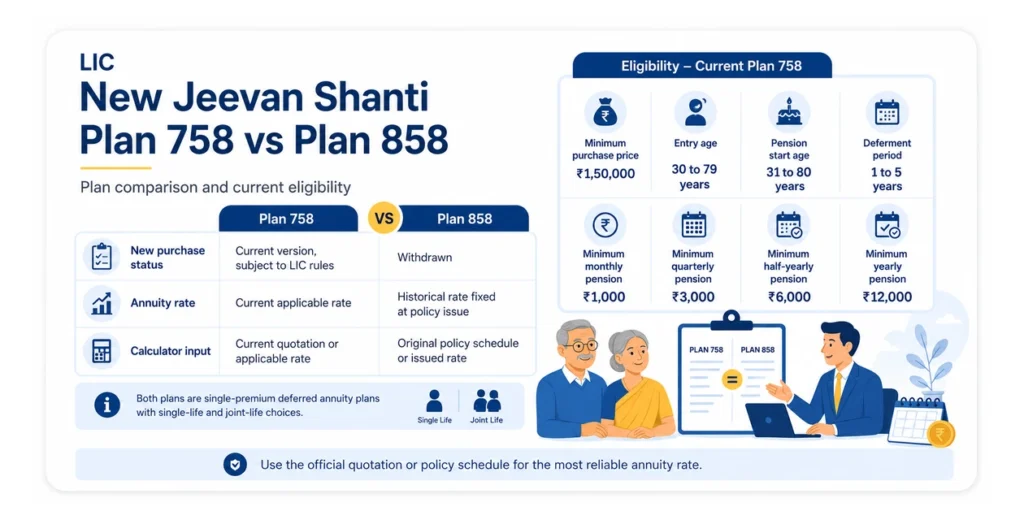
| Difference | Plan 758 | Plan 858 |
|---|---|---|
| New purchase status | Current version, subject to LIC rules | Withdrawn |
| Annuity rate | Current applicable rate | Historical rate fixed at policy issue |
| Calculator input | Current quotation or applicable rate | Original policy schedule or issued rate |
Both plans are single-premium deferred annuity plans with single-life and joint-life choices. These common features do not need separate comparison.
Current Plan 758 Eligibility
| Particular | Plan condition |
| Minimum purchase price | ₹1,50,000, subject to minimum pension |
| Maximum purchase price | No fixed limit, subject to LIC rules |
| Minimum entry age | 30 years |
| Maximum entry age | 79 years |
| Minimum pension start age | 31 years |
| Maximum pension start age | 80 years |
| Deferment period | 1 to 5 years |
| Minimum monthly pension | ₹1,000 |
| Minimum quarterly pension | ₹3,000 |
| Minimum half-yearly pension | ₹6,000 |
| Minimum yearly pension | ₹12,000 |
Different minimum-purchase-price conditions may apply in specified cases involving a dependent person with disability.
Eligibility for an older Plan 858 policy should be checked from its original policy document.
Annuity Options Explained
Single-Life Deferred Annuity
The single-life option covers one annuitant.
No regular pension is paid during the deferment period while the annuitant is alive. After the deferment period ends, pension is paid in arrears for the lifetime of the annuitant.
On the annuitant’s death, pension stops and the applicable death benefit is paid according to the policy conditions and selected death-benefit payment option.
For the same age, purchase price and deferment period, single-life pension may be higher than joint-life pension because only one life is covered.
Joint-Life Deferred Annuity
The joint-life option covers two eligible annuitants.
After the deferment period, pension continues while either annuitant is alive. It stops after the death of the last surviving annuitant.
The death benefit becomes payable after the death of the last survivor, subject to the policy conditions.
Joint-life annuity may be considered where lifetime pension protection is required for two eligible family members.
Deferment Period Explained
The deferment period is the waiting time between purchasing the policy and starting the pension.
For example, when a policy is purchased at age 50 with a five-year deferment period, the pension begins after the deferment period ends.
The vesting date is the date on which the deferment period is completed. The first pension is then paid in arrears according to the selected mode:
- after one month for monthly mode;
- after three months for quarterly mode;
- after six months for half-yearly mode; or
- after one year for yearly mode.
A longer deferment period can result in a higher annuity rate because pension starts later. However, it also delays regular income.
How Pension Is Calculated
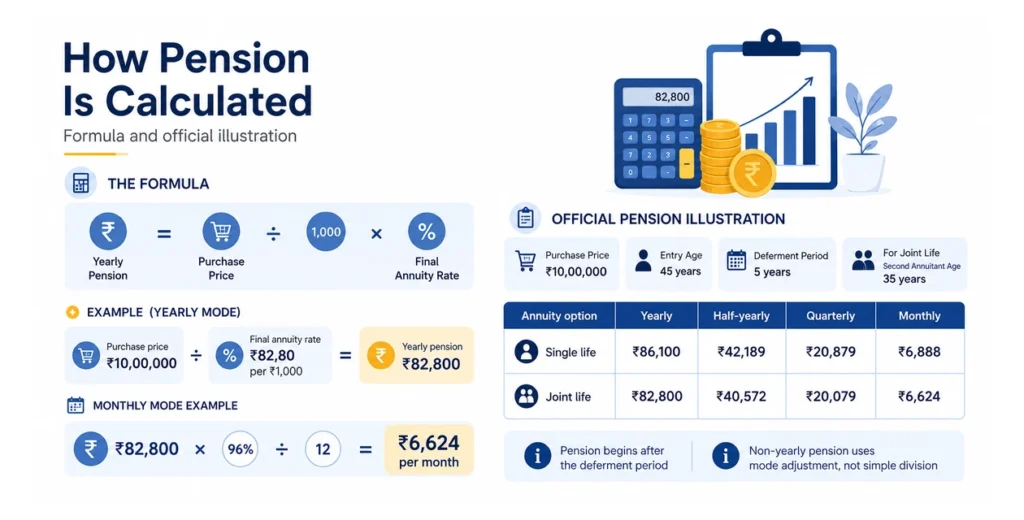
The basic pension formula is:
Yearly Pension = Purchase Price ÷ 1,000 × Final Annuity Rate
The final annuity rate may include the base rate and applicable incentives.
Example
Suppose:
- Purchase price: ₹10,00,000
- Final annuity rate: ₹82.80 per ₹1,000
Calculation:
₹10,00,000 ÷ 1,000 × ₹82.80 = ₹82,800 per year
For monthly pension, the calculator applies the applicable mode adjustment.
₹82,800 × 96% ÷ 12 = ₹6,624 per month
The actual pension depends on age, deferment period, annuity option, purchase price, selected UIN and LIC’s official annuity rate
Monthly, Quarterly and Half-Yearly Pension
A non-yearly pension may not be calculated by simply dividing the yearly pension by 12, 4 or 2.
Under the current plan, the yearly annuity rate is adjusted for the selected payment mode before instalments are calculated.
The broad reductions are:
- 2% for half-yearly pension;
- 3% for quarterly pension; and
- 4% for monthly pension.
The modal calculation can be represented as:
Modal pension = Adjusted annual pension ÷ number of payments in a year
For monthly mode, the annual pension is first calculated using the applicable reduced rate and then divided into 12 instalments.
The official quotation should be used because rounding can create a small difference.
Official Pension Illustration
The following example uses a purchase price of ₹10,00,000, entry age of 45 years and a five-year deferment period. For joint life, the second annuitant is aged 35 years.
| Annuity option | Yearly | Half-yearly | Quarterly | Monthly |
| Single life | ₹86,100 | ₹42,189 | ₹20,879 | ₹6,888 |
| Joint life | ₹82,800 | ₹40,572 | ₹20,079 | ₹6,624 |
The pension begins after the deferment period and continues according to the selected annuity option.
The example excludes applicable tax and should not be treated as an individual quotation.
Death Benefit Calculation
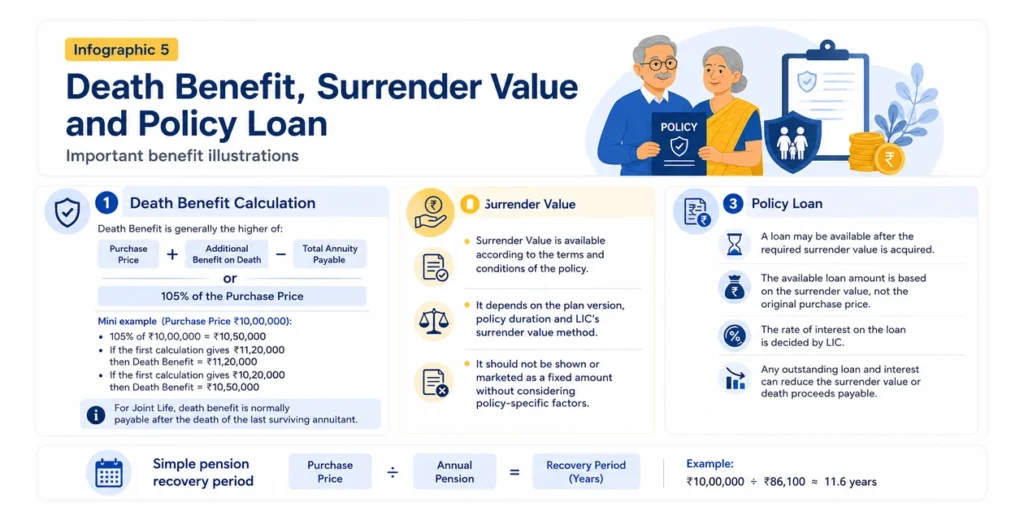
The death benefit is generally the higher of these two amounts:
Purchase Price + Additional Benefit on Death − Total Annuity Payable
or
105% of the Purchase Price
Example
If the purchase price is ₹10,00,000:
105% of ₹10,00,000 = ₹10,50,000
If the first calculation gives ₹11,20,000, the death benefit will be ₹11,20,000.
If the first calculation gives ₹10,20,000, the death benefit will be ₹10,50,000.
For Joint Life, pension continues while either annuitant is alive. The death benefit is normally payable after the death of the last surviving annuitant.
Surrender Value and Policy Loan
The policy may be surrendered according to the applicable policy conditions. The surrender amount depends on the plan version, policy duration and LIC’s prescribed calculation method.
An online calculator should not present a fixed surrender amount unless it uses the correct policy-specific formula and factors.
A policy loan may be available after the policy acquires the required surrender value. The available amount is based on surrender value rather than the original purchase price.
LIC decides the applicable loan interest rate periodically. Outstanding loan principal and interest can reduce the amount payable on surrender or death.
For Plan 858, surrender and loan calculations must follow the terms of the issued version.
Simple Pension Recovery Period
The calculator may show a simple purchase-price recovery period:
Simple pension recovery period = Purchase Price ÷ Annual Pension
Using a purchase price of ₹10,00,000 and yearly pension of ₹86,100:
₹10,00,000 ÷ ₹86,100 = approximately 11.6 years
This means the total pension payments may equal the purchase price after approximately 11.6 years of pension receipt.
This is not an investment-return calculation. It does not fully measure the value of lifetime pension, the deferment period, death benefit or the time value of money.
Inflation and Fixed Pension
The annuity amount is fixed when the policy is issued. It does not automatically increase every year with inflation.
A fixed pension provides predictable income, but its purchasing power may reduce over a long retirement period as living costs rise.
Before selecting the purchase price, consider whether the pension will remain adequate for future household, healthcare and other retirement expenses.
The annuity may form one part of a retirement-income plan rather than the only source of future income.
How to Buy LIC New Jeevan Shanti Plan
Current Plan 758 may be purchased through LIC’s authorised offline channels or directly through LIC’s official website, subject to eligibility and acceptance.
Before purchasing, obtain the latest official benefit illustration. Verify the plan number, purchase price, annuity option, deferment period, pension mode, pension start date, nominee details, applicable incentives and tax.
For joint life, confirm that the relationship between the two annuitants is permitted under the plan.
Read the sales brochure and policy conditions before payment. Do not pay through an unknown link or an unauthorised person. After the policy is issued, check the pension amount, annuitant details and selected option in the policy schedule.
Calculator Limitations
The calculator provides an estimate rather than an official quotation. Current rates may change for new purchases, while older Plan 858 policies require historical policy-specific data.
The calculator cannot confirm proposal acceptance, underwriting, tax, exact surrender value, current loan interest or a death claim. It may also exclude a special incentive or policy exception.
Small differences can arise because of rounding. The policy schedule and official LIC calculation take priority over the online result.
Frequently Asked Questions
Is LIC New Jeevan Shanti an immediate pension plan?
No. It is a deferred annuity plan. Pension begins only after the selected deferment period.
Which LIC New Jeevan Shanti plan is currently available?
Plan 758 is the current version, subject to LIC’s latest availability and eligibility rules. Plan 858 is withdrawn.
Can Plan 858 pension be calculated using Plan 758 rates?
No. An existing Plan 858 policy must use the annuity rate or pension amount recorded in its policy schedule.
What is the minimum purchase price under Plan 758?
The normal minimum purchase price is ₹1,50,000, subject to the minimum pension required for the selected payment frequency.
Does joint-life pension stop after the first death?
No. Pension continues while either annuitant is alive and stops after the death of the last survivor.
Is there a maturity benefit?
There is no separate maturity benefit. Pension is payable for life after the deferment period, and a death benefit applies according to the policy terms.
Is the calculator pension amount guaranteed?
The calculator result is not guaranteed. The annuity fixed in the official quotation and issued policy schedule is payable according to the policy terms.
Conclusion
The LIC New Jeevan Shanti Plan Calculator helps estimate deferred pension, pension start age and death benefit under Plan 758 and existing Plan 858 policies.
Plan 758 calculations should use the current applicable annuity rate. Plan 858 calculations must use the historical rate or pension recorded in the issued policy schedule.
The calculator is useful for comparing single-life and joint-life pension, payment frequencies and deferment periods. Final pension, surrender, loan and claim figures must be checked against LIC’s official quotation or policy documents.
Disclaimer
This calculator and guide are provided for general education. They are not issued by LIC and do not provide financial, insurance, investment, legal or tax advice.
Plan availability, annuity rates, eligibility, incentives, tax and policy conditions may change. Final benefits depend on LIC’s official quotation, accepted proposal, policy schedule, policy document and claim decision.

Amit Kushwaha is a financial content creator and SaaS tool developer based in Lucknow, Uttar Pradesh. He has more than seven years of experience creating insurance-related content, online calculators, and practical digital tools for LIC policyholders, insurance buyers, and LIC agents.
Through LICPolicyCalculator.com, he focuses on simplifying complex LIC policy information into easy-to-understand guides and calculators. His work covers LIC premium estimates, maturity calculations, surrender value tools, policy return calculations, term insurance planning, and plan-specific calculator pages.