LIC Jeevan Nidhi Plan 169 Calculator
| Particulars | Amount / Details |
|---|
| Year | Premium Paid | Guaranteed Benefit | Estimated Total |
|---|
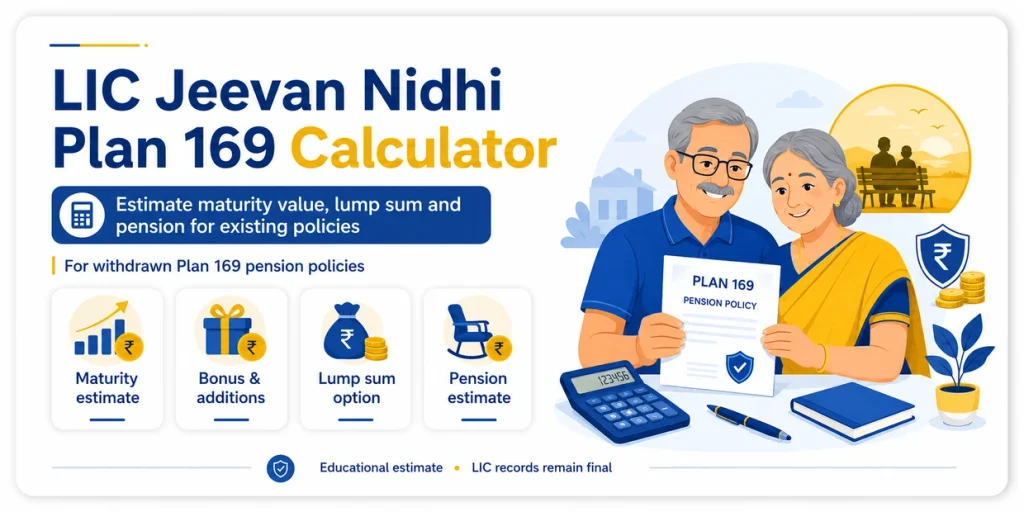
LIC Jeevan Nidhi Plan 169 is a discontinued pension policy that is no longer available for purchase. Existing policyholders may still want to check its expected maturity amount, added benefits, pension, death benefit or surrender value.
The LIC Jeevan Nidhi Plan 169 Calculator makes these calculations easy. It shows how the estimate is worked out and helps make the policy easier to understand.
What Is the LIC Jeevan Nidhi Plan 169 Calculator?
This online tool uses details from the policy bond, such as age, maturity age, Basic Sum Assured, premium type and bonus, to show an estimated policy value. It can calculate the basic premium, total basic premiums, additions earned during the first five years and the bonus added later. It can also show the expected maturity amount, possible lump-sum amount, balance available for pension, death benefit, reduced benefit after stopping premiums and estimated surrender value. These results are only estimates.
Also Check:
- LIC New Jeevan Nidhi Plan 812 Maturity Calculator
- New Jeevan Nidhi Plan 818 Calculator
- LIC Jeevan Nidhi Calculator All in One
Jeevan Nidhi Plan 169 Key Highlights
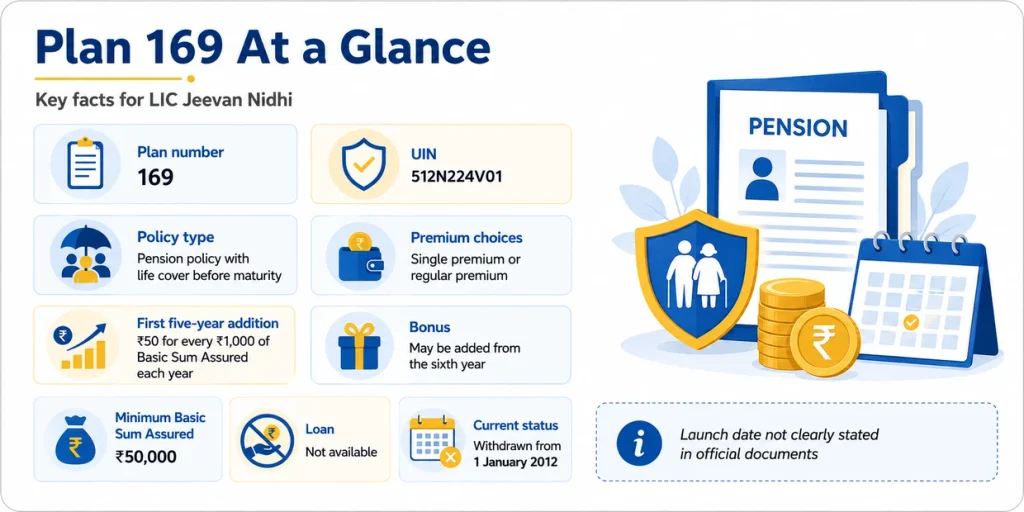
| Detail | Information |
|---|---|
| Plan name | LIC Jeevan Nidhi |
| Plan number | 169 |
| UIN | 512N224V01 |
| Type of policy | Pension policy with life cover before maturity |
| Premium choices | Single premium or regular premium |
| Addition during first five years | ₹50 for every ₹1,000 of Basic Sum Assured each year |
| Bonus | May be added from the sixth policy year |
| Minimum Basic Sum Assured | ₹50,000 |
| Loan | Not available |
| Current status | Withdrawn from 1 January 2012 |
The available official LIC documents do not clearly state the exact launch date, so it has not been included here.
What Was LIC Jeevan Nidhi Plan 169?
Plan 169 helped build money for retirement. One premium could be paid at the beginning, or regular premiums could be paid during the policy term.
The policy earned a fixed addition during its first five completed years. From the sixth year, LIC could add a bonus. This bonus was not fixed.
When the policy reached its maturity date, the available amount was mainly used to provide regular pension income. LIC calls this the vesting date. Up to one-third of the amount could be taken as a lump sum under the original plan rules. The remaining amount was used to provide regular pension payments.
Benefits of LIC Jeevan Nidhi Plan 169
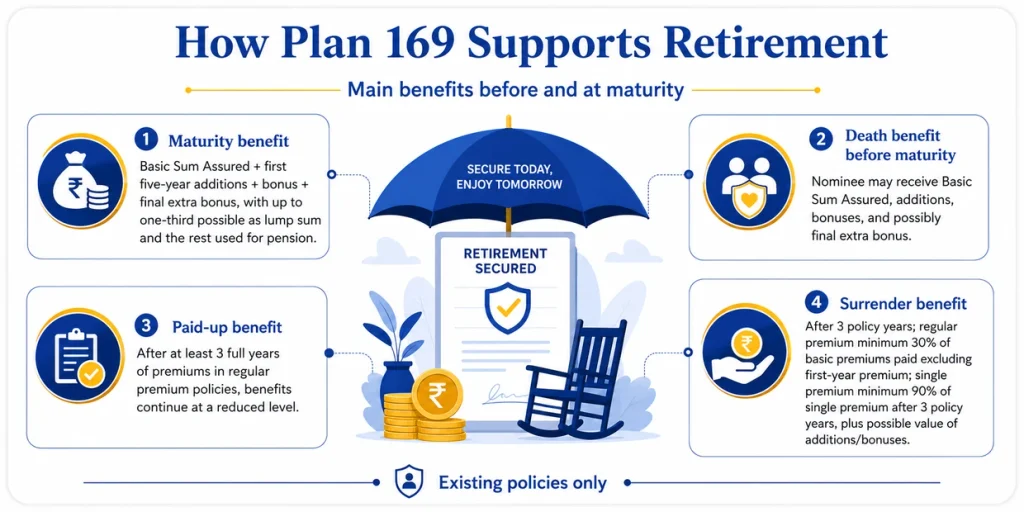
Maturity Benefit
If the policy remained active until maturity, the available amount could include:
- Basic Sum Assured;
- additions earned during the first five years;
- bonuses already added by LIC; and
- a final extra bonus, if LIC declared it and the policy qualified.
This was a pension policy, so the full amount was not normally paid in cash. Up to one-third could be taken as a lump sum under the plan rules. The rest was used to provide a pension.
Death Benefit Before Maturity
If the policyholder died before the maturity date while the policy was active, the nominee could receive the Basic Sum Assured, additions earned and bonuses already added. A final extra bonus could also be included if applicable.
The nominee could take the claim as a lump sum or use it for a regular pension, subject to the policy rules.
Benefit After Stopping Premiums
A regular premium policy could continue with lower benefits after at least three full years of premiums had been paid. This is called a paid-up policy.
The amount would be reduced according to the number of premiums paid. Additions and bonuses already earned would normally remain attached to the policy, but no new additions or bonuses would be earned after the policy became paid-up.
Surrender Benefit
Surrendering means ending the policy before maturity and taking its available value. Plan 169 could be surrendered after completing three policy years, subject to the required premiums having been paid.
For a regular premium policy, the minimum surrender amount was 30% of the basic premiums paid, excluding the first year’s premium. For a single premium policy, it was 90% of the single premium after three policy years.
Taxes, extra premiums and optional cover charges were not included in this calculation. LIC could also add the cash value of additions and bonuses already earned. The exact surrender amount requires LIC’s policy records and surrender rates.
How Does the Calculator Work?
The calculator uses details from the policy bond or latest LIC statement. It first finds the policy term from the starting age and maturity age.
It calculates the additions for the first five years and estimates the later bonus. These amounts are added to the Basic Sum Assured to show the possible maturity value.
For a pension estimate, the selected lump sum is removed and the remaining balance is used. Actual pension rates depend on age and the chosen payment option.
Formula Used in the Calculator
Policy Term
Policy term = Maturity age − Age when the policy startedAdditions for the First Five Years
LIC provided an addition of ₹50 for every ₹1,000 of Basic Sum Assured for each completed year during the first five years.
Addition =
Basic Sum Assured × 50 ÷ 1,000 × eligible years
Only up to five years are counted.
Estimated Bonus
Bonus could be added from the sixth policy year. LIC declared different bonus rates over the years, so one rate should not be treated as fixed for the complete policy term.
Estimated bonus =
Basic Sum Assured × entered bonus rate ÷ 1,000 × bonus years
For a better result, use the total bonus already shown in LIC records. If an assumed rate is used, the result should be treated only as an example.
Estimated Maturity Amount
Estimated maturity amount =
Basic Sum Assured
+ additions for the first five years
+ bonus already added or estimated
+ final extra bonus, if applicable
Lump-Sum and Pension Estimate
Lump-sum amount = Maturity amount × selected percentage

Balance used for pension = Maturity amount − Lump-sum amount

Estimated yearly pension = Balance used for pension × assumed pension rate
The plan allowed up to one-third as a lump sum. Actual pension depends on the rates and payment option available when it starts.
How to Use the Calculator
- Enter the age when the policy started.
- Enter the age when the policy matures.
- Add the Basic Sum Assured shown in the policy bond.
- Select single premium or regular premium.
- Select the premium payment frequency and enter the basic premium.
- Enter the bonus already added to the policy or use an assumed rate for a rough estimate.
- Enter the final extra bonus only if it is known or needs to be included as an example.
- Select the part to be taken as a lump sum, up to the limit allowed by the policy.
- Enter an assumed pension rate only if a simple pension estimate is needed.
- Select Calculate to see the result.
The Reset button clears all entered details and the previous result.
LIC Jeevan Nidhi Plan 169 Calculation Example
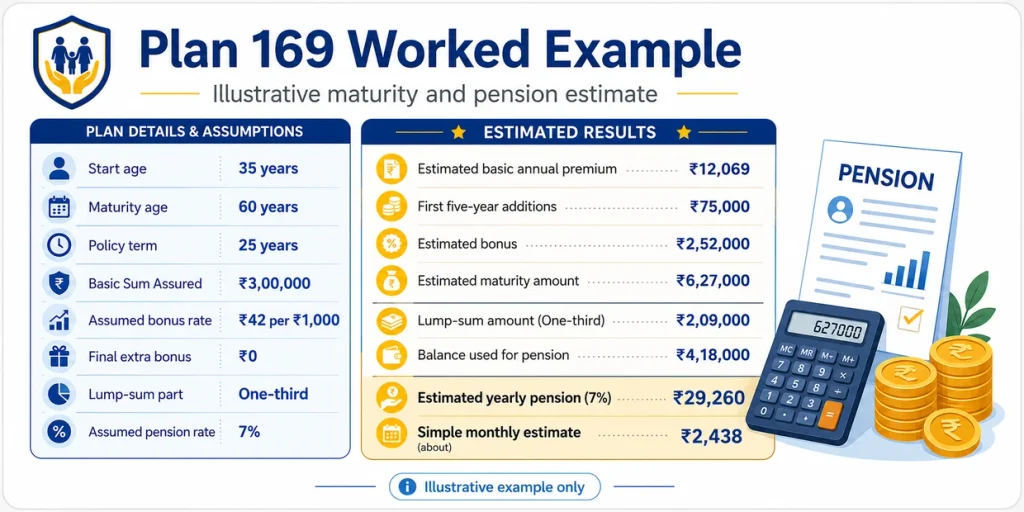
We will use the following policy details in this calculation.
| Policy detail | Example value |
| Age when policy started | 35 years |
| Age when policy matures | 60 years |
| Policy term | 25 years |
| Basic Sum Assured | ₹3,00,000 |
| Premium payment | Yearly |
| Assumed bonus rate | ₹42 per ₹1,000 |
| Final extra bonus | ₹0 |
| Lump-sum part | One-third |
| Assumed pension rate | 7% |
Step 1: Basic Annual Premium
The official brochure gives a basic annual rate of ₹42.05 per ₹1,000 for age 35 and a 25-year term. The higher Sum Assured discount is ₹1 per ₹1,000, and the yearly payment discount is 2%.
Rate after higher Sum Assured discount = ₹42.05 − ₹1 = ₹41.05

Premium before yearly discount = ₹41.05 × 300 = ₹12,315

Estimated basic annual premium = ₹12,315 × 98% = ₹12,069
This is the estimated basic premium before applicable tax and optional cover charges.
Step 2: Additions for Five Years
₹3,00,000 × 50 ÷ 1,000 × 5 = ₹75,000Step 3: Estimated Bonus
The bonus is counted for 20 years because it starts after the first five policy years.
Bonus years = 25 − 5 = 20 years

₹3,00,000 × 42 ÷ 1,000 × 20 = ₹2,52,000
The ₹42 rate is used only to explain the calculation. Actual yearly bonus rates may be different.
Step 4: Estimated Maturity Amount
Basic Sum Assured:        ₹3,00,000
First five-year addition:   ₹75,000
Estimated bonus:          ₹2,52,000
Final extra bonus:                ₹0
-----------------------------------
Estimated maturity amount: ₹6,27,000
Step 5: Lump-Sum Amount and Pension Estimate
If one-third is taken as a lump sum:
Lump-sum amount = ₹6,27,000 ÷ 3 = ₹2,09,000

Balance used for pension = ₹6,27,000 − ₹2,09,000
                         = ₹4,18,000
At an assumed pension rate of 7%:
Estimated yearly pension = ₹4,18,000 × 7% = ₹29,260

Simple monthly estimate = ₹29,260 ÷ 12 = about ₹2,438
This monthly amount is only an example. The actual pension depends on age, payment frequency, the chosen option and rates available at that time.
Understanding the Calculator Result
The result separates fixed policy amounts from estimates. The Basic Sum Assured and eligible first five-year additions come from the policy rules. Later bonuses depend on LIC’s declarations.
The pension figure is not guaranteed. A choice that also covers a spouse may pay a different amount from a pension covering only one person.
The premium result should be called the basic premium before tax and optional cover charges. Extra charges may apply because of health, occupation or added benefits.
Paid-Up and Surrender Value
For a regular premium policy, the reduced Basic Sum Assured can be understood with this formula:
Reduced Basic Sum Assured =
Basic Sum Assured × premiums paid ÷ total premiums due
This does not always show the complete paid-up benefit because additions and bonuses already earned may also be included.
For a regular premium policy, the minimum surrender value can be estimated as:
Minimum surrender value =
30% × basic premiums paid after excluding the first year’s premium
For a single premium policy:
Minimum surrender value = 90% × single premium paidThe amount offered by LIC may be higher after including the value of earned additions and bonuses. Confirm the final amount before ending the policy.
Tax Rule
Tax rules can change. The lump-sum amount and regular pension may not be taxed in the same way. The full maturity amount should not be described as tax-free. The rules that apply when the policy matures should be checked, especially when the amount is large.
Important Points to Remember
- Plan 169 is closed to new buyers and is useful only for existing policyholders.
- Use the policy bond or LIC statement for the correct Sum Assured, policy term, premiums and added bonuses.
- An assumed bonus rate does not show the exact bonus earned in every policy year.
- The pension rate entered in the calculator gives only a rough estimate.
- The final maturity, death, paid-up and surrender amounts are decided from LIC’s policy records.
Frequently Asked Questions
Is LIC Jeevan Nidhi Plan 169 still available?
No. LIC withdrew the plan on 1 January 2012. Existing policies can continue according to their conditions, but a new Plan 169 policy cannot be purchased.
How is the Plan 169 maturity amount calculated?
The amount can include the Basic Sum Assured, additions earned during the first five years, bonuses already added by LIC and a final extra bonus, if declared and applicable.
Is the calculator result guaranteed?
No. It is an estimate. The result can change because bonuses, surrender rates and pension rates are not fixed by the calculator.
Can the full maturity amount be taken in cash?
Not normally. Under the original plan rules, up to one-third could be taken as a lump sum. The remaining amount was used to provide regular pension income.
Where can the actual bonus amount be checked?
The bonus already added to the policy can be checked in the latest LIC statement or confirmed at an LIC branch. Using this amount gives a better result than using one assumed rate for all years.
Conclusion
The LIC Jeevan Nidhi Plan 169 Calculator helps existing policyholders understand their expected policy value without working through every calculation by hand. It can show the basic premium, additions for the first five years, estimated bonus, maturity amount, possible lump sum and regular pension estimate.
The calculator is useful for planning, but its result is not final. LIC’s policy records remain the final source for maturity, death, paid-up, surrender and pension benefits.