LIC Jeevan Lakshya Calculator
Plans 833, 933 and 733 • Maturity, death, paid-up and surrender estimates
Optional bonus and surrender details
Calculation Results
Year-wise premium and benefit schedule
| Policy Year | Age | Premium Status | Annual Base Premium | Cumulative Premium | Projected Bonus |
|---|
Important: This calculator provides an estimate from the selected Jeevan Lakshya version and entered information. Future bonus, Final Additional Bonus, Special Surrender Value, tax, riders and underwriting decisions are not guaranteed. The LIC policy bond and official quotation govern the final benefit.

LIC Jeevan Lakshya is a life insurance and savings plan made to provide financial support to a family during important stages of life. Its special feature is the annual income benefit that may become payable after the death of the life assured, followed by a lump-sum amount on the maturity date, subject to the applicable policy conditions.
Jeevan Lakshya has been issued under three plan numbers: 733, 933 and 833. These versions share the same broad purpose, but their UIN, sale period and some policy rules are different. The plan number printed on the policy bond must therefore be checked before reading benefit details or using a calculator. This guide explains the complete LIC Jeevan Lakshya family and helps in choosing the correct plan-specific page.
What Is LIC Jeevan Lakshya?
LIC Jeevan Lakshya is a participating, non-linked, individual savings plan that combines life protection with long-term savings. “Participating” means an eligible policy may receive bonuses declared by LIC. “Non-linked” means the policy value is not directly connected to stock-market units like a ULIP.
The plan is designed to provide financial help to the family if the life assured dies before maturity. Under the current version, an annual income benefit may be paid during the remaining policy term, while a lump-sum amount becomes payable on the maturity date. If the life assured survives the full term, the maturity benefit is paid according to the policy conditions.
Jeevan Lakshya is not a pure term plan because it also has a savings and maturity component. It is also not a market-linked investment plan. Future bonuses depend on LIC’s declarations and cannot be fixed or guaranteed when the policy is purchased.
Purpose of LIC Jeevan Lakshya
The main purpose of LIC Jeevan Lakshya is to protect a family goal even when the earning member is no longer present. LIC particularly mentions children’s needs, but the policy is not limited to education or marriage. It may support other long-term family responsibilities.
If the life assured dies during the term, annual income may help the family manage regular expenses until maturity. The lump-sum benefit can then support the original goal. This structure is useful only when the premium commitment is affordable. Someone who mainly needs large life cover at a low premium may find pure term insurance more suitable.
How Does LIC Jeevan Lakshya Work?
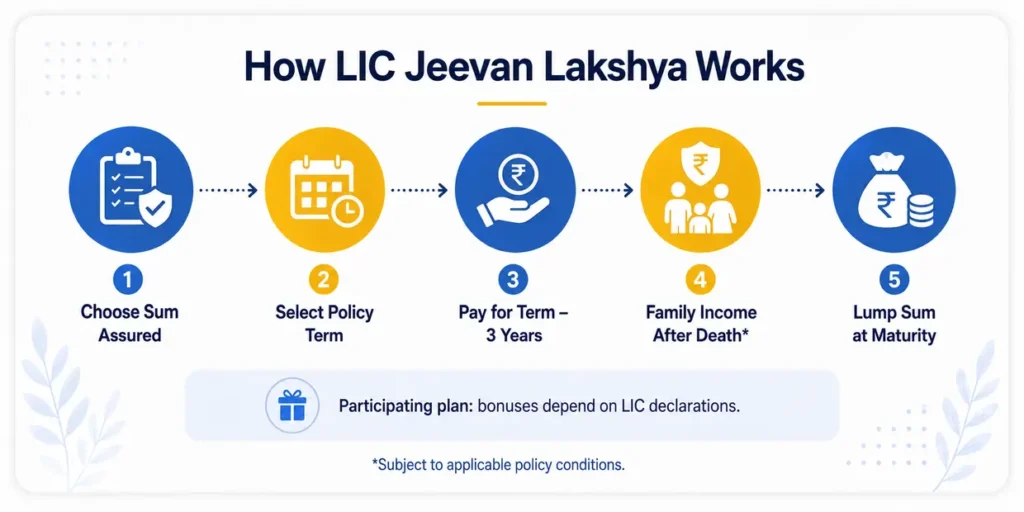
The policyholder selects the Basic Sum Assured and policy term, while premiums are paid for a shorter period. An eligible in-force policy may receive bonuses. On survival, maturity benefits are paid. If death occurs earlier, the applicable version may provide annual family income and a lump-sum component at maturity. Plans 733, 933 and 833 must always be checked under their own documents.
LIC Jeevan Lakshya Plans at a Glance
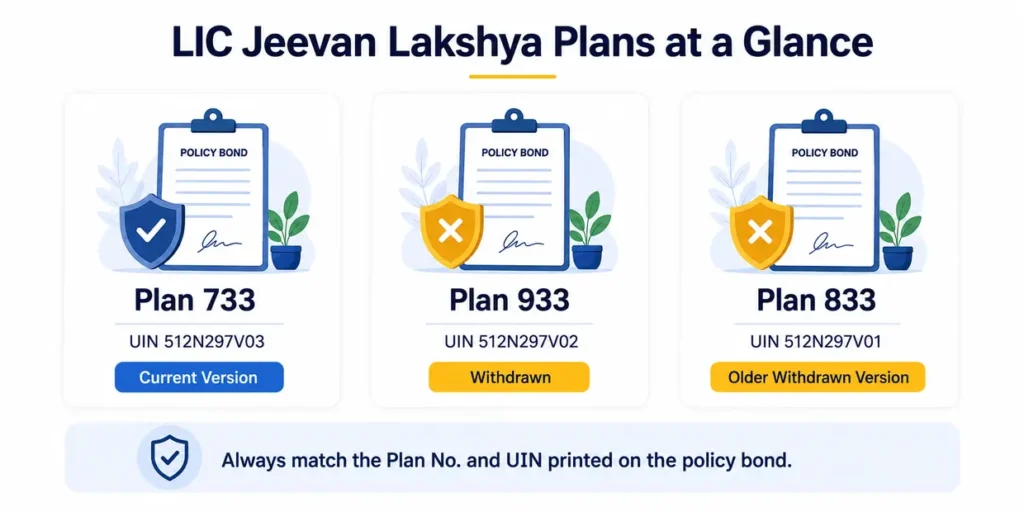
| Plan | UIN | Position |
|---|---|---|
| Plan 733 | 512N297V03 | Current version |
| Plan 933 | 512N297V02 | Withdrawn version |
| Plan 833 | 512N297V01 | Older withdrawn version |
A withdrawn plan is closed for new purchase. It does not mean that every policy already issued under that plan has ended. An existing policy continues according to its original contract and present policy status.
LIC Jeevan Lakshya Plan 733
LIC Jeevan Lakshya Plan 733 is the current version listed by LIC. Its UIN is 512N297V03. LIC describes it as a participating, non-linked, life, individual savings plan offering a combination of protection and savings.
The plan provides annual income intended to support the family if the life assured dies before maturity, along with a lump-sum amount at maturity under its terms. Its current brochure also provides a limited premium-paying structure, instalment options for certain benefits, loan provisions and optional riders subject to conditions.
Plan 733 rules should be used only for a policy carrying Plan No. 733 and the relevant UIN. Read the LIC Jeevan Lakshya Plan 733 calculator and complete guide for its exact eligibility, benefits, rider options and calculations.
LIC Jeevan Lakshya Plan 933
LIC Jeevan Lakshya Plan 933 carried UIN 512N297V02. It was launched on 1 February 2020, and LIC records its withdrawal from new sales on 1 October 2024. It was replaced by a later version, but existing Plan 933 policies continue according to the terms under which they were issued.
A Plan 933 holder should not use Plan 733 rates or assume every updated condition applies. The relevant UIN controls the contract, while policy status, premiums paid and vested bonuses affect an existing policy’s value.
For correct fields and version-based estimates, use the LIC Jeevan Lakshya Plan 933 calculator and policy details.
LIC Jeevan Lakshya Plan 833
LIC Jeevan Lakshya Plan 833 carried UIN 512N297V01 and is the earliest version in this Jeevan Lakshya series. LIC records 1 February 2020 as its withdrawal date. This version is mainly relevant to existing policyholders, nominees and family members checking old policy records.
Plan 833 is a separate contract. Plan 933 or 733 rules may not correctly describe its premium, eligibility, paid-up, surrender or claim benefits. Confirm the plan number, UIN and premium status before calculation.
Open the LIC Jeevan Lakshya Plan 833 calculator and complete guide for information prepared specifically for this version.
LIC Jeevan Lakshya Plan 733 vs 933 vs 833
The main difference is the policy-document version that applies. Plan 733 carries UIN version V03 and is the current product. Plan 933 carries V02 and is withdrawn, while Plan 833 carries V01 and is the oldest withdrawn version in this series.
The newest plan should not be selected merely because it is currently available. A policy purchased under Plan 833 remains a Plan 833 policy. In the same way, Plan 933 does not become Plan 733 after the newer version is introduced. The correct calculator is always the one matching the plan number and UIN on the policy schedule.
Key Features of LIC Jeevan Lakshya
Jeevan Lakshya combines protection and savings. Its main feature is annual income after death, followed by a maturity-linked lump sum. An eligible policy may receive bonuses, but future rates are unknown. Depending on the version, riders, instalment payments, revival, paid-up value, surrender and loan facilities may also be available.
LIC Jeevan Lakshya Eligibility
Eligibility is based on the age at entry, age at maturity, chosen policy term, premium-paying term and Basic Sum Assured. LIC may also apply underwriting requirements based on factors such as age, health, occupation and the amount of cover.
For current Plan 733, the official brochure states an entry-age range of 18 to 50 years, a policy term of 13 to 25 years and a premium-paying term equal to the policy term minus three years. The minimum Basic Sum Assured is ₹2,00,000, while the maximum is subject to LIC’s underwriting decision. These figures should not be applied to Plans 933 or 833 without checking their respective documents.
The actual premium depends on the version, age, term, Basic Sum Assured, payment mode, riders and underwriting decision.
Benefits Under LIC Jeevan Lakshya
Death Benefit
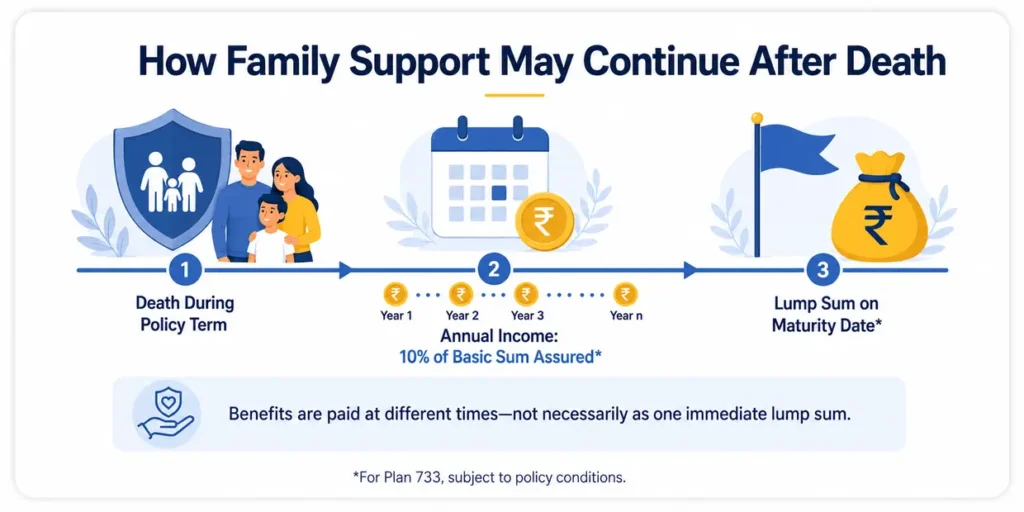
The death benefit depends on the version, date of death, premiums paid and policy status. Under Plan 733, it checks seven times the annualised premium against the structure based on 110% of Basic Sum Assured plus annual income, subject to the stated minimum. Different parts are payable at different times; it is not necessarily one immediate lump sum.
Annual Income Benefit
Under Plan 733, annual income equal to 10% of Basic Sum Assured is payable from the policy anniversary on or after death until the anniversary before maturity, subject to eligibility. It is separate from the maturity-date lump sum.
Maturity Benefit
For an in-force Plan 733 policy, the Sum Assured on Maturity equals the Basic Sum Assured. Vested bonuses and a Final Additional Bonus, if declared and applicable, are added. Future bonus rates are unknown, so projected maturity is not a fixed return.
Bonus
LIC may declare Simple Reversionary Bonus and, for an eligible claim, Final Additional Bonus. These are not guaranteed in advance, and a calculator can only use an assumption.
Rider Benefits
Optional riders can provide extra protection on payment of an additional premium. Their availability, entry conditions, cover period and exclusions depend on the Jeevan Lakshya version and rider rules. Rider benefits should not be added to the basic policy estimate unless the rider is actually attached to the policy.
LIC Jeevan Lakshya Calculator
LIC Jeevan Lakshya combines long-term savings with financial support for the family. If the life assured dies before maturity, the family may receive an Annual Income Benefit during the remaining policy term, followed by another payment on the maturity date.
The LIC Jeevan Lakshya Calculator packed with Plan 833 (UIN 512N297V01), Plan 933 (UIN 512N297V02) and current Plan 733 (UIN 512N297V03) into one tool. It changes the applicable checks according to the selected version instead of mixing old and current rules.
What Is LIC Jeevan Lakshya Calculator?
It is an online estimation tool for checking the Premium Paying Term, premium commitment, maturity benefit, Annual Income Benefit, paid-up value and surrender value where enough information is available. Plans 833 and 933 are included because existing policyholders may still need estimates under their original conditions.
This is not an official LIC quotation system. LIC’s public brochures do not provide a complete premium table for every age and term. The calculator therefore asks for the base instalment premium shown in the LIC quotation or policy document instead of inventing a rate. Enter the premium without tax, rider premium or underwriting extra premium.
The maturity estimate may include the Basic Sum Assured, an entered vested bonus or assumed Simple Reversionary Bonus and an optional Final Additional Bonus. Future bonuses are not guaranteed. Unknown bonus, GSV or SSV fields can be left blank.
How to Use LIC Jeevan Lakshya Calculator
Select the plan number printed on the policy bond and enter the age at entry, policy start year, term and Basic Sum Assured. The permitted entry age is 18 to 50 years, with terms from 13 to 25 years and maximum maturity age of 65 years. Plan 733 has a minimum Basic Sum Assured of ₹2,00,000. Plans 833 and 933 have a minimum of ₹1,00,000. The calculator also checks the permitted amount multiples for the selected version.
Choose yearly, half-yearly, quarterly or monthly mode and enter one base-premium instalment. For an existing policy, add the number of full premium years paid. Enter an assumed death policy year to view the family-income schedule. Optional fields can be used for bonus, Final Additional Bonus and LIC-provided surrender values. Press Calculate to see the separate premium, maturity, death, paid-up and surrender results. Reset clears all fields.
Formula Used in This Calculator
The Premium Paying Term is three years shorter than the policy term:
Premium Paying Term = Policy Term − 3
Annualised Base Premium = Instalment Premium × Instalments per year
Total Base Premium = Annualised Base Premium × Premium Paying Term
The maturity and bonus estimates are:
Projected Bonus = (Basic Sum Assured ÷ 1,000) × Assumed Bonus Rate × Policy Term
Estimated Maturity Benefit = Basic Sum Assured + Bonus Used + Final Additional Bonus
After an assumed death, the Annual Income Benefit is 10% of the Basic Sum Assured for each applicable year. The estimated number of payments is the policy term minus the death policy year. The scheduled base death benefit is 110% of the Basic Sum Assured plus total annual income payments.
For Plans 933 and 733, the calculator also checks seven times the annualised premium and the 105% of applicable total premiums-paid condition, then shows the highest applicable base amount. Plan 833 follows its earlier benefit structure without automatically applying the later seven-times-premium test.
Paid-up calculations use:
Paid-up Ratio = Full Premium Years Paid ÷ Original Premium Paying Term
Maturity Paid-up Sum Assured = Basic Sum Assured × Paid-up Ratio
The minimum premium requirement is checked separately: three full years for Plan 833, two for Plan 933 and one full year for Plan 733. No future bonus is projected after paid-up status. If LIC-provided GSV and SSV amounts are entered, the calculator displays the higher amount; it does not create official surrender factors.
Real-Life Use Case Example
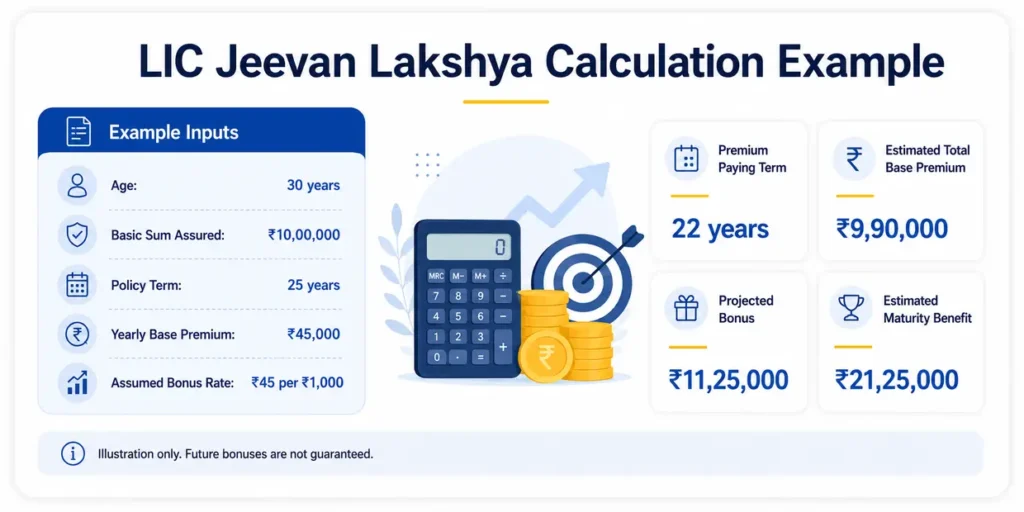
Consider Plan 733 for a 30-year-old with a Basic Sum Assured of ₹10,00,000, a 25-year term and a yearly base premium of ₹45,000. The Premium Paying Term is 22 years, so the estimated total base premium is ₹45,000 × 22 = ₹9,90,000.
At an assumed bonus rate of ₹45 per ₹1,000, the projected bonus is ₹11,25,000. The estimated maturity benefit becomes ₹10,00,000 + ₹11,25,000 = ₹21,25,000, excluding any Final Additional Bonus. This is only an illustration.
If death is assumed in policy year eight, annual income is 10% of ₹10,00,000, or ₹1,00,000. The calculator estimates 17 payments, totalling ₹17,00,000. The 110% Basic Sum Assured component is ₹11,00,000 and is payable according to the maturity-date benefit structure. Bonuses remain separate and depend on policy conditions and LIC declarations.
How This Calculator Is Beneficial
The calculator separates yearly family income, the maturity-date component, maturity benefit, bonus and premium commitment instead of showing one confusing total. It also applies the minimum Sum Assured and paid-up rules for Plan 833, 933 or 733. Uncertain figures remain clearly marked: no unsupported premium is created, assumed bonus is not shown as guaranteed, and surrender value is not estimated without LIC-provided information.
Paid-Up Value, Surrender and Policy Loan
Paid-up and surrender values arise only after the applicable conditions are met. They depend on premiums paid, completed duration, Basic Sum Assured, vested bonuses and LIC factors. If premiums stop after paid-up value is acquired, benefits normally reduce. Surrender ends the policy, while a loan may be available after surrender value is acquired. Outstanding loan and interest reduce the final payment. Calculator figures are approximate; the servicing LIC branch can confirm the official value.
Who Should Consider LIC Jeevan Lakshya?
The plan may suit someone wanting life cover with long-term, non-linked savings and structured family income after death. It may support a child’s future or another goal when premiums can be maintained. It may not suit someone seeking maximum cover at a low premium, short-term liquidity or market-linked growth. Affordability and other protection and savings options should be compared first.
Important Exclusions and Limitations
Every version contains exclusions and conditions. The suicide clause can limit the amount payable when death occurs within the period stated in the applicable policy document. Riders have separate exclusions, and their cover is not automatically included in the base plan.
Non-payment of premiums can cause the policy to lapse or continue with reduced paid-up benefits after the required conditions are met. Surrender is also subject to eligibility and official factors. Bonus projections are illustrations, not promises. Always read the exact policy document matching Plan 733, 933 or 833 before making a purchase, surrender or claim decision.
Tax Rule
Tax deductions on premiums and taxation of policy proceeds depend on the prevailing Income-tax Act, issue date, premium-to-cover conditions and other applicable rules. Every premium or benefit should not be assumed to be automatically tax-free. Current rules should be checked when filing a tax return, and professional tax advice may be taken where required.
How to Identify the Correct Plan Version
Open the policy bond and find the policy schedule near the first few pages. Check the plan or table number and confirm whether it shows 733, 933 or 833. Also note the UIN printed beside the product name. Then use the matching plan guide and calculator. If the document is unavailable, the plan details can be checked through LIC’s customer portal or servicing branch.
Frequently Asked Questions
What is LIC Jeevan Lakshya?
It is a participating, non-linked savings and protection plan. It provides a maturity benefit and a special family-income structure after the death of the life assured, subject to policy conditions.
Is LIC Jeevan Lakshya a child plan?
It is not restricted to a child. LIC mentions children’s needs as an important purpose, but the policy may support other long-term family goals as well.
What is the difference between Plans 733, 933 and 833?
They are different versions of Jeevan Lakshya with UINs V03, V02 and V01 respectively. Plan 733 is current, while Plans 933 and 833 are withdrawn from new sales.
Is LIC Jeevan Lakshya Plan 933 still available?
No, Plan 933 is not available for a new purchase. An existing Plan 933 policy can continue according to its original terms and policy status.
Is the maturity amount guaranteed?
The Basic Sum Assured used for maturity is defined in the policy, but future Simple Reversionary Bonuses and any Final Additional Bonus are not guaranteed in advance.
What happens after the policyholder’s death?
Benefits are paid according to the selected version’s death-benefit structure. This may include annual income during the remaining term and a lump-sum amount on maturity, subject to the policy conditions.
Is the calculator result an official LIC quotation?
No. It is an estimate based on the entered values and assumptions. LIC’s official records and policy document determine the final premium, surrender, maturity or claim amount.