LIC Jeevan Lakshya
Plan 733 Calculator
Enter Details
Premium Summary
Result Card
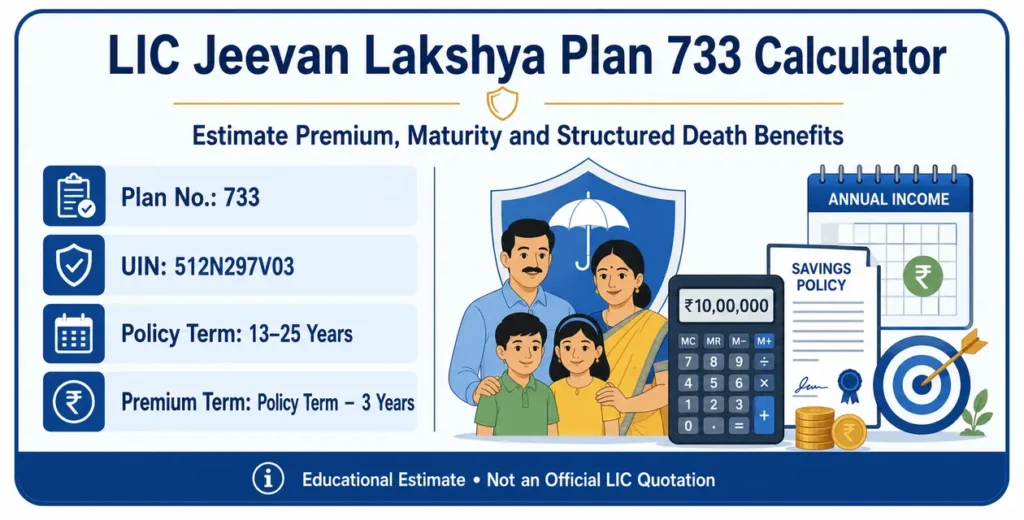
The LIC Jeevan Lakshya Plan 733 Calculator helps estimate premium outgo, maturity benefits and the structured death benefit available under LIC’s Jeevan Lakshya. The current plan carries UIN 512N297V03 and combines life insurance protection with long-term savings and participation in LIC’s profits.
The calculator is useful for understanding the relationship between entry age, policy term, premium-paying term, Basic Sum Assured and estimated bonuses. It can also illustrate the Annual Income Benefit that may support the family after the death of the Life Assured.
All results are educational estimates. LIC’s official premium quotation, benefit illustration, underwriting decision, issued policy schedule and declared bonus rates remain final.
LIC Jeevan Lakshya Plan 733 Overview
| Plan information | Details |
|---|---|
| Plan name | LIC’s Jeevan Lakshya |
| Plan number | 733 |
| UIN | 512N297V03 |
| Plan type | Participating, Non-Linked, Life, Individual Savings Plan |
| Minimum and Maximum entry age | 18 years – 50 years |
| Minimum and Maximum maturity age | 31 years – 65 years |
| Policy term | 13 to 25 years |
| Premium-paying term | Policy term minus three years |
| Minimum Basic Sum Assured | ₹2,00,000 |
| Premium modes | Yearly, half-yearly, quarterly, monthly through NACH, and salary deduction |
| Bonus participation | Simple Reversionary Bonus and Final Additional Bonus, if declared |
Age is generally considered as age nearer birthday, except that the minimum entry age requires 18 completed years.
Table of Contents
What Is the LIC Jeevan Lakshya Plan 733 Calculator?
The LIC Jeevan Lakshya Plan 733 Calculator is a planning tool that converts the plan’s important rules into understandable figures. After entering the required policy details, it can show:
- Premium-paying term;
- Maturity age;
- Premium by the selected payment mode;
- Applicable modal and High Sum Assured rebates;
- Basic maturity benefit;
- Estimated bonus-based maturity benefit;
- Annual Income Benefit following death;
- Structured Sum Assured on Death;
- The 105% minimum death-benefit check; and
- Important policy conditions.
The calculator must keep guaranteed and non-guaranteed values separate. Basic Sum Assured is used for the guaranteed maturity component, while Simple Reversionary Bonus and Final Additional Bonus depend on LIC’s declarations and cannot be known in advance.
A published sample premium should only be displayed for a matching age, term and Basic Sum Assured combination. Any separately modelled figure must be labelled as an unofficial estimate.
Also Check:
- LIC Jeevan Lakshya Calculator All in One
- LIC Jeevan Lakshya Plan 933 Calculator
- LIC Jeevan Lakshya Plan 833 Calculator
- LIC Insurance Plan Calculators
- LIC Endowment Plan Calculator
- LIC New Jeevan Anand Calculator
Highlights of the Jeevan Lakshya Plan 733 Calculator
Quick eligibility check
The calculator checks whether the selected entry age, maturity age, term and Basic Sum Assured comply with the main plan limits.
Automatic premium-paying term
The premium-paying term is calculated as:
Premium-Paying Term = Policy Term − 3 years
For a 20-year policy term, premiums are payable for 17 years.
Premium-mode comparison
Premiums can be viewed in yearly, half-yearly, quarterly or monthly mode. The result should identify any modal rebate separately rather than hiding it inside the final figure.
Maturity illustration
The calculator separates Basic Sum Assured from estimated bonuses so that guaranteed and assumed amounts are not confused.
Structured death-benefit calculation
It calculates the Annual Income Benefit, the maturity-date lump sum and the comparison with seven times annualised premium.
Reset option
The Reset button clears the entered values and restores the calculator’s default settings.
Eligibility Conditions
Entry and maturity ages
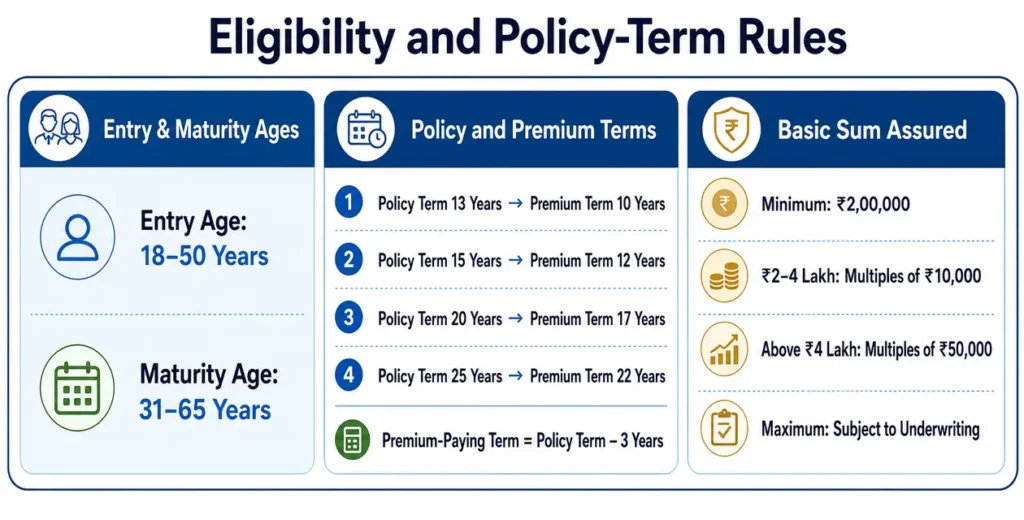
- Minimum entry age: 18 completed years
- Maximum entry age: 50 years
- Minimum maturity age: 31 years
- Maximum maturity age: 65 years
The chosen term must keep the maturity age within the permitted limit. For example, an applicant aged 50 cannot select a term that produces a maturity age above 65.
Policy term
The available policy term ranges from 13 to 25 years.
Premium-paying term
The premium-paying term is always three years shorter than the policy term.
| Policy term | Premium-paying term |
| 13 years | 10 years |
| 15 years | 12 years |
| 20 years | 17 years |
| 25 years | 22 years |
Basic Sum Assured
The minimum Basic Sum Assured is ₹2,00,000. There is no fixed maximum, but the amount accepted by LIC remains subject to underwriting.
The permitted multiples are:
- ₹2,00,000 to ₹4,00,000: multiples of ₹10,000
- Above ₹4,00,000: multiples of ₹50,000
How to Use the LIC Jeevan Lakshya Plan 733 Calculator
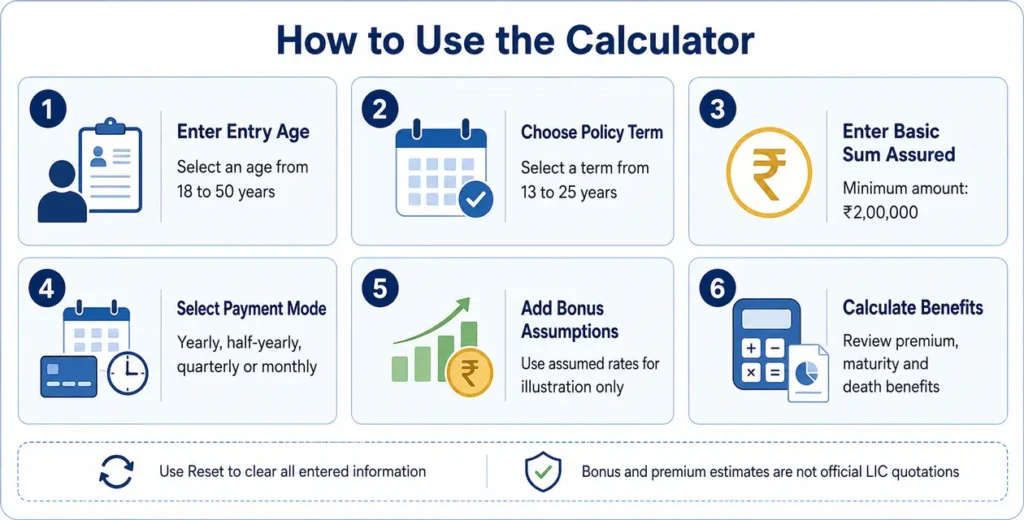
- Enter the entry age: Provide the age of the Life Assured.
- Select the policy term: Choose a term from 13 to 25 years.
- Enter the Basic Sum Assured: Follow the applicable Sum Assured multiples.
- Choose the payment mode: Select yearly, half-yearly, quarterly or monthly.
- Enter a matching premium rate if available: Use an official LIC rate or illustration applicable to the selected details.
- Add bonus assumptions: Enter an assumed Simple Reversionary Bonus rate and Final Additional Bonus only for an illustrative maturity estimate.
- Select the policy year of death: This allows the calculator to determine the possible number of Annual Income Benefit payments.
- Press Calculate: Review premium, maturity and death-benefit results.
Any tax field should use the label Applicable Tax, If Any. The calculator should apply only the tax treatment legally applicable on the policy or premium-payment date and must not automatically apply a historical tax rate.
How Premium Is Estimated in Jeevan Lakshya Plan 733
The exact premium depends on LIC’s approved rate structure and the accepted proposal. Important factors include:
- Entry age;
- Policy term;
- Basic Sum Assured;
- Premium-payment mode;
- Modal rebate;
- High Sum Assured rebate;
- Underwriting decision;
- Extra premium, if applicable;
- Optional riders; and
- Applicable tax, if any.
Modal rebate
| Premium mode | Rebate |
| Yearly | 2% of tabular premium |
| Half-yearly | 1% of tabular premium |
| Quarterly | Nil |
| Monthly | Nil |
| Salary deduction | Nil |
High Sum Assured rebate
| Basic Sum Assured | Rebate on premium |
| ₹2,00,000 to below ₹5,00,000 | Nil |
| ₹5,00,000 to below ₹10,00,000 | ₹4 per ₹1,000 of Basic Sum Assured |
| ₹10,00,000 and above | ₹5 per ₹1,000 of Basic Sum Assured |
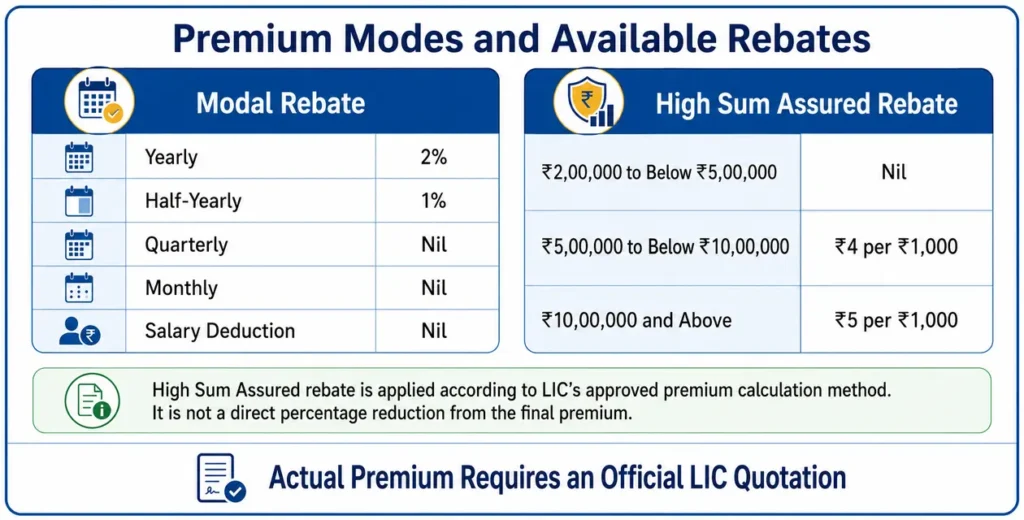
The rebate is not a percentage reduction from the final modal premium. It should be applied according to LIC’s approved premium calculation method.
Published sample premiums must not be linearly scaled or interpolated and described as official rates. The final premium must be obtained from LIC’s quotation or benefit illustration.
LIC Jeevan Lakshya Plan 733 Maturity Benefit
If the Life Assured survives to the maturity date and the policy is in force, the maturity benefit is:
Basic Sum Assured + Vested Simple Reversionary Bonus + Final Additional Bonus, if any
The Sum Assured on Maturity equals the Basic Sum Assured.
Guaranteed and estimated parts
| Maturity component | Status |
| Basic Sum Assured | Guaranteed under an in-force policy, subject to policy terms |
| Vested Simple Reversionary Bonus | Depends on bonuses declared and vested |
| Final Additional Bonus | Not guaranteed; payable only if declared and applicable |
Bonus assumptions are useful for comparison but must never be presented as LIC’s promised return.
Illustrative Maturity Calculation Example
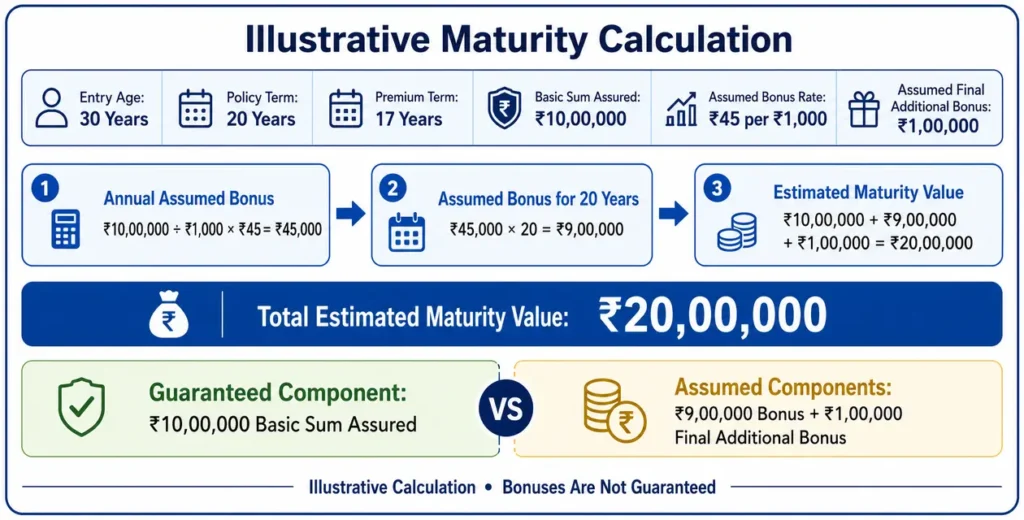
Consider the following illustrative details:
| Input | Value |
| Entry age | 30 years |
| Policy term | 20 years |
| Premium-paying term | 17 years |
| Basic Sum Assured | ₹10,00,000 |
| Assumed bonus rate | ₹45 per ₹1,000 of BSA per year |
| Assumed Final Additional Bonus | ₹1,00,000 |
First calculate the assumed annual bonus:
₹10,00,000 ÷ ₹1,000 × ₹45 = ₹45,000 per year
Assumed Simple Reversionary Bonus over 20 years:
₹45,000 × 20 = ₹9,00,000
Estimated maturity value:
₹10,00,000 + ₹9,00,000 + ₹1,00,000 = ₹20,00,000
The Basic Sum Assured component is ₹10,00,000. The ₹9,00,000 bonus and ₹1,00,000 Final Additional Bonus are assumptions only. Actual bonuses may be higher, lower or unavailable depending on LIC’s declarations and policy eligibility.
Death Benefit in LIC Jeevan Lakshya Plan 733
For an in-force policy, the death benefit includes the Sum Assured on Death, vested Simple Reversionary Bonuses and Final Additional Bonus, if any.
The Sum Assured on Death is the higher of:
- Seven times the annualised premium; or
- The combined value of:
- Annual Income Benefit equal to 10% of Basic Sum Assured, payable from the policy anniversary coinciding with or following death until the policy anniversary immediately before maturity; and
- 110% of Basic Sum Assured, payable on the maturity date.
The overall Death Benefit must not be less than 105% of total premiums paid up to the date of death.
The number of Annual Income Benefit payments depends on the exact date of death and the remaining policy anniversaries. Therefore, a calculator must ask for either the death date or the policy year of death.
Vested Simple Reversionary Bonuses and Final Additional Bonus, if any, are payable on the due date of maturity. Under an in-force policy where death has occurred, the policy continues to participate in profits up to maturity according to the plan terms.
Death-Benefit Calculation Example
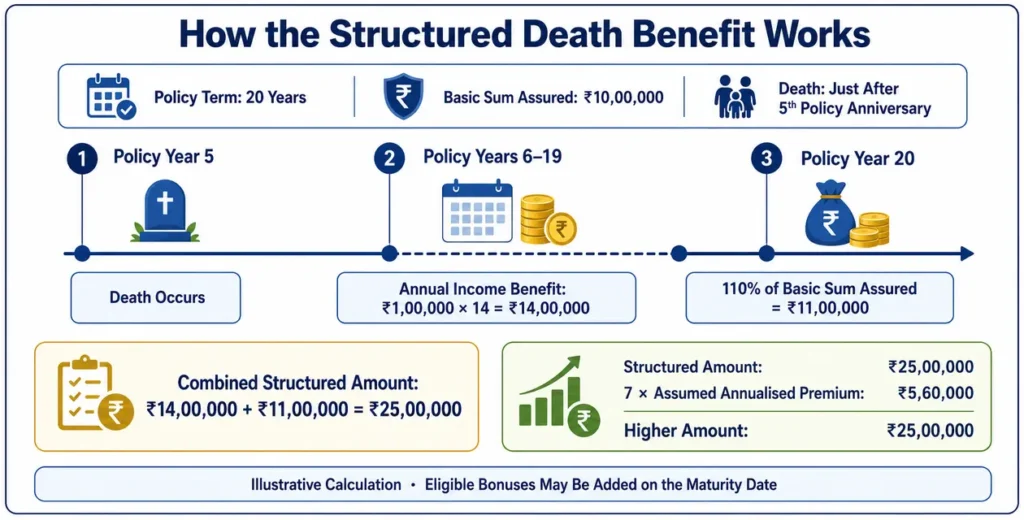
| Input | Example value |
| Policy term | 20 years |
| Basic Sum Assured | ₹10,00,000 |
| Illustrative annualised premium | ₹80,000 |
| Time of death | Just after the fifth policy anniversary |
| First income payment | Sixth policy anniversary |
| Last income payment | Nineteenth policy anniversary |
| Number of income payments | 14 |
Annual Income Benefit:
10% × ₹10,00,000 = ₹1,00,000 per year
Total Annual Income Benefit:
₹1,00,000 × 14 = ₹14,00,000
Maturity-date Basic Sum Assured component:
110% × ₹10,00,000 = ₹11,00,000
Combined structured amount:
₹14,00,000 + ₹11,00,000 = ₹25,00,000
Seven times annualised premium:
7 × ₹80,000 = ₹5,60,000
The higher Sum Assured on Death in this illustration is:
Higher of ₹25,00,000 and ₹5,60,000 = ₹25,00,000
If death occurs just after the fifth policy anniversary and the policy is in force, six yearly premiums would ordinarily have fallen due, including the initial premium. Total premiums paid would be:
₹80,000 × 6 = ₹4,80,000
The 105% minimum check would be:
105% × ₹4,80,000 = ₹5,04,000
The illustrated ₹25,00,000 exceeds this minimum. Eligible bonuses would be added according to the policy terms and paid on the maturity date.
The ₹80,000 annualised premium is an assumed figure used only to explain the formula. It is not an LIC quotation.
Bonuses Under the Jeevan Lakshya Plan 733
LIC Jeevan Lakshya is a participating plan.
Simple Reversionary Bonus
LIC may declare a Simple Reversionary Bonus based on the experience of its participating fund. Once declared and vested under the applicable terms, it becomes attached to the policy.
Final Additional Bonus
A Final Additional Bonus may be declared when the policy results in an eligible maturity or death claim. It is not guaranteed.
Estimated bonus values should always carry a clear non-guaranteed label.
Optional Riders
The plan provides access to:
- LIC’s Accidental Death and Disability Benefit Rider;
- LIC’s Accident Benefit Rider; and
- LIC’s New Term Assurance Rider.
The Accidental Death and Disability Benefit Rider and Accident Benefit Rider cannot both be selected. The New Term Assurance Rider may be selected separately. Therefore, a maximum of two riders may be attached, subject to eligibility, premium and benefit limits.
Rider premiums and benefits should only be calculated when the relevant official rate logic has been implemented. Otherwise, the calculator should identify riders as optional without estimating their cost.
Benefit Instalment Options
Death-benefit instalment option
The eligible lump-sum amount payable on the maturity date following death may be received in instalments over 5, 10 or 15 years instead of as one payment, if the Life Assured selected this option during the policy term.
This option may apply to all or part of the eligible lump-sum amount. It does not apply to the Annual Income Benefit, which continues according to the plan’s separate payment schedule.
Maturity settlement option
The policyholder may choose to receive all or part of the maturity benefit in instalments over 5, 10 or 15 years instead of taking the complete amount as a lump sum. The option must be exercised according to LIC’s prescribed procedure and time limit.
The actual instalment amount depends on the selected period, payment frequency, claim amount and the applicable interest basis. A calculator should not estimate these instalments using an outdated interest rate.
Paid-Up Policy
If at least one full year’s premium has been paid and later premiums are discontinued, the policy may continue as a paid-up policy according to its terms.
Paid-up benefits are lower than the original in-force benefits because they are adjusted using LIC’s paid-up formulas. The policy also stops participating in future profits when premiums are not duly paid, although already vested bonuses remain subject to the policy provisions.
The calculator should not treat paid-up value as equal to maturity value or surrender value. A separate paid-up section is necessary if official formulas are implemented.
Surrender Value in Jeevan Lakshya Plan 733
The policy can be surrendered after completion of the first policy year, provided at least one full year’s premium has been paid.
- Special Surrender Value may become available after the first policy year and payment of one full year’s premium.
- Guaranteed Surrender Value is acquired after at least two full years’ premiums have been paid.
- LIC pays the higher of the applicable Guaranteed Surrender Value and Special Surrender Value.
- No surrender value is available for riders.
- The policy terminates after surrender value is paid.
Actual surrender value depends on the official factors applicable to the policy term, surrender year, premiums paid and vested bonuses.
Policy Loan
A loan may be available after completion of the first policy year and payment of one full year’s premium, subject to the policy’s surrender value and LIC’s conditions.
| Policy status | Before two full years’ premiums | After two full years’ premiums |
| In-force policy | Up to 50% of surrender value | Up to 75% |
| Paid-up policy | Up to 40% of surrender value | Up to 65% |
Loan interest applies at the rate specified by LIC. Unpaid loan and interest can reduce claim proceeds and may lead to foreclosure in circumstances described in the policy document.
Revival, Grace Period and Free Look
Revival
A lapsed policy may be revived within five consecutive complete years from the date of the first unpaid premium, subject to payment of arrears, applicable interest and LIC’s continued-insurability requirements.
Grace period
- Yearly, half-yearly and quarterly modes: 30 days
- Monthly mode: 15 days
The policy remains in force during the grace period according to its terms.
Free-look period
The policyholder receives 30 days from receipt of the electronic or physical policy document, whichever is earlier, to review the terms and return the policy if dissatisfied, subject to permitted deductions.
Who May Find LIC Jeevan Lakshya Useful?
The plan 733 may be considered by people seeking:
- Traditional life insurance with a savings component;
- Annual family income support after the Life Assured’s death;
- A maturity benefit if the Life Assured survives;
- Participation in declared bonuses; and
- Loan and surrender facilities subject to policy conditions.
It should not be compared with pure term insurance only on maturity value. A term plan generally focuses on higher life cover at a lower premium, while Jeevan Lakshya combines protection, savings and a structured family benefit.
Frequently Asked Questions
Is LIC Jeevan Lakshya Plan 733 market-linked?
No. It is a non-linked participating savings plan. Its value is not directly linked to stock-market or fund performance.
What is the minimum Basic Sum Assured?
The minimum Basic Sum Assured is ₹2,00,000.
Is the maturity value guaranteed?
The Basic Sum Assured forms the guaranteed maturity component under an in-force policy. Future bonus amounts are not guaranteed.
How is the Annual Income Benefit calculated?
It equals 10% of Basic Sum Assured for each applicable annual payment after death and before maturity.
Is 110% of Basic Sum Assured paid immediately after death?
No. Under the structured death benefit, this component and eligible bonuses are payable on the due maturity date.
Can all three riders be selected?
No. Either the Accidental Death and Disability Benefit Rider or Accident Benefit Rider may be selected, along with the New Term Assurance Rider. A maximum of two riders is permitted.
Can the calculator provide an exact LIC premium?
Only an official LIC quotation or benefit illustration can confirm the premium. Calculator results are estimates unless they reproduce a published rate for an exactly matching case.
Conclusion
The LIC Jeevan Lakshya Plan 733 Calculator can make a complex traditional insurance plan easier to understand. It can show the premium-paying term, estimated maturity value, Annual Income Benefit, maturity-date death payment and minimum protection check in one place.
The most important calculation rule is that the Sum Assured on Death compares seven times annualised premium with the combined value of 110% of Basic Sum Assured and all applicable Annual Income Benefit instalments. Bonus estimates, premium estimates and future tax treatment must be clearly separated from guaranteed policy benefits.
Before purchasing or acting on a result, refer to LIC’s current sales brochure, policy document, official benefit illustration and issued policy schedule.
Official Sources
- LIC Jeevan Lakshya official product page
- LIC Jeevan Lakshya sales brochure
- LIC Jeevan Lakshya policy document
Disclaimer: This article and calculator are for educational purposes only. They do not provide financial advice, an official LIC quotation or a guarantee of bonus, surrender value, loan eligibility or claim payment. LIC’s underwriting decision and issued policy documents remain final.

Amit Kushwaha is a financial content creator and SaaS tool developer based in Lucknow, Uttar Pradesh. He has more than seven years of experience creating insurance-related content, online calculators, and practical digital tools for LIC policyholders, insurance buyers, and LIC agents.
Through LICPolicyCalculator.com, he focuses on simplifying complex LIC policy information into easy-to-understand guides and calculators. His work covers LIC premium estimates, maturity calculations, surrender value tools, policy return calculations, term insurance planning, and plan-specific calculator pages.