LIC Jeevan Utsav Calculator Plan 771, 883, 871
Estimated Results
Important: These are estimates based on the entered details. Confirm premiums, benefits, surrender value, loan eligibility, tax and claim amounts with LIC's official quotation, policy document or servicing branch.
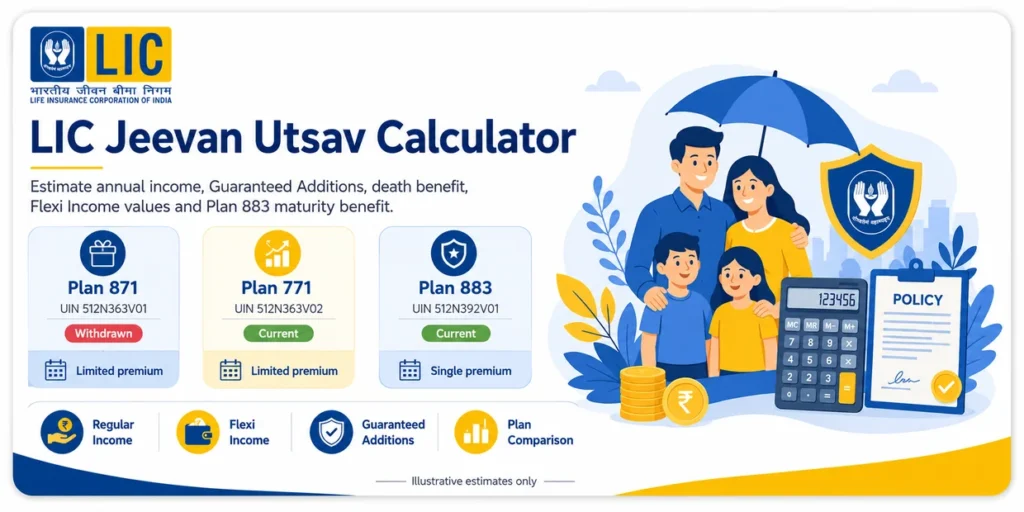
LIC Jeevan Utsav is a family of non-linked, non-participating insurance plans that combines long-term life cover with guaranteed annual survival income. Different versions are available for limited-premium and single-premium buyers, and the rules are not identical for every plan number.
The LIC Jeevan Utsav Calculator brings Plan 871, Plan 771 and Single Premium Plan 883 into one place. After selecting the correct version and entering the policy details, it estimates annual income, income commencement year, Guaranteed Additions, death benefit, Flexi Income balance and other applicable values. It also estimates the maturity benefit available under Plan 883.
What Is LIC Jeevan Utsav Calculator?
The LIC Jeevan Utsav Calculator is an online estimation tool designed for both current buyers and existing policyholders. It applies a separate set of conditions for each supported version instead of treating every Jeevan Utsav policy as the same plan.
The calculator covers:
- LIC Jeevan Utsav Plan 871, UIN 512N363V01
- LIC Jeevan Utsav Plan 771, UIN 512N363V02
- LIC Jeevan Utsav Single Premium Plan 883, UIN 512N392V01
Plan 871 is withdrawn and is included for existing policyholders. Plan 771 is the current limited-premium version. Plan 883 is the current single-premium version and follows separate maturity rules.
Using the entered Basic Sum Assured and policy details, the calculator can show the possible annual Regular or Flexi Income Benefit, accrued Guaranteed Additions and estimated death benefit. Where applicable, it can also estimate paid-up benefits, accumulated Flexi Income, the maximum permitted Flexi withdrawal and an indicative loan amount based on an entered surrender value.
Highlights of the Calculator
The main advantage is that all three versions can be checked without manually comparing several policy documents. The calculator validates important entries such as age, Basic Sum Assured, Premium Paying Term and Guaranteed Addition Period according to the selected plan.
It supports both Regular Income and Flexi Income options. For deferred Flexi Income, it estimates accumulation at the applicable rate of 5.5% per year, compounded yearly for completed months. It also checks the permitted withdrawal limit based on the accumulated balance.
For Plans 871 and 771, the calculator can estimate paid-up benefits when the required details are entered. For Plan 883, it calculates the policy term up to the stated maturity age and estimates the maturity amount. Results are presented separately so annual income is not confused with a maturity payment.
LIC Jeevan Utsav Plans Covered by the Calculator
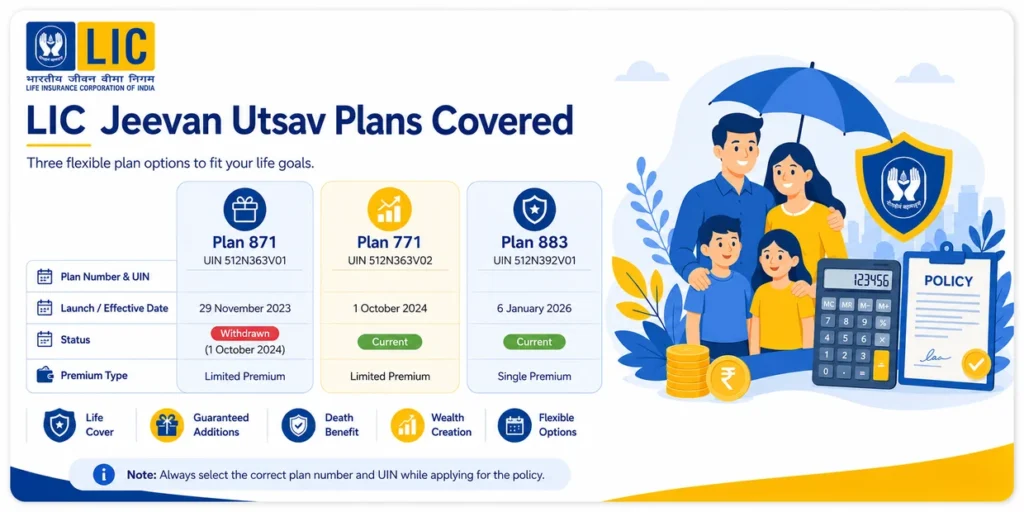
| Plan | UIN | Launch/effective date | Status | Premium structure |
|---|---|---|---|---|
| Plan 871 | 512N363V01 | 29 November 2023 | Withdrawn on 1 October 2024 | Limited premium |
| Plan 771 | 512N363V02 | Effective from 1 October 2024 | Current | Limited premium |
| Plan 883 | 512N392V01 | 6 January 2026 | Current | Single premium |
The plan number and UIN printed on the policy document should be used when selecting a version. Applying Plan 771 rules to a Plan 871 policy, or applying limited-premium rules to Plan 883, can produce an incorrect estimate. LIC has also issued Plan 771 brochures for different sale periods, including one from 1 October 2024 to 21 September 2025 and another from 22 September 2025 onwards. For an existing policy, the issue date and issued policy document should therefore be checked before applying servicing rules.
How to Use LIC Jeevan Utsav Calculator
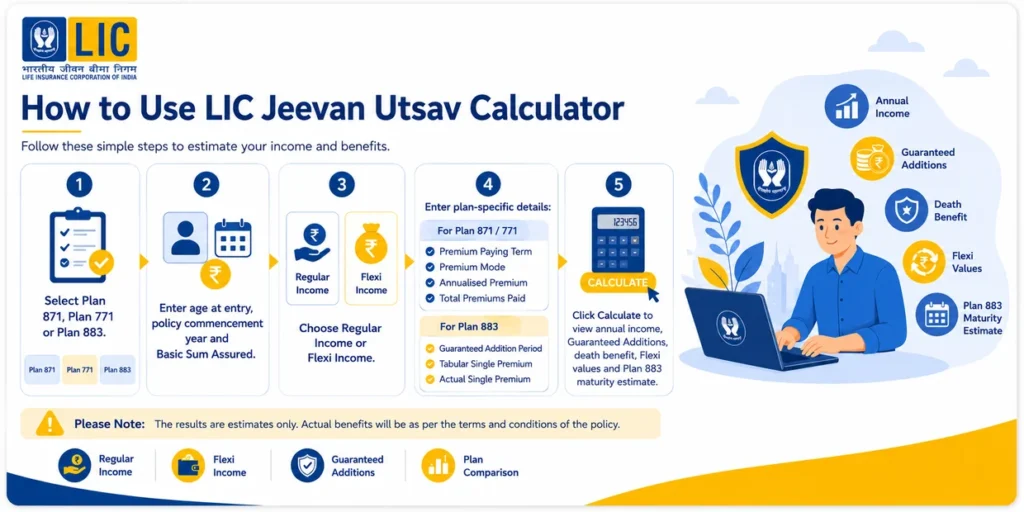
First, select Plan 871, Plan 771 or Single Premium Plan 883. Enter the age at entry, policy commencement year and Basic Sum Assured. Select Regular Income or Flexi Income and enter the number of completed policy years.
For Plan 871 or Plan 771, select the Premium Paying Term and premium mode. Enter the annualised premium and total base premiums already paid. Annualised premium means the premium payable in a year excluding tax, rider premium, underwriting extra and modal loading. These inputs help the calculator estimate the Sum Assured on Death and check the minimum death-benefit condition.
For Plan 883, select the Guaranteed Addition Period and enter the tabular single premium and actual single premium. The tabular amount must be entered separately because the policy definition of the death and maturity sums assured uses the tabular single premium before rebate, underwriting extra, rider premium and tax.
Optional fields can be used for paid-up status, a proposed Flexi Income withdrawal or current surrender value. Click Calculate to display the result. Click Reset to clear all entries and begin again.
What Is LIC Jeevan Utsav?
LIC Jeevan Utsav is a savings-oriented insurance product offering long-duration life protection and annual survival income. It is non-linked, so its benefits are not based on stock-market or investment-fund performance. It is also non-participating, which means it does not receive discretionary LIC bonuses or a share in surplus.
Instead of declared bonuses, the plans provide Guaranteed Additions according to their policy conditions. The policyholder can select Regular Income or Flexi Income. Regular Income is paid when due, while Flexi Income can be deferred and accumulated under LIC’s applicable conditions.
The product family includes limited-premium whole life versions and a single-premium version with a defined maturity age. This difference is important because Plans 871 and 771 do not provide a conventional maturity benefit, whereas Plan 883 does.
LIC Jeevan Utsav Plan 871
LIC Jeevan Utsav Plan 871, UIN 512N363V01, was the original version. LIC launched it on 29 November 2023 and withdrew it on 1 October 2024. It is no longer available for new purchases, but its rules continue to apply to policies issued while it was open.
Plan 871 uses a limited Premium Paying Term and provides a choice between Regular Income and Flexi Income. Guaranteed Additions can accrue during the Premium Paying Term when the policy remains eligible. Annual income begins after the deferment period applicable to the selected term.
The plan provides whole life protection and has no conventional maturity benefit. Existing policyholders should use the figures and conditions printed in their original policy rather than automatically applying the revised Plan 771 rules.
LIC Jeevan Utsav Plan 771
LIC Jeevan Utsav Plan 771, UIN 512N363V02, is the current limited-premium version. Its Premium Paying Term can range from 5 to 16 years, subject to the entry-age and other eligibility conditions applicable to the selected term.
The policyholder chooses Regular Income or Flexi Income. Guaranteed Additions accrue during the Premium Paying Term while the policy remains in force. The first annual income becomes due from the policy year linked to the chosen Premium Paying Term; it does not always start immediately after the final premium.
If the life assured dies while the policy is in force, the nominee receives the applicable death benefit and accrued eligible benefits. Plan 771 provides whole life protection and continuing annual survival income but no conventional maturity benefit. Loan, surrender and paid-up provisions apply according to the policy conditions.
LIC Jeevan Utsav Single Premium Plan 883
LIC Jeevan Utsav Single Premium Plan 883, UIN 512N392V01, was launched on 6 January 2026. The proposer pays one premium at the start instead of making payments for several years. A Guaranteed Addition Period from 7 to 17 years is selected, subject to the plan’s age rules.
The maximum entry age is 65 years nearer birthday, while the minimum entry age depends on the selected Guaranteed Addition Period. The minimum Basic Sum Assured is ₹5,00,000. It must be selected in multiples of ₹25,000 up to ₹24,50,000 and multiples of ₹50,000 above that amount. The policy term is calculated as 100 minus the age at entry, and the maturity age is 100 years nearer birthday. The life assured must be at least 18 completed years old on the due date of the first Regular or Flexi Income Benefit.
Guaranteed Additions accrue during that selected period. The plan provides Regular Income and Flexi Income options, and life cover continues up to the maturity age specified in the policy. Loan and surrender facilities are available under separate Plan 883 conditions.
A major difference is its maturity benefit. Plan 883 provides life cover during a policy term ending at age 100 nearer birthday. If the life assured survives to the end of that term, the applicable Sum Assured on Maturity is paid with accrued Guaranteed Additions and any eligible unwithdrawn Flexi Income balance. Plans 871 and 771 do not provide this conventional maturity payment.
Regular Income and Flexi Income Options
Regular Income Benefit
Regular Income Benefit is equal to 10% of the Basic Sum Assured under an eligible in-force policy. It becomes payable annually from the commencement year applicable to the selected version and policy details.
Flexi Income Benefit
Flexi Income Benefit also equals 10% of the Basic Sum Assured, but the eligible amount is deferred instead of being paid immediately. Each unpaid benefit accumulates at 5.5% per year, compounded yearly for completed months under the applicable terms.
A policyholder may request one withdrawal in a policy year of up to 75% of the accumulated Flexi Income balance that has not already been withdrawn. The remaining balance continues to accumulate. This option provides flexibility, but it is not an unrestricted savings account.
When Does LIC Jeevan Utsav Income Start?
Income does not necessarily start when premium payments finish. Under Plans 871 and 771, the first income becomes due at the end of the policy year linked to the selected Premium Paying Term.
| Premium Paying Term | First income due at the end of |
| 5 to 8 years | 11th policy year |
| 9 years | 12th policy year |
| 10 years | 13th policy year |
| 11 years | 14th policy year |
| 12 years | 15th policy year |
| 13 years | 16th policy year |
| 14 years | 17th policy year |
| 15 years | 18th policy year |
| 16 years | 19th policy year |
For example, a 10-year Premium Paying Term leads to the first income at the end of the 13th policy year, subject to survival and the policy satisfying the applicable conditions.
Under Plan 883, the first income is due at the end of the policy year immediately following the selected Guaranteed Addition Period.
| Guaranteed Addition Period | First income due at the end of |
| 7 years | 8th policy year |
| 8 years | 9th policy year |
| 9 years | 10th policy year |
| 10 years | 11th policy year |
| 11 years | 12th policy year |
| 12 years | 13th policy year |
| 13 years | 14th policy year |
| 14 years | 15th policy year |
| 15 years | 16th policy year |
| 16 years | 17th policy year |
| 17 years | 18th policy year |
The life assured must also be at least 18 completed years old on the due date of the first income. The calculator should check this age condition along with the selected Guaranteed Addition Period.
Formula Used in LIC Jeevan Utsav Calculator
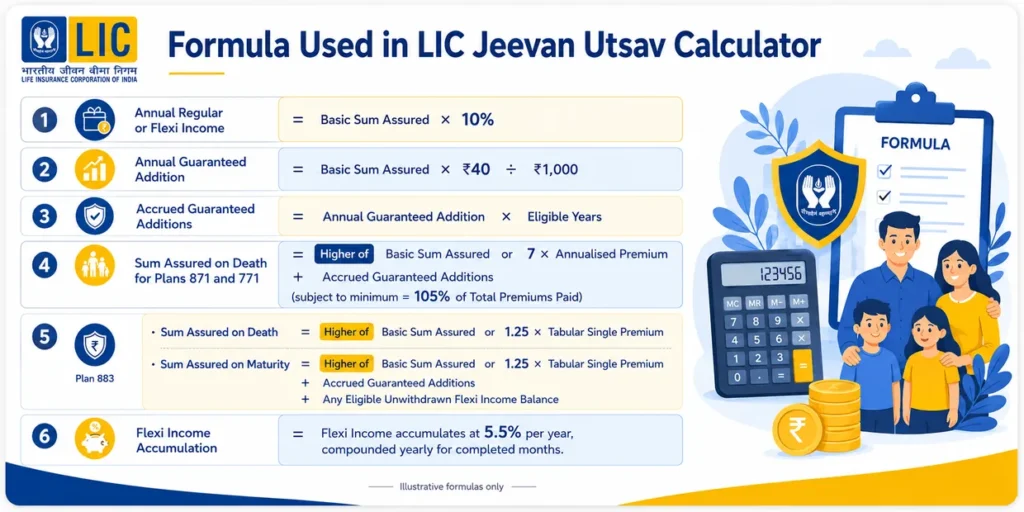
Annual Income Benefit
Annual Regular or Flexi Income = Basic Sum Assured × 10%
Guaranteed Additions
The yearly Guaranteed Addition is ₹40 for every ₹1,000 of Basic Sum Assured:
Annual Guaranteed Addition = Basic Sum Assured × ₹40 ÷ ₹1,000
For Plans 871 and 771, additions accrue during eligible years of the Premium Paying Term. For Plan 883, they accrue during the selected Guaranteed Addition Period.
Accrued Guaranteed Additions = Annual Guaranteed Addition × Eligible Years
The treatment can change when a policy becomes paid-up, is surrendered during a policy year or does not remain eligible. If death occurs during the Guaranteed Addition Period, the Guaranteed Addition for the policy year of death is payable for the full policy year under the applicable plan conditions. The calculator’s normal formula should therefore not be treated as a final servicing value.
Death Benefit for Plans 871 and 771
Sum Assured on Death = Higher of Basic Sum Assured or 7 × Annualised Premium
For an in-force policy, accrued Guaranteed Additions are added. The death benefit is also checked against the minimum requirement of 105% of total premiums paid up to the date of death. Separate rules apply before commencement of risk for an eligible minor life.
Death and Maturity Benefit for Plan 883
Sum Assured on Death = Higher of Basic Sum Assured or 1.25 × Tabular Single Premium
Sum Assured on Maturity = Higher of Basic Sum Assured or 1.25 × Tabular Single Premium
Accrued Guaranteed Additions are added to the applicable amount. Under the Flexi Income option, the unwithdrawn accumulated balance is also added where payable under the policy conditions.
Flexi Income Accumulation
Each due annual Flexi Income instalment is accumulated separately at 5.5% per year, compounded yearly for completed months. Because every instalment has a different due date, each one remains deferred for a different period.
Paid-Up Benefit for Plans 871 and 771
When a limited-premium policy acquires paid-up status, its death and survival benefits are reduced. A general proportional basis is:
Paid-Up Benefit Base = Original Benefit Base × Number of Premiums Paid ÷ Total Number of Premiums Originally Payable
The annual paid-up income is calculated from the reduced paid-up survival benefit base according to the applicable policy conditions. Guaranteed Additions already accrued remain subject to the plan rules, but future additions do not continue in the same way as under a fully in-force policy. The exact eligibility point and calculation should be taken from the policy document applicable on the issue date, especially because Plan 771 has documents for different sale periods.
Real Calculation Example
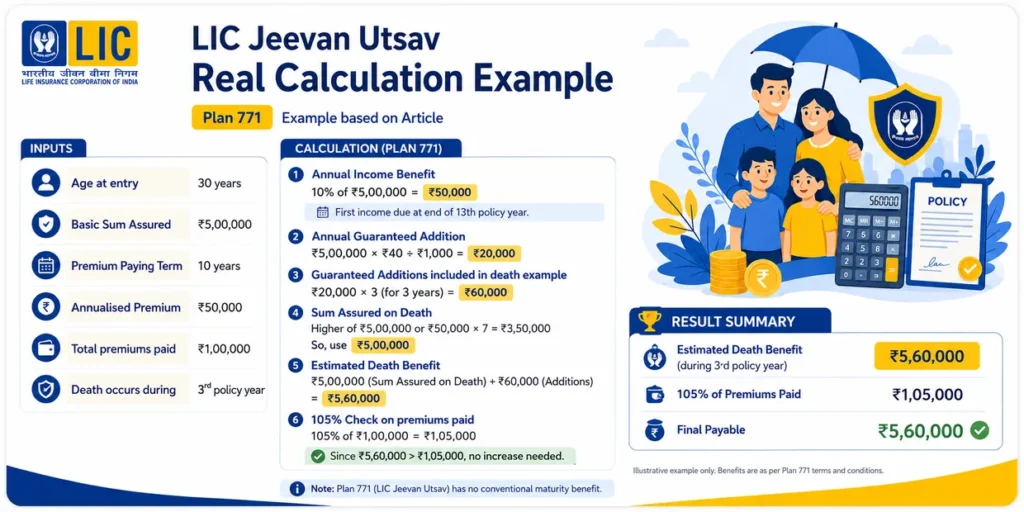
Suppose Plan 771 is selected for a person who entered at age 30 with a Basic Sum Assured of ₹5,00,000 and a Premium Paying Term of 10 years. Assume the annualised premium is ₹50,000. Two full annual premiums totalling ₹1,00,000 have been paid, and death occurs during the third policy year while the policy is in force.
The annual income benefit is 10% of ₹5,00,000, giving ₹50,000. For a 10-year Premium Paying Term, the first income becomes due at the end of the 13th policy year.
The annual Guaranteed Addition is ₹20,000:
₹5,00,000 × ₹40 ÷ ₹1,000 = ₹20,000
After two completed policy years, ₹40,000 of Guaranteed Additions has accrued. However, because death occurs during the third policy year and this is within the Guaranteed Addition Period, the Guaranteed Addition for the year of death is also payable for the full policy year. The Guaranteed Additions included in this death example are therefore:
₹20,000 × 3 = ₹60,000
The Sum Assured on Death is the higher of the Basic Sum Assured of ₹5,00,000 and seven times the annualised premium:
₹50,000 × 7 = ₹3,50,000
Therefore, ₹5,00,000 is used. After adding Guaranteed Additions of ₹60,000, the estimated death benefit is ₹5,60,000. The 105% check on premiums paid up to death gives ₹1,05,000, so it does not increase the estimate in this example. No maturity benefit is shown because Plan 771 provides annual income and whole life protection instead of a conventional maturity payment. This is an explanatory estimate, not an official claim calculation.
Main Benefits Available Under LIC Jeevan Utsav
The survival benefit is the annual Regular or Flexi Income payable from the applicable start year. The death benefit protects the nominee through the Sum Assured on Death and eligible accrued benefits.
Plans 871 and 771 do not offer a conventional maturity benefit. Plan 883 provides a maturity benefit at the end of its policy term. A loan may be available after the relevant conditions are met, and each version can acquire a surrender value according to its own rules. Early surrender may return substantially less than the premiums paid or expected future benefits.
Difference Between LIC Jeevan Utsav Plans
| Feature | Plan 871 | Plan 771 | Plan 883 |
| Status | Withdrawn | Current | Current |
| Premium structure | Limited premium | Limited premium | Single premium |
| Regular Income | Available | Available | Available |
| Flexi Income | Available | Available | Available |
| Guaranteed Additions | Available | Available | Available |
| Conventional maturity benefit | No | No | Yes |
| Most relevant for | Existing policyholders | Limited-premium buyers | Single-premium buyers |
How This Calculator Is Helpful
The calculator shows how the main policy figures connect without requiring each calculation to be completed manually. It can estimate annual income, identify the expected income start year, calculate Guaranteed Additions and explain why the death or maturity amount differs between versions.
It is also useful for understanding the difference between annual income and maturity benefit. Receiving annual income does not mean every version pays a separate maturity lump sum. Existing limited-premium policyholders can review possible paid-up results, while Flexi Income users can estimate the accumulated balance and available withdrawal.
Where the loan estimate is based on a surrender value entered manually, the calculator does not independently determine LIC’s official surrender value. The resulting loan amount is only indicative unless all relevant plan-specific surrender factors and policy records are included.
Final premium, paid-up value, surrender value, loan eligibility, claim amount and tax outcome must be confirmed through LIC’s official quotation, policy document or servicing branch.
Important Points Before Using the Results
The calculator uses the entered information and cannot confirm whether the details match LIC’s records. The tabular premium, actual premium and annualised premium must be entered in the correct fields. Taxes, rider premiums and underwriting extras should not be included where the policy formula excludes them.
Stopping premiums can reduce benefits under Plans 871 and 771. Early surrender may result in a lower value. Fixed annual income may also lose purchasing power because of inflation. Jeevan Utsav should not replace adequate pure life insurance where substantially higher protection is required at a lower premium.
Tax Rule
Tax deductions on premiums and tax rules for policy receipts depend on the prevailing Income Tax Act provisions and the facts of the individual policy. Issue date, premium, Basic Sum Assured and type of payment can affect the result. Annual income, death benefit or maturity benefit should not automatically be assumed tax-free. Current rules should be checked with a qualified tax professional.
Frequently Asked Questions
Which plans does the LIC Jeevan Utsav Calculator cover?
It covers withdrawn Plan 871, current limited-premium Plan 771 and current Single Premium Plan 883.
Which LIC Jeevan Utsav plans are currently available?
Plan 771 and Plan 883 are currently listed by LIC. Plan 871 is withdrawn and remains relevant to existing policyholders.
What is the difference between Plan 771 and Plan 883?
Plan 771 requires premiums for a selected limited period and does not provide a conventional maturity benefit. Plan 883 requires one premium at inception and provides a maturity benefit under its conditions.
Does the calculator show the exact LIC benefit amount?
No. It provides an estimate from the entered information and programmed rules. Official amounts depend on LIC’s records, policy status and claim or servicing assessment.
Are Guaranteed Additions and LIC bonuses the same?
No. Guaranteed Additions are defined in the policy and accrue according to specified conditions. LIC bonuses are discretionary benefits for participating policies. Jeevan Utsav is non-participating.
Conclusion
The LIC Jeevan Utsav Calculator provides one place to estimate benefits under Plan 871, Plan 771 and Single Premium Plan 883. It can show annual income, income start year, Guaranteed Additions, estimated death benefit, Flexi Income values and the maturity benefit applicable to Plan 883.
The selected plan number is important because the limited-premium and single-premium versions follow different rules. Calculator results should be used for understanding and comparison, while the correct plan brochure, policy document and LIC records should be used for final decisions and benefit confirmation.