
LIC Jeevan Mitra Plan 133 Calculator
Calculate an estimated maturity amount, projected bonus, and year-wise triple death cover for an existing LIC Jeevan Mitra (Plan 133) policy.
Estimated policy outcome
Policy details used for calculation
- Plan
- LIC Jeevan Mitra – Triple Cover (133)
- Basic Sum Assured
- ₹0
- Entry age
- 0 years
- Policy term
- 0 years
- Scheduled maturity year
- —
- Age at maturity
- —
- Estimated SRB rate used
- ₹0 per ₹1,000
Maturity value projection
- Basic Sum Assured
- ₹0
- Annual estimated SRB
- ₹0
- Estimated total SRB
- ₹0
- Final Additional Bonus
- Not included
Maturity projection = Basic Sum Assured + projected SRB + entered FAB. Future bonus can be higher or lower.
Death protection during policy term
- Guaranteed death cover
- ₹0
- Formula
- 3 × Basic Sum Assured
- Estimated SRB by term end
- ₹0
- Entered FAB, if payable
- Not included
Death benefit for each policy year is shown below. The optional FAB is treated as a possible terminal addition only.
Year-wise benefit accumulation
| Policy year | Age | Annual SRB | Total SRB | Maturity value (without FAB) | Death benefit (3× BSA + SRB) |
|---|
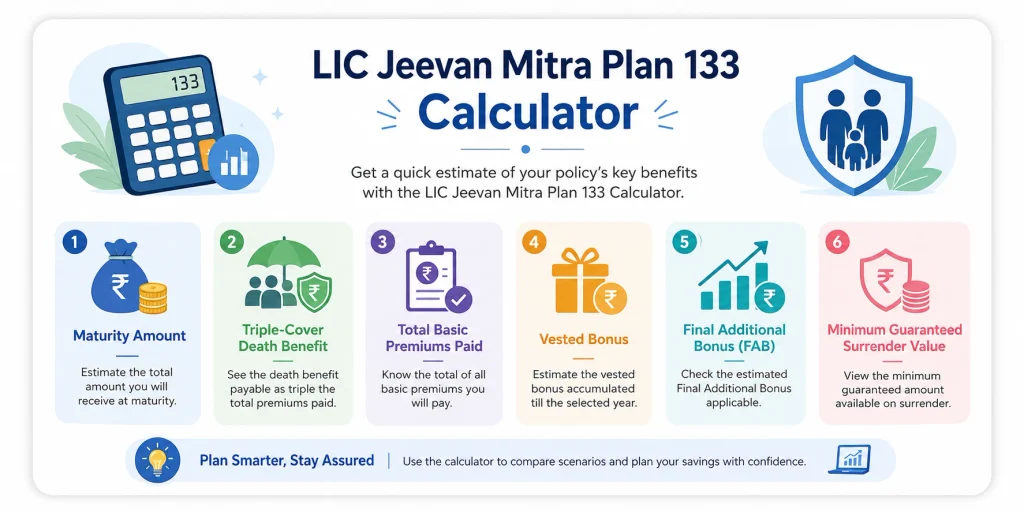
Jeevan Mitra Triple Cover Endowment Plan is also known as Jeevan Mitra Plan 133; it is a traditional life insurance and savings policy. It paid a maturity amount if the life assured survived until the end of the term and provided a higher death benefit during the policy term. This plan is no longer available for new purchase. Its closed for new sales on 29 December 2013
Through this guide, we have tried to help existing policyholders understand their maturity value, bonus, death benefit, premiums paid, and minimum surrender value, calculated through the LIC Jeevan Mitra Plan 133 Maturity Calculator
Also Check: LIC Jeevan Mitra Plan 88
About the LIC Jeevan Mitra Plan 133 Calculator
This calculator asks for user details such as the Basic Sum Assured, policy term, premium, policy status, vested bonus, and Final Additional Bonus for its calculation. It can estimate the maturity amount, triple-cover death benefit, total basic premiums paid, and Guaranteed Surrender Value.
For an old policy, the most accurate method is to use the total vested bonus confirmed in LIC records. If only an assumed yearly bonus rate is entered, the result is a projection because LIC may have declared different rates in different years.
The calculator may also show an estimated maturity year. The exact maturity date printed on the policy schedule should always be treated as final.
LIC Jeevan Mitra Plan 133 Quick Overview
| Particular | Details |
|---|---|
| Plan name | Jeevan Mitra Triple Cover Endowment Plan |
| Plan number | 133 |
| UIN | 512N120V01 |
| Plan type | Participating endowment plan |
| Premium payment | Regular premium throughout the term or until earlier death |
| Maturity benefit | Basic Sum Assured plus applicable bonuses |
| Death benefit | Three times the Basic Sum Assured plus applicable bonuses |
| Bonus | Simple Reversionary Bonus and possible Final Additional Bonus |
| Surrender eligibility | After the policy remains in force for at least three years |
| Current status | Withdrawn from sale |
What is LIC Jeevan Mitra Triple Cover Plan 133?
Plan 133 was an endowment policy that combined savings with life cover. Premiums could be paid yearly, half-yearly, quarterly, monthly or through salary deduction. If the life assured survived until maturity, LIC paid one Basic Sum Assured with bonuses added to the policy.
The special feature was its triple death cover. If the life assured died during the policy term while full benefits were available, the base death benefit was three times the Basic Sum Assured. Bonuses were added separately.
For example, if the Basic Sum Assured was ₹2,00,000, the base death cover was ₹6,00,000. However, the maturity benefit was not ₹6,00,000. It was ₹2,00,000 plus applicable bonuses.
Key Highlights of the Plan
The plan provided higher financial protection during the policy term because its death cover was three times the Basic Sum Assured. At maturity, it paid one Basic Sum Assured with bonuses declared by LIC.
Plan 133 participated in LIC’s profits, so Simple Reversionary Bonuses could be added to the policy. A Final Additional Bonus could also be paid when declared and applicable. The plan offered different premium-payment modes and a surrender facility after three years.
How to Use Jeevan Mitra Triple Cover Calculator
Start by entering the Basic Sum Assured shown on the policy bond. Add the complete policy term and policy commencement details. When the exact maturity date is available on the policy schedule, use that date instead of relying only on the estimated maturity year.
Enter the basic premium without tax, rider premium, late fee, extra premium or revival interest. Select the correct payment mode and enter the number of premium instalments actually paid. For example, ten years of quarterly payments normally means 40 instalments.
For bonus calculation, enter the total vested bonus confirmed by LIC whenever it is available. If only an assumed yearly bonus rate is used, treat the result as an estimate. Enter Final Additional Bonus only when an applicable amount has been confirmed.
Finally, select the correct policy status and calculate the benefits. A paid-up or lapsed policy may have reduced benefits, so an active-policy result should not be treated as the final value of such a policy.
Formulas Used in Jeevan Mitra Plan 133 Maturity Calculator
The main benefit formulas are:
Maturity Benefit =
Basic Sum Assured
+ Total Vested Bonus
+ Final Additional Bonus, if applicable
Death Benefit =
(3 × Basic Sum Assured)
+ Total Vested Bonus
+ Final Additional Bonus, if applicableWhen an assumed annual bonus rate is used:
Estimated Annual Bonus =
(Basic Sum Assured ÷ 1,000) × Assumed Bonus Rate

Projected Bonus =
Estimated Annual Bonus × Number of Years
The projected-bonus formula assumes that the same rate applies every year. It does not show the actual vested bonus unless the real declared rates are used.
Maturity Benefit
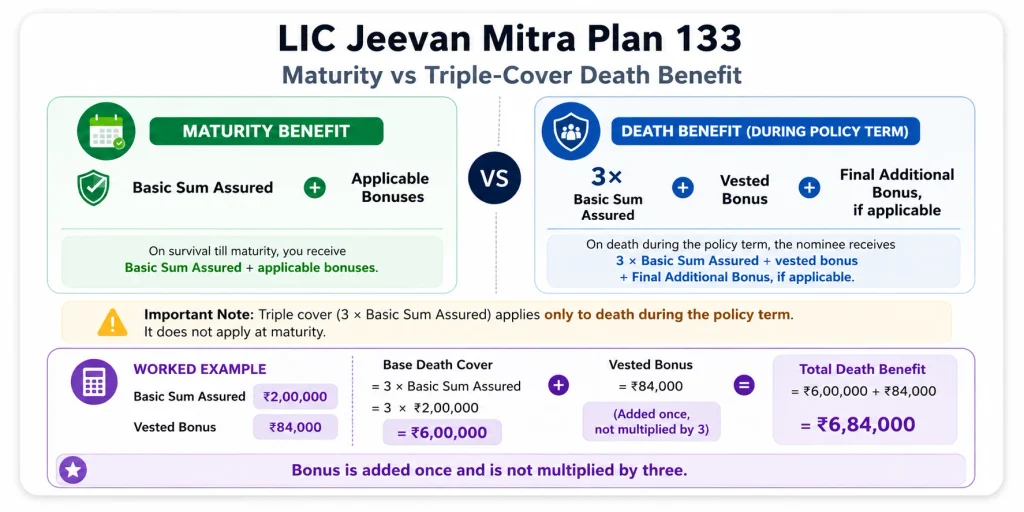
If the life assured survives until the end of the term and the policy has full benefits, the maturity value is one Basic Sum Assured plus all bonuses declared up to the maturity date.
Maturity Benefit = Basic Sum Assured + Applicable BonusesTriple cover does not apply at maturity. This is the most important difference between the maturity and death benefits under Plan 133.
For a policy that has not yet matured, future bonus cannot be known in advance. A result based only on the current vested bonus shows the value built up so far. Any projected future bonus should be displayed separately.
Triple-Cover Death Benefit
If the life assured dies during the policy term while full policy benefits are available, LIC pays three times the Basic Sum Assured plus bonuses on the Basic Sum Assured.
Suppose the Basic Sum Assured is ₹2,00,000 and the vested bonus at the time of death is ₹84,000:
Base Death Cover =
3 × ₹2,00,000
= ₹6,00,000

Total Death Benefit =
₹6,00,000 + ₹84,000
= ₹6,84,000
The bonus is added once. It is not multiplied by three. An eligible Final Additional Bonus may increase the claim. An outstanding policy loan, loan interest or other allowed deductions may reduce the final amount paid.
Bonus Calculation and Work
Plan 133 was a participating policy. LIC could declare a Simple Reversionary Bonus for every ₹1,000 of Basic Sum Assured. Once LIC declared and added a bonus to the policy, it became a vested benefit.
The annual bonus formula is:
Annual Bonus =
(Basic Sum Assured ÷ 1,000) × Bonus Rate per ₹1,000
For a Basic Sum Assured of ₹2,00,000 and an assumed rate of ₹35 per ₹1,000:
(₹2,00,000 ÷ 1,000) × ₹35
= 200 × ₹35
= ₹7,000
If the same rate is assumed for 20 years, the projected bonus is:
₹7,000 × 20 = ₹1,40,000This does not mean LIC guarantees ₹35 every year. Actual rates may differ from year to year. The total vested bonus shown in LIC records gives a better estimate than one assumed rate used for the complete term.
Final Additional Bonus is different from the yearly bonus. It may be payable at maturity or on an eligible death claim if LIC declares it and the policy meets the required conditions. It should be entered as zero when the applicable amount is not known.
Guaranteed Surrender Value
Plan 133 could be surrendered after it had remained in force for at least three years. The minimum Guaranteed Surrender Value given in the sales brochure is:
Guaranteed Surrender Value =
30% × (Total Basic Premiums Paid − First-Year Basic Premium)
Only basic premiums should be included. Tax, rider premiums and premiums for other extra benefits should be excluded.
For example, the official illustration uses a yearly premium of ₹5,453. After three years, the total premiums shown are ₹16,359.
Premium considered for GSV =
₹16,359 − ₹5,453
= ₹10,906

Guaranteed Surrender Value =
30% × ₹10,906
= ₹3,271.80
The rounded estimate is ₹3,272. This is only the Guaranteed Surrender Value. LIC may pay a Special Surrender Value if it is higher. An exact Special Surrender Value cannot be calculated without LIC’s policy-specific factors.
Premium Calculation for Different Payment Modes
The first-year basic premium means all basic instalments payable during the first policy year, not only one instalment.
| Premium mode | Instalments in one year | First-year basic premium |
| Yearly | 1 | Instalment premium × 1 |
| Half-yearly | 2 | Instalment premium × 2 |
| Quarterly | 4 | Instalment premium × 4 |
| Monthly or salary deduction | 12 | Instalment premium × 12 |
Suppose the quarterly basic premium is ₹1,500 and 40 instalments have been paid:
First-Year Basic Premium =
₹1,500 × 4
= ₹6,000

Total Basic Premium Paid =
₹1,500 × 40
= ₹60,000
These two amounts can then be used in the Guaranteed Surrender Value formula.
Complete Maturity Calculation Example
Consider an illustrative policy with the following details:
| Particular | Amount |
| Basic Sum Assured | ₹2,00,000 |
| Policy term | 20 years |
| Assumed bonus rate | ₹35 per ₹1,000 per year |
| Final Additional Bonus | Not included |
First, calculate the assumed annual bonus:
(₹2,00,000 ÷ 1,000) × ₹35
= ₹7,000
The projected bonus for 20 years is:
₹7,000 × 20 = ₹1,40,000The estimated maturity value is:
₹2,00,000 + ₹1,40,000
= ₹3,40,000
The base death cover during the policy term is:
3 × ₹2,00,000 = ₹6,00,000If the projected bonus of ₹1,40,000 were available at that time, the estimated death benefit would be ₹7,40,000. Both bonus-based results are illustrations because the ₹35 rate is assumed for every year.
LIC Official Example Explained
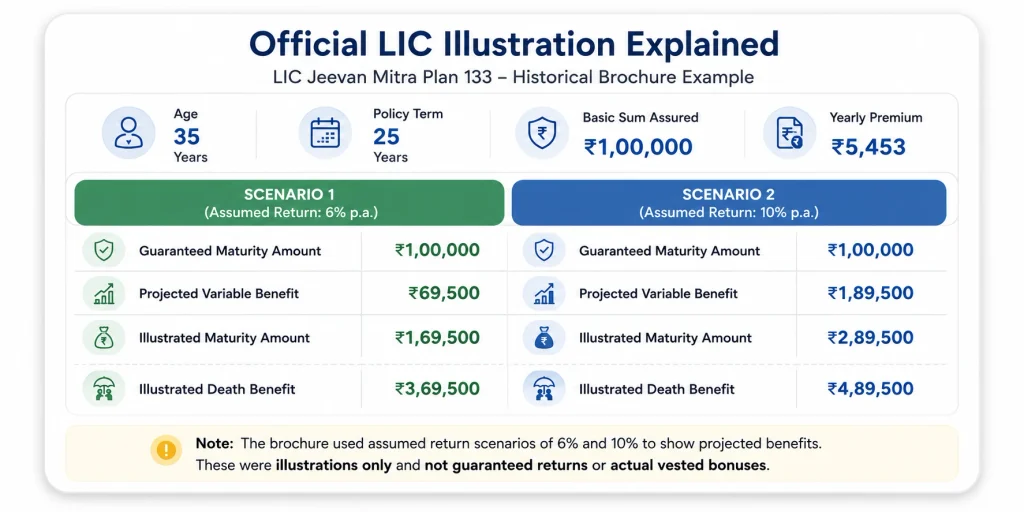
LIC’s historical sales brochure gives an example for a 35-year-old person with a 25-year term, Basic Sum Assured of ₹1,00,000 and yearly premium of ₹5,453.
| Benefit at the end of year 25 | Scenario 1 | Scenario 2 |
| Guaranteed maturity amount | ₹1,00,000 | ₹1,00,000 |
| Projected variable benefit | ₹69,500 | ₹1,89,500 |
| Illustrated maturity amount | ₹1,69,500 | ₹2,89,500 |
| Illustrated death benefit | ₹3,69,500 | ₹4,89,500 |
The brochure used assumed investment-return scenarios of 6% and 10%. These figures were provided only to explain possible benefit flows. They were not promised returns, actual vested bonuses or guaranteed maturity amounts.
What Happens If Premiums Were Stopped?
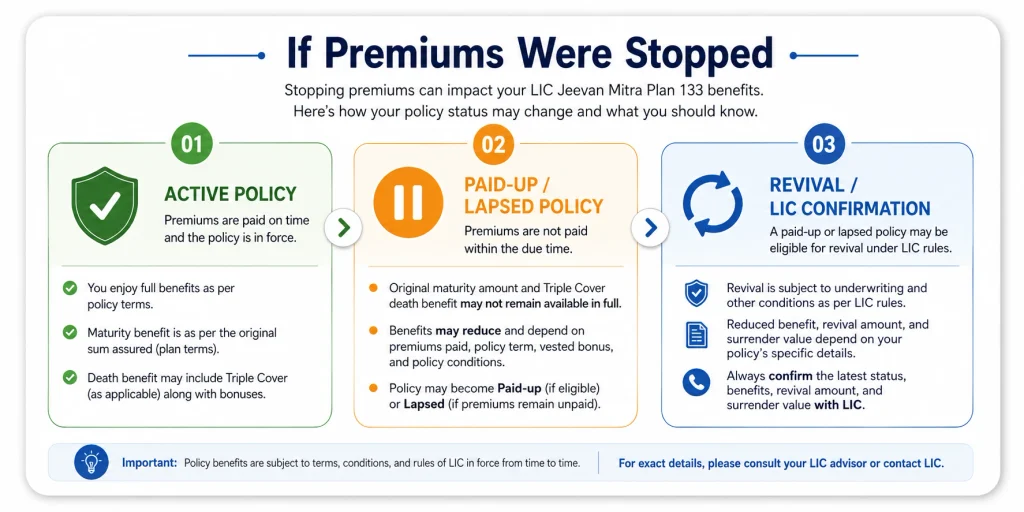
If premiums were stopped, the original maturity amount and triple-cover death benefit may not remain available in full. The reduced amount can depend on the premiums paid, policy term, vested bonuses and conditions written in the policy contract.
A lapsed policy may be eligible for revival under LIC’s rules. The calculator can provide only a basic estimate for a paid-up or lapsed policy. The reduced benefit, revival amount and surrender value should be confirmed with LIC.
Tax Benefits and Tax Rules
Tax treatment depends on the policy conditions and the law applicable when the premium or benefit is received. A premium may qualify for a deduction, while maturity or death proceeds may be taxable or exempt depending on the relevant rules.
Tax, rider premium, late fee and revival interest should not be included in the basic premium used for calculator formulas. The latest tax rules should be checked before claiming a deduction or exemption.
Important Points to Remember
- Triple cover applies to death benefit, not maturity benefit.
- Bonuses are added separately and are not multiplied by three.
- Projected bonus and vested bonus are not the same.
- Future bonus and Final Additional Bonus are not guaranteed.
- The surrender calculation must exclude the full first-year basic premium.
- Paid-up, lapsed and Special Surrender Values should be confirmed with LIC.
Frequently Asked Questions
How is the Plan 133 maturity amount calculated?
The maturity amount is the Basic Sum Assured plus vested Simple Reversionary Bonus and Final Additional Bonus, if applicable. It does not include three times the Basic Sum Assured.
Does Plan 133 pay three times the Sum Assured at maturity?
No. Triple cover applies to death during the policy term. Maturity normally includes one Basic Sum Assured plus applicable bonuses.
How is the triple-cover death benefit calculated?
The death benefit is three times the Basic Sum Assured plus vested bonuses and any applicable Final Additional Bonus. The bonuses themselves are not tripled.
Conclusion
The LIC Jeevan Mitra Plan 133 Maturity Calculator helps existing policyholders understand maturity value, triple-cover death benefit, bonus, total basic premiums and minimum surrender value.
The main benefit structure is simple: maturity includes one Basic Sum Assured plus applicable bonuses, while death during the policy term generally includes three times the Basic Sum Assured plus bonuses. Accurate results require the actual premium, policy status and vested bonus available in LIC records.

Amit Kushwaha is a financial content creator and SaaS tool developer based in Lucknow, Uttar Pradesh. He has more than seven years of experience creating insurance-related content, online calculators, and practical digital tools for LIC policyholders, insurance buyers, and LIC agents.
Through LICPolicyCalculator.com, he focuses on simplifying complex LIC policy information into easy-to-understand guides and calculators. His work covers LIC premium estimates, maturity calculations, surrender value tools, policy return calculations, term insurance planning, and plan-specific calculator pages.
1 thought on “LIC Jeevan Mitra Plan 133 Maturity Calculator Triple Cover Endowment Plan”