LIC Jeevan Tarang Plan 178 Calculator
Premium, Survival Benefit and Policy Value Estimate
Policy Benefit Calculation
This estimate covers the basic policy only. Rider premiums, taxes, underwriting extra, loan interest, revival interest and policy-specific adjustments are not included. Bonus and Loyalty Addition depend on LIC declarations and are not guaranteed.
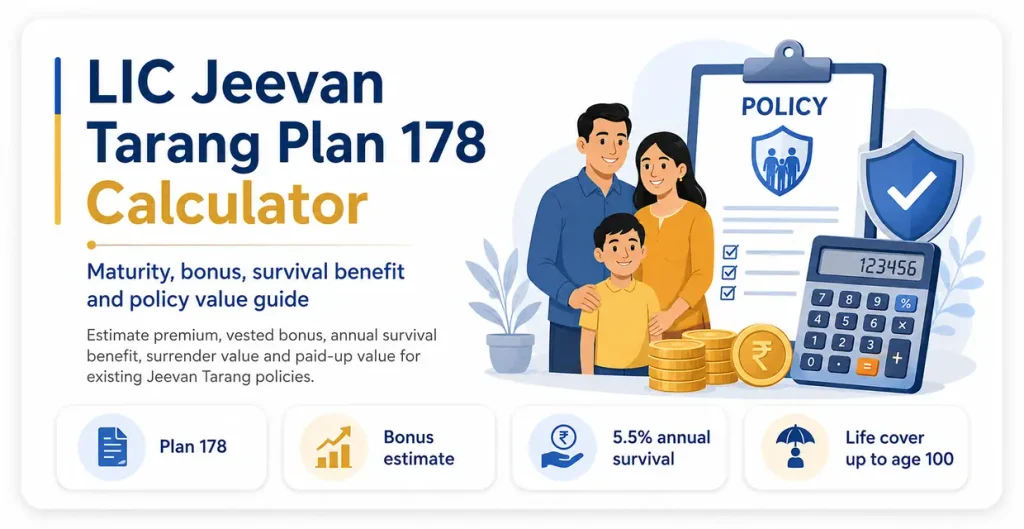
LIC Jeevan Tarang Plan 178 is a participating whole-life insurance plan launched by LIC. This policy combines bonus during an accumulation period, annual income after that period, and life cover up to age 100. LIC withdrew the plan on 1 January 2014.
In this guide, we will learn a complete guide of this plan and the LIC Jeevan Tarang Plan 178 Maturity Calculator as well as its use cases, and estimate premium, bonus, survival benefit, death benefit, surrender value and paid-up value. The end of the accumulation period is not the policy’s final maturity date.
At the end of the selected 10-year, 15-year or 20-year accumulation period, vested Simple Reversionary Bonus is paid. The Basic Sum Assured continues under the policy. Annual survival benefits then begin, while the Basic Sum Assured plus Loyalty Addition, if declared, becomes payable at age 100 or on earlier death after the accumulation period.
What is Jeevan Tarang Maturity Calculator?
This calculator is designed specifically for LIC Jeevan Tarang Plan 178. It uses the plan’s original premium rates and benefit rules instead of applying a general life-insurance formula. The calculator shows the accumulation period, estimated basic premium, applicable rebates, annual survival benefit, projected bonus, and benefits payable on survival or death.
Surrender and paid-up calculations require the premium history. Child policies also require the date on which life cover started.
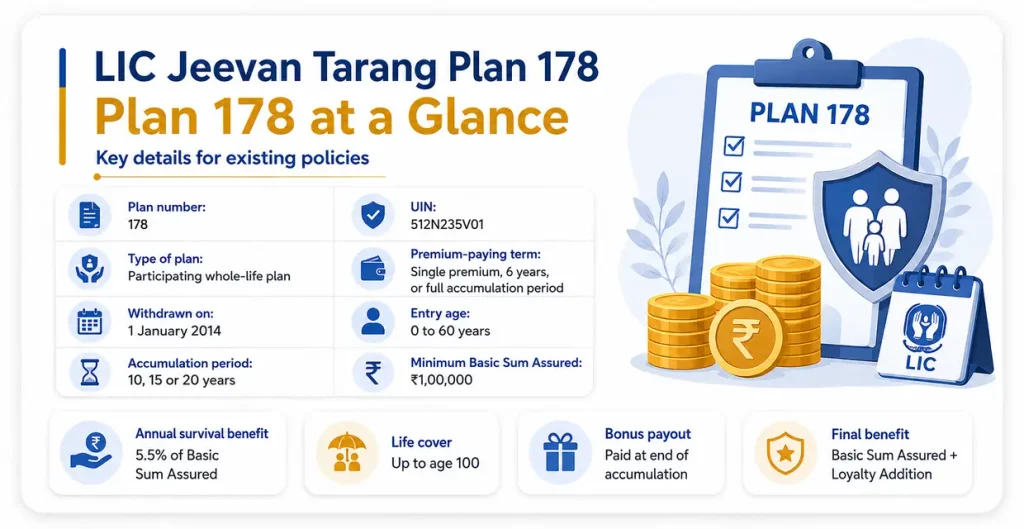
Jeevan Tarang Plan 178 Overview
| Particular | Plan details |
|---|---|
| Plan name | LIC Jeevan Tarang |
| Plan number | 178 |
| UIN | 512N235V01 |
| Plan type | Participating whole-life plan |
| Plan status | Withdrawn on 1 January 2014 |
| Accumulation period | 10, 15 or 20 years |
| Entry age | 0 to 60 years, nearest birthday |
| Minimum age at end of accumulation | 18 years, last birthday |
| Premium-paying term | Single premium, 6 years or the full accumulation period |
| Minimum Basic Sum Assured | ₹1,00,000 |
| Sum Assured multiples | ₹5,000 |
| Maximum premium-ending age | 70 years |
| Life cover | Up to age 100 |
| Annual survival benefit | 5.5% of Basic Sum Assured |
What Is LIC Jeevan Tarang Plan 178?
Jeevan Tarang is different from a normal endowment policy. Selecting an accumulation period of 10, 15 or 20 years does not mean that the Basic Sum Assured is paid when that period ends.
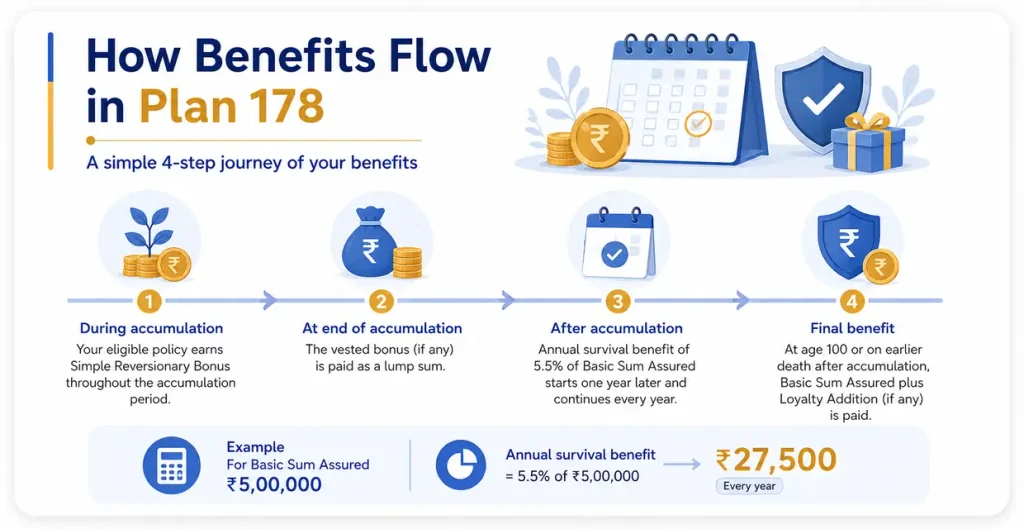
During accumulation, an eligible policy participates in LIC profits through Simple Reversionary Bonus. The vested bonus is paid as a lump sum when this period ends.
One year later, an annual survival benefit equal to 5.5% of the Basic Sum Assured starts. The Basic Sum Assured remains payable at age 100 or on earlier death after accumulation.
How to Use Jeevan Tarang Plan 178 Calculator?
Using this online calculator is free and very easy; we just need to enter the age at entry and Basic Sum Assured from the policy schedule. Select the accumulation period, premium-paying term and payment mode. Enter the actual vested bonus when available.
For surrender, enter basic premiums without GST, riders, late fees or extra premium. For a child policy, select whether life cover had started. For paid-up value, enter the premiums actually paid.
Click on Calculate and check the estimate against the policy bond and LIC records.
Benefits at the End of the Accumulation Period
At the end of the selected accumulation period, LIC pays the vested Simple Reversionary Bonus in a lump sum, provided the policy remains eligible.
Accumulation-end benefit = Total vested Simple Reversionary BonusThe Basic Sum Assured continues for the later age-100 or death benefit.
Annual Survival Benefit
The first annual survival benefit is payable one year after the accumulation period ends. It is then payable each year while the life assured survives, up to age 100, subject to the policy conditions.
Annual survival benefit = Basic Sum Assured × 5.5%For a Basic Sum Assured of ₹5,00,000:
₹5,00,000 × 5.5% = ₹27,500 per yearThis payment is based only on the Basic Sum Assured.
Age-100 Maturity Benefit
On the policy anniversary coinciding with or immediately following completion of age 100, the policy pays the Basic Sum Assured plus Loyalty Addition, if LIC declares it for the eligible claim.
Maturity benefit = Basic Sum Assured + Loyalty Addition, if anyThe scheduled 5.5% annual survival benefit also falls due in the final year under LIC’s benefit illustration. Therefore, the final cash flow can contain two separate components:
Final-year payment =
Basic Sum Assured
+ Final annual survival benefit
+ Loyalty Addition, if any
For a Basic Sum Assured of ₹5,00,000, the guaranteed components falling due in the final year would be ₹5,00,000 plus ₹27,500. Any Loyalty Addition would be added separately.
Death Benefit
The benefit depends on when death occurs.
| Policy event | Basic benefit payable |
|---|---|
| Death before risk starts under an eligible child policy | Premiums paid returned without interest, excluding additional premiums |
| Death during accumulation after risk starts | Basic Sum Assured plus vested Simple Reversionary Bonus |
| Death after the accumulation period | Basic Sum Assured plus Loyalty Addition, if any |
An eligible active rider may add a benefit. Policy loans, interest and unpaid premiums may reduce the claim.
When Does Life Cover Start for a Child?
Plan 178 allowed entry from age zero, but the normal life cover did not always start immediately for a child aged 12 or below at entry.
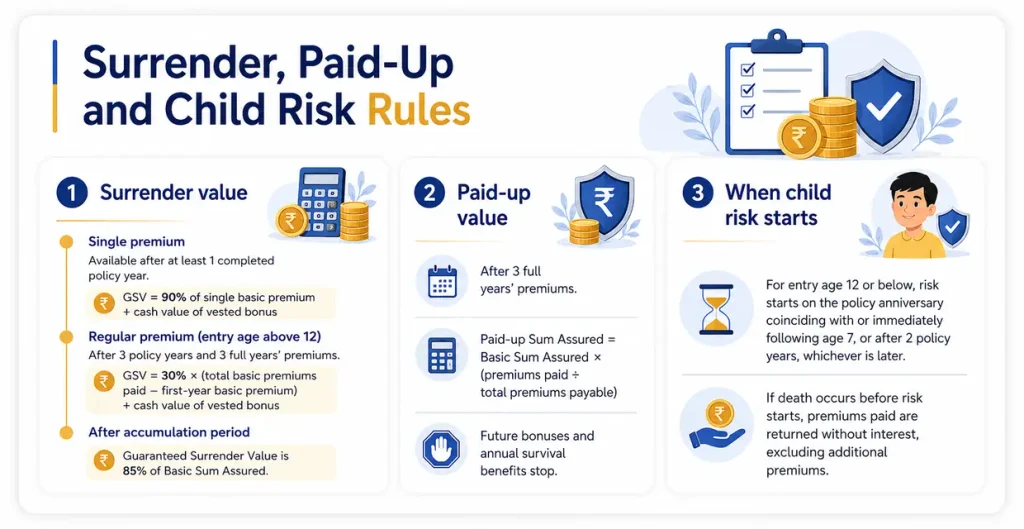
Risk starts on the policy anniversary coinciding with or immediately following age seven, or after two policy years, whichever is later.
If the child dies before risk starts, the policy is cancelled, and the premiums paid are returned without interest, excluding additional premiums. After risk starts, the normal death-benefit rules apply.
For a life assured below 18 at entry, policy ownership normally transfers on completing age 18, subject to the policy conditions.
How Bonuses Work in This Policy
Simple Reversionary Bonus and Loyalty Addition are separate benefits.
LIC may declare Simple Reversionary Bonus each year during accumulation. Once vested, it remains attached until payable.
Where an assumed annual rate is used, the projected amount can be calculated as:
Projected bonus =
(Basic Sum Assured ÷ 1,000)
× Assumed bonus rate
× Number of eligible years
LIC can declare different rates each year. Use the confirmed total vested bonus when available.
Loyalty Addition may be payable on death after accumulation or at age 100. It is not a fixed annual return and should remain an optional calculator input.
Premium Options and Calculation
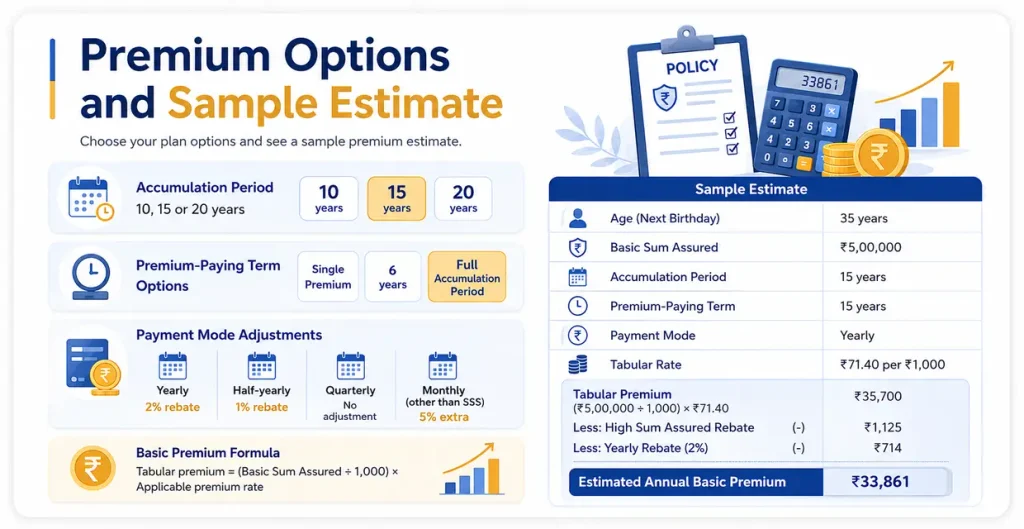
The plan offered the following choices:
| Accumulation period | Available premium-paying terms |
|---|---|
| 10 years | Single premium, 6 years or 10 years |
| 15 years | Single premium, 6 years or 15 years |
| 20 years | Single premium, 6 years or 20 years |
Premium rates were quoted per ₹1,000 of Basic Sum Assured:
Tabular premium =
(Basic Sum Assured ÷ 1,000) × Applicable premium rate
The rate depends on age, accumulation period and premium-paying term. Applicable rebates are then applied.
| Payment mode | Adjustment |
|---|---|
| Yearly | 2% rebate on tabular premium |
| Half-yearly | 1% rebate on tabular premium |
| Quarterly | No adjustment |
| Monthly other than SSS | 5% extra on tabular premium |
| Salary Saving Scheme | As shown in the applicable policy schedule |
For regular premiums, the high Sum Assured rebate was ₹1.25 per ₹1,000 for a Basic Sum Assured of ₹2,00,000 or more and ₹2.25 per ₹1,000 for ₹5,00,000 or more. Single-premium policies used separate, higher rebate rates.
LIC Jeevan Tarang Plan 178 Calculation Example
We use the following details for this calculation using the LIC Jeevan Tarang Plan 178 Maturity Calculator.
| Input | Selected value |
|---|---|
| Age at entry | 35 years |
| Basic Sum Assured | ₹5,00,000 |
| Accumulation period | 15 years |
| Premium-paying term | 15 years |
| Payment mode | Yearly |
| Assumed bonus rate | ₹40 per ₹1,000 per year |
For entry age up to 40 and a 15-year regular premium period, the historical tabular rate was ₹71.40 per ₹1,000.
Tabular premium = 500 × ₹71.40
= ₹35,700

High Sum Assured rebate = 500 × ₹2.25
= ₹1,125

Yearly mode rebate = ₹35,700 × 2%
= ₹714

Estimated annual basic premium =
₹35,700 − ₹1,125 − ₹714
= ₹33,861
GST, rider premium and any extra premium charged by LIC are not included.
The annual survival benefit after accumulation is:
₹5,00,000 × 5.5% = ₹27,500 per yearUsing the assumed bonus rate only for explanation:
Projected bonus = 500 × ₹40 × 15
= ₹3,00,000
The ₹3,00,000 amount is not guaranteed. The actual accumulation-end payment is the vested bonus shown in LIC records.
At age 100, the core maturity benefit is ₹5,00,000 plus Loyalty Addition, if declared. The final annual survival benefit of ₹27,500 is a separate payment falling due in the same final-year cash flow.
Plan 178 Surrender Value
The Guaranteed Surrender Value depends on the premium type, policy duration and age at entry.
For a single-premium policy, surrender becomes available after at least one completed policy year:
GSV = 90% of single basic premium
+ Cash value of vested bonus, if any
For a regular-premium policy where entry age was above 12, surrender becomes available after three policy years and payment of three full years’ premiums:
GSV =
30% × (Total basic premiums paid − First-year basic premium)
+ Cash value of vested bonus, if any
Rider premiums and extra charges are excluded.
For entry age of 12 or below, a different calculation applies. Before risk starts, the guaranteed value is 90% of eligible premiums paid, excluding the first-year premium and extras. After risk starts, it is 90% of eligible premiums paid before risk commencement plus 30% of eligible premiums paid after risk commencement. The first-year premium and extras remain excluded as required by the policy wording.
After the accumulation period, the Guaranteed Surrender Value is 85% of the Basic Sum Assured. LIC may deduct an outstanding loan, interest or other policy dues from the amount payable.
Paid-Up Value
A regular-premium policy can acquire paid-up value after at least three full years’ premiums have been paid.
Paid-up Sum Assured =
Basic Sum Assured ×
(Number of premiums paid ÷ Total premiums originally payable)
If the Basic Sum Assured is ₹5,00,000 and six annual premiums were paid out of an original 15-year premium-paying term:
₹5,00,000 × 6 ÷ 15 = ₹2,00,000The reduced amount plus vested bonus is payable at the end of accumulation or on earlier death. Future bonuses and annual survival benefits stop. Riders do not acquire paid-up value.
Tax Benefits and Tax Rules
Premiums may have qualified for a deduction under Section 80C, subject to the conditions and limits applicable when they were paid. Tax treatment of survival, maturity, surrender and death payments depends on the policy’s issue date, premium details, policy status and the law applicable at the time of payment.
GST, rider premiums, late fees and extra premium should not be included in the basic-premium formulas. No payment should be described as tax-free without checking the individual policy and applicable tax rules.
Important Points to Remember
- The accumulation period is not the final maturity date.
- Future bonus and Loyalty Addition are not guaranteed.
- Child policies may have a delayed risk-start date and a different surrender formula.
- A paid-up policy does not receive future annual survival benefits.
- Loans, interest, unpaid premiums and other dues can reduce the final payment.
Also Check:
- LIC Jeevan Anurag Plan 168 Calculator
- LIC Jeevan Saral Plan 165 Calculator
- LIC Bal Vidya Plan 135 Calculator
- LIC Jeevan Vishwas Plan 136
Frequently Asked Questions
What is paid at the end of the accumulation period?
LIC pays the vested Simple Reversionary Bonus in a lump sum. The Basic Sum Assured normally continues under the whole-life policy and is not paid at this stage.
When does the 5.5% annual survival benefit start?
The first payment is due one year after the selected accumulation period ends. It is then payable annually while the life assured survives, subject to the policy conditions.
What is payable at age 100?
The policy pays the Basic Sum Assured plus Loyalty Addition, if declared. The final scheduled annual survival benefit also falls due in the final-year cash flow.
How is the death benefit calculated?
After risk starts, death during accumulation pays Basic Sum Assured plus vested bonus. Death after accumulation pays Basic Sum Assured plus Loyalty Addition, if any. For an eligible child who dies before risk starts, premiums are returned without interest, excluding additional premiums.
How are surrender and paid-up values calculated?
Surrender value depends on the premium type, duration and whether risk had started for a child policy. Paid-up value is based on the proportion of premiums paid to premiums originally payable. The final eligible amounts should be confirmed with LIC.
Conclusion
The LIC Jeevan Tarang Plan 178 Maturity Calculator can help explain the policy’s unusual payment pattern. Vested bonus is paid at the end of accumulation, the 5.5% annual survival benefit begins one year later, and the Basic Sum Assured remains available until age 100 or earlier death after accumulation.
Accurate results require the correct policy status, premium history, vested bonus and risk-start date. LIC records should be used for the final surrender, maturity or claim amount.

Amit Kushwaha is a financial content creator and SaaS tool developer based in Lucknow, Uttar Pradesh. He has more than seven years of experience creating insurance-related content, online calculators, and practical digital tools for LIC policyholders, insurance buyers, and LIC agents.
Through LICPolicyCalculator.com, he focuses on simplifying complex LIC policy information into easy-to-understand guides and calculators. His work covers LIC premium estimates, maturity calculations, surrender value tools, policy return calculations, term insurance planning, and plan-specific calculator pages.