LIC Jeevan Chhaya Plan 103 Calculator
UIN: 512N096V01 · Premium outgo, four scheduled payouts, bonus illustration and surrender estimate
Plan benefit overview
Four-payment survival schedule
Each scheduled amount equals 25% of the Basic Sum Assured. Bonus is added only with the final scheduled payment.
| Policy year completed | Benefit description | Payable amount |
|---|
Death-benefit view
On death during the policy term, the full Basic Sum Assured is payable immediately. The four scheduled payments remain part of the plan’s benefit flow.
Guaranteed surrender-value checkpoint
Calculated at 30% of basic premiums paid after excluding the first-year basic premium and fixed benefits already received.
LIC Jeevan Chhaya Plan 103 is an old LIC participating endowment policy with life cover and four planned payouts in the final four policy years. It is no longer available for a new purchase, but existing policyholders may still need to check the maturity value, bonus, surrender value, death benefit, and premium details.
This is not a normal lump-sum maturity plan. The Basic Sum Assured is split into four equal payments of 25% during the final four policy years. Bonuses, where applicable, are paid with the last instalment. If the life assured dies during the term, the full Basic Sum Assured is payable immediately, while scheduled benefits remain part of the policy’s benefit flow.
This guide explains the plan in plain language and shows how to use the LIC Jeevan Chhaya Calculator Plan 103 on this page. For an actual claim, maturity payment or surrender request, the policy bond and LIC’s calculation will prevail.
Table of Contents
LIC Jeevan Chhaya Plan 103 Calculator: Important Update
LIC Jeevan Chhaya is Plan No. 103 with UIN 512N096V01. LIC lists it under withdrawn plans, with a withdrawal date of 1 January 2014. That means a new Jeevan Chhaya policy cannot be bought today. The calculator and this article are useful for understanding existing policies, checking old policy schedules and estimating the expected cash-flow pattern.
Some websites describe Plan 103 as a child plan because the last-four-year payouts could support education or other family goals. However, LIC’s own brochure describes it as a participating Endowment Assurance plan. The policy structure, not a website category, should be used to understand its benefits.
LIC Jeevan Chhaya Plan 103 Overview
| Policy feature | What it means |
|---|---|
| Plan name | LIC Jeevan Chhaya |
| Plan number | 103 |
| UIN | 512N096V01 |
| Current status | Withdrawn; not available for new sale |
| Plan category | Participating Endowment Assurance plan |
| Premium payment | Yearly, half-yearly, quarterly, monthly or salary deduction |
| Fixed late-term payments | 25% of Basic Sum Assured at the end of each of the last four policy years |
| Death protection | Full Basic Sum Assured payable immediately on death during the term |
| Bonus types | Simple Reversionary Bonus and possible Final Additional Bonus |
| Surrender | Available after the policy has been in force for at least three years, subject to rules |
The brochure is a benefit illustration, not the complete contract. Use the policy schedule for the exact premium, term, riders and special conditions.
What Is LIC Jeevan Chhaya Plan 103?
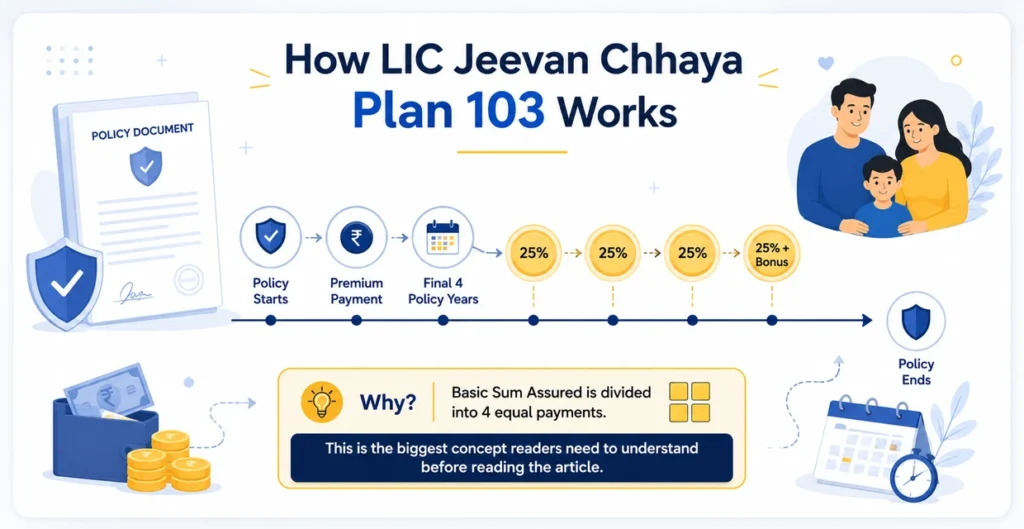
Jeevan Chhaya Plan 103 combines savings with life insurance protection. Premiums are paid during the policy term. In return, the policy creates a fixed payment pattern in the final four years and provides life cover throughout the policy term.
The policy does not hold the full Basic Sum Assured until one maturity date and then pay it in one instalment. It pays one-fourth at the end of each final policy year.
For example, a Basic Sum Assured of ₹4,00,000 produces four fixed instalments of ₹1,00,000. The fourth instalment includes its 25% share plus vested bonus and any applicable Final Additional Bonus.
This design gives a family staged payments, but future bonus is not guaranteed before LIC declares it.
Check Other Plans:
- LIC Jeevan Surabhi Plan 108 Maturity Calculator 25-Year Plan
- LIC Jeevan Surabhi Plan 107 Calculator- 20 Year Policy Calculate Maturity, Benefits
- LIC Jeevan Surabhi Calculator Plan 106 (15 Year) Check Maturity, Bonus, Surrender Value, Premium
- LIC Anmol Jeevan II Plan 822 Calculator Check Premium, Maturity, Plan Details
LIC Jeevan Chhaya Plan 103 Benefits Explained
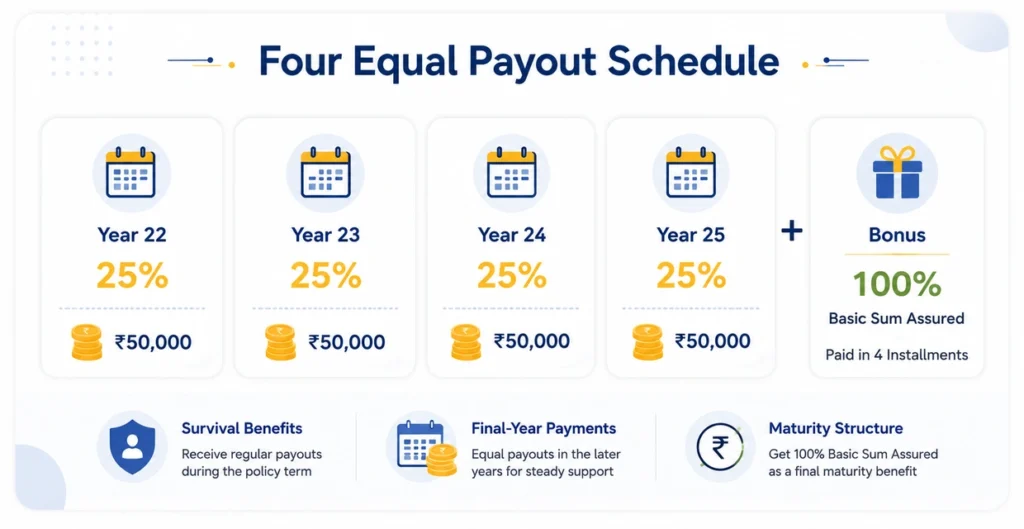
Four survival benefits in the last four years
The core benefit is the scheduled payment of 25% of the Basic Sum Assured at the end of each of the last four policy years. This benefit is payable whether the life assured survives the policy term or dies during the policy term.
Each final-year instalment = Basic Sum Assured ÷ 4If the Basic Sum Assured is ₹2,00,000:
| Benefit year | Fixed amount |
|---|---|
| End of fourth-last policy year | ₹50,000 |
| End of third-last policy year | ₹50,000 |
| End of second-last policy year | ₹50,000 |
| End of final policy year | ₹50,000 plus bonus, if any |
The total of the four fixed instalments equals 100% of the Basic Sum Assured. Do not add the full Sum Assured again as a separate maturity amount.
Immediate Death Benefit
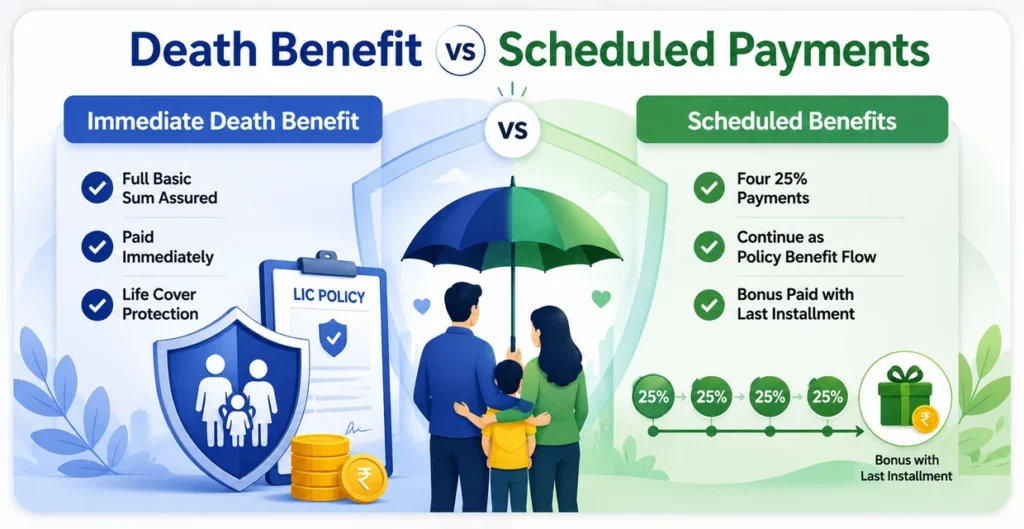
If the life assured dies during the policy term, LIC’s brochure states that an amount equal to the Basic Sum Assured is payable immediately. This is separate from the four scheduled 25% payouts.
For a policy with ₹2,00,000 Basic Sum Assured, the immediate death benefit is ₹2,00,000. In addition, the four scheduled instalments of ₹50,000 each remain part of the policy benefit stream, subject to the policy terms. Any declared bonus is paid with the final instalment.
The calculator separates the immediate death claim from future scheduled payments, so an immediate payout is not confused with total policy cash flow.
Maturity and final payment
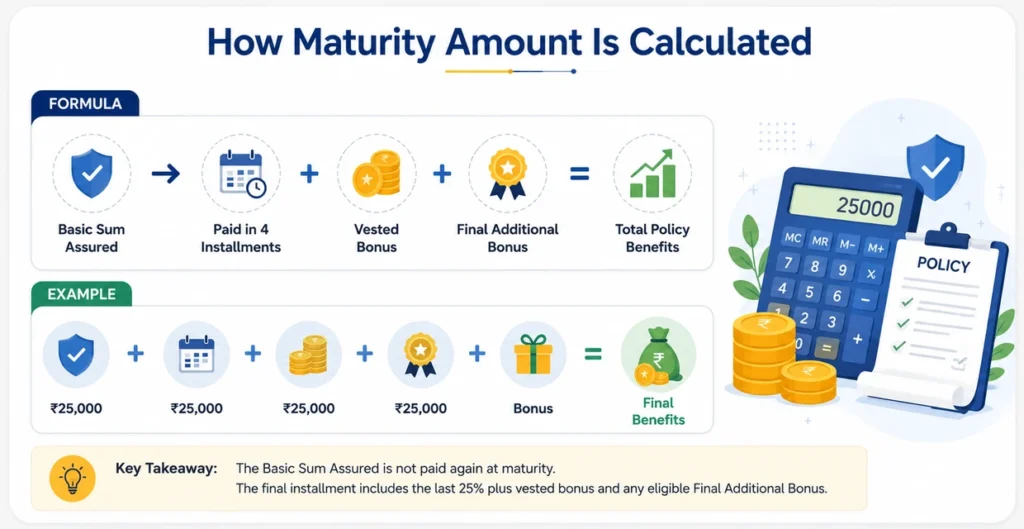
The final policy-year payment is not a second full Sum Assured. It is the fourth 25% instalment, together with accumulated bonuses.
Total scheduled maturity value =
Basic Sum Assured
+ vested Simple Reversionary Bonus
+ Final Additional Bonus, if declared and applicable
The money is received in stages. The first three 25% instalments are paid before the last year. The final instalment contains the remaining 25% of the Basic Sum Assured plus bonus. Therefore, when checking maturity value, add all four payments together rather than looking only at the final payment.
Optional supplementary benefits
The brochure says supplementary or extra benefits could be added for an additional premium. The available benefit, premium and eligibility would depend on the original policy contract. Do not assume a rider is present only because it was available as an option. Check the policy schedule or premium receipt for the exact rider name and premium.
LIC Jeevan Chhaya Plan 103 Bonus Rate Explained
Jeevan Chhaya is a with-profits plan. That means it participates in LIC’s life insurance business profits through bonuses. The key bonus is the Simple Reversionary Bonus, usually shown as an amount per ₹1,000 of Basic Sum Assured.
Annual bonus = (Basic Sum Assured ÷ 1,000) × declared bonus rateSuppose the Basic Sum Assured is ₹2,00,000 and the declared rate for a particular year is ₹40 per ₹1,000 of Sum Assured:
Annual bonus = (₹2,00,000 ÷ 1,000) × ₹40
             = ₹8,000
A separate rate may be declared for each year, so total vested bonus is the sum of every annual declaration. Multiplying one old rate by the whole policy term gives only a rough estimate.
Once LIC declares a Simple Reversionary Bonus and adds it to the policy, it becomes vested. Future bonus is not guaranteed. The official illustration’s 6% and 10% scenarios were investment-return assumptions for that period, not promised bonus rates or guaranteed returns.
Final Additional Bonus
A Final Additional Bonus, often called FAB, may be payable if the policy meets the required conditions. It is not an automatic amount for every policy and should not be entered as a guaranteed figure unless it is confirmed by LIC.
For policy calculations, treat FAB as a separate field. Use ₹0 without official confirmation. Where applicable, it is added to the final instalment. Historical LIC bonus instructions also treated eligible FAB on a Jeevan Chhaya death claim as payable at the end of the original term with reversionary bonus, based on the original-term rate.
How to Use the LIC Jeevan Chhaya Calculator Plan 103
The calculator is designed for existing policyholders. It does not generate an official new-policy quotation because Plan 103 has been withdrawn and the brochure does not provide a complete premium-rate chart.
Use the policy bond, premium receipt and LIC bonus details before entering values.
Step 1: Enter age at policy start
Fill the age recorded when the policy began. This mainly helps create a clear policy profile. For an existing policy, the age shown on the bond is the correct value.
Step 2: Add the policy term
Enter the complete policy term printed on the policy schedule. The calculator uses this to find the four final policy years. For a 25-year policy, the scheduled benefit years are 22, 23, 24 and 25.
Step 3: Enter Basic Sum Assured
Use the Basic Sum Assured, not a total maturity estimate and not the premium amount. The calculator divides this figure by four to calculate each fixed survival instalment.
Basic Sum Assured: ₹1,00,000
Each scheduled payment: ₹25,000
Step 4: Select premium payment mode
Select yearly, half-yearly, quarterly, monthly or salary deduction according to the policy schedule. Enter the actual premium payable in that selected mode.
The tool calculates premium outgo from the amount entered and payment frequency. Use the exact modal premium from the policy rather than inventing it from an annual figure.
Step 5: Enter bonus details carefully
The bonus-rate field is useful for a broad estimate. Enter a bonus rate per ₹1,000 of Basic Sum Assured only when it is taken from relevant LIC declared bonus information.
For precision, calculate each year’s bonus separately and add the vested amounts. Where yearly rates are unavailable, treat the result as an estimate.
Step 6: Add Final Additional Bonus only when known
Enter FAB only if LIC has confirmed it or an applicable official circular supports it. Otherwise, leave it blank or enter zero. The calculator will then keep the final benefit estimate conservative.
Step 7: Use completed years for surrender estimate
Enter how many complete premium years have been paid when checking surrender value. The calculator checks whether the three-year condition is met and provides a Guaranteed Surrender Value estimate based on the brochure formula.
Step 8: Review the payment schedule
After calculation, check these outputs:
- Premium payable in the selected mode
- Estimated total premium outgo
- Immediate death benefit
- Four final policy-year instalments
- Bonus added to the final instalment
- Estimated Guaranteed Surrender Value
- Separate death-benefit flow view
This shows when money is payable instead of presenting one misleading total.
Real Calculation Example from LIC
LIC’s official brochure provides an illustration for a standard non-smoker life aged 35 years. The policy term is 25 years, the Basic Sum Assured is ₹1,00,000 and the yearly premium is ₹4,653.
The total yearly premium outgo over 25 years is:
₹4,653 × 25 = ₹1,16,325Because the Basic Sum Assured is ₹1,00,000, each final-year fixed payment is:
₹1,00,000 ÷ 4 = ₹25,000The schedule looks like this:
| End of policy year | Fixed payment | Bonus included? |
|---|---|---|
| 22 | ₹25,000 | No |
| 23 | ₹25,000 | No |
| 24 | ₹25,000 | No |
| 25 | ₹25,000 | Yes, if declared |
The brochure’s historical illustration shows a variable amount of ₹69,500 under one assumed scenario and ₹1,82,500 under another assumed scenario in the final year. That produced final-year payments of ₹94,500 and ₹2,07,500 respectively.
The cumulative illustration totals were therefore:
| Illustration scenario | Total of four scheduled payments |
|---|---|
| First scenario | ₹1,69,500 |
| Second scenario | ₹2,82,500 |
These figures are not a forecast for another policy. They used the old 6% and 10% investment-return assumptions and are useful only for understanding payment sequence. Actual bonus depends on LIC declarations for the policy.
How to Use This Example in the Calculator
| Calculator field | Value |
|---|---|
| Age at policy start | 35 years |
| Policy duration | 25 years |
| Basic Sum Assured | ₹1,00,000 |
| Payment frequency | Yearly |
| Premium for selected frequency | ₹4,653 |
| Bonus rate | Leave blank unless using confirmed yearly rates |
| Final Additional Bonus | Leave blank unless officially confirmed |
The calculator should show four fixed payments of ₹25,000 in years 22, 23, 24 and 25. It should show a total full-term basic premium outgo of ₹1,16,325. Any bonus estimate appears separately so that it is not confused with a guaranteed amount.
LIC Jeevan Chhaya Plan 103 Surrender Value Calculator
A Jeevan Chhaya policy may be surrendered after it has been in force for three years or more. The Guaranteed Surrender Value stated in the official brochure is 30% of basic premiums paid, excluding the first year’s premium and fixed benefits already paid.
Guaranteed Surrender Value =
30% × (basic premiums paid
− first-year basic premium
− fixed benefits already received)
Use only basic premiums. Do not add taxes, extra premiums or rider premiums unless LIC’s claim calculation specifically includes them.
Assume yearly basic premium is ₹6,000 and the policy is surrendered after five completed years before any final-four-year instalment has been received.
Basic premiums paid = ₹6,000 × 5 = ₹30,000
Less first-year premium = ₹6,000
Less fixed benefits already paid = ₹0
Eligible base = ₹24,000
Guaranteed Surrender Value = 30% × ₹24,000 = ₹7,200
This is only the guaranteed minimum calculation. LIC may pay a Special Surrender Value equal to or higher than GSV. The actual amount depends on paid premiums and surrender duration, and an early surrender amount can be lower than total premiums paid.
Important Points Before Relying on a Plan 103 Calculation
Distinguish between Basic Sum Assured and maturity value. Basic Sum Assured is the base for the 25% instalments and death benefit; maturity value is four instalments plus bonus.
Do not treat all money as payable on one date. The four final payments are spread across four policy years. Bonus rates are not fixed for life, so use annual LIC declarations wherever possible.
Do not use Plan 103 calculators as new-purchase calculators. Existing policyholders should use the actual premium and term from the policy bond. If the policy has been altered, made paid-up, lapsed, revived or has an outstanding loan, the standard illustration may not reflect the actual claim amount.
Frequently Asked Questions
Is LIC Jeevan Chhaya Plan 103 still available?
No. LIC lists Plan 103 as withdrawn from 1 January 2014. Existing policies can continue according to their contract terms, but a new proposal cannot be made under this plan.
What are the main LIC Jeevan Chhaya Plan 103 benefits?
The plan provides four fixed late-term payments of 25% of the Basic Sum Assured each, immediate Basic Sum Assured on death during the policy term, and bonus participation through Simple Reversionary Bonus and possible Final Additional Bonus.
Is the full Sum Assured paid again at maturity?
No. The Basic Sum Assured is paid through four 25% scheduled instalments in the final four policy years. The final instalment can include vested bonus and applicable FAB.
How is LIC Jeevan Chhaya Plan 103 bonus calculated?
For one policy year, divide Basic Sum Assured by ₹1,000 and multiply it by LIC’s declared bonus rate for that year. Add each declared annual bonus to get the total vested bonus. Future bonus is not guaranteed before declaration.
When is bonus paid under Plan 103?
The brochure says bonuses declared during the policy term are paid along with the last instalment. This applies to the policy’s stated death or survival benefit structure.
What happens if the life assured dies before the policy ends?
The full Basic Sum Assured is payable immediately. The policy’s four scheduled 25% benefits and applicable bonus continue as part of the original benefit flow, subject to the policy terms.
Can LIC Jeevan Chhaya Plan 103 be surrendered?
Yes, after the policy has been in force for at least three years. The Guaranteed Surrender Value is based on 30% of basic premiums paid after excluding the first-year premium and fixed benefits already paid.
Does the calculator provide the exact LIC maturity amount?
It provides a structured estimate. Exact payment depends on the policy bond, paid premiums, vested bonus, FAB eligibility, policy status and LIC’s final claim calculation.
Conclusion
LIC Jeevan Chhaya Plan 103 is best understood as a participating endowment policy with four planned late-term payments, life cover and bonus participation. The most reliable calculation starts with the policy bond: use the exact Basic Sum Assured, policy term, premium mode and paid-premium record. Use the calculator to understand the schedule, estimate bonus separately and check the Guaranteed Surrender Value formula. For a final maturity, death or surrender claim, rely on LIC’s official calculation and the policy contract.