
LIC Jeevan Dhara II Plan 872 Calculator
Deferred annuity estimate with eligibility, premium and benefit calculations
Enter age as on last birthday.
Applicable only for joint-life options.
Use official LIC annuity rate from benefit illustration
Enter the final rate mentioned in the LIC benefit illustration. Leave blank to use the built-in illustrative rate engine.
Calculation Results
Policy Benefit Summary
Selected Option:
Benefit After Vesting:
Early Return of Premium:
Minimum Annuity Status:
View Premium and Benefit Schedule
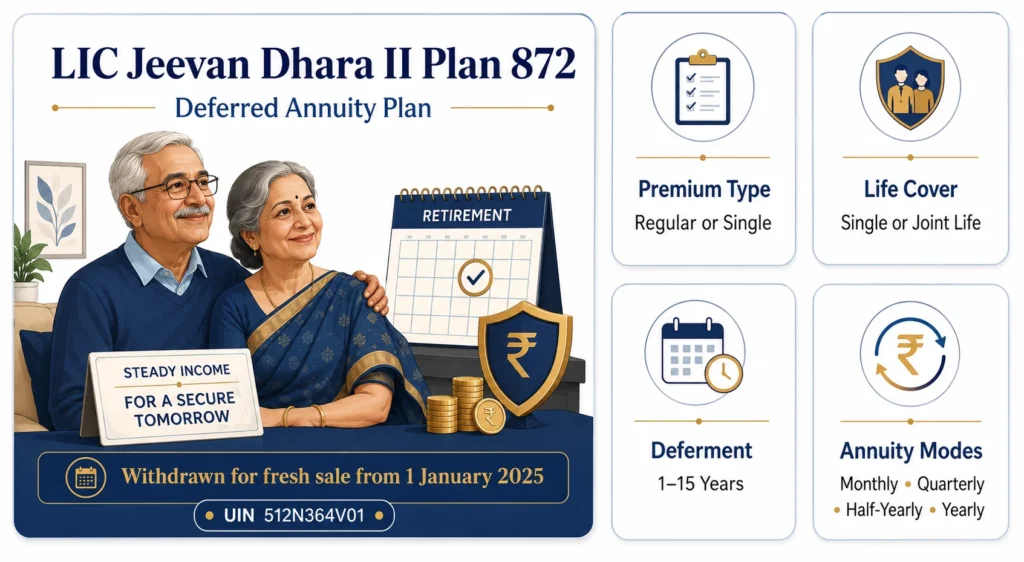
LIC Jeevan Dhara II Plan 872 was a deferred annuity plan designed to provide regular income after a selected deferment period. LIC launched the plan on 22 January 2024 and withdrew it from fresh sale from 1 January 2025. Therefore, the plan is now mainly relevant for existing policyholders who want to understand their annuity, vesting age, premium, death benefit or other policy benefits.
The LIC Jeevan Dhara II Plan 872 Calculator helps estimate important policy values using details such as premium type, age, deferment period, premium amount, selected annuity option and annuity payment mode.
The calculator is useful for understanding the policy, but the final guaranteed annuity should always be checked from the original LIC policy schedule or benefit illustration because the annuity rate was fixed according to the conditions applicable when the policy was purchased.
Table of Contents
What Is LIC Jeevan Dhara II Plan 872?
LIC Jeevan Dhara II was a non-linked, non-participating individual deferred annuity plan. Unlike an endowment plan, it was not primarily designed to pay a large maturity amount at the end of the policy term.
Instead, the policyholder selected a deferment period. After this period ended, regular annuity payments started and continued according to the selected annuity option.
The plan supported both regular premium and single premium structures. Regular premium policies allowed premiums to be paid over several years, while single premium policies were purchased by paying the purchase price once.
Annuity could be received monthly, quarterly, half-yearly or yearly.
There was no bonus, loyalty addition, final additional bonus or market-linked fund value under this plan because it was a non-participating and non-linked policy.
Jeevan Dhara II should also not be treated as a normal maturity plan. At the end of the deferment period, the policy reaches the vesting stage and annuity starts. Some options provided return of premium or purchase price on death, while Options 3 to 7 included early return-of-premium benefits.
Highlights of the LIC Jeevan Dhara II Calculator
The calculator is designed to make the plan easier to understand without requiring complicated manual calculations. It can check whether the entered age and deferment period are suitable for the selected annuity option, calculate the expected vesting age, convert instalment premium into annual equivalent premium where required, estimate the total premium paid before vesting and show the applicable death-benefit structure.
It can also separate regular premium and single premium calculations and adjust the required inputs when a joint-life annuity option is selected.
For the most accurate annuity estimate, the policy-specific annuity rate or annuity amount from the original LIC benefit illustration should be used because LIC annuity rates depend on factors such as age, premium, option, deferment period, and applicable incentives.
Also Check:
- LIC Policy Calculator
- LIC Payout Calculator
- LIC Final Settlement Calculator
- LIC Paid Up Value Calculator
- LIC Pre Maturity Calculator
How to Use the LIC Jeevan Dhara II Calculator
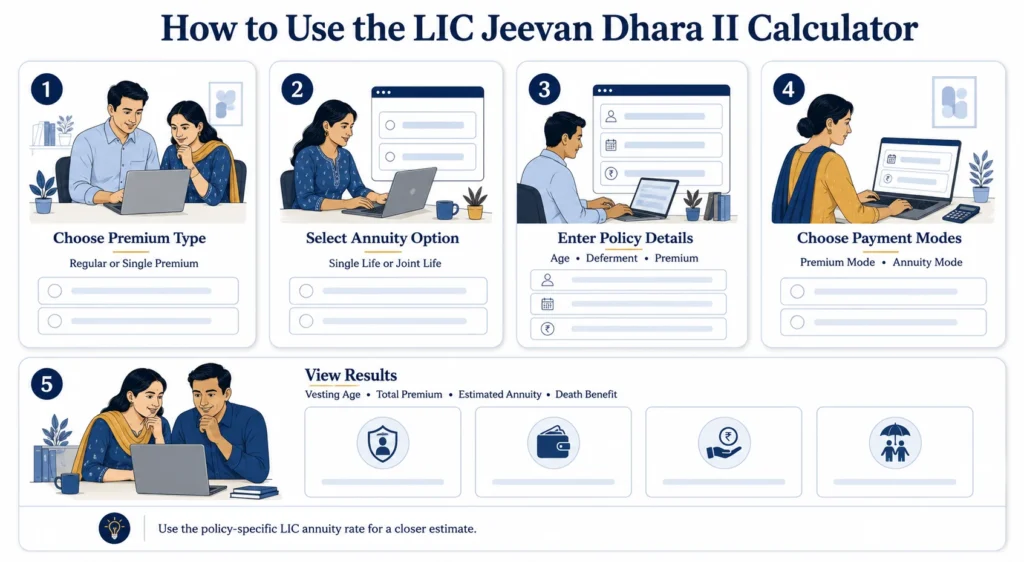
First select whether the policy is a Regular Premium or Single Premium policy. Then select the annuity option mentioned in the policy document.
Enter the age of the annuitant. If a joint-life option is selected, enter the age of the second annuitant as well.
Next, enter the deferment period and premium amount or single purchase price. For a regular premium policy, select the premium payment mode such as yearly, half-yearly, quarterly or monthly.
Select how the annuity is payable — monthly, quarterly, half-yearly or yearly. If the calculator provides a field for the policy-specific LIC annuity rate, enter the rate shown in the original benefit illustration.
After entering the details, click Calculate.
The result may show the vesting age, annual equivalent premium, total premium up to vesting, expected annuity, payment frequency and applicable death benefit.
Remember that the calculated annuity is an estimate unless the exact policy-specific annuity rate from LIC has been entered.
LIC Jeevan Dhara 2 Calculation Example
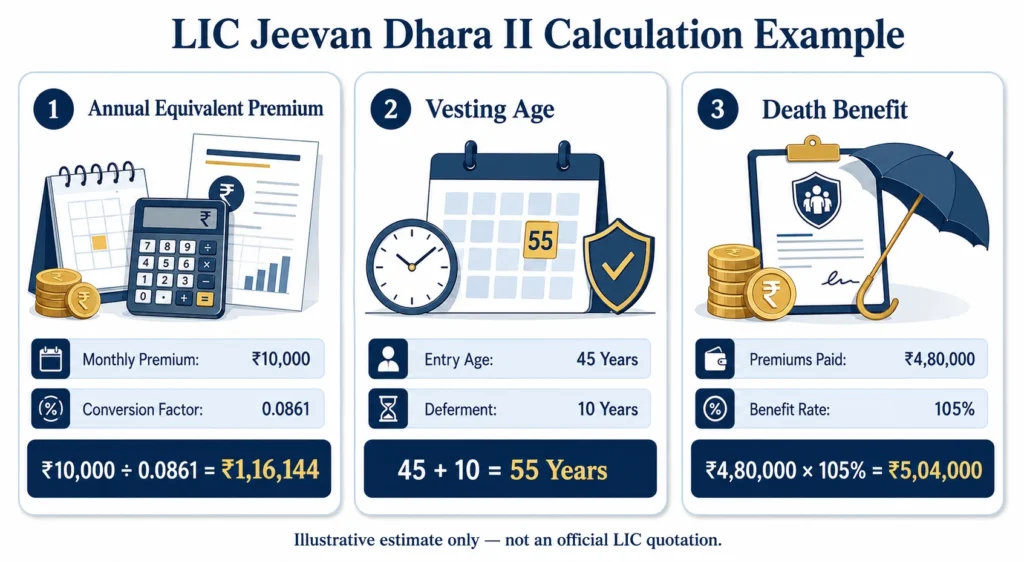
Consider a regular premium policy where the monthly premium is ₹10,000 and the selected deferment period is 10 years.
LIC used a conversion factor of 0.0861 for the monthly premium while calculating the annual equivalent premium.
Therefore:
Annual Equivalent Premium = ₹10,000 ÷ 0.0861
This gives an annual equivalent premium of approximately ₹1,16,144.
This annual equivalent figure is different from simply multiplying ₹10,000 by 12. LIC uses the annual equivalent premium for annuity-rate calculations and applicable premium incentives.
However, the actual cash premium paid over one year would still be based on the policy’s scheduled monthly instalments.
If the annuitant enters the policy at age 45 with a deferment period of 10 years, the vesting age would be approximately 55 years.
If the selected option is one where death during deferment is covered by 105% of total premiums paid and ₹4,80,000 has been paid before death, the applicable deferment-period death benefit would be:
₹4,80,000 × 105% = ₹5,04,000
The actual annuity should then be calculated using the annuity rate fixed by LIC for that particular policy.
This example is only to explain how the calculator works. It is not an official LIC quotation.
LIC Jeevan Dhara II Plan Details
| Particular | Plan Details |
|---|---|
| Plan Name | LIC’s Jeevan Dhara II |
| Plan Number | 872 |
| UIN | 512N364V01 |
| Plan Type | Non-linked, non-participating deferred annuity |
| Premium Options | Regular Premium and Single Premium |
| Life Options | Single Life and Joint Life |
| Regular Premium Deferment | 5 to 15 years |
| Single Premium Deferment | 1 to 15 years |
| Annuity Modes | Monthly, Quarterly, Half-Yearly and Yearly |
| Bonus | Not available |
| Current Status | Withdrawn for fresh sale from 1 January 2025 |
Who Should Choose LIC Jeevan Dhara II?
Since LIC Jeevan Dhara II Plan 872 has already been withdrawn, it cannot now be selected as a fresh policy. This section is therefore mainly useful for understanding who the product was originally designed for and whether its features matched the policyholder’s retirement-income objective.
The plan was designed for people who wanted to create a guaranteed regular income after a waiting period rather than receive a normal maturity lump sum.
The regular premium version allowed retirement income to be built through periodic premium payments, while the single premium version allowed a lump-sum purchase price to be converted into future annuity income.
Joint-life options were useful where income was intended to continue for a second annuitant after the first annuitant’s death. Return-of-premium and return-of-purchase-price options were available for people who wanted a death benefit along with lifetime annuity.
Existing policyholders should judge the plan according to the annuity option already selected because the annuity option cannot be changed after policy issue.
Eligibility Criteria for LIC Jeevan Dhara II Plan 872 Calculator
The minimum entry age under the plan was 20 years.
Maximum entry age was not the same for every annuity option. It depended on both the selected option and the deferment period.
For Options 1, 2, 8, 9, 10 and 11, the maximum entry age was generally calculated as 80 years minus the deferment period.
For Options 5, 6 and 7, it was 70 years minus the deferment period, while for Options 3 and 4 it was 65 years minus the deferment period.
The minimum vesting age was 35 years for regular premium Options 1 to 9 and 31 years for single premium Options 10 and 11.
Maximum vesting age also depended on the selected option. Joint-life options had separate age limits for the second annuitant.
For this reason, a calculator should not check entry age alone. It should check the selected deferment period and resulting vesting age together.
LIC Jeevan Dhara II Annuity Options
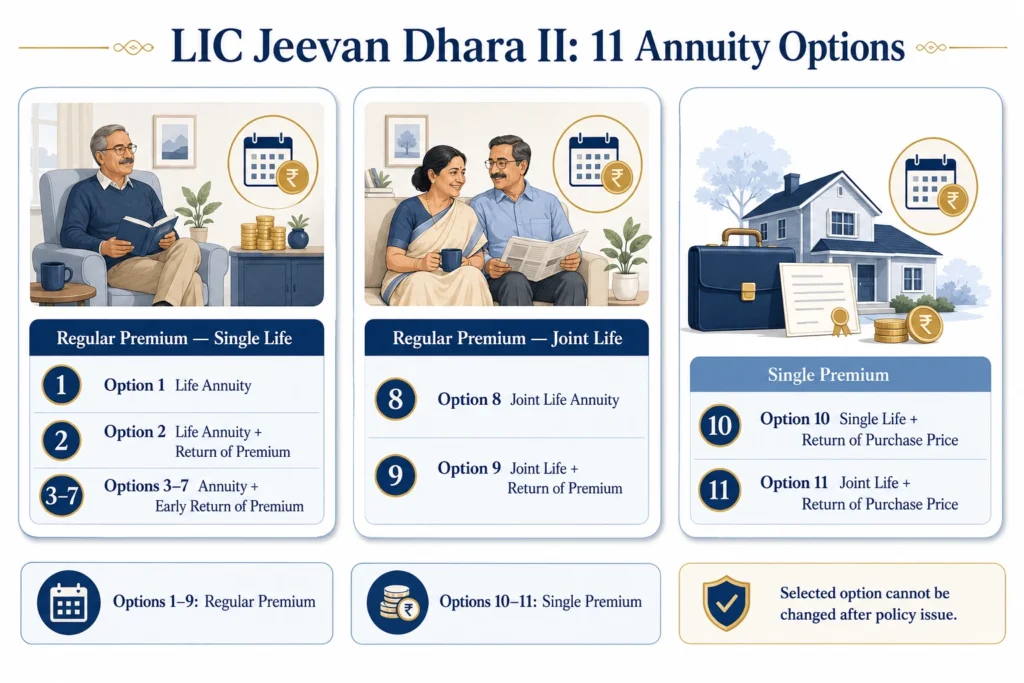
LIC Jeevan Dhara II offered 11 annuity options.
Options 1 to 9 were available under regular premium policies, while Options 10 and 11 were available under single premium policies.
Option 1 provided a single-life annuity without return of premium. Option 2 provided a single-life annuity with return of premium on death.
Options 3 to 7 combined a lifetime annuity with different forms of early return of premium.
Options 8 and 9 were joint-life regular premium options. Option 8 provided a joint-life annuity without a return-of-premium death benefit after the last survivor, while Option 9 included a return-of-premium structure.
Option 10 was a single-life single-premium annuity with return of purchase price, and Option 11 was a joint-life single-premium option with return of purchase price after the death of the last survivor.
The option selected when the policy was issued could not later be changed.
Benefits of LIC Jeevan Dhara II Plan 872
The main benefit of Jeevan Dhara II was lifetime annuity after completion of the selected deferment period.
Under joint-life options, annuity could continue to the surviving annuitant according to the terms of the selected option.
Death benefits differed according to the option. Under Options 1 to 7, death during the deferment period generally resulted in a benefit equal to 105% of total premiums paid up to the date of death.
For joint-life Options 8 and 9, the policy continued after the first death during deferment. The applicable death benefit became payable after the death of the last surviving annuitant.
For Option 10, death during deferment resulted in 105% of the purchase price. Under Option 11, 105% of the purchase price was payable on the death of the last survivor during deferment.
After vesting, the benefit again depended on the selected option.
Option 1 normally stopped on death without a further death benefit. Option 2 returned total premiums paid on death. Options 3 to 7 returned premiums after adjusting for applicable early-return benefits already received.
Option 8 continued annuity to the surviving annuitant, while Option 9 included a return-of-premium structure after the last survivor. Options 10 and 11 provided return of purchase price according to their respective single-life and joint-life conditions.
Options 3 to 7 also provided scheduled early return of premium. Depending on the option, 50% or 100% of total premiums could become payable at the specified age, or 5% could be returned every eligible year from age 76 to 95 under Option 7.
Premium, Deferment and Annuity Payment Rules
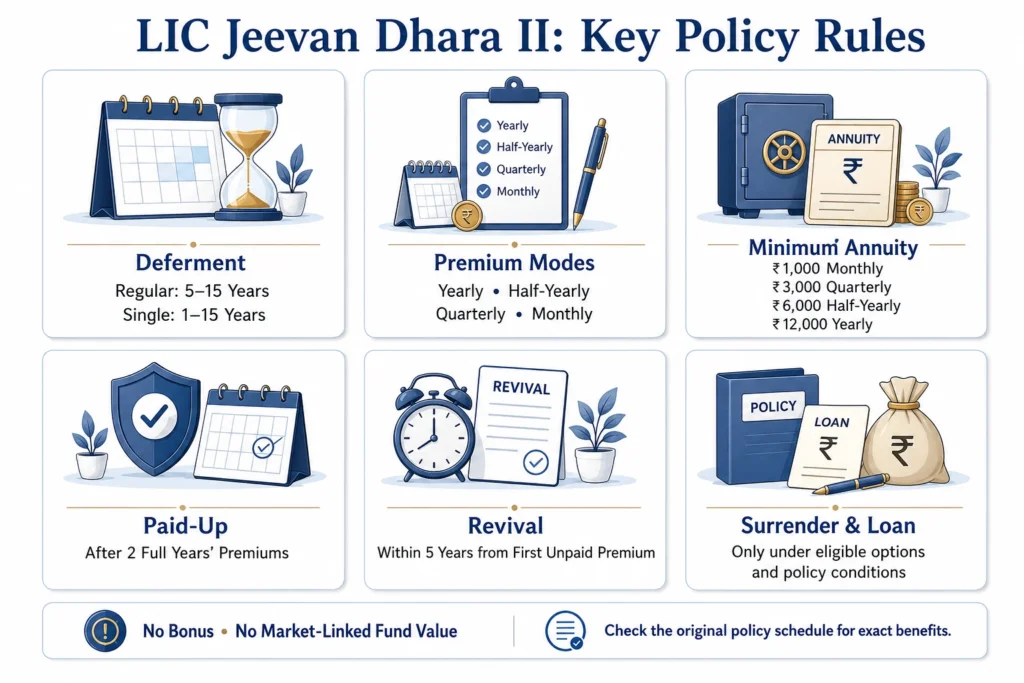
Under regular premium policies, the deferment period could generally be selected between 5 and 15 years. For single premium policies, the available deferment period was 1 to 15 years.
Regular premiums could be paid yearly, half-yearly, quarterly or monthly.
LIC used specific conversion factors when converting instalment premium into annual equivalent premium. The factors were 1.0000 for yearly, 0.5090 for half-yearly, 0.2568 for quarterly and 0.0861 for monthly premium.
Minimum premium or purchase price depended on the annuity option, age and deferment period, so one fixed minimum amount did not apply to every combination.
After vesting, annuity was payable in arrears. A monthly annuity was first paid after one month, quarterly after three months, half-yearly after six months and yearly after twelve months.
The minimum annuity amount was ₹1,000 monthly, ₹3,000 quarterly, ₹6,000 half-yearly or ₹12,000 yearly.
Paid-Up, Surrender and Loan Rules
A regular premium Jeevan Dhara II policy normally acquired paid-up value after at least two full years’ premiums had been paid.
The paid-up annuity was reduced according to the proportion of premiums actually paid compared with the total premium-paying period.
The revival period was five years from the date of the first unpaid premium. The grace period was 30 days for yearly, half-yearly and quarterly modes and 15 days for monthly mode.
Regular premium policies could generally be surrendered after payment of at least two full years’ premiums. Single premium policies could be surrendered after payment of the purchase price.
During deferment, the surrender value was the higher of the applicable Guaranteed Surrender Value and Special Surrender Value. After deferment, surrender was available only under eligible return-of-premium or return-of-purchase-price options.
Loan facility was also available only under eligible options. For regular premium policies, loan eligibility generally started after two full years’ premiums under the specified return-of-premium options. For single premium Options 10 and 11, it became available after three months from policy completion or after expiry of the free-look period, whichever was later.
Exact surrender and loan values should always be checked from LIC because Special Surrender Value and applicable loan terms can depend on servicing rules.
Important Points to Know
LIC Jeevan Dhara II Plan 872 is no longer available for fresh purchase.
It was a deferred annuity plan and did not provide a normal endowment-style maturity lump sum. The main benefit after vesting was regular annuity.
There was no bonus or market-linked fund value.
The annuity option selected at policy inception could not later be changed.
The plan also included additional features under eligible options, including top-up annuity during the deferment period, liquidity facility, advanced annuity and policy loan.
Top-up annuity allowed an additional single premium to be paid during deferment while the base policy remained in force. LIC calculated each top-up using the rates applicable on the date of that top-up rather than the original policy rate.
Liquidity was available only under selected return-of-premium or return-of-purchase-price options, while advanced annuity was available under eligible joint-life options after the deferment period.
These features could affect future annuity or other policy benefits, so the original policy schedule and LIC servicing quotation should be checked before exercising them.
Frequently Asked Questions
Is LIC Jeevan Dhara II Plan 872 still available?
No. LIC shows Jeevan Dhara II Plan 872 as withdrawn for fresh sale from 1 January 2025. The calculator is mainly useful for existing policyholders.
Is LIC Jeevan Dhara II a maturity plan?
No. It is a deferred annuity plan. After the deferment period ends, regular annuity starts instead of a normal maturity lump sum.
What was the minimum entry age?
The minimum entry age was 20 years. Maximum entry age depended on the selected annuity option and deferment period.
Can the annuity option be changed later?
No. The annuity option selected at policy inception could not normally be changed later.
Does Jeevan Dhara II provide a bonus?
No. The policy was non-participating and therefore did not provide a reversionary bonus, final additional bonus or share in LIC’s surplus.
Can LIC Jeevan Dhara II be surrendered?
Yes, subject to policy conditions. Regular premium policies generally required at least two full years’ premiums before surrender, while single premium policies could be surrendered after the purchase price had been paid.
How can the exact Jeevan Dhara II annuity be checked?
The most reliable figure is the guaranteed annuity mentioned in the original LIC benefit illustration or policy schedule. The calculator can provide an estimate, but the issued policy document should be used for the final policy-specific amount.

Amit Kushwaha is a financial content creator and SaaS tool developer based in Lucknow, Uttar Pradesh. He has more than seven years of experience creating insurance-related content, online calculators, and practical digital tools for LIC policyholders, insurance buyers, and LIC agents.
Through LICPolicyCalculator.com, he focuses on simplifying complex LIC policy information into easy-to-understand guides and calculators. His work covers LIC premium estimates, maturity calculations, surrender value tools, policy return calculations, term insurance planning, and plan-specific calculator pages.