LIC Jeevan Lakshya Plan 833 Calculator
UIN: 512N297V01 • Participating Non-Linked PlanAdvanced Policy Value Inputs (Optional)
Premium & Benefits Summary
Premium Details
Maturity Benefit (On Survival)
Death Benefit (In Case of Unfortunate Death During Policy Term)
Annual Income Benefit
Lump Sum at Maturity
Paid-Up Value Estimate
At least three full years’ premiums are required for paid-up value.
Estimated Surrender Value
At least three full years’ premiums are required for surrender value.
LIC Jeevan Lakshya Plan 833 is a participating, non-linked savings and protection plan from Life Insurance Corporation of India. It was designed to build long-term savings while providing continuing financial support to the family if the life assured died before maturity.
Plan 833 carries UIN 512N297V01 and was withdrawn from new sales on 1 February 2020. It is therefore relevant only to existing policyholders, nominees and families dealing with a policy issued under this version. The plan number and UIN printed on the policy bond should be checked before using the calculator because later Jeevan Lakshya versions have different rules.
What is Jeevan Lakshya Plan 833 Calculator?
The LIC Jeevan Lakshya Plan 833 Calculator helps estimate premium commitment, maturity benefit, Annual Income Benefit after death, the lump sum payable on the maturity date and reduced paid-up benefits. It may also provide an indicative Guaranteed Surrender Value when the required official factors are available. Bonus: In this calculator, the Final Additional Bonus and Special Surrender Value should always be treated carefully because they cannot be guaranteed by a generic calculator.
Also Check:
- LIC Jeevan Lakshya Calculator All in One
- LIC Jeevan Lakshya Plan 933 Calculator
- LIC Jeevan Lakshya Plan 733 Calculator
What Is LIC Jeevan Lakshya Plan 833?
LIC Jeevan Lakshya Plan 833 combined savings and life cover. As a participating policy, it was eligible for Simple Reversionary Bonuses declared by LIC, provided the policy remained in force. It was non-linked, so its benefits were not directly connected to the market value of equity or mutual fund units.
Its death-benefit structure was different from that of a simple endowment policy. If the life assured died during the policy term while the policy was in force, the family did not receive the entire benefit immediately. Instead, an Annual Income Benefit became payable during the remaining policy term. A separate lump sum, along with applicable bonuses, became payable on the original maturity date.
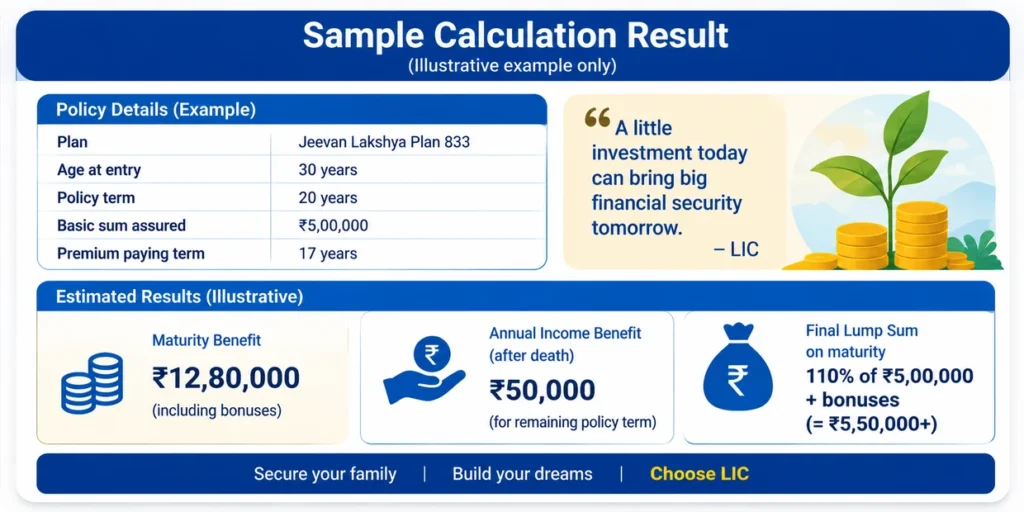
For example, a policy with a Basic Sum Assured of ₹5 lakh provides an Annual Income Benefit of ₹50,000. This is payable from the policy anniversary coinciding with or following death until the policy anniversary immediately before maturity. On the maturity date, 110% of the Basic Sum Assured, vested Simple Reversionary Bonuses and Final Additional Bonus, if any, become payable under the in-force death-benefit structure.
How does this Calculator Help?
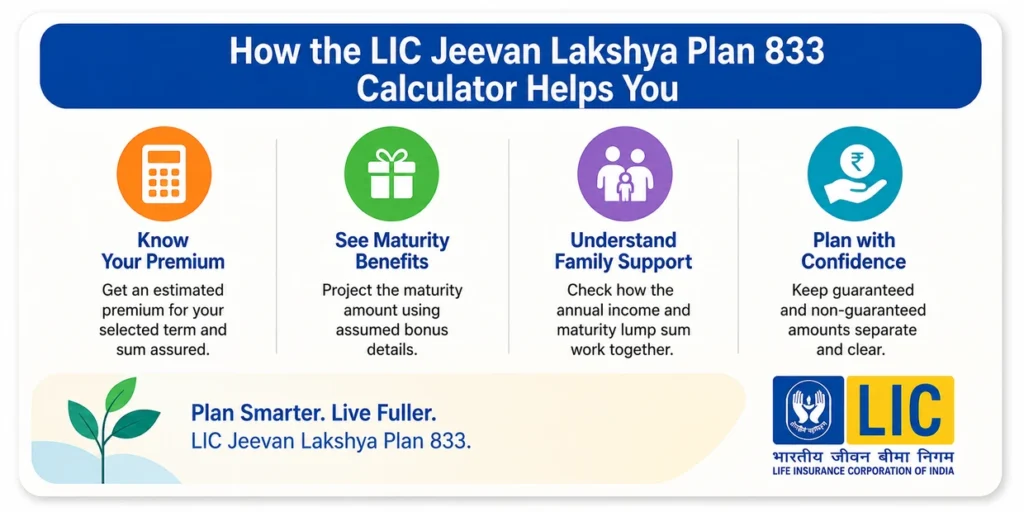
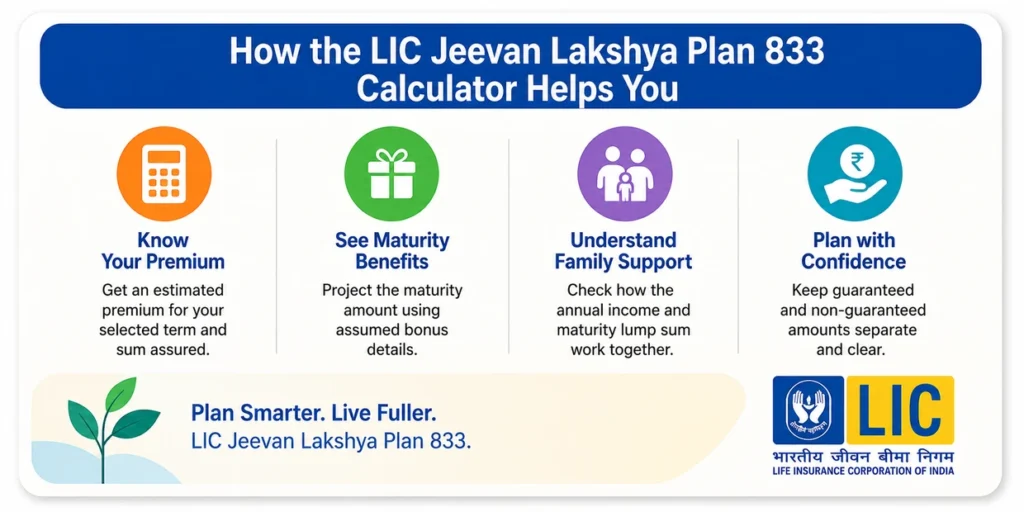
The calculator converts the policy rules into an easier estimate. It can determine the Premium Paying Term automatically, estimate premium using the brochure’s sample rates, calculate maturity using actual or assumed bonus details and explain the payment pattern after death.
It is most useful when the policy bond, premium receipts and vested bonus record are available. The premium printed on the policy bond should take priority over a sample-rate estimate because the actual premium may include underwriting decisions, rider charges or extra premium.
The calculator does not replace an official LIC quotation, policy statement, surrender quotation or claim calculation.
Table of Contents
LIC Jeevan Lakshya Plan 833 Quick Overview
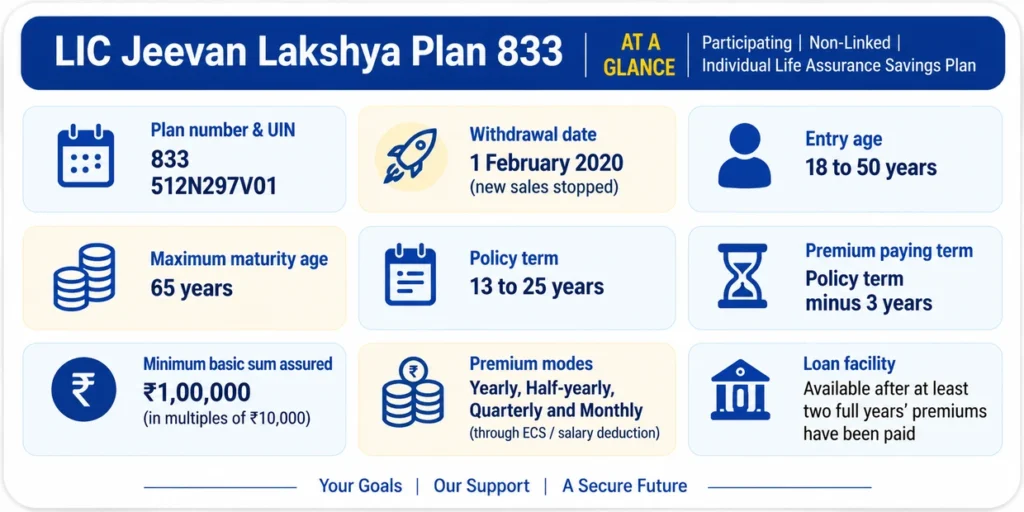
| Feature | Plan 833 Rule |
|---|---|
| Plan number and UIN | 833; 512N297V01 |
| Plan type | Participating and non-linked |
| Withdrawal date | 1 February 2020 |
| Entry age | 18 to 50 years, subject to LIC’s age basis |
| Maximum maturity age | 65 years |
| Policy term | 13 to 25 years |
| Premium Paying Term | Policy Term minus 3 years |
| Basic Sum Assured | Minimum ₹1,00,000; multiples of ₹10,000; no stated maximum |
| Premium modes | Yearly, half-yearly, quarterly or monthly through ECS or salary deduction |
| Paid-up and surrender eligibility | After at least three full years’ premiums |
| Revival period | Within two consecutive years from the first unpaid premium |
| Loan | Available after the policy acquires surrender value |
The selected term must also satisfy the maximum maturity-age condition. A person entering at age 50, for example, cannot take a term that carries the policy beyond age 65.
How to Use the LIC Jeevan Lakshya Plan 833 Calculator
Enter the age at which the policy started, the Basic Sum Assured and the original policy term. The calculator determines the Premium Paying Term by subtracting three years from the policy term. A 15-year policy therefore has a 12-year Premium Paying Term, while a 25-year policy has a 22-year Premium Paying Term.
Select the premium mode recorded in the policy. Where possible, enter the annual premium shown on the policy bond or premium receipt. A rate-based estimate should be used only when the actual premium is unavailable.
For maturity estimation, enter the vested bonus already attached to the policy. If the exact figure is unavailable and an assumed annual bonus rate is used, the result must be labelled as a projection. Final Additional Bonus should be entered as an assumed amount only and must not be presented as guaranteed.
For a death-benefit illustration, select the exact policy anniversary on which death is assumed to occur. This is more reliable than selecting only a general policy year because the number of income payments depends on the date of death relative to the policy anniversary.
If paid-up or surrender estimates are required, enter the completed premium-paying period, current policy year and applicable factors. The final surrender amount should still be confirmed through LIC because a more favourable Special Surrender Value may apply.
Formulas Used in the Calculator
Premium Paying Term
Premium Paying Term = Policy Term − 3 yearsMaturity Benefit
If the life assured survives to maturity and all due premiums have been paid, the benefit is:
Maturity Benefit = Basic Sum Assured
                 + Vested Simple Reversionary Bonuses
                 + Final Additional Bonus, if any
The Basic Sum Assured is the guaranteed core maturity amount under an in-force policy. Future bonuses are not fixed in advance. Once Simple Reversionary Bonuses are declared and vested, they remain attached subject to the policy conditions.
Death Benefit
For an in-force policy, the Annual Income Benefit is:
Annual Income Benefit = 10% of Basic Sum AssuredIt is payable from the policy anniversary coinciding with or following death through the policy anniversary immediately before maturity.
The lump sum payable on the original maturity date is:
110% of Basic Sum Assured
+ Vested Simple Reversionary Bonuses
+ Final Additional Bonus, if any
The total death benefit cannot be less than 105% of all premiums paid as on the date of death. For this comparison, taxes, extra premium and rider premiums are excluded as specified in the brochure.
Calculation Example
Consider a Plan 833 policy with the following details: age at entry 40 years, Basic Sum Assured ₹6,00,000, policy term 15 years, Premium Paying Term 12 years and half-yearly premium mode. LIC’s brochure provides a sample annual tabular premium rate of ₹85.70 per ₹1,000 Basic Sum Assured for this age and term.
The starting annual tabular premium is:
₹6,00,000 ÷ 1,000 × ₹85.70 = ₹51,420For a Basic Sum Assured of ₹5 lakh or more, the brochure shows a high-sum-assured rebate of ₹3 per ₹1,000. The illustrative rebate is therefore:
₹6,00,000 ÷ 1,000 × ₹3 = ₹1,800The half-yearly mode rebate is 1% of the tabular premium:
1% of ₹51,420 = ₹514.20Based on these brochure rates and assumptions, the illustrative annualised base premium is:
₹51,420 − ₹1,800 − ₹514.20 = ₹49,105.80The estimated half-yearly instalment is approximately ₹24,553, and the base premium across the 12-year Premium Paying Term is approximately ₹5,89,270. These amounts exclude applicable tax, riders, medical loading, extra premium and policy-specific adjustments. The premium printed on the policy bond remains the more reliable figure.
Maturity Benefit
Assume the policy record shows vested Simple Reversionary Bonuses of ₹2,10,000 and the calculator uses an illustrative FAB amount of ₹30,000.
Estimated Maturity Benefit
= ₹6,00,000 Basic Sum Assured
+ ₹2,10,000 vested bonuses
+ ₹30,000 assumed FAB
= ₹8,40,000
The ₹2.10 lakh bonus in this example is assumed to come from the policy record; it is not produced using a guessed bonus rate. The ₹30,000 FAB remains illustrative because LIC may or may not declare it under the applicable conditions.
Death-Benefit
Assume death occurs exactly on the fifth policy anniversary of this 15-year policy. The Annual Income Benefit is:
10% of ₹6,00,000 = ₹60,000 per yearIt is payable from the fifth through the fourteenth policy anniversary, resulting in 10 annual payments:
₹60,000 × 10 = ₹6,00,000The illustrative lump sum payable on the original maturity date is:
110% of ₹6,00,000 = ₹6,60,000

₹6,60,000
+ ₹2,10,000 vested bonuses
+ ₹30,000 assumed FAB
= ₹9,00,000
The combined nominal value is ₹15,00,000. It adds payments made at different times and is not a present-value calculation, investment return or amount paid immediately after death. Under an in-force policy following death, the policy continues participating in profits up to maturity, so the final bonus amount may differ from the figure used in this simplified illustration.
Paid-Up Value Under Plan 833
Plan 833 acquires paid-up value after at least three full years’ premiums have been paid. If later premiums are not paid, the policy continues with reduced benefits instead of becoming completely void.
A reader-friendly paid-up ratio is:
Paid-Up Ratio = Completed Premium-Paying Period
              ÷ Original Premium Paying Term
The maturity paid-up sum assured is:
Maturity Paid-Up Sum Assured = Basic Sum Assured × Paid-Up RatioFor a ₹6 lakh policy with six completed years out of a 12-year Premium Paying Term, the ratio is 6/12 and the Maturity Paid-Up Sum Assured is ₹3 lakh.
The 110% assured amount payable on the maturity date after death and the Annual Income Benefit are also reduced using the paid-up ratio. Vested bonuses remain attached, but the policy does not earn future bonuses after becoming paid-up. Final Additional Bonus is not payable under a reduced paid-up policy, and riders do not acquire paid-up value.
If the calculator counts instalments instead of completed years, the numerator and denominator must use the same premium mode.
Surrender Value, Revival and Loan
Plan 833 could be surrendered after at least three full years’ premiums had been paid. Its Guaranteed Surrender Value broadly consists of eligible premiums multiplied by the applicable premium GSV factor, plus vested bonuses multiplied by the applicable bonus GSV factor:
Guaranteed Surrender Value =
(Eligible Premiums Paid × Applicable Premium GSV Factor)
+ (Vested Bonuses × Applicable Bonus GSV Factor)
Eligible premiums exclude tax, extra premium and rider premiums. The factors vary according to the policy term and policy year. LIC may pay Special Surrender Value if it is more favourable, so the calculator should not describe its GSV estimate as the guaranteed final surrender payment. An official surrender quotation should be obtained before making an exit decision.
If the policy lapsed, revival was allowed within two consecutive years from the first unpaid premium, subject to payment of arrears with applicable interest, satisfactory evidence of continued insurability and LIC’s approval. Riders could be considered for revival only with the base policy.
A policy loan was available after the policy acquired surrender value. The brochure did not specify a permanent loan percentage or fixed interest rate. Outstanding loan and interest could be recovered from surrender or maturity proceeds. Following death, applicable recovery could also be made from immediate benefits, Annual Income Benefits or the final lump sum according to the policy conditions.
Optional Riders and Grace Period
Plan 833 offered LIC’s Accidental Death and Disability Benefit Rider and LIC’s New Term Assurance Rider for an additional premium, subject to eligibility. The Rider Sum Assured could not exceed the Basic Sum Assured under the base policy.
The grace period was one month, but not less than 30 days, for yearly, half-yearly and quarterly premiums and 15 days for monthly premiums. If death occurred during the grace period, the policy was treated as in force under the applicable conditions. If the premium remained unpaid after the grace period, the policy lapsed.
Important Calculator Limitations
An online calculator cannot independently verify the policy’s underwriting terms, actual premium, vested bonus record, rider cover, assignment, loan balance, revival history or current LIC Special Surrender Value. Assumed bonuses and FAB should never be presented as promised returns.
For an existing policy, the policy bond, premium receipts, LIC bonus statement and official servicing quotation should take priority over a general online estimate.
Frequently Asked Questions
Is LIC Jeevan Lakshya Plan 833 still available?
No. LIC withdrew Plan 833 from new sales on 1 February 2020. Existing policies continue according to their original terms and current policy status.
How is the Plan 833 maturity amount calculated?
For an in-force policy, it is the Basic Sum Assured plus vested Simple Reversionary Bonuses and Final Additional Bonus, if any.
What is the Annual Income Benefit after death?
It equals 10% of the Basic Sum Assured each year. The payment period depends on the death date and the remaining policy anniversaries before maturity.
When does Plan 833 acquire paid-up and surrender value?
After at least three full years’ premiums have been paid, subject to the original policy conditions.
Can a loan be taken under Plan 833?
Yes, after the policy acquires surrender value. The permissible loan amount and applicable interest rate must be confirmed with LIC.
Final Words
LIC Jeevan Lakshya Plan 833 combines a maturity benefit with continuing family support after the death of the life assured. Its Annual Income Benefit and maturity-date lump sum make its benefit pattern more complex than a basic endowment plan.
The LIC Jeevan Lakshya Plan 833 Calculator simplifies this structure by estimating premium commitment, maturity benefit, death benefits and reduced paid-up value. Its result should be treated as a planning estimate and checked against the policy bond, actual vested bonuses, current policy status and LIC’s official calculation.