LIC Jeevan Pragati Plan 838 Calculator
UIN: 512N306V01 · Non-Linked · With-Profits Endowment Plan
The following amount is the applicable Sum Assured on Death before adding vested bonus and Final Additional Bonus.
| Policy Period | Risk Cover Multiplier | Sum Assured on Death |
|---|
Maturity value is estimated using Basic Sum Assured and the optional bonus values entered above.
Select completed full policy years for indicative Guaranteed Surrender Value and paid-up calculations.
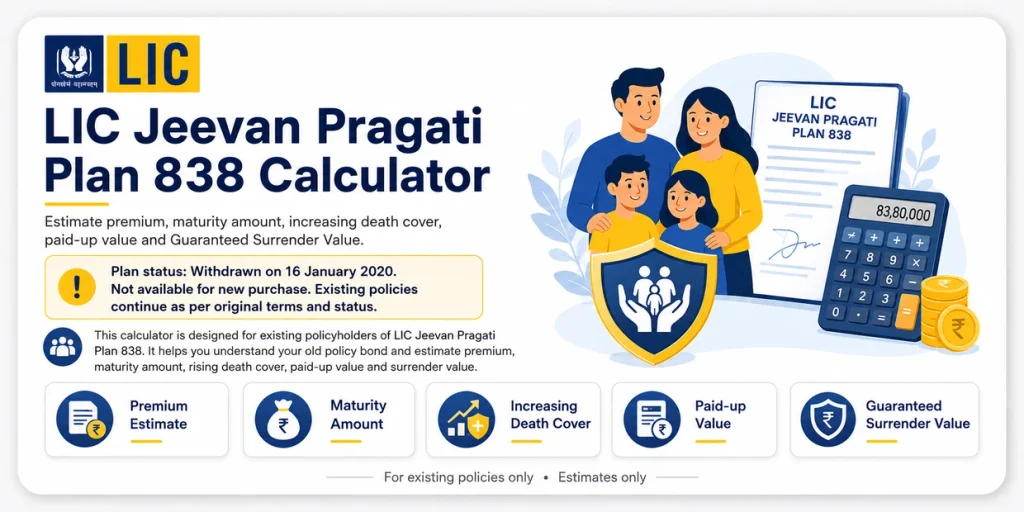
The LIC Jeevan Pragati Plan 838 Calculator helps estimate the premium, maturity amount, increasing death cover, paid-up value and Guaranteed Surrender Value of an existing policy. It brings the main calculations together so that an old policy bond is easier to understand.
LIC Jeevan Pragati was a savings and life insurance plan. Its special feature was that the death cover increased after every five policy years. However, the Basic Sum Assured selected when the policy started remained the same.
Plan status: LIC Jeevan Pragati Plan 838 was withdrawn on 16 January 2020. It is not available for new purchase. Existing policies continue according to their original terms and present status.
What Is the LIC Jeevan Pragati Plan 838 Calculator?
This calculator is mainly for people who already have a Jeevan Pragati Plan 838 policy. It uses details from the policy bond, such as age when the policy started, Basic Sum Assured, policy term, premium payment mode and number of premiums paid.
It can estimate the basic premium, total premium, maturity amount, death cover for different policy years, reduced paid-up value and Guaranteed Surrender Value. It can also include the bonus already added to the policy or an assumed bonus rate for illustration.
For the most accurate result, enter the basic premium printed on the policy bond. LIC published sample rates only for selected ages and terms, so a missing premium rate should not be guessed.
Also Check:
- LIC Insurance Plan Calculators
- LIC Endowment Plan Calculator
- LIC Jeevan Lakshya Plan 733
- LIC New Jeevan Sathi – Single Premium
Calculator Highlights
- Estimates premium and total basic premiums.
- Shows how death cover rises during the policy term.
- Calculates maturity with an entered bonus amount.
- Estimates maturity and death benefits after the policy becomes paid-up.
- Calculates Guaranteed Surrender Value using the correct factors.
- Keeps fixed benefits separate from bonus-based estimates.
- Uses the main information normally available on the policy bond.
Jeevan Pragati Plan 838 Quick Overview
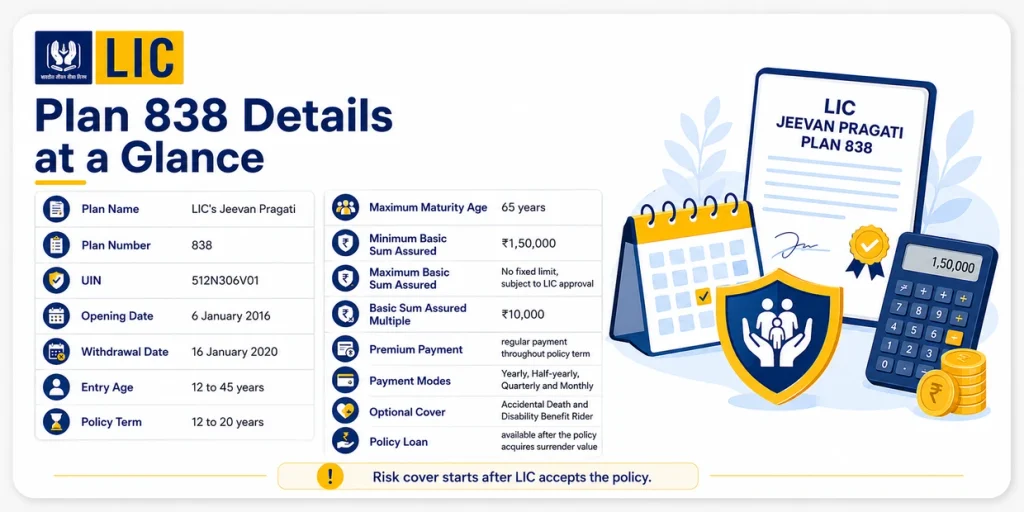
| Particular | Plan detail |
|---|---|
| Plan name | LIC Jeevan Pragati |
| Plan number | 838 |
| UIN | 512N306V01 |
| Plan type | Non-linked, participating endowment plan |
| Opening date | 6 January 2016 |
| Withdrawal date | 16 January 2020 |
| Entry age | 12 to 45 years |
| Policy term | 12 to 20 years |
| Maximum maturity age | 65 years |
| Minimum Basic Sum Assured | ₹1,50,000 |
| Maximum Basic Sum Assured | No fixed limit, subject to LIC approval |
| Basic Sum Assured multiple | ₹10,000 |
| Premium payment | Regular payment throughout the policy term |
| Payment modes | Yearly, half-yearly, quarterly and permitted monthly arrangements |
| Optional cover | Accidental Death and Disability Benefit Rider |
| Policy loan | Available after the policy acquired surrender value |
Risk cover started after LIC accepted the policy, including when the insured person was a minor.
What Was LIC Jeevan Pragati Plan 838?
LIC Jeevan Pragati was a traditional policy that combined life cover with a maturity payment. Premiums were normally paid throughout the selected policy term.
The plan was not linked to the share market. Its benefits did not rise or fall with market prices. An active policy could receive a Simple Reversionary Bonus declared by LIC. Once a bonus was added to the policy, it remained attached. LIC could also declare a Final Additional Bonus when the policy ended through maturity or an eligible death claim.
The Basic Sum Assured was payable at maturity, but the death cover increased in stages. This gave a higher base death benefit in the later policy years without increasing the Basic Sum Assured.
How to Use Jeevan Pragati Plan 838 Calculator
Keep the policy bond or latest policy statement ready before starting.
- Enter the age when the policy started, not the present age.
- Enter the Basic Sum Assured shown on the policy schedule.
- Select the original policy term and premium payment mode.
- Enter the annual basic premium from the policy bond when available.
- Select the policy year to check the applicable death cover.
- Enter the bonus already added to the policy or use a clearly marked assumed rate.
- Enter the number of full premiums paid when checking paid-up or surrender value.
- Use the correct surrender factors for the policy term and surrender year.
- Press Calculate and read the fixed and estimated amounts separately.
Do not include tax, rider premium or any extra premium charged by LIC in the basic premium used for benefit calculations.
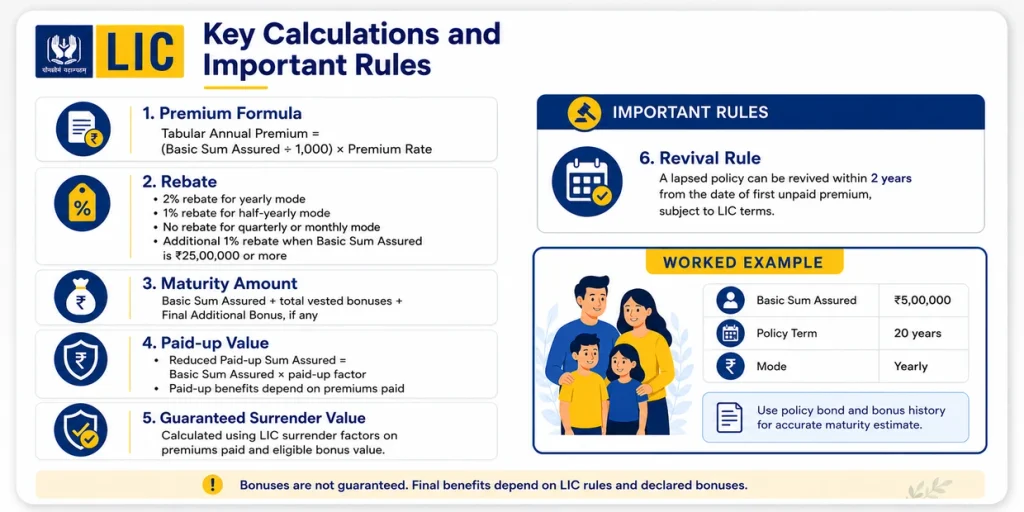
Formula Used in the Calculator
Premium Formula
LIC’s sample premium rates were shown for every ₹1,000 of Basic Sum Assured. When the exact rate is available, the premium is estimated as follows:
Tabular Annual Premium
= (Basic Sum Assured ÷ 1,000) × Premium Rate
The original plan offered a 2% rebate for yearly payment and a 1% rebate for half-yearly payment. Quarterly and permitted monthly payments did not receive this rebate.
The High Sum Assured rebate was:
| Basic Sum Assured | Rebate for every ₹1,000 |
| ₹1,50,000 to ₹2,90,000 | Nil |
| ₹3,00,000 to ₹4,90,000 | ₹1.50 |
| ₹5,00,000 to ₹9,90,000 | ₹2.00 |
| ₹10,00,000 and above | ₹2.25 |
Estimated Annual Basic Premium
= Tabular Annual Premium
− Payment-Mode Rebate
− High Sum Assured Rebate
The result does not include tax, rider premium or any extra premium.
Maturity Formula
If the policy remains active and all required premiums are paid, the maturity amount is:
Maturity Benefit
= Basic Sum Assured
+ Bonus Already Added to the Policy
+ Final Additional Bonus, if declared
The Basic Sum Assured is fixed. Future bonus and Final Additional Bonus cannot be known in advance.
Increasing Death-Benefit Formula
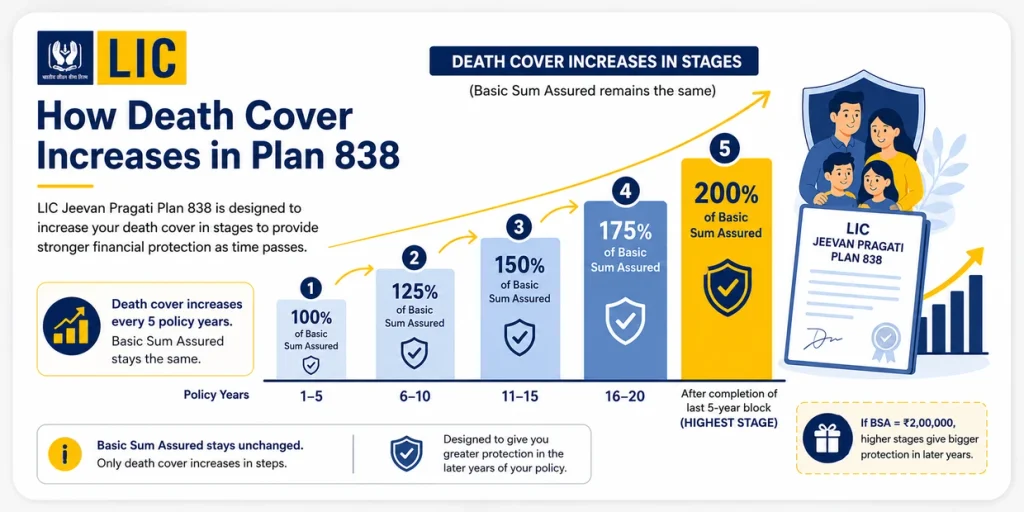
The base death cover is increased according to the policy year:
| Death during | Base death cover |
| Policy years 1 to 5 | 100% of Basic Sum Assured |
| Policy years 6 to 10 | 125% of Basic Sum Assured |
| Policy years 11 to 15 | 150% of Basic Sum Assured |
| Policy year 16 onward | 200% of Basic Sum Assured |
The Sum Assured on Death is the higher of:
1. Death cover for the applicable policy year
2. 10 × Basic Premium for One Full Year
The total death benefit cannot be lower than 105% of eligible premiums paid up to the date of death.
Death Benefit
= Sum Assured on Death
+ Bonus Already Added to the Policy
+ Final Additional Bonus, if declared
Paid-Up Value Formula
If at least three full years’ premiums are paid and later premiums are stopped, the policy can continue with lower benefits.
Maturity Paid-Up Sum Assured
= Basic Sum Assured
× Number of Premiums Paid
÷ Total Premiums Payable
The paid-up death cover is calculated separately because the Sum Assured on Death changes with the policy year.
Death Paid-Up Sum Assured
= Sum Assured on Death for the Applicable Policy Year
× Number of Premiums Paid
÷ Total Premiums Payable
Bonus already added before the policy became paid-up remains attached. New bonuses stop after the policy becomes paid-up, and rider benefits also stop.
Guaranteed Surrender Value Formula
The policy could be surrendered after at least three full years’ premiums had been paid. Guaranteed Surrender Value has two parts:
Premium Surrender Value
= Eligible Basic Premiums Paid
× Premium Surrender Factor

Bonus Surrender Value
= Bonus Already Added to the Policy
× Bonus Surrender Factor

Guaranteed Surrender Value
= Premium Surrender Value
+ Bonus Surrender Value
Both factors change according to the policy term and surrender year. LIC may pay a higher Special Surrender Value when applicable, so the calculator result is not the final surrender quotation.
Real Calculation Example
| Policy detail | Example value |
| Age when policy started | 40 years |
| Basic Sum Assured | ₹5,00,000 |
| Policy term | 15 years |
| Premium mode | Yearly |
| Historical sample premium rate | ₹72.20 per ₹1,000 |
| Assumed bonus rate | ₹35 per ₹1,000 each year |
| Assumed Final Additional Bonus | ₹15,000 |
Estimated Annual Premium
First calculate the tabular premium:
₹5,00,000 ÷ 1,000 × ₹72.20
= ₹36,100
The yearly payment rebate is 2%:
₹36,100 × 2% = ₹722For a Basic Sum Assured of ₹5,00,000, the High Sum Assured rebate is ₹2 for every ₹1,000:
₹5,00,000 ÷ 1,000 × ₹2
= ₹1,000
The estimated annual basic premium is:
₹36,100 − ₹722 − ₹1,000
= ₹34,378 before tax
The estimated total basic premium over 15 years is ₹5,15,670.
Estimated Maturity Amount
Using an assumed bonus rate of ₹35 for every ₹1,000:
Annual Bonus
= ₹5,00,000 ÷ 1,000 × ₹35
= ₹17,500

Bonus for 15 Years
= ₹17,500 × 15
= ₹2,62,500
The estimated maturity amount is:
Basic Sum Assured             ₹5,00,000
Assumed Bonus                 ₹2,62,500
Assumed Final Additional Bonus  ₹15,000
Estimated Maturity Amount     ₹7,77,500
The bonus figures are examples only. Actual bonuses depend on LIC’s declarations.
Estimated Death Benefit
Suppose death happens in policy year 12. The base death cover is 150% of the Basic Sum Assured:
₹5,00,000 × 150%
= ₹7,50,000
Ten times the annual basic premium is ₹3,43,780. The higher amount is ₹7,50,000. Bonus already added to the policy and any Final Additional Bonus may be paid in addition, subject to the policy conditions.
Estimated Paid-Up Value
If six full yearly premiums are paid and later premiums are stopped:
₹5,00,000 × 6 ÷ 15
= ₹2,00,000
The Maturity Paid-Up Sum Assured becomes ₹2,00,000. Bonus already added during the first six years remains attached, but no new bonus is added after the policy becomes paid-up.
Estimated Guaranteed Surrender Value
Suppose the policy is surrendered after six full yearly premiums. Eligible basic premiums paid are:
₹34,378 × 6
= ₹2,06,268
For a 15-year policy surrendered in year six, the premium factor is 50%. If the bonus already added is ₹1,05,000, the applicable bonus factor is 18.60%.
Premium Part
= ₹2,06,268 × 50%
= ₹1,03,134

Bonus Part
= ₹1,05,000 × 18.60%
= ₹19,530

Estimated Guaranteed Surrender Value
= ₹1,03,134 + ₹19,530
= ₹1,22,664
LIC may calculate a higher Special Surrender Value. Any policy loan and interest may also reduce the final payment.
What Happens If Premiums Are Stopped?
If fewer than three full years’ premiums are paid, the policy normally lapses after the grace period and does not receive paid-up value. After three full years, it can continue with reduced paid-up benefits.
The original policy allowed revival within two consecutive years from the first unpaid premium, before maturity and while the insured person was alive. Revival required unpaid premiums, interest and any health documents requested by LIC. Actual revival availability now depends on the policy dates and LIC approval.
Surrender and policy-loan facilities could become available after the policy acquired surrender value. Surrender ends the policy, while a loan leaves an amount and interest that may later be deducted from policy benefits.
Important Points for Existing Policyholders
- Plan 838 cannot be purchased now, but an existing policy may still be active.
- Use the basic premium shown on the policy bond whenever possible.
- Death cover increases, but the maturity Basic Sum Assured does not increase.
- Future bonus and Final Additional Bonus are not guaranteed.
- A paid-up policy keeps bonus already added but does not earn new bonus.
- Surrender factors depend on the policy term and surrender year.
- An unpaid policy loan and interest can reduce maturity, surrender or death payments.
- LIC’s current policy record and final quotation will decide the actual amount.
Tax Benifits
Premiums and policy payments may receive tax benefits when the conditions of the Income-tax Act are met. Tax treatment can depend on the policy issue date, premium amount, Basic Sum Assured, payment history and type of payment. A maturity or surrender amount should not be treated as automatically tax-free without checking the rules that apply at the time of payment.
Frequently Asked Questions
Is LIC Jeevan Pragati Plan 838 still available?
No. LIC withdrew Plan 838 on 16 January 2020. New policies cannot be purchased, but existing policies continue according to their original terms and present status.
How is the maturity amount calculated?
For an active policy, the maturity amount is the Basic Sum Assured plus bonus already added to the policy and Final Additional Bonus, if LIC declares it. Future bonus amounts are not guaranteed.
Does the life cover increase under Jeevan Pragati?
Yes. The base death cover is 100% of the Basic Sum Assured in years 1 to 5, 125% in years 6 to 10, 150% in years 11 to 15 and 200% from year 16 onward.
What happens if premiums are stopped after three years?
The policy can continue with reduced paid-up benefits. Bonus already added remains attached, but new bonus and rider benefits stop. Revival or surrender may also be available according to the policy conditions.
Can Plan 838 be surrendered?
Yes, after at least three full years’ premiums have been paid. The amount depends on eligible premiums, bonus already added, policy term, surrender year and applicable factors. LIC may pay a higher Special Surrender Value.
Conclusion
The LIC Jeevan Pragati Plan 838 Calculator makes an existing policy easier to understand. It can estimate the premium, maturity amount, increasing death cover, paid-up value and Guaranteed Surrender Value using information from the policy bond.
The plan’s main feature was its increasing death cover. The maturity Basic Sum Assured stayed unchanged, while bonuses depended on LIC’s declarations. Paid-up and surrender values depend on the premium record and policy status.
Plan 838 has been withdrawn, so the calculator is mainly useful for checking an existing policy. LIC’s records and final calculation will decide the actual amount payable.