LIC Jeevan Akshay Calculator
Select a Jeevan Akshay Plan and estimate the immediate annuity.
Calculation Result
| Selected Plan | — |
|---|---|
| Annuity Option | — |
| Purchase Price | — |
| Primary Age | — |
| Secondary Age | — |
| Payment Mode | — |
| First Payment | — |
| Death Benefit | — |
| Spouse/Joint Annuity | — |
| Surrender & Loan | — |
| Calculation Basis | — |
This calculator is an informational estimator based on selected figures and conditions shown in historical LIC brochures. It is not an official LIC quotation. Actual annuity depends on the rate, option, mode, purchase channel, applicable incentive and rules prevailing when the policy was purchased.
LIC Jeevan Akshay is a well-known series of immediate annuity plans introduced by the Life Insurance Corporation of India. These plans were designed for people who wanted to invest a lump-sum amount and receive a regular income throughout retirement as a pension.
LIC introduced several versions of Jeevan Akshay over the years. Although the basic purpose remained the same, each version brought changes in eligibility, annuity rates, spouse benefits, guaranteed periods and return-of-purchase-price options.
The LIC Jeevan Akshay Calculator brings seven important versions into one place. It covers Plan 146, Plan 163, Plan 170, Plan 176, Plan 183, Plan 189 and Plan 857. After selecting a plan, the calculator estimates the monthly, quarterly, half-yearly or yearly annuity based on the purchase price, age and selected annuity option.
Most versions covered by this calculator have been withdrawn. Therefore, the results are mainly useful for understanding an old policy, checking an approximate historical benefit and comparing different versions. They should not be treated as a current LIC quotation.
Table of Contents
What Is the LIC Jeevan Akshay Calculator?
The LIC Jeevan Akshay Calculator is an online estimation tool for calculating the regular income available under different Jeevan Akshay plans. It combines the available plan options, eligibility rules and selected historical annuity rates in a single calculator.
A lump-sum amount paid to purchase an immediate annuity is called the purchase price. In return, LIC pays a fixed or option-based annuity at regular intervals. Depending on the chosen mode, this income can be received every month, quarter, six months or year.
The calculator requires the following information:
- Selected Jeevan Akshay plan
- Annuity option
- Purchase price
- Primary annuitant’s age
- Payment mode
- Secondary annuitant’s age for joint-life options
- Projection year for the 3% increasing-annuity option
After calculation, it displays the estimated periodic annuity, annual annuity, indicative annuity rate, death benefit, spouse benefit and relevant surrender or loan conditions.
The calculator distinguishes between published brochure rates and estimated rates. Some old brochures provide complete figures only for selected ages or options. Where a complete rate table is unavailable, the result is clearly treated as an approximation.
How the LIC Jeevan Akshay Calculator Helps
Comparing immediate annuity plans manually can be difficult. The annuity amount changes according to age, purchase price, option and payment frequency. A plan offering a high initial income may not return the purchase price after death, while another plan may provide a lower income but stronger protection for the nominee.
The calculator makes these differences easier to understand. It can show how much income (pension)may be generated from a purchase price such as ₹5 lakh, ₹10 lakh or ₹20 lakh. It also helps compare a regular life annuity with an annuity that returns the purchase price.
For joint-life options, the calculator considers the age of the secondary annuitant and estimates the income that may continue after the primary annuitant’s death. Under the increasing-annuity option, it can project how the payment may rise at a simple rate of 3% per year.
It is especially helpful when reviewing an old Jeevan Akshay policy because selecting the correct plan version is important. Annuity rates and benefits under Plan 146 were not the same as those under Plans 189 or 857.
Quick Comparison of LIC Jeevan Akshay Plans
| Plan | Annuity options | Entry age | Minimum purchase price | Important feature |
|---|---|---|---|---|
| New Jeevan Akshay-I, Plan 146 | 5 | 40–79 years | ₹25,000 | Early version with basic immediate-annuity options |
| Jeevan Akshay-II, Plan 163 | 5 | 40–79 years | ₹50,000 or amount required for minimum annuity | Revised rates and purchase-price incentives |
| Jeevan Akshay-III, Plan 170 | 5 | 40–79 years | ₹50,000 or amount required for minimum annuity | Improved high-purchase incentives |
| Jeevan Akshay-IV, Plan 176 | 6 | 40–79 years | ₹50,000 or amount required for minimum annuity | Added 100% spouse annuity |
| Jeevan Akshay-V, Plan 183 | 6 | 40–79 years | ₹50,000 or amount required for minimum annuity | Published rate examples for all six options |
| Jeevan Akshay-VI, Plan 189 | Up to 10 in later revisions | Version-dependent | Version-dependent | Expanded guaranteed and joint-life options |
| Jeevan Akshay-VII, Plan 857 | 10 | Generally 25–85 years; up to 100 for a specified option | Age-dependent | Options A–J with modern joint-life features |
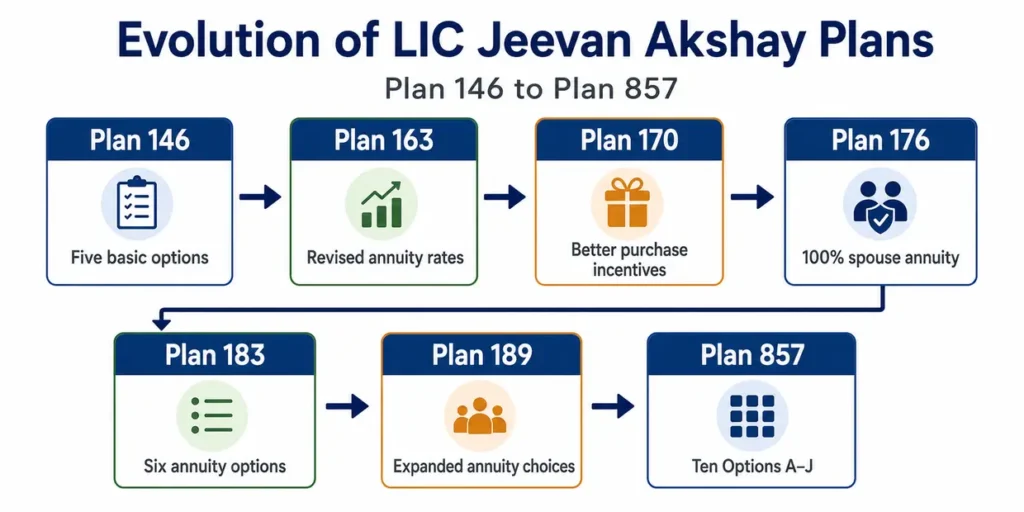
The eligibility conditions for Plan 189 changed across its different revisions. Plan 857 was also revised several times. The calculator follows the supplied historical versions and uses the available official information as its reference.
LIC Jeevan Akshay Interest Rate and Annuity Rate
The term “interest rate” is commonly used while searching for Jeevan Akshay, but technically it is an annuity rate. The purchase price is not placed in a savings account on which LIC credits a declared annual interest rate.
LIC uses an annuity rate to determine the income payable under the policy. This rate depends on the plan version, age, annuity option, payment mode and purchase price.
The indicative annuity rate can be understood using this formula:
Indicative annuity rate = Annual annuity ÷ Purchase price × 100
Suppose a purchase price of ₹10 lakh provides an annual annuity of ₹74,200. The indicative annuity rate is:
₹74,200 ÷ ₹10,00,000 × 100 = 7.42%
This 7.42% should not be confused with a bank deposit interest rate. It represents the annual annuity relative to the purchase price. Whether the original purchase price is returned after death depends on the selected annuity option.
Options that return the purchase price normally provide a lower regular annuity. This is because the plan must provide lifetime income while also preserving the purchase price for the nominee.
New Jeevan Akshay-I Plan 146 Details
New Jeevan Akshay-I Plan 146 was an early immediate annuity version. It required a single lump-sum payment, after which the annuity became payable according to the selected frequency.
The minimum entry age was 40 years and the maximum was 79 years. Its minimum purchase price was ₹25,000, and there was no stated maximum purchase-price limit. A medical examination was not required.
Five annuity choices were available. These included a regular annuity for life, annuity guaranteed for 5, 10, 15 or 20 years and life thereafter, life annuity with return of purchase price, annuity increasing at 3% simple per year and life annuity with 50% continuation to the spouse.
The policy did not provide a surrender value or policy loan.
The brochure published selected annual rates for every ₹1,000 of purchase price. At age 40, ₹1,000 could purchase approximately ₹71.50 of annual life annuity or ₹64.70 with return of purchase price. This was equal to approximately ₹7,150 or ₹6,470 respectively for every ₹1 lakh.
At age 60, the comparable figures were approximately ₹9,500 for regular life annuity and ₹7,090 for the purchase-price-return option per ₹1 lakh. These were historical brochure figures and not current LIC rates.
LIC Jeevan Akshay-II Plan 163 Details
Jeevan Akshay-II Plan 163 continued the single-premium immediate-annuity structure. The entry-age range was 40 to 79 years. The minimum purchase price was ₹50,000 or the amount required to generate a minimum annual annuity of ₹3,000.
The plan offered the same five broad annuity choices as Plan 146. The payment frequency could be monthly, quarterly, half-yearly or yearly.
Under the regular life-annuity option, payments stopped after the annuitant’s death. Under a guaranteed-period option, the nominee continued receiving the annuity until the selected guaranteed period ended if the annuitant died during that period.
The return-of-purchase-price option paid the purchase price to the nominee after the annuitant’s death. The 3% increasing option raised the original annuity by a simple 3% after every completed policy year. The spouse option continued 50% of the annuity to the surviving spouse.
At age 40, the brochure showed approximately ₹5,710 of yearly life annuity per ₹1 lakh of purchase price. The return-of-purchase-price option provided approximately ₹4,660. At age 60, these figures were approximately ₹7,780 and ₹4,850 respectively.
Plan 163 also provided higher annuity-rate incentives for larger purchase prices. It had no paid-up value, surrender value or policy-loan facility.
LIC Jeevan Akshay-III Plan 170 Details
Jeevan Akshay-III Plan 170 replaced Plan 163 and retained five main annuity choices. It remained a single-premium immediate-annuity plan with entry permitted from age 40 to 79.
The minimum purchase price was ₹50,000 or the amount required to provide an annual annuity of at least ₹3,000. There was no stated maximum purchase-price limit.
The plan offered annual, half-yearly, quarterly and monthly annuity payments. The first payment became due after one year, six months, three months or one month, depending on the chosen mode.
At age 40, the published annual life-annuity amount was approximately ₹6,590 per ₹1 lakh. The corresponding return-of-purchase-price amount was ₹5,730. At age 60, the figures were approximately ₹8,560 and ₹5,860.
Plan 170 provided better high-purchase incentives than Plan 163. For example, the annuity rate received an additional increase when the purchase price was ₹1.50 lakh or more. The exact addition depended on the purchase-price slab and payment frequency.
No surrender value, paid-up value or policy loan was available.
LIC Jeevan Akshay-IV Plan 176 Details
Jeevan Akshay-IV Plan 176 introduced an important sixth option: life annuity with 100% of the annuity continuing to the surviving spouse.
Its minimum and maximum entry ages were 40 and 79 years. The minimum purchase price was ₹50,000 or the amount needed to generate an annual annuity of at least ₹3,000.
Under the 50% spouse option, half of the annuity continued to the named surviving spouse after the primary annuitant’s death. Under the new 100% spouse option, the full annuity continued throughout the surviving spouse’s lifetime.
If the spouse died before the primary annuitant, payments continued to the primary annuitant. After the primary annuitant’s subsequent death, no further benefit was payable under these spouse options.
At age 40, the annual life-annuity illustration was approximately ₹6,820 per ₹1 lakh. The return-of-purchase-price option provided approximately ₹6,190. At age 60, the corresponding amounts were around ₹8,700 and ₹6,320.
Higher purchase prices qualified for an addition to the annuity rate. However, Plan 176 did not acquire paid-up value, offer a surrender value or provide a policy loan.
LIC Jeevan Akshay-V Plan 183 Details
Jeevan Akshay-V Plan 183 was another single-premium immediate-annuity plan. It offered six options and allowed payments every month, quarter, half-year or year.
The entry age ranged from 40 to 79 years. The minimum purchase price was ₹50,000 or the amount required to generate a minimum annual annuity of ₹3,000. There was no stated upper purchase-price limit.
Plan 183 is useful for comparison because its brochure provides indicative rates for all six options at selected ages.
For a 60-year-old purchasing an annuity for ₹1 lakh, the brochure showed approximately ₹9,230 annually under the regular life-annuity option. The five-year guaranteed option provided approximately ₹9,140. The return-of-purchase-price option provided ₹6,940.
At the same age, the first-year annuity under the 3% increasing option was approximately ₹7,410. The 50% spouse option provided around ₹8,510, while the 100% spouse option provided approximately ₹7,900.
The difference shows the trade-off between income and protection. A regular life annuity produced a higher amount because nothing was payable after death. The return-of-purchase-price option offered a lower amount because the purchase price was preserved for the nominee.
No surrender value, paid-up value or policy loan was available under Plan 183.
LIC Jeevan Akshay-VI Plan 189 Details
Jeevan Akshay-VI Plan 189 was issued in several revisions. Its later policy structure separated the annuity choices into Options A to J.
Options A to E covered regular life annuity and four guaranteed periods. Option F provided a life annuity with return of purchase price. Option G increased the annuity at a simple rate of 3% per year.
Option H continued 50% of the annuity to the surviving spouse. Option I continued 100% of the annuity to the surviving spouse. Option J provided 100% spouse continuation and returned the purchase price after the death of the last survivor.
The exact eligibility rules and annuity rates changed between revisions. In an adjacent published Plan 189 rate table, a 60-year-old received indicative annual amounts of approximately ₹9,350 per ₹1 lakh for regular life annuity, ₹8,790 for a 15-year guaranteed annuity, ₹7,110 with purchase-price return, ₹7,530 under the increasing option, ₹8,640 with 50% spouse continuation and ₹8,030 with 100% spouse continuation.
These figures should not be applied automatically to every Plan 189 policy because the rate applicable to an actual policy depends on its commencement date and revision.
Under the supplied policy version, restricted surrender was allowed under the return-of-purchase-price option after at least one policy year in specified circumstances, such as certain critical illnesses or permanent relocation to another country. A regular policy loan was not available.
LIC Jeevan Akshay-VII Plan 857 Details
Jeevan Akshay-VII Plan 857 is a non-linked, non-participating individual immediate-annuity plan. It offers ten annuity options, labelled A to J.
The supplied revision allowed a minimum entry age of 25 years. The general maximum age was 85 years, while the maximum age under Option F was 100 years.
For ages 25 to 29, the minimum purchase price was ₹10 lakh. From age 30, the standard minimum purchase price was ₹1 lakh, subject to the minimum-annuity requirement. Special provisions applied to NPS subscribers and policies purchased for the benefit of a dependent person with a disability.
The minimum annuity was ₹1,000 per month, ₹3,000 per quarter, ₹6,000 per half-year or ₹12,000 per year.
The official illustration used a purchase price of ₹10 lakh, primary age of 45 years and yearly payment mode. It showed ₹74,200 under Option A, ₹74,100 under Option B, ₹73,800 under Option C, ₹73,300 under Option D and ₹72,800 under Option E.
Option F provided ₹64,800, while Option G provided a first-year annuity of ₹56,400. With a secondary annuitant aged 35, the illustration showed ₹70,700 under Option H, ₹67,500 under Option I and ₹63,900 under Option J.
Surrender and policy-loan facilities were generally connected to Options F and J, subject to the waiting period and policy conditions. The supplied revision was launched on 25 August 2022 and withdrawn on 28 February 2023. Official Jeevan Akshay-VII brochure
What Do the Jeevan Akshay Annuity Options Mean?
| Option | Meaning | Benefit after death |
|---|---|---|
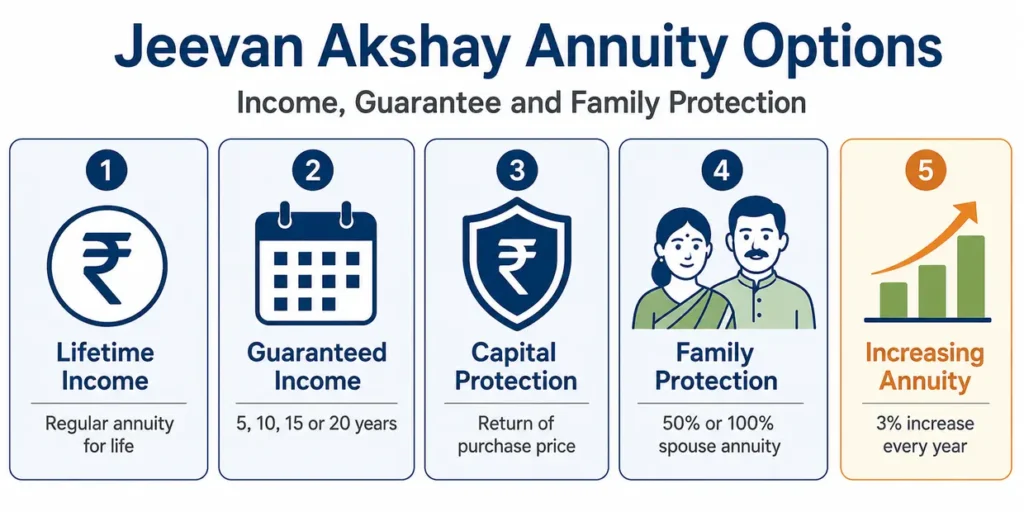
| Life annuity | Fixed annuity throughout the annuitant’s life | Payments stop after death |
| Guaranteed period | Annuity guaranteed for 5, 10, 15 or 20 years and life thereafter | Nominee receives payments for the remaining guaranteed period |
| Return of purchase price | Lifetime annuity with capital-return protection | Purchase price paid to nominee |
| Increasing annuity | Initial annuity rises by 3% simple after each completed year | Payments stop after death |
| 50% spouse annuity | Spouse receives half the original annuity | Stops after spouse’s death |
| 100% joint-life annuity | Full annuity continues while either annuitant survives | Stops after the last survivor’s death |
| Joint life with purchase-price return | Full joint-life annuity with capital protection | Purchase price paid after the last survivor’s death |
In Plans 146, 163 and 170, the guaranteed-period choices were grouped under Option 2. In Plans 189 and 857, they were divided into separate Options B, C, D and E.
How to Choose the Right Pension Plan
The right option depends on the need for income, spouse protection and capital return.
A regular life annuity may be suitable when the main objective is to receive the highest possible immediate income. It generally offers a higher annuity because nothing is returned after death.
A guaranteed-period option may be considered when regular income must continue for at least a fixed number of years. If death occurs during the selected period, the nominee receives the remaining payments. If the annuitant survives the guaranteed period, the annuity continues for life.
The return-of-purchase-price option may be more suitable when preserving the original investment for the nominee is important. Its starting annuity is normally lower than a regular life annuity.
The 3% increasing option offers a lower starting income but gradually increases the annuity. The increase is calculated at a simple rate, not compounded. It can provide some support against increasing expenses, although a 3% simple rise may not fully match inflation.
A 50% spouse option may be appropriate when the surviving spouse requires partial income. A 100% spouse or joint-life option provides stronger income protection but normally reduces the starting annuity.
Option J combines full joint-life income with return of purchase price after the last survivor’s death. It offers broader family protection, but its starting annuity is usually among the lowest.
How to Use the LIC Jeevan Akshay Calculator
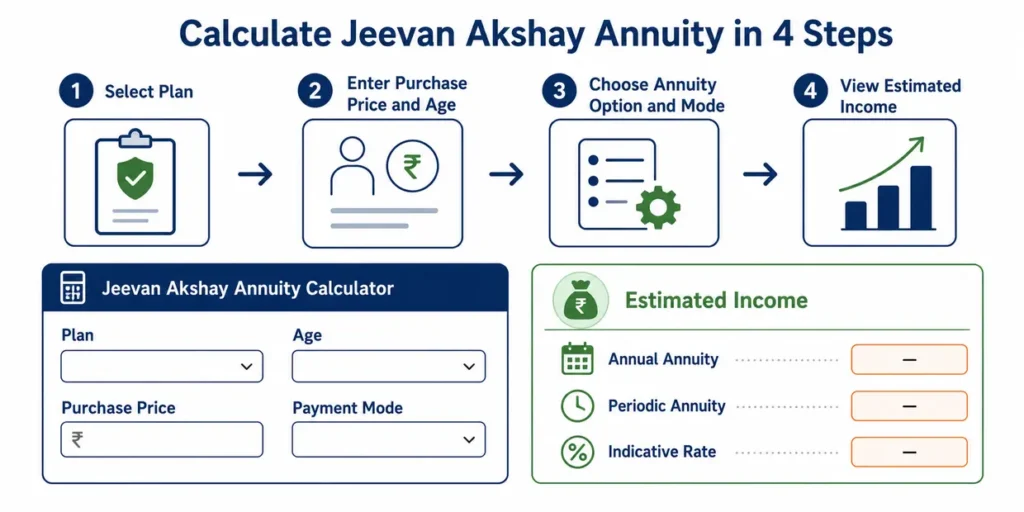
First, select the correct Jeevan Akshay plan. The plans appear in descending order, starting with Plan 857 and ending with Plan 146.
Next, select the annuity option. The available choices automatically change according to the selected plan. Older plans display numbered options, while Plans 189 and 857 use Options A to J.
Enter the purchase price and the primary annuitant’s age. The calculator checks whether these details satisfy the basic limits used for the selected plan.
Select monthly, quarterly, half-yearly or yearly payment mode. If a spouse or joint-life option is selected, enter the secondary annuitant’s age.
For the 3% increasing-annuity option, enter the policy year for which the projected income is required. Finally, select Calculate Annuity.
The result displays the periodic annuity, annual annuity and indicative rate. It also explains the first-payment timing, spouse continuation, death benefit and available surrender or loan conditions.
The Reset button clears the entered information and returns the calculator to Plan 857.
LIC Jeevan Akshay Calculation Example
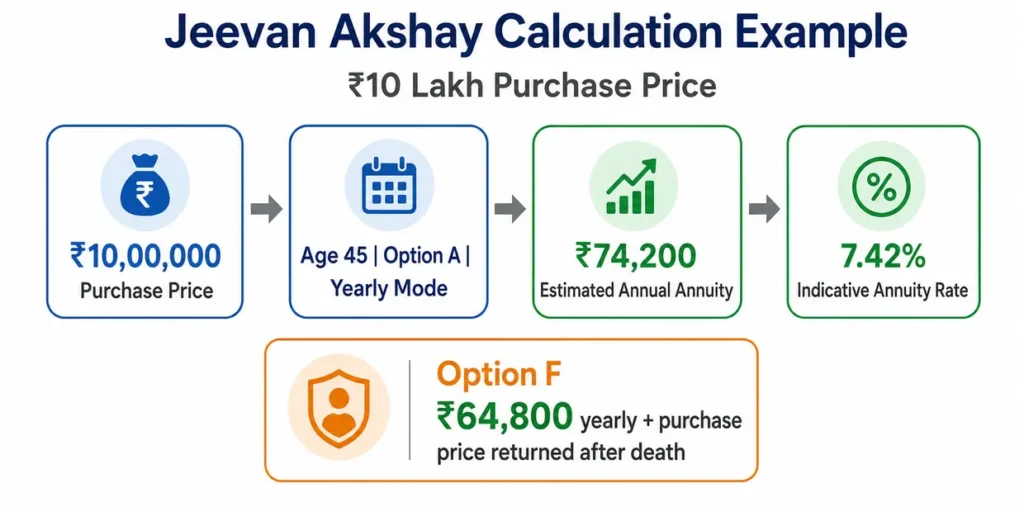
Consider the official Plan 857 illustration:
- Purchase price: ₹10,00,000
- Primary annuitant’s age: 45 years
- Selected option: Option A
- Payment mode: Yearly
The applicable illustrated annual annuity is ₹74,200.
The indicative annuity percentage is:
₹74,200 ÷ ₹10,00,000 × 100 = 7.42%
The annuitant would receive approximately ₹74,200 every year for life. Under Option A, the payments would stop after death, and the purchase price would not be returned.
Now compare this with Option F. The illustrated annual annuity under Option F is ₹64,800.
₹64,800 ÷ ₹10,00,000 × 100 = 6.48%
The regular income is lower, but the ₹10 lakh purchase price becomes payable to the nominee after the annuitant’s death.
The difference between ₹74,200 and ₹64,800 is the cost of obtaining purchase-price protection. This example shows why an annuity option should not be selected only by looking at the highest payment.
Important Limitations of the Calculator
The calculator is intended for information and comparison. It does not issue an official LIC quotation or confirm the benefit payable under an existing policy.
Several old brochures publish rates only at five-year age intervals. The calculator may use interpolation for an age that falls between two published ages. Some brochures also provide rates for only selected options. Comparative estimation is used where a complete official rate table is unavailable.
Historical annuity rates changed between plan revisions. The exact benefit under an existing policy is the amount written in its policy schedule. Taxes are not included in the purchase price used for calculating the annuity benefit.
Also Check:
- LIC Jeevan Akshay Plan 857 Calculator
- LIC Pension Plan Calculator All in One
- LIC Saral Jeevan Bima Calculator Plan 859
- LIC New Jeevan Amar Calculator Plan 955
Frequently Asked Questions
What is the LIC Jeevan Akshay Plans Calculator?
It is an online calculator that estimates regular annuity income under Plans 146, 163, 170, 176, 183, 189 and 857. It calculates periodic and annual income based on the selected plan, purchase price, age, option, and payment mode.
Is the Jeevan Akshay annuity rate the same as an interest rate?
No. Jeevan Akshay provides an annuity rate, not a bank-style interest rate. The annuity rate determines the regular payment generated from the purchase price. Death benefits and return of capital depend on the chosen option.
Which Jeevan Akshay option provides the highest annuity?
A regular life annuity generally provides the highest starting income because payments stop after the annuitant’s death and the purchase price is not returned. The actual result depends on the plan, age, and payment mode.
Which option returns the purchase price?
The life-annuity-with-return-of-purchase-price option returns the purchase price after the annuitant’s death. In Plans 189 and 857, this is generally Option F. Option J returns the purchase price after the death of the last survivor under joint life.
Can the annuity option be changed after purchasing the policy?
Normally, the selected annuity option cannot be changed after the policy has been issued. The option should therefore be selected only after comparing income requirements, spouse protection and nominee benefits.
Are all Jeevan Akshay plans covered by the calculator still available?
No. The calculator mainly covers withdrawn historical versions. It is designed for old-policy understanding and comparison. It should not be used to assume that a particular version is currently available for purchase.
Is the calculated annuity an exact LIC benefit?
Not always. The result is based on available historical brochure figures and estimation rules. The actual benefit under an existing policy is the annuity amount recorded in its policy schedule.
Conclusion
The LIC Jeevan Akshay Calculator offers a convenient way to compare seven important immediate-annuity versions in one place. It helps estimate retirement income under Plans 146, 163, 170, 176, 183, 189 and 857 without performing complicated manual calculations.
Each annuity option serves a different purpose. A regular life annuity focuses on higher immediate income. A guaranteed-period option protects payments for a fixed duration. Return-of-purchase-price options preserve capital for the nominee, while spouse and joint-life options provide continuing family income.
A higher annuity is not automatically the best choice. The selected option should balance current income, spouse security and the need to leave the purchase price to the family.
Because these are historical or withdrawn versions, calculator results should be treated as estimates. For an existing Jeevan Akshay policy, the policy schedule remains the final source for the exact annuity, option and death benefit.

Amit Kushwaha is a financial content creator and SaaS tool developer based in Lucknow, Uttar Pradesh. He has more than seven years of experience creating insurance-related content, online calculators, and practical digital tools for LIC policyholders, insurance buyers, and LIC agents.
Through LICPolicyCalculator.com, he focuses on simplifying complex LIC policy information into easy-to-understand guides and calculators. His work covers LIC premium estimates, maturity calculations, surrender value tools, policy return calculations, term insurance planning, and plan-specific calculator pages.