LIC Jeevan Akshay V Plan 183 Calculator
Annuity Details
High Purchase Price Incentive (Optional)
Calculation Result
| Selected Option | — |
|---|---|
| Rate per ₹1 Lakh | — |
| Equivalent Rate | — |
| First Payment | — |
| Projected Total | — |
| Death/Continuation Benefit | — |
Year-wise Annuity Schedule
| Year | Annual | Per Instalment | Cumulative |
|---|
Historical calculator based on LIC brochure UIN 512N234V02. Launch and withdrawal dates are drawn from archived plan-circular references because these dates are not printed in the brochure.
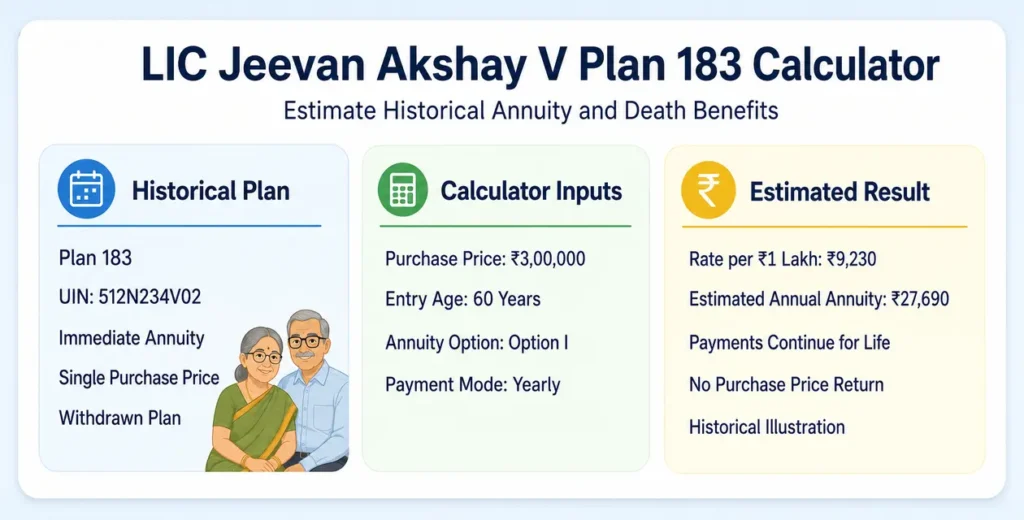
The LIC Jeevan Akshay V Plan 183 Calculator is an online pension calculation tool designed to estimate the annuity income available under LIC’s withdrawn Jeevan Akshay-V policy. It calculates the expected annual and periodic annuity using the purchase price, entry age, annuity option, and payment frequency.
LIC Jeevan Akshay-V was an immediate annuity plan introduced on 20 September 2006. It was withdrawn with effect from 10 September 2007 and replaced by LIC Jeevan Akshay-VI. The plan’s Unique Identification Number is 512N234V02.
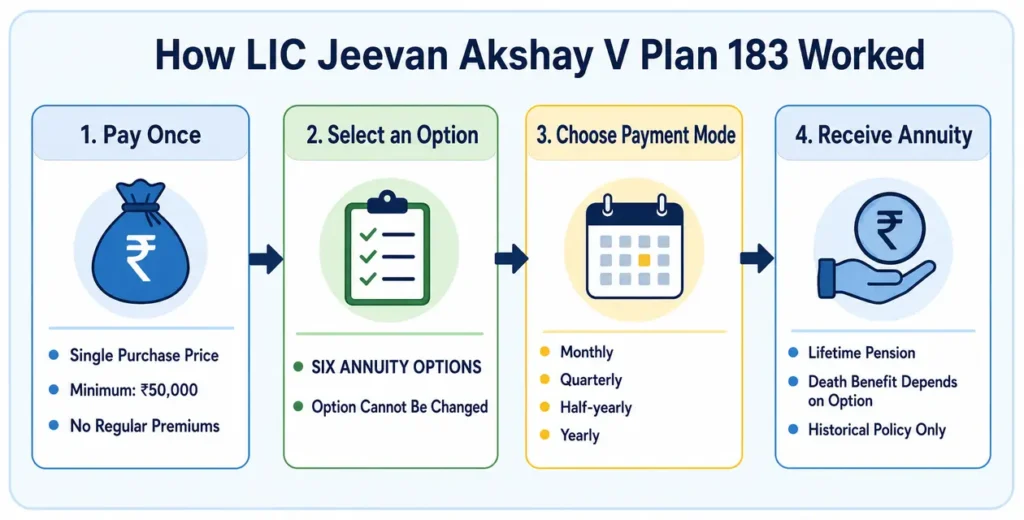
This was a single-premium pension plan. The policyholder paid a lump-sum purchase price, after which LIC provided an annuity according to the selected option. Annuity payments could be received monthly, quarterly, half-yearly or yearly. The selected annuity option could not be changed after the policy was purchased.
The calculator is mainly useful for existing policyholders, nominees, family members and researchers who want to understand the benefits of an old Jeevan Akshay-V policy. It is not intended for purchasing a new policy because Plan 183 is no longer available to new customers.
LIC lists Jeevan Akshay-V, UIN 512N234V02, among its withdrawn insurance products. All rates and calculations presented here are historical illustrations based on the official LIC Jeevan Akshay-V brochure. They are not current LIC pension quotations.
LIC Jeevan Akshay V Plan 183 Quick Overview
| Plan detail | Historical information |
|---|---|
| Plan name | LIC Jeevan Akshay V |
| Plan number | 183 |
| UIN | 512N234V02 |
| Plan category | Immediate annuity plan |
| Premium requirement | Single lump-sum purchase price |
| Introduction date | 20 September 2006 |
| Withdrawal date | 10 September 2007 |
| Minimum entry age | 40 years last birthday |
| Maximum entry age | 79 years last birthday |
| Minimum purchase price | ₹50,000, subject to minimum annuity |
| Minimum annuity | ₹3,000 per year |
| Payment modes | Monthly, quarterly, half-yearly and yearly |
| Medical examination | Not required |
| Paid-up value | Not available |
| Surrender value | Not available |
| Policy loan | Not available |
| Current status | Withdrawn |
Table of Contents
What Was LIC Jeevan Akshay V Plan 183?
LIC Jeevan Akshay-V was an immediate annuity policy that converted a single lump-sum payment into regular pension instalments. Unlike a deferred pension plan, it did not have a long accumulation period before income started.
The amount deposited at the beginning was known as the purchase price. No further monthly or yearly premiums were required after this amount had been paid.
The annuitant selected an annuity option according to the preferred balance between personal pension, guaranteed payments, return of purchase price and financial protection for a spouse. This choice determined both the pension amount during the annuitant’s lifetime and what happened after death.
Plan 183 was not an endowment, money-back or market-linked insurance policy. Its main purpose was to provide regular annuity income rather than a maturity corpus. Except under the return-of-purchase-price option, the amount paid to purchase the policy was not automatically returned after the annuitant’s death.
What Is the LIC Jeevan Akshay V Plan 183 Calculator?
The LIC Jeevan Akshay V Plan 183 Calculator estimates the pension that a lump-sum purchase price could have provided under the historical terms of Jeevan Akshay-V.
The calculation is based on the annual annuity available for every ₹1 lakh of purchase price. For example, the official brochure shows that an annuitant aged 60 could receive ₹9,230 per year for every ₹1 lakh under Option I, which provided a regular annuity for life.
The basic formula is:
Estimated annual annuity = (Purchase price ÷ ₹1,00,000) × annual annuity rate per ₹1 lakh
If the purchase price is ₹3 lakh, the applicable brochure rate is multiplied by three. The resulting annual annuity can then be converted into an estimated monthly, quarterly or half-yearly amount.
The brochure publishes sample rates only for ages 40, 45, 50, 55, 60, 65, 70 and 75. It does not provide a rate for every eligible age between 40 and 79. Therefore, the calculator requires a custom rate when the entered age is not included in the published table. It does not silently interpolate or invent an LIC rate.
Also Check:
- LIC Jeevan Akshay Calculator
- LIC Jeevan Akshay VII Plan 857 Calculator
- LIC Jeevan Akshay VI Plan 189 Calculator
- LIC Jeevan Akshay IV Plan 176 Calculator
- LIC Jeevan Akshay III Plan Calculator
- LIC Jeevan Akshay II Calculator
- LIC New Jeevan Akshay I Plan 146 Calculator
Highlights of the LIC Jeevan Akshay V Calculator
The calculator combines all six annuity options of Jeevan Akshay-V in one compact tool. It uses the yearly annuity rates published in the official LIC brochure and converts the annual result into the selected payment frequency.
Its main features include:
- Calculations for all six historical annuity options
- Monthly, quarterly, half-yearly and yearly pension estimates
- Separate guaranteed periods of 5, 10, 15 and 20 years
- Return-of-purchase-price calculation
- Surviving-spouse annuity calculation at 50% or 100%
- Year-wise schedule for the 3% increasing annuity
- Projected pension for a selected period of up to 50 years
- Optional high-purchase-price incentive input
- Custom annuity-rate input where the brochure does not show a rate
- Explanation of death and continuation benefits
- Mobile-friendly results without horizontal scrolling
- Reset button for starting a new calculation
The tool also identifies whether an official rate is available for the selected age and annuity option. If the brochure does not contain the required rate, the calculator requests a verified rate from the policy schedule instead of presenting an assumed figure as official.
How Did LIC Jeevan Akshay V Plan 183 Calculator Work?
The policy began with the payment of a single purchase price. The annuitant then chose an annuity option based on the required income and post-death benefit.
A payment frequency also had to be selected. Annuity instalments could be received monthly, quarterly, half-yearly or yearly. The first payment became due after completion of the corresponding interval from the purchase date.
Under monthly mode, the first instalment was payable after one month. Quarterly payments began after three months, half-yearly payments after six months and yearly payments after one year.
The selected option affected the annuity rate. A basic lifetime annuity generally provided a different pension from an option that returned the purchase price or continued income to a surviving spouse. This difference reflected the benefits LIC was required to pay under each option.
Once selected, the annuity option could not be changed. This made the original selection an important and effectively permanent policy decision.
Eligibility and Purchase Conditions
The minimum entry age under LIC Jeevan Akshay-V was 40 years last birthday, while the maximum entry age was 79 years last birthday. Documentary proof of age was required, but the plan did not require a medical examination.
The minimum purchase price was ₹50,000. However, the amount also had to be sufficient to generate an annual annuity of at least ₹3,000. Consequently, ₹50,000 might not have met the minimum annuity condition for every age and option.
The brochure did not prescribe a general maximum limit for the purchase price or annuity. It also stated that a purchase price of ₹1.50 lakh or more qualified for a higher annuity.
Because the full purchase price was paid at the beginning, there was no separate premium-paying term. The policy entered its annuity-payment stage after purchase, subject to the first-payment interval selected by the annuitant.
Annuity Options Available Under Jeevan Akshay-V
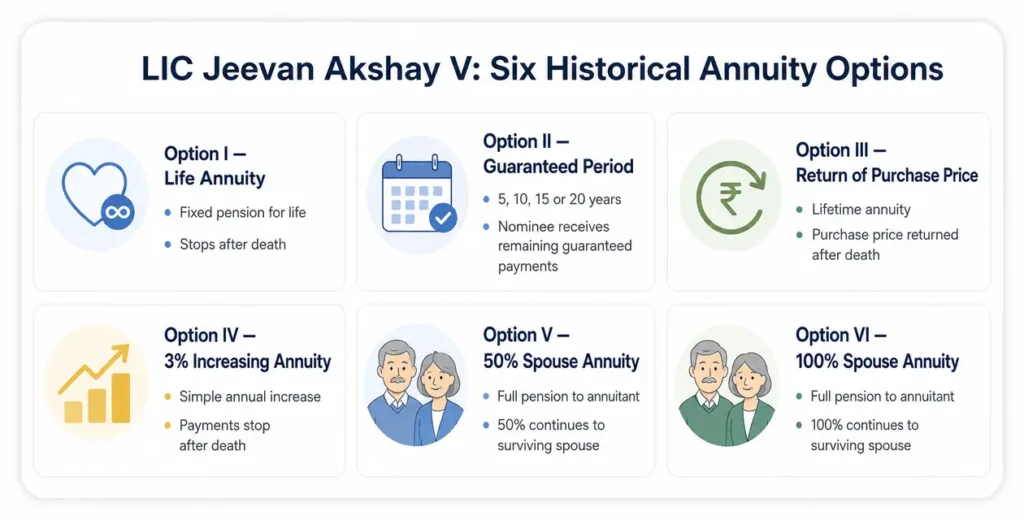
Option I: Regular Annuity for Life
Option I provided a fixed annuity throughout the annuitant’s lifetime. Payments stopped after the annuitant’s death.
This option did not provide a continuing pension to a spouse or return the purchase price to a nominee. It was a straightforward lifetime-income arrangement.
Because it did not create an additional payment obligation after death, its historical annuity amount was generally higher than options carrying purchase-price return or spouse protection.
Option II: Guaranteed Annuity for 5, 10, 15 or 20 Years and Thereafter for Life
Option II combined a guaranteed payment period with a lifelong annuity.
If the annuitant remained alive after the guaranteed period ended, pension continued throughout the annuitant’s remaining lifetime. Completion of the guaranteed period did not stop the pension while the annuitant was alive.
If the annuitant died during the guaranteed period, the nominee continued receiving the annuity until that period ended. Payments then stopped. If death occurred after the guaranteed period, no further annuity was payable.
For example, if the annuitant selected a 10-year guaranteed period and died after six years, the nominee would receive the annuity for the remaining four years.
The brochure’s sample rate table provides only the five-year-certain rate. A verified rate from the original policy schedule is therefore required to calculate the 10-, 15- or 20-year alternatives accurately.
Option III: Annuity for Life with Return of Purchase Price
Option III provided regular annuity payments throughout the annuitant’s life. After death, the annuity stopped and the original purchase price became payable to the nominee.
The returned purchase price was a death benefit rather than a maturity benefit. It generally represented the original amount used to purchase the annuity and did not include investment growth.
This option preserved the original purchase price for the nominee, but its regular annuity was lower than the basic life-annuity amount shown in the historical brochure.
Option IV: Annuity Increasing at 3% Per Year
Option IV provided a lifetime annuity that increased every year at a simple rate of 3%. The annual increase was calculated using the first-year annuity and not the previous year’s revised pension.
If the first-year annuity was ₹20,000, the yearly increase would be:
₹20,000 × 3% = ₹600
The second-year annuity would be ₹20,600, the third-year annuity ₹21,200 and the fourth-year amount ₹21,800.
This was a simple increase, not compound growth. After the annuitant’s death, payments stopped. The option did not provide a purchase-price return or continuing spouse annuity.
Option V: Life Annuity with 50% Payable to the Surviving Spouse
Under Option V, the primary annuitant received the full pension throughout life. After the primary annuitant’s death, 50% of that pension continued to the surviving named spouse for the spouse’s lifetime.
For example, if the primary annuity was ₹60,000 per year, the surviving spouse would receive ₹30,000 per year.
If the named spouse died before the primary annuitant, the annuity stopped after the primary annuitant’s death. No payment to another nominee was specified after both lives had ended.
Option VI: Life Annuity with 100% Payable to the Surviving Spouse
Option VI provided the full annuity to the surviving named spouse after the primary annuitant’s death.
If the original pension was ₹60,000 per year, the surviving spouse continued to receive ₹60,000 per year for life.
If the spouse had already died before the primary annuitant, payments ended after the primary annuitant’s death. The purchase price was not returned under this option.
Annuity Option Comparison
| Option | Benefit during the annuitant’s life | Benefit after death |
|---|---|---|
| Option I | Regular lifelong annuity | Payments stop |
| Option II | Guaranteed-period annuity and thereafter for life | Remaining guaranteed payments continue if death occurs within the selected period |
| Option III | Lifelong annuity | Purchase price paid to nominee |
| Option IV | Annuity increases by 3% a year on a simple basis | Payments stop |
| Option V | Full lifelong annuity | 50% continues to the surviving named spouse |
| Option VI | Full lifelong annuity | 100% continues to the surviving named spouse |
Annuity Payment Modes
LIC Jeevan Akshay-V offered four annuity-payment frequencies:
- Monthly
- Quarterly
- Half-yearly
- Yearly
The selected frequency affected the time of the first payment and the number of instalments received during a year. It did not change the underlying death or continuation benefit of the selected annuity option.
The brochure’s sample rate table presents yearly annuity amounts. Where the calculator divides the annual figure by 12, 4 or 2, the result should be treated as a periodic estimate. The issued policy schedule remains the authoritative source for the actual instalment payable under an existing policy.
Historical LIC Jeevan Akshay V Annuity Rates per ₹1 Lakh
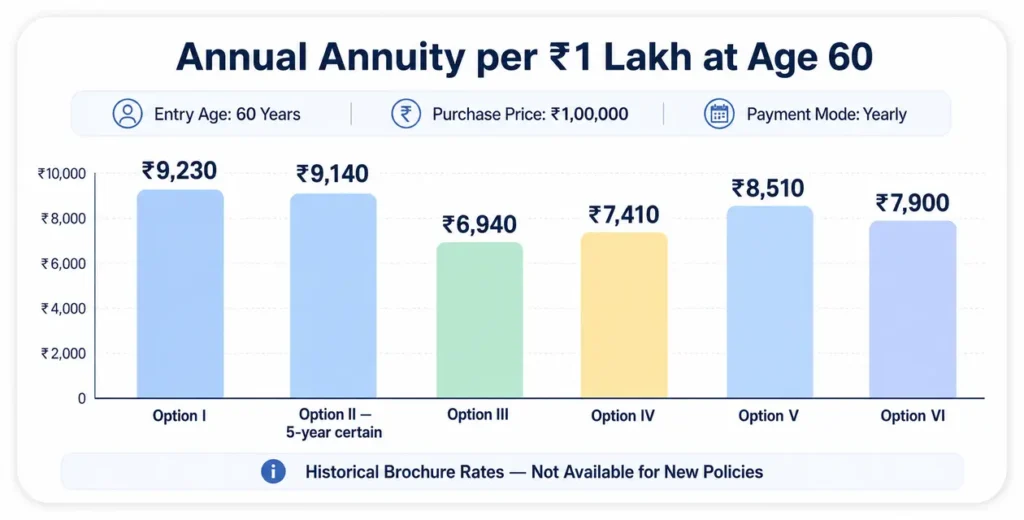
The following table shows the annual annuity amounts that could be purchased with ₹1 lakh at selected ages. These are historical figures from the official LIC brochure.
| Age | Option I: Life | Option II: 5-year certain | Option III: Return of price | Option IV: 3% increase | Option V: 50% spouse | Option VI: 100% spouse |
|---|---|---|---|---|---|---|
| 40 | ₹7,330 | ₹7,320 | ₹6,720 | ₹5,430 | ₹7,120 | ₹6,920 |
| 45 | ₹7,610 | ₹7,590 | ₹6,760 | ₹5,730 | ₹7,320 | ₹7,060 |
| 50 | ₹7,990 | ₹7,960 | ₹6,800 | ₹6,130 | ₹7,600 | ₹7,250 |
| 55 | ₹8,520 | ₹8,460 | ₹6,860 | ₹6,680 | ₹7,990 | ₹7,520 |
| 60 | ₹9,230 | ₹9,140 | ₹6,940 | ₹7,410 | ₹8,510 | ₹7,900 |
| 65 | ₹10,300 | ₹10,130 | ₹7,030 | ₹8,480 | ₹9,280 | ₹8,450 |
| 70 | ₹11,980 | ₹11,570 | ₹7,130 | ₹10,130 | ₹10,450 | ₹9,270 |
| 75 | ₹14,420 | ₹13,400 | ₹7,240 | ₹12,500 | ₹12,150 | ₹10,500 |
Historical illustration: These rates relate to a withdrawn product and are not available for purchasing a new LIC policy.
The table shows how age and annuity selection affected pension income. At age 60, Option I provided ₹9,230 per ₹1 lakh, whereas Option III provided ₹6,940. Option III offered a lower regular pension because it also required LIC to return the purchase price after death.
The table shows only the five-year guaranteed rate under Option II. It should not be used for the 10-, 15- or 20-year guaranteed alternatives.
How to Use the LIC Jeevan Akshay V Calculator
Enter the lump-sum purchase price first. The minimum amount stated in the brochure was ₹50,000, subject to the requirement that it generate at least ₹3,000 in annual annuity.
Enter the annuitant’s age last birthday. Entry age under the plan was between 40 and 79 years. The calculator selects an official rate automatically when the age matches one of the rows published in the brochure.
Choose one of the six annuity options. If Option II is selected, an additional field appears for choosing a guaranteed period of 5, 10, 15 or 20 years.
Select the preferred payment frequency. Available choices are monthly, quarterly, half-yearly and yearly.
Enter the number of years for which the pension projection is required. This input is particularly useful for Option IV because its annuity rises by 3% of the first-year amount every year.
If the brochure does not show a rate for the selected age or guaranteed period, enter the annual annuity per ₹1 lakh from the original policy schedule in the custom-rate field.
A separate optional field can be used for a verified high-purchase-price incentive. It should remain blank when the applicable historical enhancement cannot be confirmed from an authoritative record.
Press Calculate to view the annual annuity, estimated periodic instalment, applied rate, payout percentage, first-payment time, projected pension and death benefit. Press Reset to clear the calculation and restore the default fields.
Real LIC Jeevan Akshay V Calculation Example
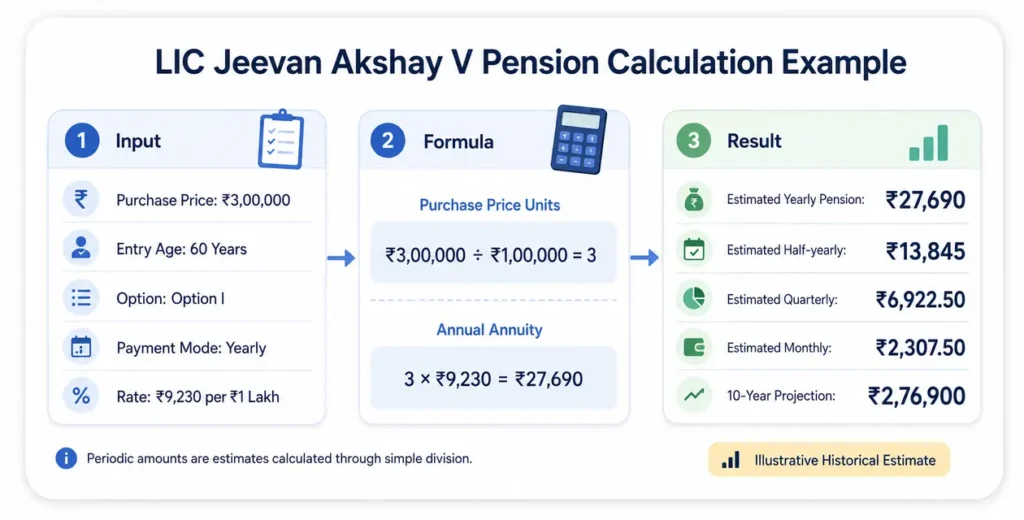
Consider the following historical illustration:
| Particular | Selected value |
|---|---|
| Purchase price | ₹3,00,000 |
| Age last birthday | 60 years |
| Annuity option | Option I |
| Payment mode | Yearly |
| Projection period | 10 years |
| Official brochure rate | ₹9,230 per ₹1 lakh |
The purchase price contains three units of ₹1 lakh:
₹3,00,000 ÷ ₹1,00,000 = 3
The estimated annual annuity is:
3 × ₹9,230 = ₹27,690
The estimated yearly pension is therefore ₹27,690.
Using simple division, the equivalent periodic estimates would be:
- Half-yearly: ₹27,690 ÷ 2 = ₹13,845
- Quarterly: ₹27,690 ÷ 4 = ₹6,922.50
- Monthly: ₹27,690 ÷ 12 = ₹2,307.50
If the annuitant survives for ten complete years and the annual pension remains unchanged, the projected total is:
₹27,690 × 10 = ₹2,76,900
Under Option I, payments continue while the annuitant is alive. After death, pension stops and the purchase price is not returned.
The annual figure of ₹9,230 per ₹1 lakh is equal to 9.23% of the purchase price. This percentage describes the annual annuity payout and should not be presented as an investment return or interest rate. Under most options, the annuity includes the financial effect of exchanging access to the purchase price for lifelong income.
Comparison with Return of Purchase Price
For an annuitant aged 60, the brochure shows an Option III rate of ₹6,940 per ₹1 lakh.
The estimated annual annuity would be:
(₹3,00,000 ÷ ₹1,00,000) × ₹6,940 = ₹20,820
The estimated yearly pension would therefore be ₹20,820. After the annuitant’s death, the original ₹3,00,000 purchase price would become payable to the nominee, subject to the issued policy terms.
This comparison demonstrates why the option providing a purchase-price return produced a lower annual pension than the basic lifetime-annuity option.
Main Benefits of Plan 183
The principal benefit was regular pension income throughout the annuitant’s lifetime. Because it was an immediate annuity plan, income began after the first interval associated with the selected payment mode.
Six annuity structures allowed the annuitant to choose between higher personal income, a guaranteed payment period, return of purchase price, an increasing pension or income continuation for a spouse.
The availability of monthly, quarterly, half-yearly and yearly modes made it possible to align payments with different income requirements.
No medical examination was required. This simplified the purchase process, although acceptable proof of age remained necessary.
The annuity benefit was determined by the terms applicable when the policy was purchased. It was not linked to daily stock-market movements. However, this did not eliminate inflation risk or make every annuity option equally suitable.
Surrender, Loan, Paid-Up and Maturity Conditions
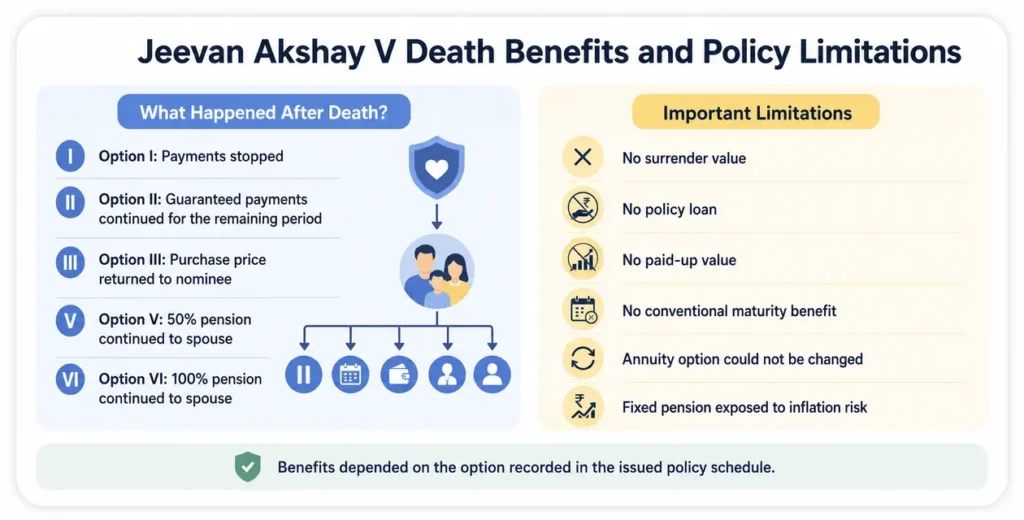
LIC Jeevan Akshay-V did not acquire a paid-up value. A paid-up benefit is generally associated with regular-premium policies where future premiums are discontinued after a minimum period. Plan 183 required only one purchase payment, so there was no future premium stream to discontinue.
No surrender value was available under the brochure’s terms. After the cooling-off period, the annuitant could not ordinarily cancel the policy and recover the purchase price through surrender.
The plan did not offer a policy-loan facility. The purchase price could therefore not be accessed through a loan against the policy.
There was also no conventional maturity benefit payable after a fixed policy term. The plan was designed to provide annuity income for life or according to the guaranteed conditions of the selected option.
Under Option III, the purchase price was payable to the nominee after the annuitant’s death. This was a death benefit, not a maturity value.
Cooling-Off Period
The historical brochure allowed the policy to be returned within 15 days from the date the policy bond was received if the policyholder disagreed with its terms and conditions.
This initial review period should not be confused with a continuing surrender facility. The plan did not provide a surrender value after the applicable cooling-off stage.
For an existing policy, the issued policy bond should be checked for the exact conditions that applied to the contract.
Important Calculator Limitations
The LIC brochure states that a higher annuity was available when the purchase price was ₹1.50 lakh or more. However, the short sales brochure containing the sample rate table does not provide the complete enhancement structure. The calculator should exclude this enhancement unless a verified incentive amount is entered manually.
The brochure also does not display separate monthly, quarterly and half-yearly rate tables. Periodic amounts calculated through simple division are estimates and may not reproduce the exact instalment written in an issued policy schedule.
Rates for non-tabulated ages should not be estimated through simple averaging. The difference between ages may not follow a straight line, particularly at higher ages.
The brochure shows only the five-year-certain rate for Option II. The rate displayed for that choice must not be applied to the 10-, 15- or 20-year guaranteed alternatives.
A projected total pension assumes survival for the selected number of years. It is not a guaranteed total benefit because lifetime payments depend on how long the annuitant or eligible spouse survives.
The calculator does not replace an LIC policy bond, policy schedule, claim decision or official annuity quotation.
How to Verify an Existing Plan 183 Policy
The policy schedule is the most reliable source for an existing annuity. It should show the purchase price, selected annuity option, payment mode, annuity instalment and date from which pension became payable.
The UIN should be checked carefully. Different versions of Jeevan Akshay carried different UINs and could have different rates and conditions. The terms of Jeevan Akshay-IV, V or VI should not be applied interchangeably.
For a spouse-annuity option, verify the named spouse recorded in the policy. For a guaranteed-period option, confirm whether the selected period was 5, 10, 15 or 20 years.
A nominee handling a death claim should refer to the policy bond and LIC’s current documentary requirements. An online historical calculator can explain the expected benefit but cannot confirm whether a claim is admissible.
Frequently Asked Questions
What was LIC Jeevan Akshay V Plan 183?
LIC Jeevan Akshay V Plan 183 was a single-premium immediate annuity policy. A lump-sum purchase price was converted into regular pension payments under one of six available annuity structures.
What is the UIN of LIC Jeevan Akshay V?
The UIN is 512N234V02. It identifies Jeevan Akshay-V and distinguishes it from earlier and later versions of the Jeevan Akshay product.
Is LIC Jeevan Akshay V still available?
No. Plan 183 is a withdrawn policy and cannot be purchased by new customers. The calculator is intended only for historical estimates and understanding existing policies.
What was the minimum purchase price?
The minimum purchase price was ₹50,000, provided the amount generated an annual annuity of at least ₹3,000.
What were the entry-age limits?
The minimum entry age was 40 years last birthday, and the maximum was 79 years last birthday. Documentary age proof was required.
Was a medical examination required?
No medical examination was required under the historical plan conditions.
Was the purchase price returned after death?
The purchase price was returned only under Option III. Other options provided different post-death benefits and did not automatically return the original amount.
Could the annuity option be changed later?
No. Once an annuity option had been selected, it could not be altered.
Was surrender or a policy loan available?
No surrender value or loan facility was available under the official brochure’s terms. The policy also did not acquire a paid-up value.
When did annuity payments begin?
The first payment became due after one month, three months, six months or one year, depending on whether monthly, quarterly, half-yearly or yearly mode was selected.
Did Plan 183 provide a maturity benefit?
No conventional maturity benefit was available. Under Option III, the purchase price was returned after death as a death benefit rather than as a maturity payment.
Are the calculator results official LIC figures?
No. The calculator provides historical estimates. The issued policy schedule and LIC’s records remain authoritative for an existing policy.
Conclusion
LIC Jeevan Akshay V Plan 183, UIN 512N234V02, was a single-premium immediate annuity policy offering six pension structures. Depending on the selected option, it could provide a regular lifetime annuity, guaranteed payments, a 3% simple annual increase, return of purchase price or continuing income for a surviving spouse.
The LIC Jeevan Akshay V Plan 183 Calculator helps explain how the historical annual annuity was determined from the purchase price, age and annuity rate. It can also estimate periodic instalments, projected pension and the benefit payable after death.