LIC New Jeevan Akshay I Plan 146 Calculator
Minimum purchase price is Rs. 25,000. Age limit is 40 to 79 years. Brochure gives sample rates only for selected ages and mainly for Option 1 and Option 3. For other options, enter official manual annuity rate per Rs. 1,000.
Calculation Result
Also Check:
- LIC Jeevan Akshay Calculator All In One
- LIC Jeevan Akshay VII Plan 857 Calculator
- LIC Jeevan Akshay VI Plan 189 Calculator
- LIC Jeevan Akshay IV Plan 176 Calculator
- LIC Jeevan Akshay V Plan 183 Calculator
- LIC Jeevan Akshay III Plan 170 Calculator
- LIC Jeevan Akshay II Calculator
LIC New Jeevan Akshay I Plan 146 Calculator
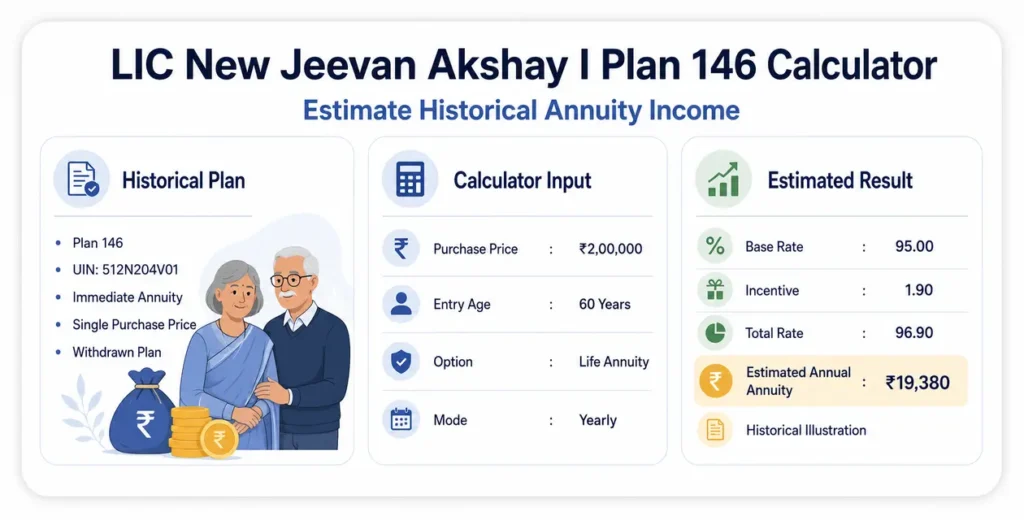
New Jeevan Akshay I Plan 146 was a single-purchase-price immediate annuity plan offered by Life Insurance Corporation of India. It converted a lump-sum amount into regular annuity payments under the option and payment mode selected when the policy was purchased. The version covered in this guide carried UIN 512N204V01.
This is a withdrawn plan and is not available for new purchases. The LIC New Jeevan Akshay I Plan 146 Calculator is therefore intended for historical estimates, educational comparison and a better understanding of existing policies. It is not an official LIC calculator, quotation or policy statement.
The available historical brochure contains sample annuity rates for selected ages and options. A calculator can use those rates to show how the purchase price, entry age, annuity option and payment mode may affect the estimated income. However, the result cannot replace the terms printed in an issued policy or an official benefit confirmation from LIC.
New Jeevan Akshay I Plan 146 Overview
| Particular | Historical plan detail |
|---|---|
| Plan name | LIC New Jeevan Akshay-I |
| Plan number | 146 |
| UIN covered here | 512N204V01 |
| Plan status | Withdrawn; unavailable for new purchase |
| Plan type | Immediate annuity plan |
| Payment structure | Single purchase price |
| Minimum purchase price | ₹25,000 |
| Maximum purchase price | No maximum stated in the brochure |
| Entry age | 40 to 79 years, age last birthday |
| Medical examination | Not required |
| Annuity modes | Yearly, half-yearly, quarterly and monthly |
| Loan facility | Not available |
| Surrender value | Not available |
The official LIC withdrawn-plans page also lists another historical version of New Jeevan Akshay-I with UIN 512N204V02. The rates and explanations on this page should not automatically be applied to that version. Existing policyholders should check the UIN printed on the policy document before using any historical calculator.
Table of Contents
What Was New Jeevan Akshay I Plan 146?
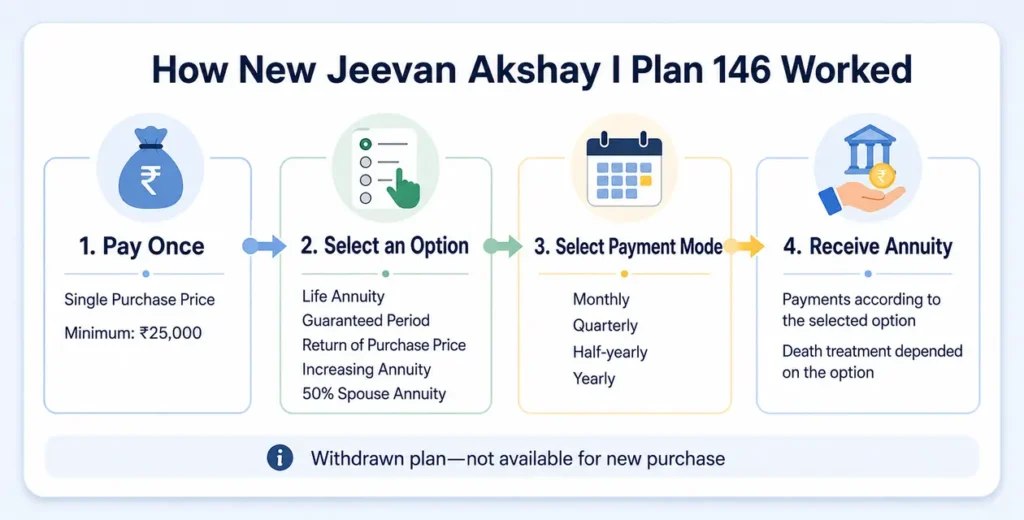
New Jeevan Akshay-I was an immediate annuity product. The annuitant paid one lump-sum purchase price at the beginning, after which annuity payments became payable according to the selected option and frequency. There was no continuing premium-paying term.
The first instalment depended on the payment mode. Under monthly mode it was generally due after one month, under quarterly mode after three months, under half-yearly mode after six months and under yearly mode after one year. The annuity then continued according to the conditions of the chosen option.
The product was structured for people who wanted to convert accumulated money into a predictable income stream. Some options concentrated on lifetime income for one annuitant, while others provided a guaranteed payment period, return of the purchase price after death, an increasing annuity or continued income for a spouse.
The purchase price was not the same as a recurring insurance premium. It was the one-time amount used to purchase the annuity. Once the plan had been bought, the applicable annuity rate and selected option determined the contractual payments.
What Does the New Jeevan Akshay I Plan 146 Calculator Estimate?
The calculator estimates the annuity that a historical Plan 146 policy might have provided based on the data entered. Its main inputs are purchase price, age last birthday, annuity option, payment mode and the corresponding annuity rate per ₹1,000 of purchase price.
Where the required brochure-based rate is available, the calculator can estimate the annualised annuity and the amount payable in each instalment. It can also display the consequence of death under the selected option, such as cessation of annuity, continuation during a guaranteed period, return of purchase price or payment of 50% annuity to the surviving spouse.
A reverse calculation may estimate the approximate purchase price required for a target annuity. Such a result remains indicative because the high purchase-price incentive depends on the resulting purchase-price slab. The calculation must therefore identify the correct slab instead of applying one incentive rate to every amount.
The calculator is most useful for comparing the mechanics of the options. It should not be used to confirm an existing policy payment, settle a claim, value a policy or make a new purchase decision.
Eligibility and Purchase-Price Conditions
According to the historical brochure, the minimum entry age was 40 years and the maximum was 79 years, measured as age last birthday. The minimum purchase price was ₹25,000, and the brochure did not state a maximum purchase-price limit.
No medical examination was required. This was a product condition rather than an additional benefit calculated from health status. The annuity was primarily determined by the applicable rate, entry age, option, payment mode and purchase price.
The brochure stated that no loan and no surrender value were available. Consequently, the purchase price generally could not be recovered simply by exiting the policy. Money was returned after death only where the selected annuity option expressly provided for it.
These restrictions are important when interpreting an old policy. Return of purchase price under a death-benefit option should not be confused with surrender value during the annuitant’s lifetime.
Annuity Payment Modes
Plan 146 allowed yearly, half-yearly, quarterly and monthly annuity payments. These modes determined both the timing of the first payment and the number of instalments in a year.
An important calculation distinction must be maintained: the yearly-mode annuity rate cannot automatically be used for monthly, quarterly or half-yearly mode. Historical annuity tables may contain a separate annualised rate for each mode. The calculator must first use the rate applicable to the selected age, option and mode. Only after calculating the annualised annuity should it divide that figure by 1, 2, 4 or 12 to determine the amount of each instalment.
For example, a monthly instalment is not necessarily one-twelfth of an annuity calculated with the yearly-mode rate. It is one-twelfth of the annualised annuity calculated with the applicable monthly-mode rate.
Annuity Options Available Under Plan 146
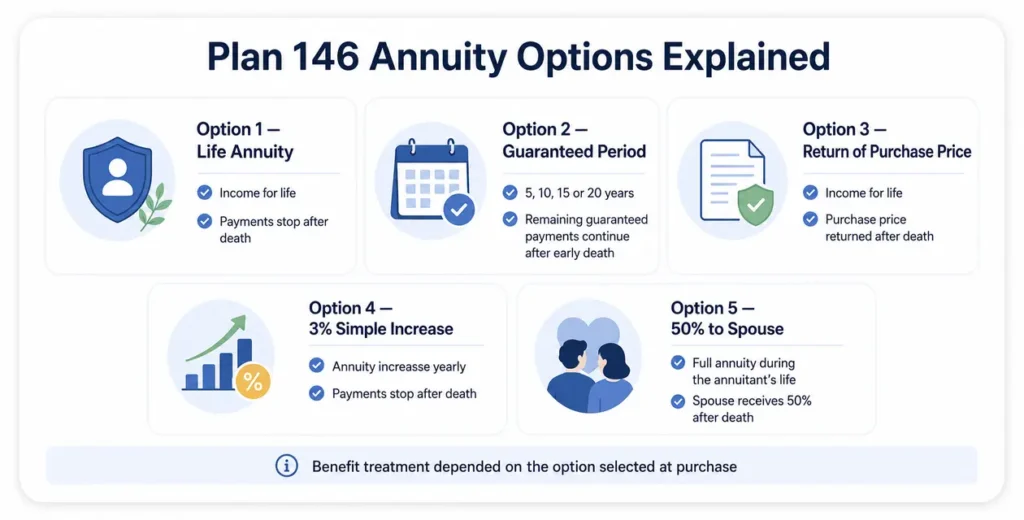
The plan offered five broad annuity choices. The correct option affected both the amount of income and what happened after the annuitant’s death.
| Option | How the annuity worked | Position after death |
| Life annuity | Annuity was payable throughout the annuitant’s lifetime | Payments stopped on death |
| Annuity guaranteed for 5, 10, 15 or 20 years and thereafter for life | Payments were guaranteed for the selected period and continued after it while the annuitant was alive | If death occurred during the guaranteed period, the remaining guaranteed payments continued to the nominee |
| Life annuity with return of purchase price | Annuity continued throughout the annuitant’s lifetime | Purchase price was returned to the nominee after death |
| Life annuity increasing at 3% simple rate | Initial annuity increased every year by 3% of the original annuity | Payments stopped on death |
| Life annuity with 50% annuity to spouse | Full annuity was paid during the annuitant’s lifetime | The surviving spouse received 50% of the annuity for life |
Life Annuity
Under the life-annuity option, income continued for as long as the annuitant remained alive. Payments ended on death, and the purchase price was not returned. Because this option did not include a continuing family benefit, its annuity rate was generally higher than the rate under the return-of-purchase-price option at the same age and mode.
Guaranteed-Period Annuity
This option allowed a guaranteed period of 5, 10, 15 or 20 years. If the annuitant survived beyond that period, payments continued for life. If death occurred before the guaranteed period ended, the remaining guaranteed instalments continued to the nominee until that period was completed.
For instance, if a 10-year guaranteed period had been selected and the annuitant died after six years, payments would continue for the remaining four years. If death occurred after the guaranteed period, the annuity would stop.
Life Annuity With Return of Purchase Price
This option paid an annuity throughout the annuitant’s lifetime and returned the purchase price to the nominee after death. It did not mean that the policy could be surrendered for the purchase price while the annuitant was alive.
The annuity was generally lower than under the basic life-annuity option because the contract also provided for repayment of the purchase price after death.
Increasing Life Annuity
Under this option, the annuity increased at a simple rate of 3% each year. “Simple” is significant because the annual increase was based on the initial annuity, not the increased amount from the previous year.
If the first-year annuity was ₹20,000, the annual increase would be ₹600. The second-year annuity would therefore be ₹20,600, the third-year annuity ₹21,200 and the fourth-year annuity ₹21,800. Payments stopped after the annuitant’s death.
Life Annuity With 50% to Spouse
The annuitant received the full annuity during life. After the annuitant’s death, the surviving spouse received 50% of that annuity for life. If the original annual annuity was ₹20,000, the spouse benefit would be ₹10,000 a year, subject to the policy terms and payment mode.
This option provided income continuity for the spouse but did not, on the information covered here, provide return of the purchase price.
High Purchase-Price Incentive
The historical brochure provided an addition to the tabular annuity rate for qualifying purchase-price slabs. The addition was quoted per ₹1,000 of purchase price and differed by annuity mode.
No addition applied below ₹50,000. For purchase prices from ₹50,000 to ₹99,999, the additions were 1.10 for yearly mode, 1.30 for half-yearly mode, 1.50 for quarterly mode and 2.90 for monthly mode.
For purchase prices from ₹1,00,000 to ₹1,99,999, the respective additions were 1.70, 1.90, 2.30 and 4.30. At ₹2,00,000 and above, they were 1.90, 2.20, 2.60 and 5.00.
This addition did not by itself represent the annuity payment. It was added to the base rate applicable to the selected age, option and mode. The combined rate was then applied per ₹1,000 of purchase price.
Sample Yearly-Mode Annuity Rates
The following historical sample rates are expressed as annual annuity per ₹1,000 of purchase price under yearly mode. They cover selected ages and only two options. They should not be used as monthly, quarterly or half-yearly base rates.
| Age last birthday | Life annuity | Life annuity with return of purchase price |
| 40 | 71.50 | 64.70 |
| 45 | 75.40 | 65.90 |
| 50 | 80.50 | 67.40 |
| 55 | 86.90 | 69.00 |
| 60 | 95.00 | 70.90 |
| 65 | 106.20 | 72.90 |
| 70 | 123.70 | 75.10 |
| 75 | 148.60 | 77.30 |
The life-annuity rate rises noticeably with age in this sample. The return-of-purchase-price rate also rises, but more gradually because that option included repayment of the purchase price after death.
Rates for unlisted ages should not be guessed by silently selecting the nearest age. Interpolation can also produce a figure that was never part of LIC’s table. Where a verified rate is unavailable, the calculator should request manual entry or state that a brochure-based calculation cannot be produced.
How the Calculator Works
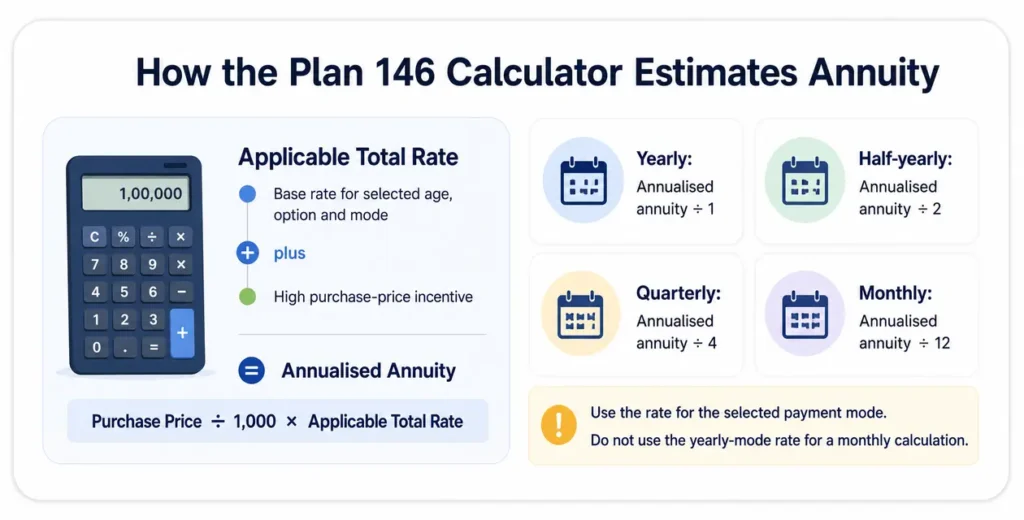
The correct base formula is:
Annualised annuity = Purchase price ÷ 1,000 × applicable total annuity rate
The total annuity rate is:
Applicable total rate = Base rate for the selected age, option and mode + high purchase-price addition
The annualised result is then converted into the amount of each instalment:
Instalment amount = Annualised annuity ÷ number of payments in a year
The divisor is 1 for yearly mode, 2 for half-yearly mode, 4 for quarterly mode and 12 for monthly mode. This final division is valid only after the correct mode-specific annualised rate has been used.
For the increasing-annuity option, the first-year estimate becomes the base annuity. Each subsequent policy year adds 3% of that initial figure. The increase is not compounded.
For the return-of-purchase-price option, the calculator should display the purchase price as the amount potentially payable after the annuitant’s death, subject to the issued policy terms. It should not label that amount as a maturity value or surrender value.
How to Use the LIC New Jeevan Akshay I Plan 146 Calculator
Begin by selecting whether the calculation should estimate annuity from a known purchase price or approximate the purchase price for a target annuity. Next, choose the annuity option and enter the age last birthday applicable when the historical policy was purchased.
Select the payment mode shown in the policy. Enter the purchase price, ensuring that the amount is not below the historical minimum of ₹25,000. The calculator should then use a verified rate for the selected age, option and mode.
If the required rate is not included in the calculator, enter it manually only after checking a reliable historical rate table. A yearly-mode sample rate should not be entered for monthly, quarterly or half-yearly mode.
After selecting Calculate, review the displayed base rate, purchase-price addition, combined rate, annualised annuity, instalment amount and death-benefit treatment. Use Reset to clear the entries before starting another comparison.
Real Calculation Example: Life Annuity
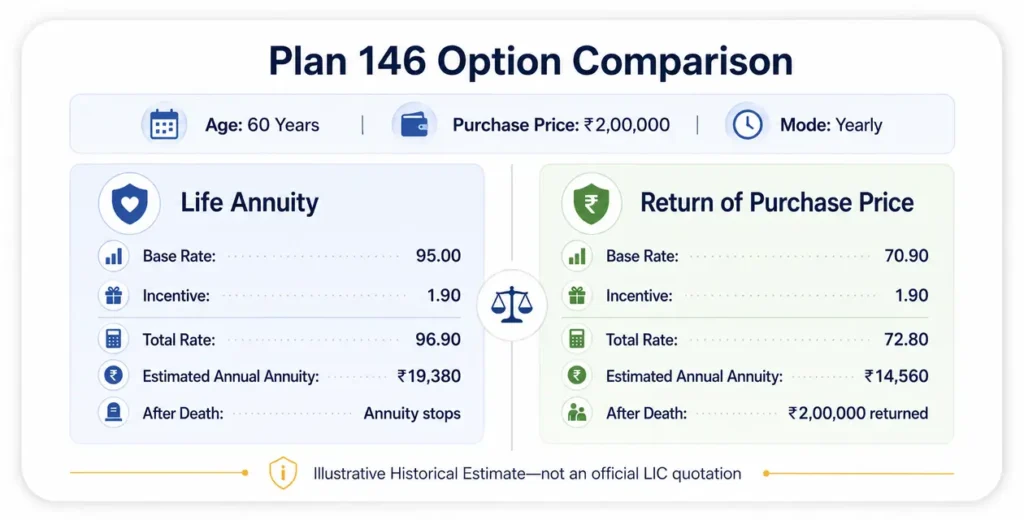
Consider a historical illustration for a person aged 60 with a purchase price of ₹2,00,000. The selected option is life annuity, and the payment mode is yearly.
The sample yearly-mode rate at age 60 is 95.00 per ₹1,000. The yearly-mode addition for a purchase price of ₹2,00,000 or more is 1.90. The combined rate is therefore:
95.00 + 1.90 = 96.90 per ₹1,000
The estimated annual annuity is:
₹2,00,000 ÷ 1,000 × 96.90 = ₹19,380
Because yearly mode was selected, the estimated instalment is ₹19,380 once a year. Under this option, annuity would stop after the annuitant’s death and the purchase price would not be returned.
This example should not be converted into a monthly result by simply dividing ₹19,380 by 12. A proper monthly illustration would require the monthly-mode base rate and monthly high purchase-price addition.
Real Calculation Example: Return of Purchase Price
Now keep the age, purchase price and yearly mode unchanged but select life annuity with return of purchase price.
The sample yearly-mode base rate at age 60 is 70.90. Adding the yearly high purchase-price rate of 1.90 gives:
70.90 + 1.90 = 72.80 per ₹1,000
The estimated annual annuity is:
₹2,00,000 ÷ 1,000 × 72.80 = ₹14,560
The estimated yearly annuity is therefore ₹14,560. After the annuitant’s death, the purchase price of ₹2,00,000 would be returned to the nominee according to the option’s terms.
In these two illustrations, the basic life-annuity option produces ₹4,820 more annual income. The return-of-purchase-price option produces less annual income but includes repayment of the purchase price after death. This is a comparison of benefit structures, not a statement that one option is universally better.
Which Option Produced the Highest Initial Annuity?
The basic life-annuity option generally produced a higher initial income because it ended on the annuitant’s death and did not return the purchase price. Adding a guaranteed period, repayment after death, increasing payments or spouse income changed the insurer’s expected payment obligation and normally affected the rate.
A higher initial annuity should therefore not be interpreted as a larger overall benefit in every situation. Each option covered a different risk. One focused on lifetime income for a single annuitant, while another protected a guaranteed period, returned capital after death or continued part of the income to a spouse.
The correct comparison is not limited to the first-year amount. It must also consider the payment duration, treatment after death, guaranteed period and whether any purchase price is returned.
Advantages and Limitations of the Historical Plan
Plan 146 required only one payment and offered a choice of annuity structures. It did not require medical examination, and the annuity was not linked to day-to-day market movements after purchase. The guaranteed-period, return-of-purchase-price and spouse options allowed different forms of post-death protection.
Its main limitation was lack of liquidity. The brochure stated that no surrender value and no loan were available. Except under the 3% simple-increase option, the annuity did not automatically increase each year. Even a fixed contractual payment can lose purchasing power as prices rise over a long retirement period.
The return-of-purchase-price option returned the original purchase price rather than an inflation-adjusted amount. Likewise, a 3% simple annual increase was not the same as a 3% compounded increase.
These characteristics explain how the historical product worked. They should not be treated as a recommendation to purchase a current annuity product with similar features.
Who Was Plan 146 Designed For?
New Jeevan Akshay-I was structured for people who had a lump-sum amount and wanted to convert it into immediate annuity income. The life-annuity option concentrated on income during the annuitant’s lifetime. The guaranteed-period option addressed the possibility of early death during a chosen period.
The return-of-purchase-price option preserved a defined payment for the nominee after death, while the spouse option continued half of the annuity to the surviving spouse. The increasing option provided a fixed simple increase instead of a level annuity.
Because the plan is withdrawn, this section describes its original design only. It is not a current suitability assessment.
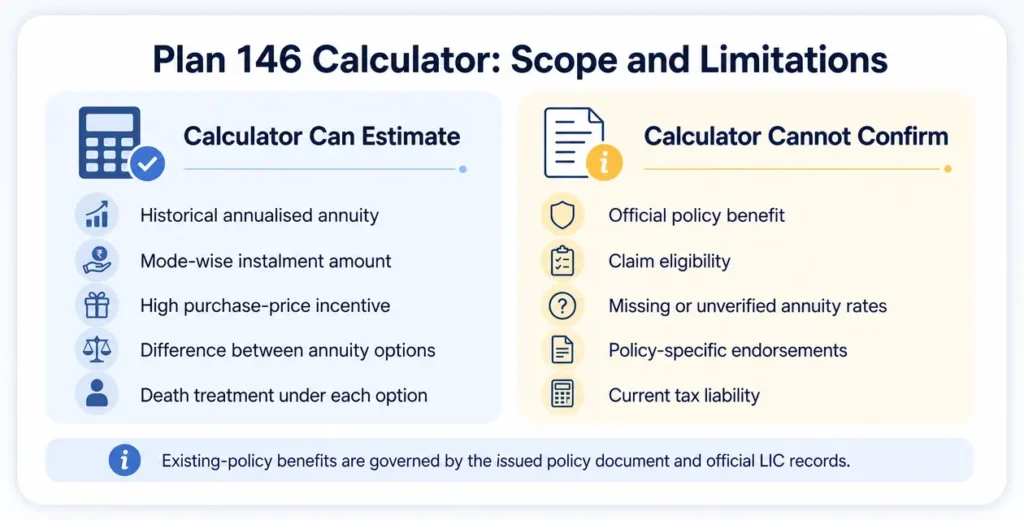
Important Limitations of the Calculator
The calculator can be no more accurate than its underlying rate data. The brochure presents only selected sample rates, while the full calculation may require an exact rate for the age, option and payment mode.
Results should be labelled “Historical estimate” or “Illustrative estimate.” The calculator should not display unsupported descriptions such as “official pension,” “guaranteed calculator result” or “confirmed LIC benefit.”
Existing policy benefits are controlled by the issued policy document and LIC’s records. A calculator cannot account for every policy-specific endorsement, correction, assignment, nomination detail or payment history. It also cannot determine claim eligibility.
Tax treatment is not calculated here. Annuity taxation depends on the law applicable to the recipient and relevant period, so a historical annuity estimate should not be presented as a post-tax amount unless the tax assumptions are separately disclosed.
Frequently Asked Questions
Is LIC New Jeevan Akshay I Plan 146 still available?
No. LIC lists New Jeevan Akshay-I among its withdrawn plans. It is not available for new purchase. The calculator is intended for historical estimates and understanding older policies.
What is the UIN of LIC New Jeevan Akshay-I?
This guide covers UIN 512N204V01. LIC’s withdrawn-plan records also list a 512N204V02 version. The UIN printed on the policy should be checked before applying any rates or conditions.
How many annuity options were available?
The plan offered five broad options. The guaranteed-period option contained four choices: 5, 10, 15 or 20 years certain and thereafter for life.
Could Plan 146 be surrendered?
The historical brochure stated that no surrender value was available. Return of purchase price after death under the relevant option was different from surrender during the annuitant’s lifetime.
Was a loan available under the policy?
No. The brochure stated that a loan facility was not available under this plan.
Was the purchase price returned under every option?
No. It was returned after death only under the life-annuity-with-return-of-purchase-price option described here. Other options provided different death-related treatments.
Can monthly annuity be calculated from the yearly rate?
Not accurately by simple division. The monthly-mode calculation requires the applicable monthly-mode annualised base rate and monthly high purchase-price addition. That annualised result can then be divided by 12 to estimate each monthly instalment.
Are the calculator results official LIC figures?
No. They are historical estimates based on the entered information and available rate data. Contractual figures for an existing policy should be confirmed from the policy document and official LIC records.
Conclusion
New Jeevan Akshay I Plan 146 was a withdrawn immediate annuity plan that converted a single purchase price into regular income. Its five broad annuity choices covered lifetime income, guaranteed payments, return of purchase price, a 3% simple annual increase and continuation of 50% annuity to a spouse.
The historical calculator can demonstrate how age, purchase price, option, payment mode and high purchase-price additions influenced an annuity estimate. Its calculations are most reliable when an exact rate is available for the selected age, option and mode.
The calculator should not apply a yearly-mode rate to other payment modes, guess missing rates or present its output as an official policy benefit. For an existing policy, the issued contract and LIC’s records remain the authoritative sources.

Amit Kushwaha is a financial content creator and SaaS tool developer based in Lucknow, Uttar Pradesh. He has more than seven years of experience creating insurance-related content, online calculators, and practical digital tools for LIC policyholders, insurance buyers, and LIC agents.
Through LICPolicyCalculator.com, he focuses on simplifying complex LIC policy information into easy-to-understand guides and calculators. His work covers LIC premium estimates, maturity calculations, surrender value tools, policy return calculations, term insurance planning, and plan-specific calculator pages.