LIC Jeevan Akshay VI Plan 189 Calculator
Single Premium Immediate Annuity – Estimate Your Pension
Taxes are not included in the purchase price used for this calculation.
Your Pension Calculation
Illustrative estimate based on selected inputs
Important: LIC Jeevan Akshay-VI Plan 189 is a withdrawn plan. This guide is designed for existing policyholders, family members, and people checking old policy benefits—not for buying a new policy.
LIC Jeevan Akshay VI Plan 189 was a single-premium immediate annuity plan designed to provide regular pension income after payment of a one-time purchase price. Unlike an endowment or money-back policy, it did not require annual premiums or accumulate a conventional maturity benefit.
After purchasing the policy, the annuitant started receiving pension in monthly, quarterly, half-yearly or yearly instalments. The amount depended on the annuitant’s age, purchase price, selected annuity option, payment mode, applicable purchase-price incentive and the annuity rates prevailing when the policy was purchased.
The LIC Jeevan Akshay VI Plan 189 Calculator helps estimate pension and understand the effect of different annuity options. It can also explain whether pension continues to a spouse, whether payments are guaranteed for a fixed period, and whether the purchase price becomes payable after death.
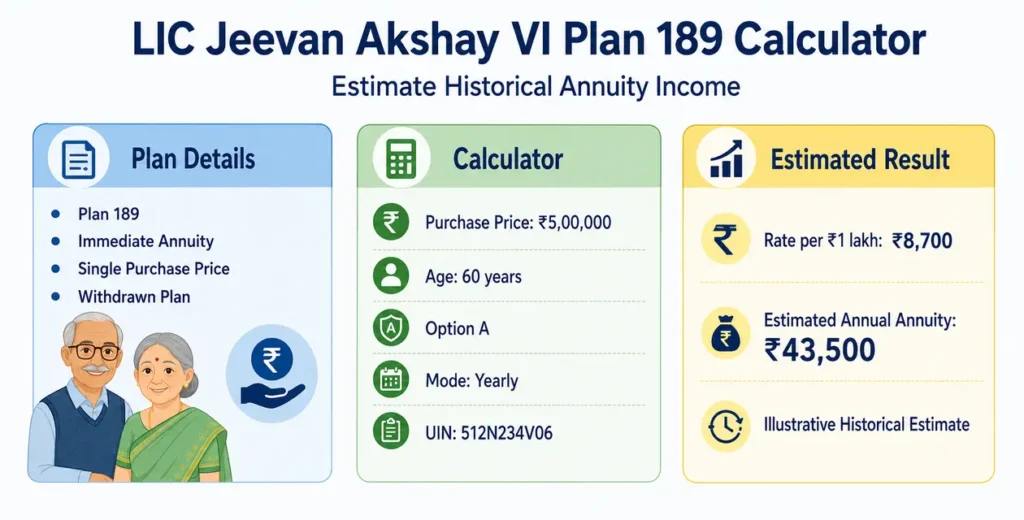
Table of Contents
LIC Jeevan Akshay VI Plan 189 at a Glance
| Particular | Details |
|---|---|
| Plan name | LIC’s Jeevan Akshay-VI |
| Plan number | 189 |
| Primary UIN covered | 512N234V05 |
| Plan type | Single-premium, non-linked, without-profit immediate annuity plan |
| Premium payment | One-time purchase price |
| Annuity modes | Monthly, quarterly, half-yearly and yearly |
| Annuity options | Ten options, from A to J |
| Traditional maturity benefit | Not available |
| Loan facility | Not available |
| Assignment | Not allowed |
| Surrender | Restricted to Option F under specified conditions |
| 512N234V05 withdrawal date | 1 December 2017 |
| Current availability | Withdrawn and unavailable for new purchase |
What Is LIC Jeevan Akshay VI Plan 189?
LIC Jeevan Akshay-VI was an immediate annuity policy. The policyholder paid a lump-sum purchase price at the beginning, and LIC paid a predetermined annuity according to the selected payment frequency.
“Immediate annuity” does not necessarily mean that pension is paid on the date of purchase. It means the income phase begins without a long accumulation or deferment period. The first payment was generally due after one month in monthly mode, three months in quarterly mode, six months in half-yearly mode or one year in yearly mode.
For example, when yearly mode was selected, the first annual pension instalment was normally payable one year after the purchase date. The annuity was paid in arrears and continued according to the selected option.
This plan did not function like a bank fixed deposit or regular LIC savings policy. There was no standard maturity date on which the purchase price automatically became payable. Return of the purchase price depended entirely on the annuity option selected when the policy was purchased.
The selected option was important because it determined:
- How long pension would be paid
- Whether payments were guaranteed for a minimum period
- Whether a spouse would receive pension
- Whether the purchase price would be returned after death
Once the annuity option was selected, it could not ordinarily be changed.
Is LIC Jeevan Akshay VI Plan 189 Still Available?
No. LIC Jeevan Akshay VI Plan 189 is no longer available for new purchases.
LIC’s official withdrawn-plan page states that UIN 512N234V05 was withdrawn on 1 December 2017. A later revision, UIN 512N234V06, was subsequently introduced and is listed among the plans withdrawn during the financial year 2019–20.
Withdrawal from sale does not by itself terminate policies that had already been issued. An existing contract continues according to its policy schedule, applicable UIN and policy conditions.
This distinction is particularly important for Plan 189 because it existed under several UIN revisions. A rate published for 512N234V06 should not automatically be used to calculate the pension of a 512N234V05 policy.
Comparison of UIN 512N234V05 and 512N234V06
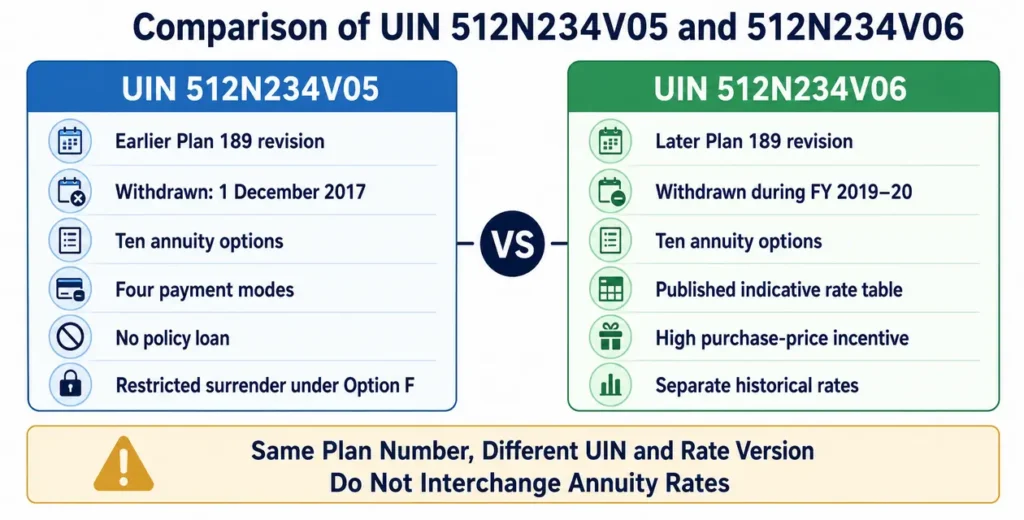
Both 512N234V05 and 512N234V06 belonged to LIC Jeevan Akshay VI Plan 189, but they were separate product revisions. Their broad annuity structure was similar, while their applicable rates, sale periods, and certain purchase conditions could differ.
| Feature | UIN 512N234V05 | UIN 512N234V06 |
|---|---|---|
| Plan name and number | Jeevan Akshay VI Plan 189 | Jeevan Akshay VI Plan 189 |
| Position in product history | Earlier revision | Later revision that followed 512N234V05 |
| Withdrawal information | Withdrawn on 1 December 2017 | Listed as withdrawn during FY 2019–20 |
| Number of annuity options | Ten options, A to J | Ten corresponding annuity choices |
| Payment modes | Monthly, quarterly, half-yearly and yearly | Monthly, quarterly, half-yearly and yearly |
| Option G increase | 3% simple increase per completed policy year | 3% simple increase per completed policy year |
| Restricted surrender | Option F under specified conditions | Option F under specified conditions |
| Loan facility | Not available | Not available |
| Published rate information | The policy bond establishes benefits and conditions but does not provide a complete sales-rate table | Official 512N234V06 sales brochure provides indicative age-wise rates and purchase conditions |
| Can rates be interchanged? | No | No |
The most important difference for calculator use is rate compatibility. Even though both versions carried Plan Number 189 and offered similar annuity choices, the annuity rate applicable to a policy was determined when the policy was purchased.
The 512N234V06 brochure’s published rates are useful for explaining how the calculation works. They should not be represented as the actual rates of 512N234V05.
For an existing policy, check the UIN printed on the policy bond. If it ends in 512N234V05, a 512N234V06 illustration may explain the method but cannot verify the policy’s pension amount.
How LIC Jeevan Akshay VI Worked
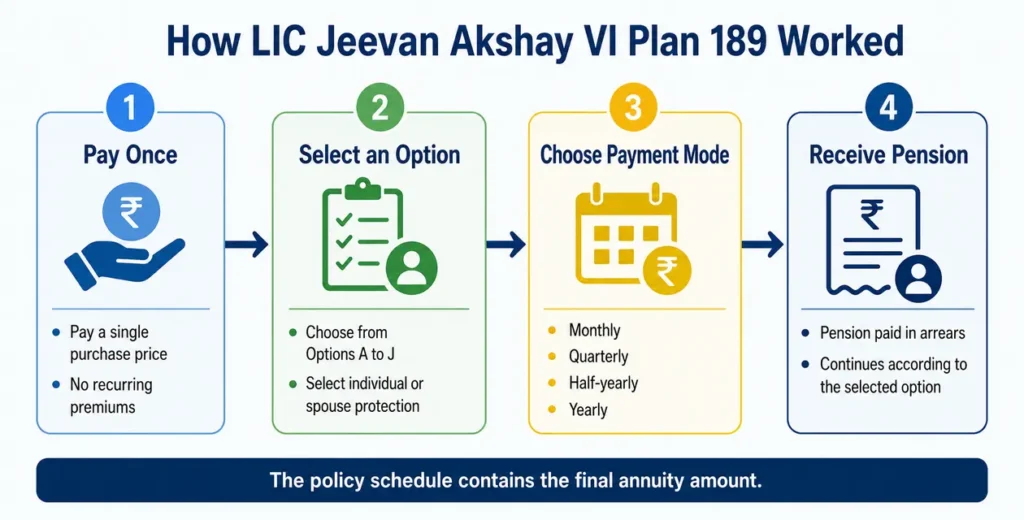
The policyholder first paid a single purchase price. There was no requirement to continue paying premiums every month or year.
At the time of purchase, the annuitant selected one of ten annuity options and chose the payment mode. LIC then fixed the annuity using the applicable rate structure, age at last birthday, purchase price, and any eligible incentive.
Once the policy had been issued, pension started after the first selected payment interval. Payments continued for life, for a guaranteed period, to a surviving spouse, or until the return of the purchase price, depending on the option.
The actual annuity amount was recorded in the policy schedule. That schedule should contain details such as the purchase price, age of the annuitant, selected option, payment mode, first payment date, annuity amount, nominee and named spouse where applicable.
LIC Jeevan Akshay VI Plan 189 Annuity Options
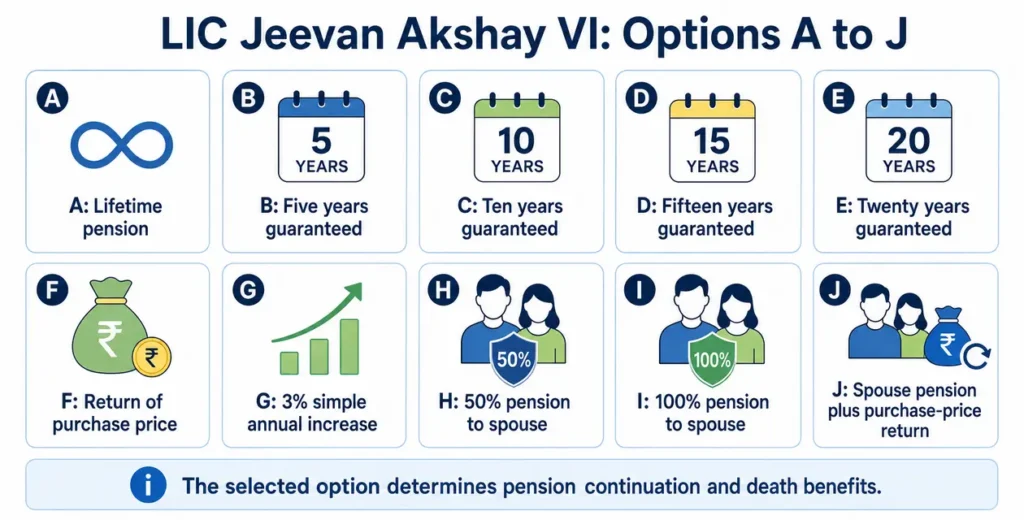
Plan 189 offered ten options. The option could not be chosen only on the basis of the highest initial pension because each option provided a different level of protection after death.
| Option | Annuity structure | Benefit following death |
|---|---|---|
| A | Lifetime annuity | Pension stops after the annuitant’s death |
| B | Five years guaranteed and life thereafter | Nominee receives the remaining guaranteed payments if death occurs within five years |
| C | Ten years guaranteed and life thereafter | Nominee receives the remaining guaranteed payments if death occurs within ten years |
| D | Fifteen years guaranteed and life thereafter | Nominee receives the remaining guaranteed payments if death occurs within fifteen years |
| E | Twenty years guaranteed and life thereafter | Nominee receives the remaining guaranteed payments if death occurs within twenty years |
| F | Lifetime annuity with return of purchase price | Purchase price is paid to the nominee after the annuitant’s death |
| G | Lifetime annuity increasing by 3% simple each year | Pension stops after death; no purchase-price return |
| H | Lifetime annuity with 50% pension to spouse | Surviving named spouse receives 50% pension for life |
| I | Lifetime annuity with 100% pension to spouse | Surviving named spouse receives the full pension for life |
| J | 100% pension to spouse with return of purchase price | Spouse receives full pension; purchase price is returned after the last survivor’s death |
Option A: Lifetime Annuity
Option A paid a uniform pension for as long as the annuitant remained alive. Pension stopped after the annuitant’s death, and no purchase price became payable to the nominee.
Under the relevant historical rate table, a pure lifetime option could provide a higher initial pension than an option carrying a guaranteed period, spouse benefit or purchase-price return. The absence of a post-death benefit, however, made it unsuitable for someone who wanted to leave the original purchase price to family members.
Options B to E: Guaranteed Period with Lifetime Pension
Options B, C, D and E guaranteed pension for five, ten, fifteen or twenty years respectively. Pension continued for life if the annuitant survived beyond the guaranteed period.
Suppose Option D was selected and the annuitant died five years after commencement. The nominee would normally receive the remaining payments until the fifteen-year guaranteed period ended. If the annuitant survived for more than fifteen years, the pension would continue for the annuitant’s lifetime.
The guarantee did not mean that the purchase price would be returned. It guaranteed only the remaining pension instalments within the selected period.
Option F: Lifetime Pension with Return of Purchase Price
Option F paid pension throughout the annuitant’s life. Following death, pension stopped, and the purchase price became payable to the nominee.
This option provided a combination of lifetime income and capital protection for the nominee. Its initial annuity was generally lower than a comparable pure lifetime option because LIC also carried the obligation to return the purchase price.
Option F was also the only option under 512N234V05 that provided restricted surrender eligibility after completion of at least one policy year and fulfilment of specified conditions.
Option G: Pension Increasing by 3% Every Year
Option G provided a lifetime annuity that increased at a simple rate of 3% for each completed policy year. The increase was calculated using the original pension, not the previous year’s increased amount.
If the original annual pension was ₹30,000, the annual increase would be:
₹30,000 × 3% = ₹900
The pension would therefore be ₹30,000 in the first year, ₹30,900 in the second year, ₹31,800 in the third year and ₹32,700 in the fourth year.
This is simple growth rather than compound growth. Pension stopped after the annuitant’s death, and the option did not provide return of the purchase price.
Options H, I and J: Spouse Pension
Options H, I and J were designed for married annuitants who wanted income to continue to a surviving named spouse.
Under Option H, the spouse received 50% of the original annuity after the annuitant’s death. Under Option I, the surviving spouse received 100% of the original annuity.
Option J provided 100% pension to the surviving spouse and returned the purchase price after the death of the last survivor. If the spouse died before the annuitant, pension continued to the annuitant and the purchase price became payable to the nominee after the annuitant’s death.
The spouse had to be named under the policy. Spouse information should not be assumed to affect the pension calculation unless the relevant historical rate table specifically used it.
Highlights of the LIC Jeevan Akshay VI Calculator
The calculator brings the main pension and death-benefit consequences into one result. Instead of comparing ten options manually, it can show whether an option includes a guaranteed period, spouse pension or purchase-price return.
It is especially useful for:
- Estimating annual and instalment-wise pension
- Comparing the effect of annuity options
- Understanding spouse pension percentages
- Identifying guaranteed-payment periods
- Checking purchase-price return status
- Separating 512N234V05 and 512N234V06 illustrations
The estimate should never be presented as a guaranteed LIC quotation. Its purpose is to explain the policy and reproduce a historical calculation only when the correct rate table is available.
How to Use the LIC Jeevan Akshay VI Plan 189 Calculator
First, select the correct UIN. This is the most important step because Plan 189 was issued under multiple revisions.
Enter the original purchase price excluding taxes. Next, enter the annuitant’s age last birthday on the policy commencement date. The current age should not be used for an old policy calculation.
Select the exact annuity option shown in the policy schedule and choose the payment mode. For Options H, I and J, confirm that the policy contains the named spouse’s details.
If available, select the original purchase date or historical rate period. This allows the calculator to identify the applicable rate table and purchase-price slab.
After pressing Calculate, review both the estimated pension and benefit summary. The result should show:
- Pension per instalment
- Estimated annual pension
- Selected option
- Payment frequency
- Guaranteed period, if applicable
- Spouse pension percentage
- Purchase-price return status
- Surrender eligibility note
- UIN and rate-version warning
Finally, compare the estimate with the annuity amount printed in the policy schedule. When the two figures differ, the policy schedule should be treated as authoritative.
Also Check:
- LIC Jeevan Akshay Calculator All In One
- LIC New Jeevan Akshay I Plan 146 Calculator
- LIC Jeevan Akshay II Calculator
- LIC Jeevan Akshay VII Plan 857 Calculator
- Jeevan Akshay V Plan 183 Calculator
- LIC Jeevan Akshay IV Plan 176 Calculator
- LIC Jeevan Akshay III Plan 170 Calculator
How the Pension Estimate Is Calculated
When an annuity table provides a rupee amount per ₹1 lakh of purchase price, the calculation is:
Estimated annual annuity = (Purchase price ÷ ₹1,00,000) × annual annuity amount per ₹1 lakh
For example, assume:
- Purchase price: ₹5,00,000
- Illustrative annual annuity amount: ₹8,000 per ₹1 lakh
The calculation would be:
₹5,00,000 ÷ ₹1,00,000 × ₹8,000 = ₹40,000 per year
The ₹8,000 rate in this example is hypothetical. It explains the method and is not represented as an official 512N234V05 rate.
When LIC provides separate mode-wise rates, the yearly amount should not automatically be divided by 12, four or two. Monthly, quarterly and half-yearly modes can have different rate structures.
Historical UIN 512N234V06 Calculation Example
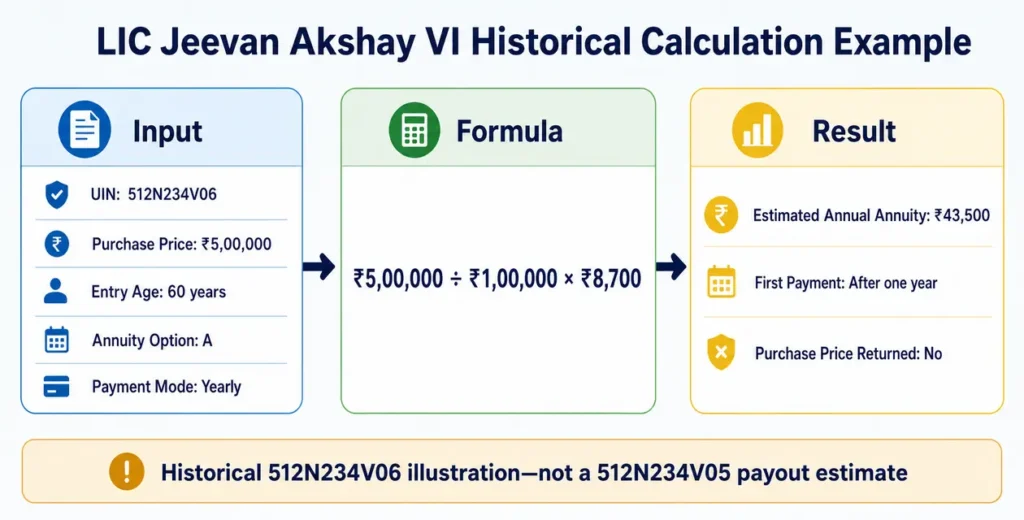
The following example uses the official 512N234V06 sales brochure. It demonstrates a published historical calculation but does not verify a 512N234V05 policy payout.
The 512N234V06 brochure showed an indicative annual annuity of ₹8,700 per ₹1 lakh for a 60-year-old under the pure lifetime annuity option. For a purchase price of ₹5,00,000, before considering any applicable slab incentive:
Estimated annual annuity = ₹5,00,000 ÷ ₹1,00,000 × ₹8,700
Estimated annual annuity = ₹43,500
Because yearly mode is used, the first instalment would generally become payable after one year. No purchase price would be returned under the pure lifetime option.
This example must be labelled as a 512N234V06 illustration. A 512N234V05 policy may have a different historical rate even when the age, option and purchase price are identical.
Historical UIN 512N234V06 Purchase Conditions
The official 512N234V06 sales brochure recorded a minimum entry age of 30 completed years. The maximum age was 100 completed years for the lifetime-annuity-with-return-of-purchase-price option and 85 completed years for the other options.
Its minimum purchase price was ₹1,00,000 through offline distribution channels and ₹1,50,000 for online sale. No maximum purchase-price limit was stated, and no medical examination was required.
These figures belong to the later 512N234V06 revision. They should not be automatically presented as confirmed 512N234V05 purchase conditions unless supported by the applicable 512N234V05 sales material or original policy records.
High Purchase-Price Incentive
Historical Jeevan Akshay VI rates could include an incentive for a larger purchase price. The incentive depended on the purchase-price slab and selected payment mode.
The 512N234V06 brochure published separate incentives for purchase prices beginning from ₹2,50,000, with different values for yearly, half-yearly, quarterly and monthly modes. It also described an additional rate increase for qualifying online policies.
This means a reliable calculator requires more than one general annuity rate. Its calculation data should account for age, annuity option, payment mode, purchase-price slab, UIN and applicable purchase period.
If any of these values is unavailable, the result should be marked as illustrative.
Surrender Rules Under UIN 512N234V05
Surrender was not generally available across all annuity options.
The 512N234V05 policy document allowed restricted surrender under Option F—lifetime annuity with return of purchase price—after completion of at least one policy year. Surrender could be considered if the annuitant was diagnosed with one of the specified critical illnesses or was permanently relocating to another country, supported by visa or citizenship documents.
The specified illnesses included conditions such as cancer of defined severity, heart attack, open-heart procedures, kidney failure requiring regular dialysis, stroke with permanent symptoms, major organ or bone-marrow transplant, paralysis, blindness and other listed serious conditions.
The surrender amount depended on the policyholder’s age at the time of surrender. The policy document did not state one fixed surrender percentage applicable to every policy.
For Options A, B, C, D, E, G, H, I and J, surrender was not permitted under the stated 512N234V05 conditions.
Loan, Assignment, Nomination and Taxes
No policy loan was available under Jeevan Akshay VI Plan 189. The purchase price could not be used to obtain an LIC policy loan.
Assignment was also not allowed. Nomination was required in accordance with Section 39 of the Insurance Act. The nominee could receive guaranteed annuity payments or the purchase price only when those benefits were payable under the selected option.
Applicable taxes were collected separately over and above the purchase price. Tax paid was not included when calculating annuity benefits. Therefore, the calculator should use the purchase price excluding taxes.
The tax treatment of annuity income depends on the applicable tax laws and individual circumstances. The calculator should not describe pension as tax-free.
Existence Certificate and Claim Requirements
LIC may require an existence certificate to confirm that the annuitant is alive and remains eligible to receive pension. For a joint-life option, a surviving spouse may also have to provide an existence certificate after pension transfers to the spouse.
Claim requirements depend on the selected option and type of claim. Common documents may include the claim form, death certificate, original policy document, identity proof, NEFT mandate and evidence establishing the claimant’s entitlement.
The servicing branch may request additional documents based on the policy record and applicable claim procedure.
Advantages of Plan 189
The main advantage of Jeevan Akshay VI was the ability to convert a lump-sum amount into regular lifetime income without future premium payments. Pension did not depend on daily market movement after the policy had been issued.
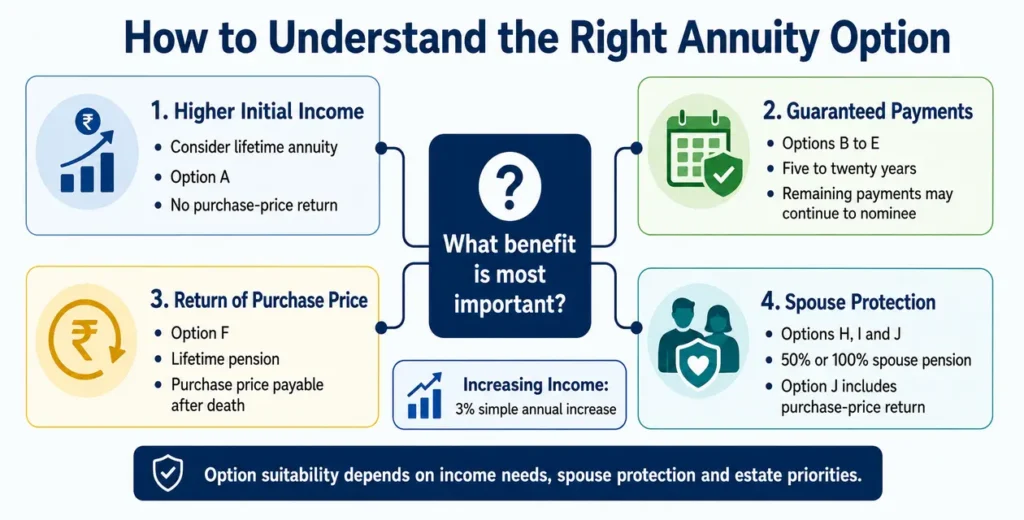
Its ten annuity options allowed different priorities to be addressed. A person focused on initial income could consider a pure lifetime option, while someone concerned about family protection could select a guaranteed-period, spouse-pension or purchase-price-return option.
The plan also offered four payment frequencies, making it possible to align pension with monthly expenses or choose a less frequent payment schedule.
Important Limitations
The plan is withdrawn and cannot be purchased now. Its historical rates should not be compared directly with a currently available product without considering differences in interest conditions, taxation, benefits and policy terms.
The selected annuity option could not normally be changed after purchase. A choice that produced a higher starting pension might provide little or no benefit after the annuitant’s death.
There was no regular maturity value, no policy loan and only restricted surrender under Option F. Except for Option G’s simple annual increase, the pension did not automatically rise with inflation.
A calculator also cannot recreate an exact historical payout unless it contains the rate table applicable to the policy’s UIN and purchase date.
Frequently Asked Questions
Is LIC Jeevan Akshay VI Plan 189 still available?
No. The plan has been withdrawn and is unavailable for new purchases. Existing policies continue subject to their schedules and original terms.
What is the difference between UIN 512N234V05 and UIN 512N234V06?
512N234V05 and 512N234V06 are separate UIN revisions of Plan 189. Their broad annuity options were similar, but their sale periods, applicable rates and certain purchase conditions could differ. A 512N234V06 rate should not be used as an exact 512N234V05 rate.
Does Plan 189 provide a maturity benefit?
No traditional maturity benefit is available. The purchase price is returned only under an option that specifically includes this benefit, such as Option F or Option J.
Which option returns the purchase price?
Option F returns the purchase price after the annuitant’s death. Option J returns it following the death of the last survivor between the annuitant and named spouse.
Is the 3% increase under Option G compounded?
No. The increase is calculated at a simple rate of 3% of the original annuity for each completed policy year.
Can Jeevan Akshay VI Plan 189 be surrendered?
Under the 512N234V05 policy conditions, surrender was restricted to Option F after at least one completed policy year and only under specified circumstances. Other options did not provide surrender.
Why can the calculator result differ from the policy pension?
The actual amount depended on the UIN, purchase date, age, option, mode, purchase-price slab and prevailing annuity rate. The pension recorded in the policy schedule remains authoritative.
Conclusion
LIC Jeevan Akshay VI Plan 189 provided immediate pension from a single purchase price. Its ten annuity options covered lifetime income, guaranteed payment periods, an annual simple increase, spouse protection and return of purchase price.
The UIN is essential when using the LIC Jeevan Akshay VI Plan 189 Calculator. UIN 512N234V05 and UIN 512N234V06 shared the same plan number but were separate product revisions, and their rates must not be interchanged.
For a historical estimate, enter the original purchase price, age at commencement, exact UIN, annuity option and payment mode. The result can help explain the policy, but the annuity amount and benefits printed in the policy schedule should always receive priority.

Amit Kushwaha is a financial content creator and SaaS tool developer based in Lucknow, Uttar Pradesh. He has more than seven years of experience creating insurance-related content, online calculators, and practical digital tools for LIC policyholders, insurance buyers, and LIC agents.
Through LICPolicyCalculator.com, he focuses on simplifying complex LIC policy information into easy-to-understand guides and calculators. His work covers LIC premium estimates, maturity calculations, surrender value tools, policy return calculations, term insurance planning, and plan-specific calculator pages.