LIC Jeevan Akshay VII Calculator
Enter Details
Result Card
- Profile: age 45 years, purchase price Rs. 10,00,000, standard purchase.
- Selected annuity option: Option A - Immediate Annuity for Life.
- Official quoted annuity used: Rs. 74,200 on yearly basis.
- Annual equivalent annuity: Rs. 74,200.
- Selected mode payout: Rs. 74,200 yearly.
- First annuity payment timing: after 1 year from commencement.
- Purchase price slab: Rs. 10,00,000 to Rs. 24,99,999.
- Minimum purchase price rule satisfied.
- Option A pays annuity for life and nothing is payable after death.
- Surrender and loan are not available under this option.
Mode-wise Annuity Table
| Payout Type | Estimated Annuity | When Payable |
|---|---|---|
| Yearly Annuity | Rs. 74,200 | After 1 year |
| Half-yearly Equivalent | Rs. 37,100 | After 6 months |
| Quarterly Equivalent | Rs. 18,550 | After 3 months |
| Monthly Equivalent | Rs. 6,183 | After 1 month |
LIC Jeevan Akshay VII Plan 857 was an immediate annuity plan that converted a one-time purchase price into regular annuity income. Unlike an endowment or money-back policy, it did not accumulate a maturity amount after a fixed policy term.
This article specifically covers LIC Jeevan Akshay VII UIN 512N337V04. This version was launched on 25 August 2022 and withdrawn on 28 February 2023. The information is useful for understanding policies issued under this UIN and for using the LIC Jeevan Akshay VII Calculator available on this page.
The annuity amount depended on the purchase price, entry age, payment mode, purchase channel and selected annuity option. Ten options were available, covering lifetime income, guaranteed payment periods, joint-life income and return of purchase price.
Important: This calculator provides an educational estimate. It does not generate an official LIC quotation or calculate the final surrender, loan, tax or claim amount.
Table of Contents
LIC Jeevan Akshay VII Plan 857 Details
| Particular | Details |
|---|---|
| Plan name | LIC Jeevan Akshay VII |
| Plan number | 857 |
| UIN | 512N337V01, 512N337V02, 512N337V03, 512N337V04, 512N337V05, 512N337V06, 512N337V07 |
| Plan status | Withdrawn, Active (512N337V07) |
| Plan type | Non-linked, non-participating, individual immediate annuity plan |
| Payment structure | One-time purchase price |
| Number of annuity options | 10 |
| Available modes | Monthly, quarterly, half-yearly and yearly |
| Minimum entry age | 25 completed years |
| Maximum entry age | 85 years for most options |
| Maximum age under Option F | 100 completed years |
| Maturity benefit | Not available |
| Surrender facility | Options F and J only |
| Loan facility | Options F and J only, subject to conditions |
The eligibility rules, benefits and illustrations on this page apply to UIN 512N337V04. Other versions of Jeevan Akshay VII may have different conditions and annuity rates.
What Is LIC Jeevan Akshay VII Plan 857?
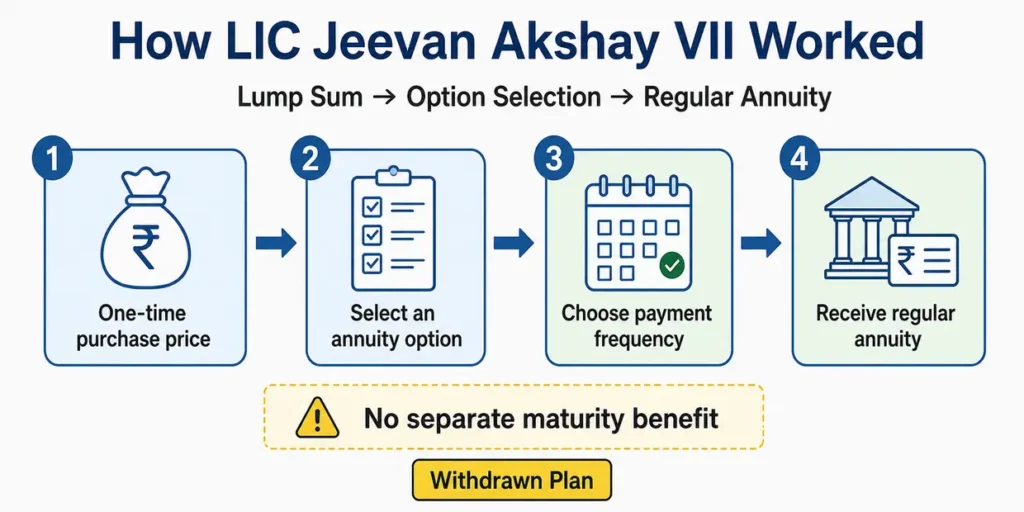
LIC Jeevan Akshay VII was an immediate annuity plan. The policyholder paid a lump-sum purchase price and selected one of ten annuity options. LIC then paid a predetermined amount at monthly, quarterly, half-yearly or yearly intervals.
The annuity rate was fixed at the beginning of the policy. The policy was not linked to the stock market and did not participate in LIC’s profits. Therefore, bonuses, loyalty additions and market-linked returns were not applicable.
Depending on the selected option, the plan could provide:
- Annuity throughout the annuitant’s lifetime
- A guaranteed payment period of 5, 10, 15 or 20 years
- Annuity increasing by a simple rate of 3% each year
- Joint-life annuity for two eligible family members
- Continuation of 50% or 100% annuity after the first death
- Return of purchase price after the relevant death
The annuity option selected at the beginning could not be changed later.
What Is the LIC Jeevan Akshay VII Calculator?
The LIC Jeevan Akshay VII Plan 857 Calculator helps estimate and understand the annuity generated from a one-time purchase price. It also explains how the selected option affects payments during life and benefits after death.
Depending on the information entered, the calculator may display:
- Selected annuity option
- Estimated annual annuity
- Monthly, quarterly or half-yearly payment
- Single-life or joint-life coverage
- Guaranteed payment period
- Payment after the annuitant’s death
- Return-of-purchase-price provision
- Availability of surrender and policy loan
If the calculator asks for an official quoted annuity, it uses that amount to provide a payment breakdown. In that case, it works as an annuity explanation and conversion tool rather than an official rate calculator.
Also Check:
- LIC Jeevan Akshay Calculator All Plans
- LIC New Jeevan Akshay I Plan 146 Calculator
- LIC Jeevan Akshay II Calculator
- LIC Jeevan Akshay III Plan 170 Calculator
- LIC Jeevan Akshay IV Plan 176 Calculator
- Jeevan Akshay V Plan 183 Calculator
- LIC Jeevan Akshay VI Plan 189 Calculator
Highlights of the LIC Jeevan Akshay VII Calculator
The calculator places the estimated payment and important policy rules in one result. This makes it easier to compare the plan’s ten options without confusing annuity income with maturity value.
Its main functions include:
- Comparing single-life and joint-life options
- Converting annual annuity into different payment frequencies
- Identifying options with guaranteed payment periods
- Explaining what happens after the annuitant’s death
- Showing whether the purchase price is returned
- Identifying options that permit surrender and loans
- Providing a clear summary of the selected option
The result is an estimate and should be checked against the policy schedule or official LIC records.
Important Points Before Using the Calculator
Before entering the details, the following conditions should be understood:
- This was an immediate annuity plan, not a maturity plan.
- Annuity payments were made in arrears. A monthly payment became due after one month, while a yearly payment became due after one year.
- The selected annuity option could not be changed after policy issuance.
- Return of purchase price was available only under Options F and J.
- Surrender and loan facilities were restricted to Options F and J.
- The purchase price returned after death was not an investment gain or maturity amount.
- Taxes paid in addition to the purchase price were not included in policy benefits.
- The calculator cannot issue an official LIC quotation or determine a claim amount.
Did LIC Jeevan Akshay VII Have a Maturity Benefit?
LIC Jeevan Akshay VII did not provide a maturity benefit because it was not a fixed-term savings policy. It was designed to pay an annuity according to the selected option.
Depending on the option, payments could stop after death, continue for a guaranteed period, continue to a surviving secondary annuitant or be followed by return of the purchase price.
Return of purchase price should not be treated as maturity value. It represented the original purchase price covered under the policy. It did not include investment growth, inflation adjustments or taxes paid separately.
LIC Jeevan Akshay VII Annuity Options
Option A: Immediate Annuity for Life
Annuity was payable for as long as the annuitant remained alive. After the annuitant’s death, payments stopped immediately and nothing further was payable.
This option did not include a guaranteed payment period, joint-life continuation or return of purchase price.
Option B: Five-Year Guaranteed Annuity and Life Thereafter
Annuity was payable throughout the annuitant’s lifetime. If death occurred during the first five policy years, payments continued to the nominee until the guaranteed period ended.
If death occurred after completing the guaranteed period, payments stopped and nothing further was payable.
Option C: 10-Year Guaranteed Annuity and Life Thereafter
This option provided a 10-year guaranteed payment period. If the annuitant died during those ten years, the nominee received the remaining guaranteed payments.
If the annuitant completed the guaranteed period, the annuity continued for life.
Option D: 15-Year Guaranteed Annuity and Life Thereafter
Annuity payments were guaranteed for 15 years. If death occurred during that period, payments continued to the nominee until the fifteenth policy year ended.
After completing the guaranteed period, annuity remained payable only while the annuitant was alive.
Option E: 20-Year Guaranteed Annuity and Life Thereafter
This option provided a 20-year guaranteed payment period. If the annuitant survived beyond that period, payments continued for life.
The guarantee applied only to annuity payments. It did not provide return of the purchase price.
Option F: Life Annuity with Return of Purchase Price
Annuity was payable throughout the annuitant’s lifetime. After death, annuity payments stopped and the purchase price became payable according to the death-benefit method selected under the policy.
The returned purchase price was not increased for inflation or investment growth. Option F also permitted surrender and policy loans, subject to the applicable rules.
Option G: Life Annuity Increasing at 3% Each Year
The annuity increased at a simple rate of 3% after every completed policy year. The increase was calculated using the original annuity amount, not the amount paid in the previous year.
For example, if the original annual annuity was ₹60,000, the yearly increase would be ₹1,800:
| Policy year | Annual annuity |
|---|---|
| First year | ₹60,000 |
| Second year | ₹61,800 |
| Third year | ₹63,600 |
| Fourth year | ₹65,400 |
After the annuitant’s death, payments stopped and nothing further was payable.
Option H: Joint-Life Annuity with 50% to the Secondary Annuitant
The primary annuitant received the complete annuity while alive. After the primary annuitant’s death, 50% of the annuity continued to the surviving secondary annuitant for life.
If the secondary annuitant died first, the primary annuitant continued receiving the original annuity. After the subsequent death of the primary annuitant, the policy ended without return of purchase price.
Option I: Joint-Life Annuity with 100% to the Survivor
The complete annuity remained payable while either annuitant was alive. After the first death, the surviving annuitant continued receiving 100% of the annuity.
After the last survivor’s death, payments stopped and nothing further was payable.
Option J: Joint-Life Annuity with 100% to the Survivor and Return of Purchase Price
The complete annuity was payable while either annuitant remained alive. After the first death, the surviving annuitant continued receiving the full annuity.
After the last survivor’s death, annuity payments stopped and the purchase price became payable according to the selected death-benefit method.
Surrender and policy loan facilities were available under this option, subject to LIC’s rules.
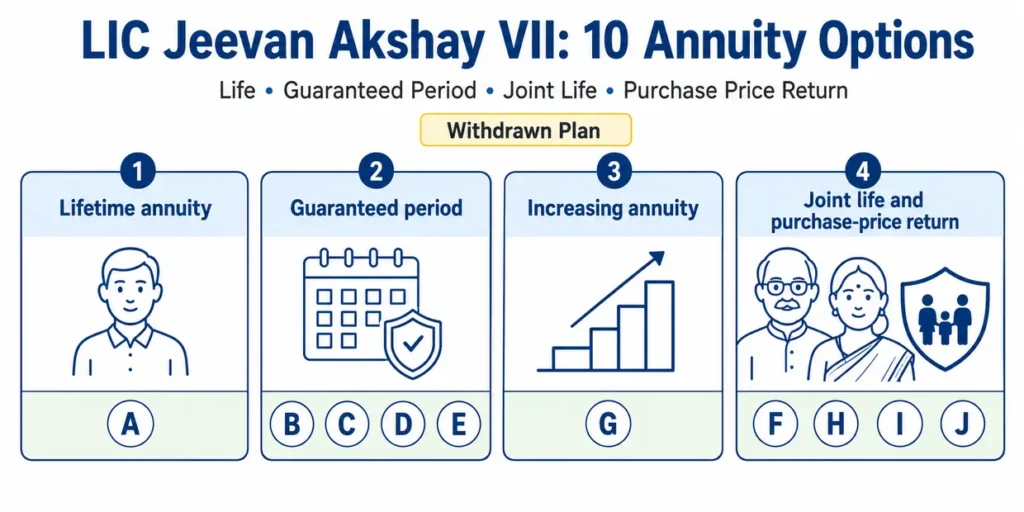
Quick Annuity Option Comparison
| Option | Coverage | Benefit after death | Purchase price returned |
|---|---|---|---|
| A | Single life | Payments stop | No |
| B | Single life | Paid until five-year guarantee ends | No |
| C | Single life | Paid until 10-year guarantee ends | No |
| D | Single life | Paid until 15-year guarantee ends | No |
| E | Single life | Paid until 20-year guarantee ends | No |
| F | Single life | Purchase price paid after death | Yes |
| G | Single life | Payments stop | No |
| H | Joint life | 50% continues to secondary annuitant | No |
| I | Joint life | 100% continues to survivor | No |
| J | Joint life | 100% to survivor; purchase price after last death | Yes |
LIC Jeevan Akshay VII Eligibility Conditions
Entry Age
| Eligibility condition | Age |
|---|---|
| Minimum entry age | 25 completed years |
| Maximum entry age for most options | 85 completed years |
| Maximum entry age for Option F | 100 completed years |
Minimum Purchase Price
| Entry age | Minimum purchase price |
|---|---|
| 25–29 years | ₹10,00,000 |
| 30 years and above | ₹1,00,000, subject to the minimum-annuity requirement |
There was no general maximum purchase-price limit. A higher amount could be required when the listed minimum was insufficient to produce the prescribed minimum annuity.
Minimum Annuity
| Payment mode | Minimum annuity |
|---|---|
| Monthly | ₹1,000 per month |
| Quarterly | ₹3,000 per quarter |
| Half-yearly | ₹6,000 per half-year |
| Yearly | ₹12,000 per year |
Joint-Life Relationship Conditions
The joint-life options were available only between specified family members. Eligible relationships included:
- Husband and wife
- Parents and children
- Grandparents and grandchildren
- Eligible lineal ascendants or descendants
- Brothers and sisters
The primary and secondary annuitants had to satisfy the applicable age, relationship and documentation requirements.
Annuity Payment Modes
Four payment modes were available. Payments were made in arrears after completing the relevant interval.
| Payment mode | First scheduled payment |
|---|---|
| Monthly | After one month |
| Quarterly | After three months |
| Half-yearly | After six months |
| Yearly | After one year |
The term “immediate annuity” did not mean that the first payment was made on the policy purchase date. It meant that there was no separate accumulation or deferment period.
Higher Purchase-Price Incentive
UIN 512N337V04 provided an increase in annuity rates for the following purchase-price slabs:
- ₹5,00,000–₹9,99,999
- ₹10,00,000–₹24,99,999
- ₹25,00,000–₹99,99,999
- ₹1 crore and above
The incentive depended on the purchase-price slab and annuity mode. The official brochure also specified a 2% increase in the annuity rate for eligible online, NPS and QROPS purchases.
These incentives were specific to this plan version and should not be assumed to apply to another UIN.
Reduction for Purchase Prices Below ₹1.5 Lakh
For a purchase price below ₹1,50,000, LIC applied a reduction factor to the annuity rate. Two slabs were specified:
- ₹1,00,000–₹1,49,999
- Below ₹1,00,000 in permitted exceptional cases
The reduction for the first slab was lower than the reduction for the second slab. It was not applicable to qualifying purchases made for a dependent person with a disability.
Official LIC Annuity Illustration
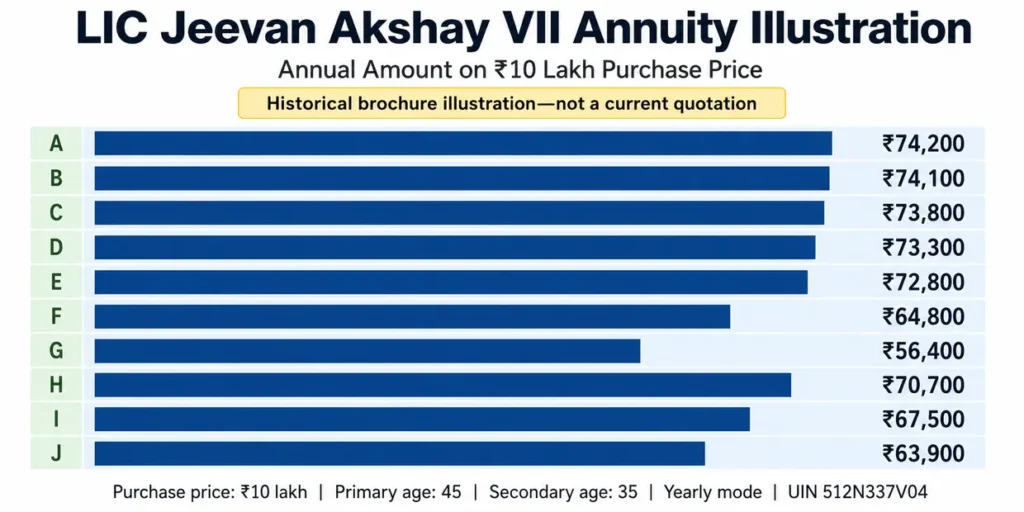
The following figures were included in the official sales illustration for UIN 512N337V04. They are historical examples, not current quotations.
Illustration assumptions:
- Purchase price: ₹10,00,000, excluding applicable taxes
- Primary annuitant’s age: 45 years
- Secondary annuitant’s age: 35 years
- Annuity mode: Yearly
- Plan version: UIN 512N337V04
| Annuity option | Illustrative annual annuity |
|---|---|
| Option A | ₹74,200 |
| Option B | ₹74,100 |
| Option C | ₹73,800 |
| Option D | ₹73,300 |
| Option E | ₹72,800 |
| Option F | ₹64,800 |
| Option G | ₹56,400 |
| Option H | ₹70,700 |
| Option I | ₹67,500 |
| Option J | ₹63,900 |
The amounts differed because every option imposed a different future payment obligation on LIC. Options that included survivor income or return of purchase price generally provided a lower initial annuity than an option under which payments ended completely after death.
LIC Jeevan Akshay VII Calculation Example
Consider an annuitant aged 45 who paid a purchase price of ₹10 lakh and selected Option F with yearly payments.
According to the official illustration, the annual annuity was ₹64,800.
A simple mathematical breakdown would be:
| Payment frequency | Mathematical equivalent |
|---|---|
| Yearly | ₹64,800 |
| Half-yearly | ₹32,400 |
| Quarterly | ₹16,200 |
| Monthly | ₹5,400 |
These values are obtained by dividing the yearly amount. They are not official mode-specific quotations because LIC applied different rates and incentives to different payment modes.
Under Option F:
- The annuitant received income throughout life.
- Annuity payments stopped after death.
- The purchase price became payable under the selected death-benefit method.
- Surrender and loan facilities were available subject to the policy conditions.
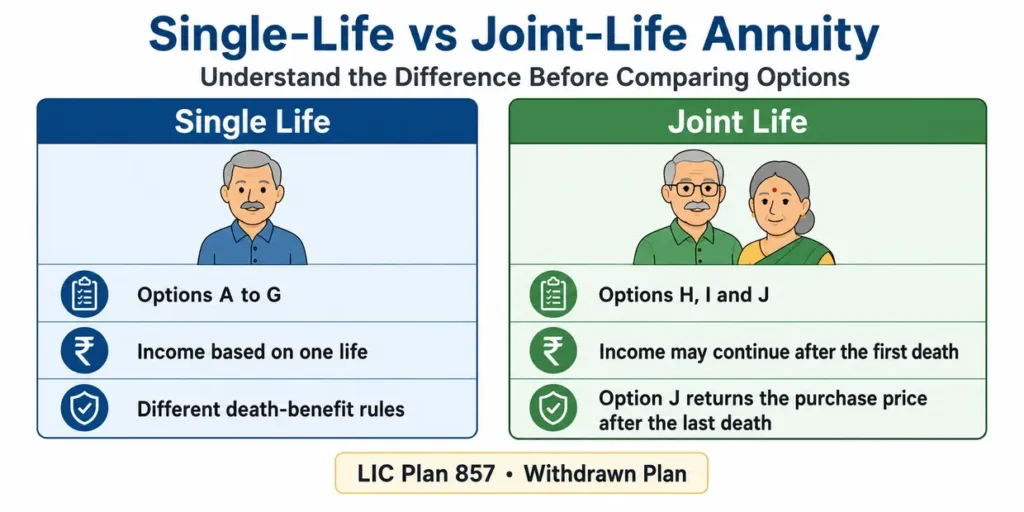
Death-Benefit Choices Under Options F and J
Options F and J allowed the annuitant to select how the purchase price would be paid after the relevant death.
Lump-Sum Death Benefit
The applicable purchase price was paid to the nominee as a single amount.
Annuitisation of Death Benefit
The full or selected part of the benefit was used to purchase an immediate annuity for the nominee. The resulting annuity depended on the nominee’s age, eligibility and the annuity rates available when the death claim was admitted.
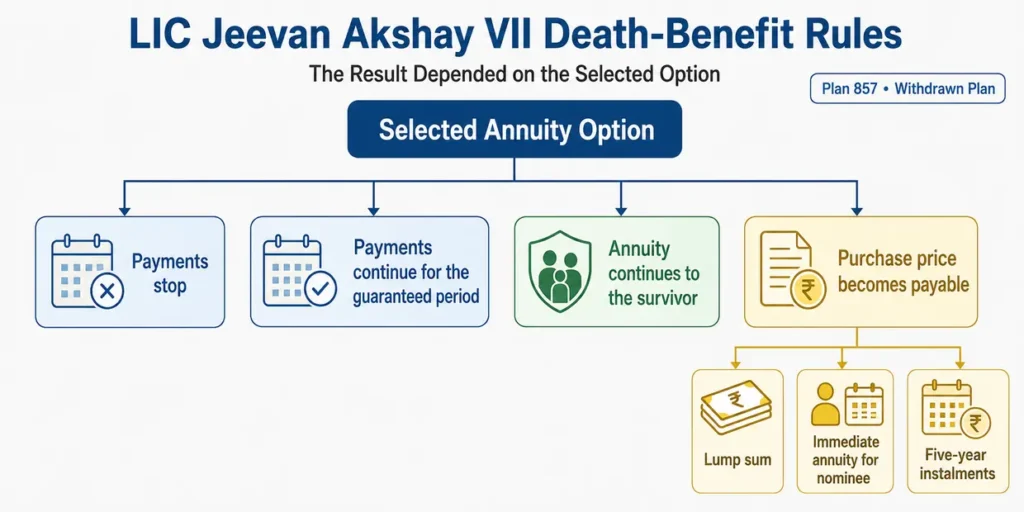
Death Benefit in Instalments
The full or selected part of the purchase price could be paid over five years at monthly, quarterly, half-yearly or yearly intervals.
| Instalment mode | Minimum instalment |
|---|---|
| Monthly | ₹5,000 |
| Quarterly | ₹15,000 |
| Half-yearly | ₹25,000 |
| Yearly | ₹50,000 |
If the available claim amount was insufficient to provide the required minimum instalment, the amount was payable as a lump sum.
Surrender Rules
Surrender was available only under Options F and J. It could be requested after three months from the date of policy issuance or after the free-look period ended, whichever was later.
The surrender amount depended on the annuitant’s age and LIC’s applicable surrender-value rules. It was not necessarily equal to the purchase price and could involve a significant financial loss.
After the surrender value was paid:
- The policy terminated.
- Annuity payments stopped.
- All remaining death and survival benefits ended.
An online calculator cannot accurately determine the surrender value unless it uses LIC’s official version-specific formula.
Policy Loan Rules
A policy loan was available only under Options F and J after satisfying the applicable waiting condition.
The maximum loan was subject to two limits:
- Annual loan interest could not exceed 50% of the annual annuity.
- The loan could not exceed 80% of the surrender value.
Loan interest was recoverable from annuity payments. Any outstanding loan and interest could be deducted from the claim proceeds when the policy ended.
The loan facility did not permit unrestricted withdrawal of the original purchase price.
Free-Look Period
The policy provided a 30-day free-look period from the date of receiving the electronic or physical policy document, whichever was earlier.
If the policy was returned during this period, LIC refunded the purchase price after deducting:
- Stamp duty
- Annuity already paid, if any
Additional procedures applied when the purchase price came from another deferred pension policy, NPS or QROPS arrangement.
Special Provisions
NPS Subscribers
NPS subscribers could select options permitted under PFRDA regulations. Under the Government Sector NPS default arrangement described in the brochure:
- Option J applied when a spouse was surviving.
- Option F applied when there was no surviving spouse.
Other conditions remained subject to the applicable PFRDA rules.
Dependent Person with Disability
The plan could be purchased for the benefit of an eligible dependent person with a disability. In qualifying cases:
- The minimum purchase price was ₹50,000.
- The normal minimum-annuity restriction did not apply.
- The reduction factor for a low purchase price did not apply.
- The dependent person could be covered as a nominee or secondary annuitant under the permitted options.
QROPS
The plan could be purchased as a Qualifying Recognised Overseas Pension Scheme using eligible UK tax-relieved assets. The minimum age was 55 years, subject to applicable HMRC requirements.
Tax Treatment
Applicable taxes were payable separately in addition to the purchase price. Tax paid was not included when calculating the annuity, purchase-price return or other policy benefits.
Annuity income may be taxable according to the recipient’s applicable income-tax rules. Tax laws and personal circumstances can change, so individual tax treatment should be confirmed with a qualified tax professional.
How to Use the LIC Jeevan Akshay VII Calculator
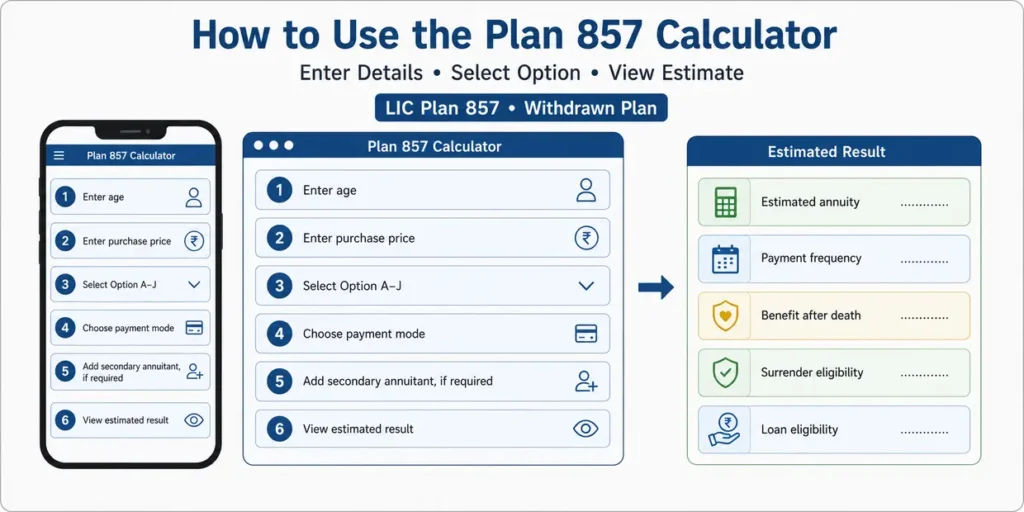
- Enter the primary annuitant’s age.
- Enter the one-time purchase price.
- Select an annuity option from A to J.
- Choose monthly, quarterly, half-yearly or yearly payment mode.
- Enter the secondary annuitant’s details when selecting Option H, I or J.
- Select the death-benefit payment method for Option F or J, if included in the calculator.
- Enter the official quoted annuity if the calculator requires it.
- Select Calculate to view the estimated annuity and policy summary.
- Review what happens after death and whether surrender or loan is available.
- Select Reset to clear the entered values and perform another calculation.
The calculated amount should be treated as an educational estimate. For an existing policy, the policy schedule and LIC records determine the actual benefits.
Frequently Asked Questions
Is LIC Jeevan Akshay VII Plan 857 still available?
UIN 512N337V04 was withdrawn on 28 February 2023. The information on this page applies to policies issued under that version.
Did LIC Jeevan Akshay VII provide a maturity benefit?
No. It was an immediate annuity plan without a separate maturity benefit. Options F and J returned the purchase price after the relevant death, but this was not a maturity value.
Which options returned the purchase price?
Option F returned the purchase price after the annuitant’s death. Option J returned it after the death of the last surviving annuitant.
Which options provided joint-life coverage?
Options H, I and J covered two eligible lives. Option H continued 50% annuity to the secondary annuitant, while Options I and J continued 100% to the survivor.
Was surrender allowed under every option?
No. Surrender was allowed only under Options F and J, subject to the applicable waiting period and surrender-value rules.
Could the selected annuity option be changed?
No. The annuity option selected when purchasing the policy could not be changed after policy issuance.
Does the calculator provide an official LIC quotation?
No. It provides an educational estimate or payment breakdown. The policy schedule and official LIC records determine the actual annuity and benefits.
Conclusion
LIC Jeevan Akshay VII Plan 857 UIN 512N337V04 was an immediate annuity plan with ten options covering lifetime income, guaranteed payment periods, joint-life protection and return of purchase price.
Each option involved a different trade-off. An option without a benefit after death could provide a comparatively higher annuity, while survivor protection or return of purchase price generally reduced the initial payment. Surrender and loan facilities were limited to Options F and J and remained subject to LIC’s conditions.
The calculator can help explain these differences and provide an estimated payment breakdown. However, the policy schedule remains the final document for determining benefits under an existing policy.

Amit Kushwaha is a financial content creator and SaaS tool developer based in Lucknow, Uttar Pradesh. He has more than seven years of experience creating insurance-related content, online calculators, and practical digital tools for LIC policyholders, insurance buyers, and LIC agents.
Through LICPolicyCalculator.com, he focuses on simplifying complex LIC policy information into easy-to-understand guides and calculators. His work covers LIC premium estimates, maturity calculations, surrender value tools, policy return calculations, term insurance planning, and plan-specific calculator pages.