LIC Jeevan Akshay III Plan 170 Calculator
| Year | Annual Annuity | Per Instalment |
|---|
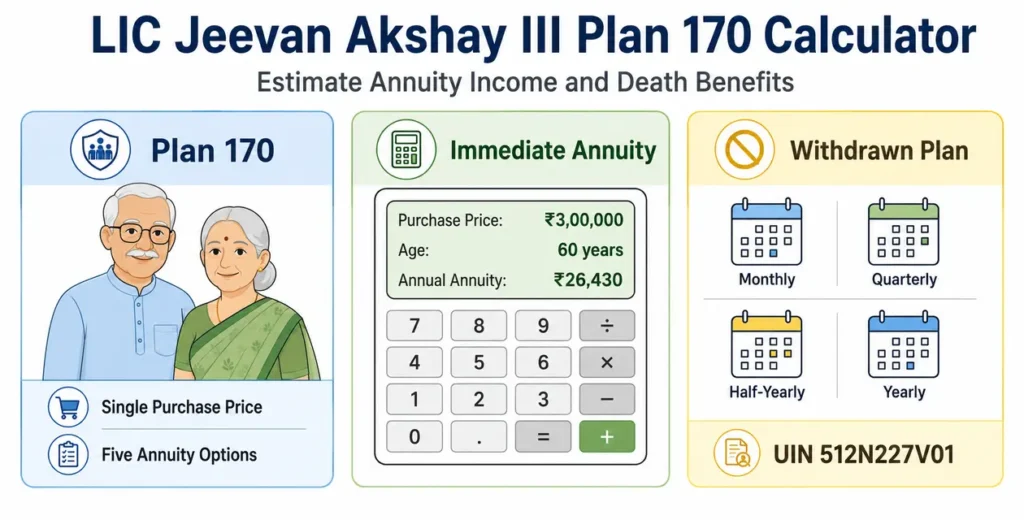
The LIC Jeevan Akshay III Plan 170 Calculator is an online tool that estimates the annuity income available under LIC’s withdrawn Jeevan Akshay-III policy. It calculates the approximate annual and instalment-wise annuity based on the purchase price, entry age, selected annuity option, payment mode and applicable annuity rate.
LIC Jeevan Akshay-III was introduced in December 2004 and withdrawn on 17 March 2006. Its Unique Identification Number was 512N227V01. It was a single-premium immediate annuity plan under which the policyholder paid a lump-sum purchase price and received regular income according to the selected annuity option and payment frequency.
The plan is no longer open for new purchases. However, existing policyholders, nominees, insurance professionals and researchers may use the calculator to understand how its benefits were structured. Calculator results are estimates and should always be verified against the original policy schedule and LIC-issued benefit documents.
Also Check:
- LIC Jeevan Akshay Calculator Plans All in One
- LIC New Jeevan Akshay I Plan 146 Calculator
- LIC Jeevan Akshay II Calculator
- LIC Jeevan Akshay VII Plan 857 Calculator
- LIC Jeevan Akshay VI Plan 189 Calculator
- LIC Jeevan Akshay IV Plan 176 Calculator
- Jeevan Akshay V Plan 183 Calculator
LIC Jeevan Akshay III Plan 170 Overview
| Particular | Plan details |
|---|---|
| Plan name | LIC Jeevan Akshay-III |
| Plan number | 170 |
| UIN | 512N227V01 |
| Introduction | December 2004 |
| Withdrawal date | 17 March 2006 |
| Plan category | Immediate annuity plan |
| Premium type | Single lump-sum payment |
| Minimum entry age | 40 years, last birthday |
| Maximum entry age | 79 years, last birthday |
| Annuity modes | Monthly, quarterly, half-yearly and yearly |
| Current availability | Withdrawn; unavailable for new purchases |
| Official Brochure | Check Here |
Table of Contents
What Is LIC Jeevan Akshay III Plan 170?
LIC Jeevan Akshay-III was an immediate annuity plan designed to create regular income from a one-time payment. The amount paid to purchase the annuity was known as the purchase price. In return, LIC paid an annuity for the period specified under the selected option.
The person whose life determined the continuation of the annuity was known as the annuitant. In most options, the annuity continued throughout the annuitant’s lifetime. Depending on the selected option, payments could stop after death, continue for a guaranteed period, pass partly to a surviving spouse or result in the return of the purchase price to the nominee.
It was not a regular-premium insurance policy. The entire purchase price had to be paid as a single lump sum. Once the policy was issued and the applicable cooling-off period had ended, the amount could not ordinarily be withdrawn because the plan did not provide a surrender value.
How Did the Immediate Annuity Work?
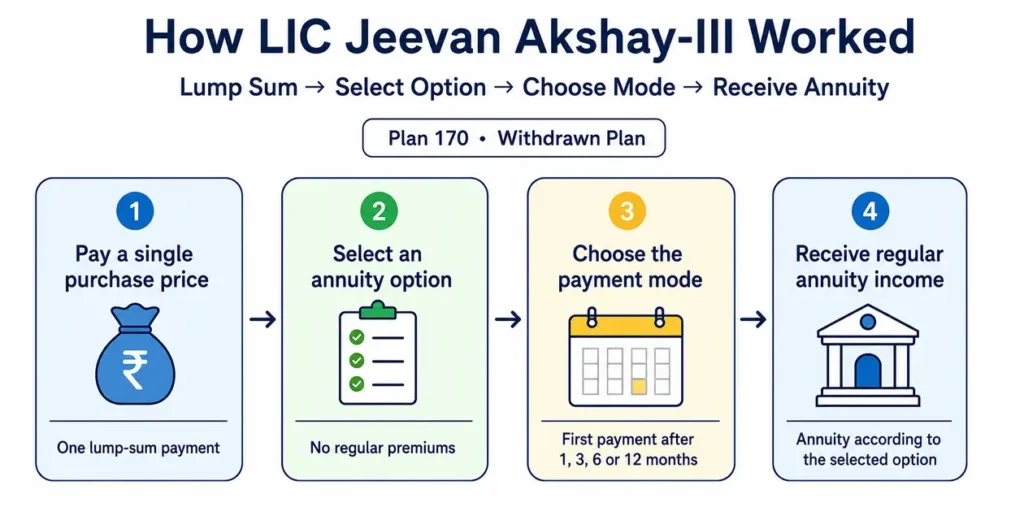
The annuitant selected an annuity option and payment mode when purchasing the policy. LIC then calculated the annuity using the person’s age, selected option, payment frequency, purchase price and applicable annuity rate.
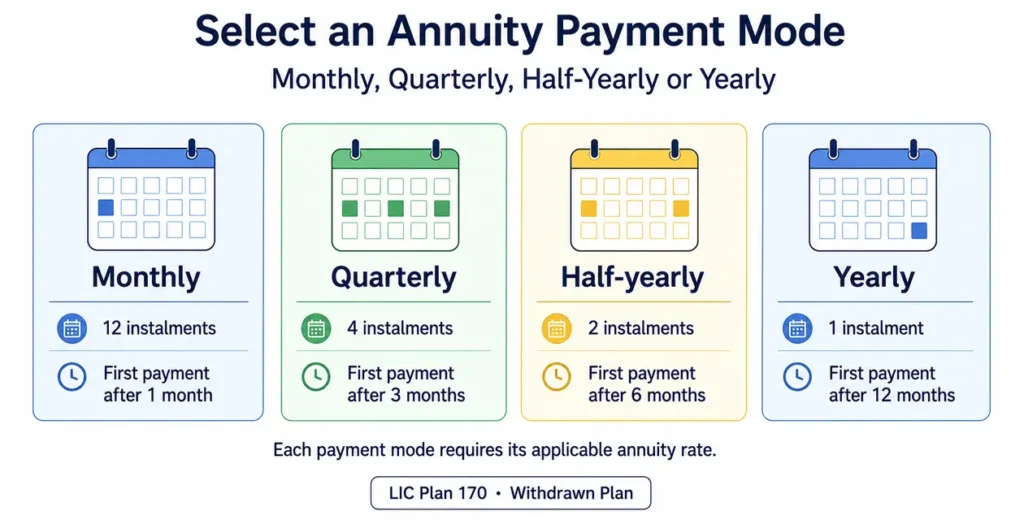
The first annuity instalment became payable according to the selected mode. In monthly mode, the first instalment was due after one month. It was due after three months in quarterly mode, six months in half-yearly mode and one year in yearly mode.
The annuity was assured according to the chosen option. It was not affected by later changes in market conditions, but the benefits after the annuitant’s death varied substantially between the five options.
Eligibility and Purchase Conditions
The minimum entry age was 40 years and the maximum entry age was 79 years, calculated on a last-birthday basis. Standard proof of age was required, although no medical examination was necessary.
The purchase price was subject to a minimum of ₹50,000. It also had to be sufficient to secure an annual annuity of at least ₹3,000. Therefore, paying ₹50,000 did not automatically satisfy the requirement if the selected option and applicable rate produced an annuity below the prescribed minimum.
The official brochure did not specify a maximum limit on the purchase price or annuity amount. A higher purchase price could also qualify for an addition to the applicable annuity rate.
Annuity Options Under LIC Jeevan Akshay III
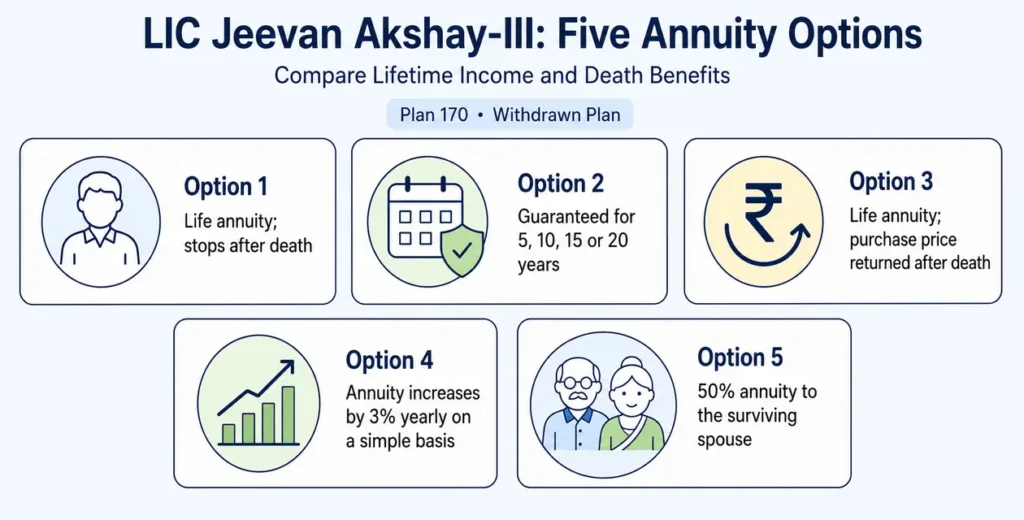
LIC Jeevan Akshay III offered five main annuity options. Option 2 included four guaranteed-period choices.
Option 1: Life Annuity
Under this option, the annuitant received regular income throughout life. Payments stopped after the annuitant’s death, and no amount was payable to the nominee.
This option generally produced a comparatively higher annuity because it did not include a guaranteed period, spouse pension or return of purchase price.
Option 2: Guaranteed Period and Life Thereafter
The annuity was guaranteed for 5, 10, 15 or 20 years and continued thereafter for as long as the annuitant remained alive.
If the annuitant died during the selected guaranteed period, the nominee continued receiving the annuity until that period ended. For example, if a 10-year guarantee was selected and the annuitant died after four years, payments continued for the remaining six years.
If the annuitant survived beyond the guaranteed period, the annuity continued for life. When death occurred after the guaranteed period, payments stopped and no further benefit was available.
Option 3: Life Annuity with Return of Purchase Price
The annuitant received regular income throughout life. After the annuitant’s death, annuity payments stopped and the original purchase price was returned to the nominee.
The purchase price return made this option useful where leaving the original lump-sum amount to the nominee was important. Its regular annuity was generally lower than the life-only option because it included a death benefit.
Option 4: Increasing Life Annuity
This option paid an annuity throughout the annuitant’s life, with an increase of 3% per year on a simple basis.
The annual increase was calculated using the original annuity amount rather than the previous year’s increased amount. If the original annual annuity were ₹30,000, the increase would be ₹900 every year. The projected annuity would therefore be ₹30,900 in the second year, ₹31,800 in the third year and ₹32,700 in the fourth year.
Payments stopped after the annuitant’s death. No purchase price or continuing annuity was payable to the nominee.
Option 5: Life Annuity with 50% Payable to Spouse
The annuitant received a regular annuity throughout life. Following the annuitant’s death, 50% of the annuity became payable to the surviving spouse for the spouse’s lifetime.
If the spouse had already died before the annuitant, nothing was payable after the annuitant’s death. This option did not provide for the return of the purchase price.
What Is the LIC Jeevan Akshay III Plan 170 Calculator?
The LIC Jeevan Akshay III Plan 170 Calculator converts an applicable annuity rate into an estimated annual and instalment-wise annuity. It can also explain the death benefit, guaranteed-period provision, spouse benefit and purchase-price return associated with the selected option.
The official sales brochure contains sample yearly annuity rates for Options 1 and 3 at ages 40, 45, 50, 55, 60, 65, 70 and 75. These published rates can be used automatically only when the selected option, age and yearly payment mode match the brochure table.
The brochure does not provide a complete rate table for every age, option and payment mode. Therefore, the calculator should require an applicable official rate to be entered manually for combinations not covered by the published samples. This prevents estimated or interpolated figures from being presented as official LIC rates.
Why Is This Calculator Useful?
Manual annuity calculations can become confusing because the result depends on several variables. The calculator brings the purchase price, age, option, mode, rate incentive and death-benefit conditions into one place.
It can estimate the annual annuity and amount payable in each instalment. It also shows when the first payment would become due and whether payments would continue after death. For Option 4, it can prepare an illustrative increasing-annuity schedule. For Option 5, it can calculate the 50% annuity potentially payable to the surviving spouse.
The calculator is particularly helpful when reviewing an old policy schedule or comparing the financial effect of different options. It does not, however, replace LIC’s original records.
High Purchase-Price Incentive
LIC provided an incentive for higher purchase prices by adding a specified amount to the applicable annuity rate. The addition was quoted per year for every ₹1,000 of purchase price.
| Annuity mode | Below ₹1,50,000 | ₹1,50,000–₹2,99,999 | ₹3,00,000 and above |
|---|---|---|---|
| Yearly | 0 | 2.00 | 2.50 |
| Half-yearly | 0 | 2.50 | 3.00 |
| Quarterly | 0 | 3.00 | 3.75 |
| Monthly | 0 | 3.50 | 4.50 |
The incentive must be added to the annuity rate specifically applicable to the selected payment mode. A yearly rate should not be used to calculate an official monthly, quarterly or half-yearly annuity.
How Does the Calculator Work?
The calculation begins with the annuity rate applicable to the selected age, option and payment mode. The appropriate high-purchase-price addition is then added to that rate.
The final rate is calculated as:
Final annuity rate = Applicable annuity rate + Purchase-price addition
The annualised annuity is calculated as:
Annualised annuity = Purchase price ÷ 1,000 × Final annuity rate
The estimated amount of each instalment is then calculated according to the payment frequency:
Annuity per instalment = Annualised annuity ÷ Number of payments per year
Yearly mode has one payment per year, half-yearly mode has two, quarterly mode has four and monthly mode has twelve.
The calculation must start with the mode-specific rate. Simply dividing a yearly-mode annuity by 12 does not produce the official monthly-mode benefit because LIC used different annuity rates for different payment modes.
An annuity rate should also not be confused with a bank deposit interest rate. It represents the annuity payable per ₹1,000 of purchase price under a particular age, option and payment mode.
How to Use the Calculator
First, select the required annuity option. If Option 2 is chosen, select the required guaranteed period of 5, 10, 15 or 20 years.
Enter the annuitant’s age on a last-birthday basis and provide the single purchase price. Next, select monthly, quarterly, half-yearly or yearly payment mode.
The calculator can automatically display a brochure-published rate when Option 1 or Option 3, yearly mode and one of the listed sample ages are selected. For any other combination, enter the correct official LIC rate applicable to the original policy.
After checking the details, press the Calculate button. The results should show the base rate, purchase-price addition, final rate, annualised annuity, amount per instalment and first-payment interval. They should also explain what happens after the annuitant’s death.
The Reset button clears the entered information and calculated results so that a new illustration can be prepared.
Real Calculation Example
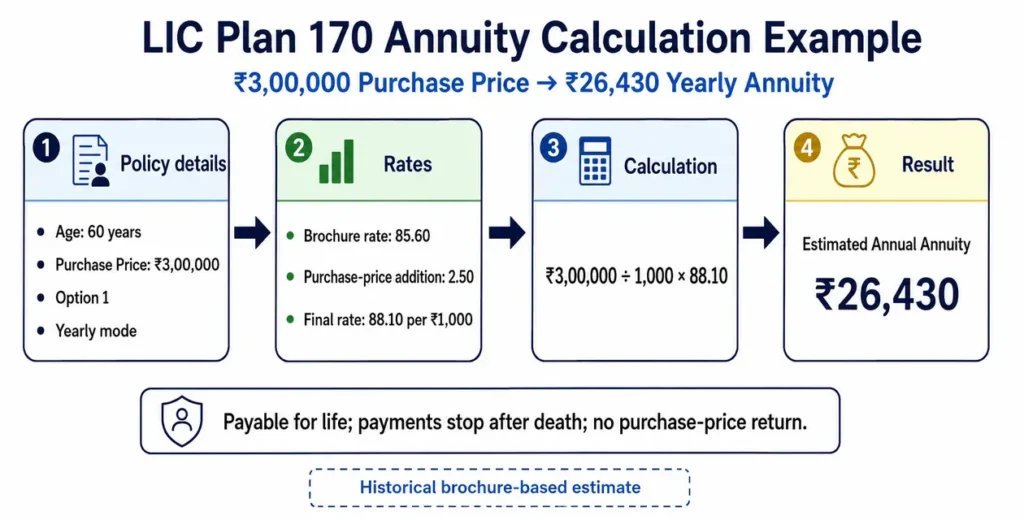
Consider an individual who purchased the annuity with the following details:
- Entry age: 60 years
- Purchase price: ₹3,00,000
- Selected option: Option 1—life annuity
- Payment mode: Yearly
- Brochure-published rate: 85.60 per ₹1,000
Because the purchase price is ₹3,00,000, the yearly high-purchase-price addition is 2.50 per ₹1,000.
The final rate is:
85.60 + 2.50 = 88.10 per ₹1,000
The annual annuity is:
₹3,00,000 ÷ 1,000 × 88.10
300 × 88.10 = ₹26,430
The estimated annuity is therefore ₹26,430 per year. Since yearly mode was selected, one instalment of ₹26,430 would become due each year, with the first payment due one year after the purchase date, subject to the policy schedule.
Under Option 1, this annuity would continue throughout the annuitant’s lifetime. Payments would stop after death, and the original purchase price would not be returned to the nominee.
This example is based on a rate published in the LIC brochure for Option 1, age 60 and yearly payment mode. It should not be reused for another option, age or payment mode.
Death Benefits Under Different Options
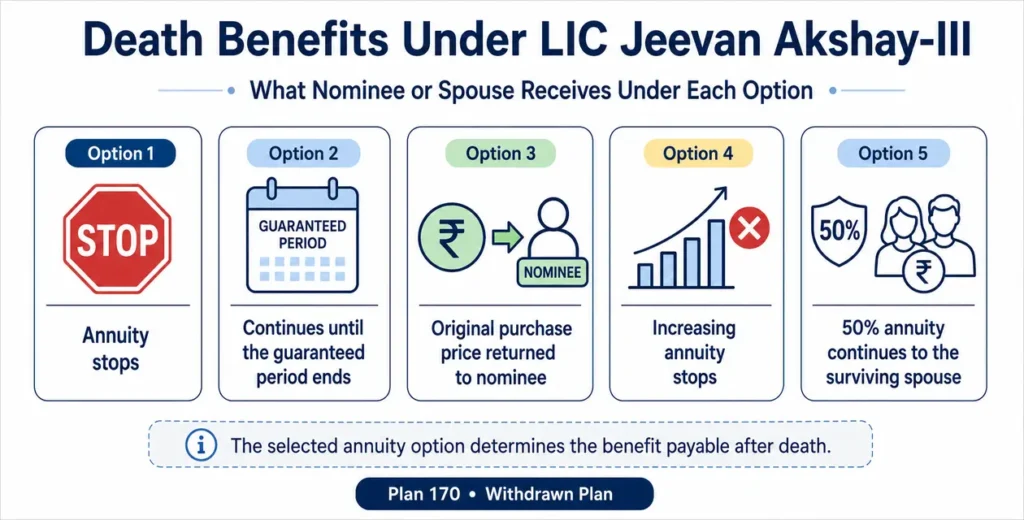
The benefit payable after death depended entirely on the annuity option selected when the policy was purchased.
Under Option 1, payments stopped after the annuitant’s death. Under Option 2, the nominee continued receiving the annuity only for the remaining guaranteed period if death occurred before that period ended. Under Option 3, payments stopped and the original purchase price was returned to the nominee.
Option 4 did not provide a continuing annuity or purchase-price return after death. Under Option 5, 50% of the annuity continued for the lifetime of the surviving spouse. If the spouse had predeceased the annuitant, nothing was payable after the annuitant’s death.
Surrender Value, Loan and Paid-Up Value
LIC Jeevan Akshay-III did not acquire a paid-up value. This was logical because the entire premium was paid as a single lump sum rather than through continuing instalments.
No surrender value was available, and the policy could not be used to obtain a loan. After the cooling-off period, the purchase price could not ordinarily be recovered by terminating the policy. A return of purchase price after death was available only under Option 3.
The brochure allowed a policyholder who disagreed with the policy terms to return the policy within 15 days, subject to the applicable conditions. This cooling-off provision should not be confused with a regular surrender facility.
Limitations of the Calculator
The available LIC brochure provides only limited sample rates. It does not contain the complete rate table for every entry age, annuity option and payment mode.
Automatic calculations based on the brochure should therefore be limited to Options 1 and 3, yearly mode and the sample ages specifically listed. For all other combinations, the applicable rate should be taken from the original policy schedule or another authoritative LIC record.
Rates for intermediate ages should not be estimated through simple interpolation and described as official rates. LIC may also have applied contractual conditions and rounding rules that an independent calculator cannot reproduce completely.
The original policy bond, policy schedule and LIC-issued statement remain the final references for an existing policyholder’s benefits.
Important Points to Remember
LIC Jeevan Akshay-III Plan 170 is a withdrawn plan and cannot be purchased today. Information about it should be treated as historical policy guidance rather than a recommendation for a new retirement product.
The option selected when the policy was issued determines the lifetime annuity and death benefit. It is not sufficient to know only the purchase price and age. The payment mode, applicable rate, guaranteed period and purchase-price incentive must also be considered.
Calculator results based on a manually entered rate are only as accurate as the rate supplied. Before relying on any estimate, compare it with the annuity amount stated in the original policy schedule.
Frequently Asked Questions
Is LIC Jeevan Akshay III Plan 170 still available?
No. LIC Jeevan Akshay-III was withdrawn on 17 March 2006 and is not available for new purchases. The calculator is intended for understanding or reviewing old policies.
What was the minimum purchase price?
The minimum purchase price was ₹50,000 or the amount required to secure an annual annuity of at least ₹3,000. Both conditions had to be considered when issuing the policy.
Was a medical examination required?
No medical examination was required. However, standard proof of the annuitant’s age was necessary.
Could LIC Jeevan Akshay III be surrendered?
No regular surrender value was available under the plan. The brochure provided a 15-day cooling-off period, subject to the applicable terms, but this was not a continuing surrender facility.
Which option returned the purchase price?
Option 3 provided a life annuity with return of purchase price. Following the annuitant’s death, annuity payments stopped and the original purchase price was returned to the nominee.
Can the yearly rate be used for monthly calculations?
No. The applicable annuity rate varied according to the payment mode. An official yearly-mode rate should not be divided by 12 and presented as an official monthly-mode annuity. A monthly-mode calculation requires the relevant monthly-mode rate.
Are calculator results guaranteed by LIC?
No. An independent calculator provides an estimate based on the information and rates entered. The original policy schedule and benefit documents issued by LIC determine the actual contractual benefit.
Conclusion
The LIC Jeevan Akshay III Plan 170 Calculator helps explain how purchase price, age, annuity option, payment frequency and rate incentives affected the income available under this withdrawn immediate annuity plan.
Its most reliable automatic calculations are those based on the limited yearly rates published in the official brochure for Options 1 and 3 at selected ages. Other calculations require the correct mode-specific rate from an authoritative LIC record.
The calculator can make an old policy easier to understand, but its results should be treated as estimates. Existing policyholders and nominees should rely on the original policy schedule or an official statement from LIC when confirming actual benefits.
Disclaimer: This is an independent educational calculator and guide. It is not affiliated with or endorsed by the Life Insurance Corporation of India. Calculated values are illustrative and do not replace the terms, annuity rates or benefits recorded in the original LIC policy documents.

Amit Kushwaha is a financial content creator and SaaS tool developer based in Lucknow, Uttar Pradesh. He has more than seven years of experience creating insurance-related content, online calculators, and practical digital tools for LIC policyholders, insurance buyers, and LIC agents.
Through LICPolicyCalculator.com, he focuses on simplifying complex LIC policy information into easy-to-understand guides and calculators. His work covers LIC premium estimates, maturity calculations, surrender value tools, policy return calculations, term insurance planning, and plan-specific calculator pages.