LIC Jeevan Akshay IV Plan 176 Calculator
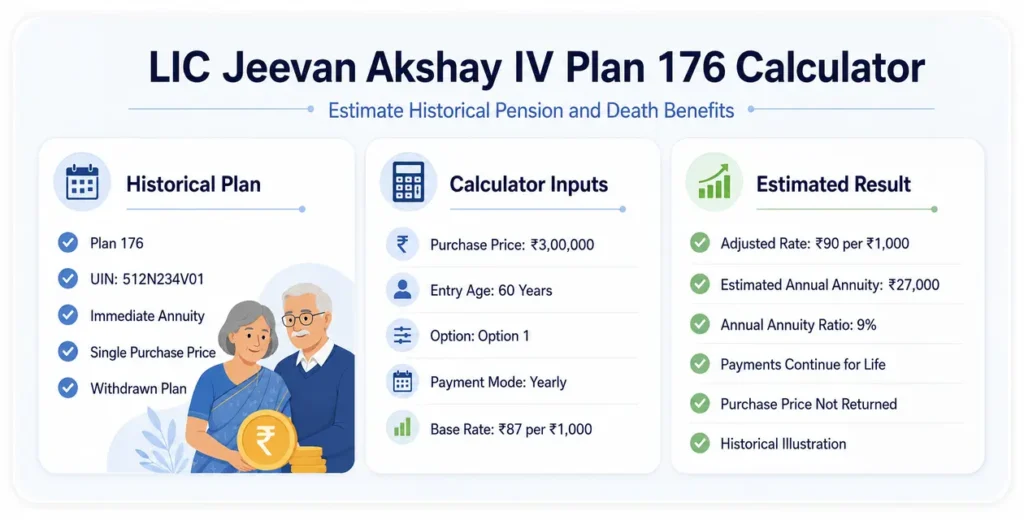
The LIC Jeevan Akshay IV Plan 176 Calculator is an online tool for estimating annuity income under LIC’s withdrawn immediate annuity policy. It uses the purchase price, entry age, annuity option, payment mode and applicable historical rate to estimate the pension payable yearly, half-yearly, quarterly or monthly.
According to the IRDAI historical product record, LIC’s Jeevan Akshay-IV opened for buy on 7 March 2006 and was withdrawn on 20 September 2006. Its plan number is 176 and its Unique Identification Number is 512N234V01. Since the policy is no longer available for new purchases, the calculator is mainly useful for reviewing an existing policy or understanding an old quotation.
Jeevan Akshay-IV was a single-premium immediate annuity plan. The proposer paid one lump-sum purchase price, after which LIC paid an annuity according to the option and payment frequency selected at inception. There was no regular premium-paying period or conventional maturity date.
The rates and examples in this guide are historical illustrations based on the official LIC Jeevan Akshay-IV brochure. They are not current LIC annuity quotations.
Table of Contents
LIC Jeevan Akshay IV Plan 176 Overview
| Plan detail | Historical information |
|---|---|
| Plan name | LIC’s Jeevan Akshay-IV |
| Plan number | 176 |
| UIN | 512N234V01 |
| Opening date | 7 March 2006 |
| Withdrawal date | 20 September 2006 |
| Plan category | Immediate annuity |
| Premium type | Single lump-sum purchase price |
| Minimum entry age | 40 years last birthday |
| Maximum entry age | 79 years last birthday |
| Minimum purchase price | ₹50,000, subject to minimum annuity |
| Minimum annuity | ₹3,000 per year |
| Payment modes | Monthly, quarterly, half-yearly and yearly |
| Medical examination | Not required |
| Paid-up value | Not available |
| Surrender value | Not available |
| Policy loan | Not available |
| Current status | Withdrawn |
What Is the LIC Jeevan Akshay IV Plan 176 Calculator?
The LIC Jeevan Akshay IV Plan 176 Calculator estimates the regular income that a policyholder may receive after investing a single lump-sum purchase price. Once the purchase price was paid, annuity payments began according to the selected payment mode.
The calculator contains all six annuity options offered under Plan 176. In addition to estimating annual and periodic income, it explains the guaranteed period, increasing annuity, surviving-spouse pension and return of purchase price wherever applicable.
- Option 1: Regular annuity for life without return of purchase price
- Option 3: Life annuity with return of purchase price after death
For these two options, rates at ages 40, 45, 50, 55, 60, 65, 70 and 75. The calculator can select those rates automatically.
For another option, age or payment-mode combination, an official rate from the policy schedule, original LIC quotation or another authoritative record must be entered. The calculator does not interpolate between ages or borrow a rate from another Jeevan Akshay version.
Also Check:
- LIC Jeevan Akshay Calculator
- LIC Jeevan Akshay VII Plan 857 Calculator
- LIC Jeevan Akshay VI Plan 189 Calculator
- LIC Jeevan Akshay V Plan 183 Calculator
- LIC Jeevan Akshay III Plan 170 Calculator
- LIC Jeevan Akshay II Calculator
- LIC New Jeevan Akshay I Plan 146 Calculator
Highlights of Jeevan Akshay IV Plan 176 Calculator
The calculator helps explain both the estimated pension and the conditions attached to the selected annuity option. Its principal features include:
- All six Jeevan Akshay-IV annuity options in one calculator
- Monthly, quarterly, half-yearly and yearly payment modes
- Automatic brochure rates for supported age-and-option combinations
- Manual official-rate input where the brochure provides no rate
- Automatic high-purchase-price addition
- Annual annuity and individual instalment calculation
- Guaranteed-period details for 5, 10, 15 and 20 years
- Simple 3% increasing-annuity explanation
- Surviving-spouse pension at 50% or 100%
- Clear explanation of the benefit payable after death
- Warning when an automatic historical rate is unavailable
- Reset button for starting a new calculation
These functions are intended to explain historical policy benefits. An issued policy schedule remains authoritative for an existing contract.
What is LIC Jeevan Akshay IV Plan 176?
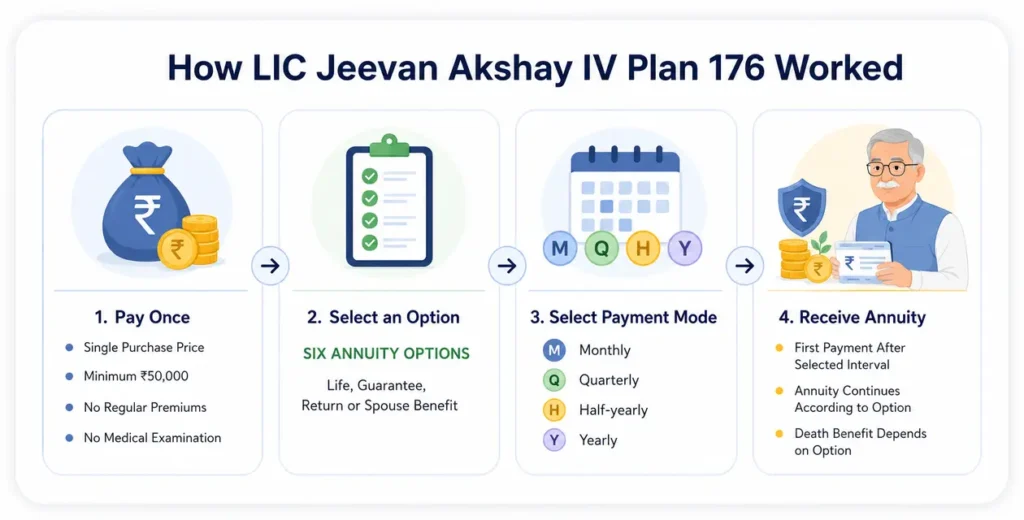
The proposer paid a single purchase price to obtain regular annuity income. The annuitant then selected an annuity option and payment frequency.
LIC determined the pension using factors such as the annuitant’s age, purchase price, chosen option, payment mode and applicable high-purchase-price addition. Different options produced different annuity amounts because their lifetime and post-death payment obligations were not the same.
Annuity payments started after the first interval associated with the selected frequency. The first instalment became payable:
- After one month under monthly mode
- After three months under quarterly mode
- After six months under half-yearly mode
- After one year under yearly mode
The pension then continued according to the selected option. A basic life annuity stopped after the annuitant’s death, while other options offered a guaranteed payment period, return of purchase price or continuing pension for a named spouse.
Eligibility and Purchase Conditions
The minimum entry age was 40 years last birthday, and the maximum was 79 years last birthday. Acceptable proof of age was required.
The minimum purchase price was ₹50,000 or the amount required to secure at least ₹3,000 in annual annuity. Therefore, ₹50,000 might not have satisfied the minimum-annuity condition under every option and payment frequency.
The official brochure did not prescribe a general maximum limit for the purchase price or annuity. A larger purchase price could be used subject to the terms and administrative requirements applicable when the policy was issued.
No medical examination was required. However, the absence of medical underwriting did not remove the need to submit valid age and identity documents.
Because the full purchase price was paid at inception, there were no future premiums to discontinue. The policy entered its annuity-payment stage after purchase.
Annuity Options Under LIC Jeevan Akshay IV Plan 176
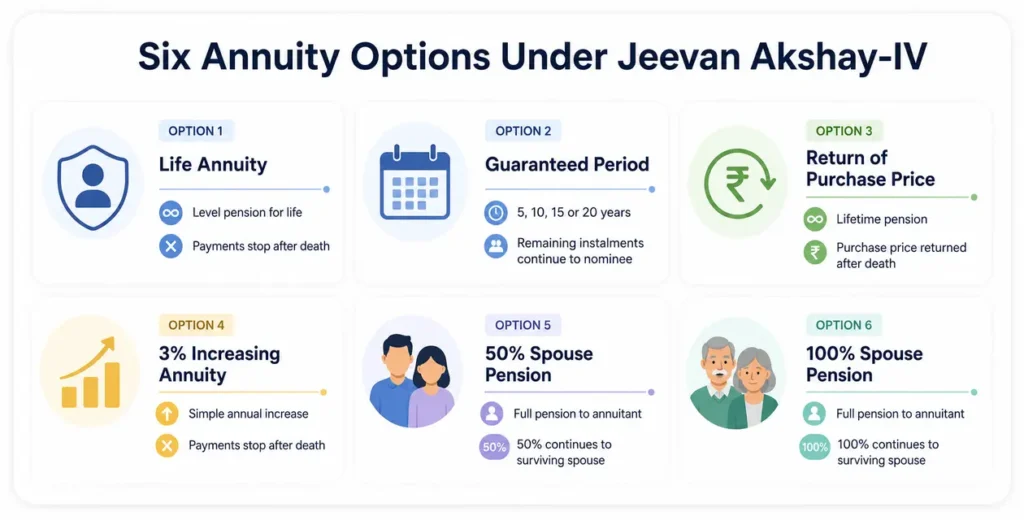
Option 1: Regular Annuity for Life
Option 1 provided a level annuity throughout the annuitant’s lifetime. Payments stopped after death.
No purchase-price return, nominee pension or surviving-spouse pension was specified under this option. Its purpose was to provide income for one life.
Because LIC had no stated payment obligation after the annuitant’s death, this option generally offered a higher starting pension than an alternative that returned the purchase price or protected a surviving spouse.
Option 2: Guaranteed Annuity for 5, 10, 15 or 20 Years and Thereafter for Life
Option 2 combined a guaranteed payment period with a lifetime annuity.
If the annuitant remained alive after the selected guaranteed period, pension continued for the annuitant’s lifetime. Completion of the guaranteed period did not stop pension while the annuitant was alive.
If death occurred during the guaranteed period, the nominee received the remaining scheduled annuity instalments until that period ended. Payments then stopped.
For example, if a 10-year guaranteed period was selected and the annuitant died after six years, the nominee would receive the scheduled pension for the remaining four years.
If death occurred after the guaranteed period had ended, no further annuity was payable. This option guaranteed a minimum payment period; it did not guarantee the return of the complete purchase price.
Option 3: Life Annuity with Return of Purchase Price
Option 3 provided regular annuity payments throughout the annuitant’s life. After death, annuity payments stopped and the original purchase price became payable to the nominee.
The returned amount was a death benefit rather than a maturity benefit. It should not be described as investment profit, interest or an additional bonus.
This option provided capital protection for a nominee but produced a lower regular annuity than Option 1 in the historical brochure.
Option 4: Annuity Increasing at 3% per Year
Option 4 provided a lifetime annuity that increased at a simple rate of 3% each year. The annual increase was calculated using the original annuity amount rather than the previous year’s revised pension.
If the first-year annual annuity was ₹20,000, the annual increase would be:
₹20,000 × 3% = ₹600
The second-year annuity would be ₹20,600, the third-year annuity ₹21,200 and the fourth-year amount ₹21,800.
This was a simple increase, not compound growth. Pension stopped after the annuitant’s death, and no purchase-price return or spouse benefit was specified under this option.
Option 5: Life Annuity with 50% Payable to the Surviving Spouse
Option 5 paid the full pension to the primary annuitant throughout life. After the primary annuitant’s death, 50% of that pension continued to the surviving named spouse for life.
If the primary annual annuity was ₹60,000, the surviving spouse would receive ₹30,000 per year after the annuitant’s death.
If the named spouse died before the primary annuitant, nothing was payable after the primary annuitant’s death. No purchase-price return was specified under this option.
Option 6: Life Annuity with 100% Payable to the Surviving Spouse
Option 6 paid the full pension to the primary annuitant during life. After the annuitant’s death, 100% of the pension continued to the surviving named spouse.
If the primary pension was ₹60,000 per year, the named spouse would continue receiving ₹60,000 per year for life.
If the spouse died before the primary annuitant, no further benefit was payable after the annuitant’s death. Payments ended after the death of the surviving eligible spouse, and the purchase price was not automatically returned.
Death Benefits Overview
| Selected option | Benefit after the annuitant’s death |
|---|---|
| Option 1 | Annuity stops |
| Option 2 | Remaining guaranteed instalments continue if death occurs during the selected period |
| Option 3 | Annuity stops and the purchase price is paid to the nominee |
| Option 4 | Annuity stops |
| Option 5 | 50% of the annuity continues to the surviving named spouse |
| Option 6 | 100% of the annuity continues to the surviving named spouse |
A nominee should not assume that the purchase price is refundable under every Plan 176 policy. The selected annuity option recorded in the policy schedule must be checked first.
LIC Jeevan Akshay IV Historical Annuity Rates per ₹1,000
The official brochure publishes yearly annuity rates for every ₹1,000 of purchase price under Options 1 and 3.
| Entry age | Option 1: Without purchase-price return | Option 3: With purchase-price return |
|---|---|---|
| 40 | ₹68.20 | ₹61.90 |
| 45 | ₹70.90 | ₹62.10 |
| 50 | ₹74.70 | ₹62.40 |
| 55 | ₹79.90 | ₹62.70 |
| 60 | ₹87.00 | ₹63.20 |
| 65 | ₹97.50 | ₹63.70 |
| 70 | ₹114.10 | ₹64.40 |
| 75 | ₹138.20 | ₹65.20 |
Historical illustration: These are annual annuity rates for every ₹1,000 of purchase price. They are not current LIC pension rates.
The difference between the two columns reflects their different death benefits. Under Option 1, LIC’s annuity obligation ended after death. Under Option 3, LIC also had to return the original purchase price to the nominee.
The brochure does not publish complete rates for every guaranteed-period, increasing-annuity or spouse-annuity alternative. Rates missing from the brochure should not be invented or taken from Jeevan Akshay-III, V, VI or VII.
High-Purchase-Price Addition
Plan 176 provided an increase in the annual annuity rate for larger purchase prices.
| Payment mode | ₹1,50,000–₹2,99,999 | ₹3,00,000 and above |
|---|---|---|
| Yearly | ₹2.50 | ₹3.00 |
| Half-yearly | ₹3.00 | ₹3.50 |
| Quarterly | ₹3.50 | ₹4.25 |
| Monthly | ₹4.00 | ₹5.00 |
These figures represented additions to the annual annuity rate per ₹1,000 of purchase price.
The brochure’s text says the incentive applied when the purchase price was more than ₹1.50 lakh, while its table begins at ₹1,50,000. For a policy issued at exactly ₹1,50,000, the issued schedule or original quotation should determine whether the addition applied.
When entering a manual rate in the calculator, it is important to know whether that rate already includes the high-purchase-price addition. If it does, the corresponding checkbox should be selected to prevent the calculator from adding the incentive twice.
How the Pension Is Calculated
The basic formula is:
Annual annuity = (Purchase price ÷ ₹1,000) × applicable annual rate per ₹1,000
If the high-purchase-price addition applies:
Adjusted rate = Base rate + high-purchase-price addition
The adjusted rate is then used in the calculation:
Estimated annual annuity = (Purchase price ÷ ₹1,000) × adjusted rate
For periodic results:
- Estimated monthly instalment = Annual annuity ÷ 12
- Estimated quarterly instalment = Annual annuity ÷ 4
- Estimated half-yearly instalment = Annual annuity ÷ 2
- Estimated yearly instalment = Annual annuity
These divisions should be used only after applying an appropriate annual rate for the selected payment mode. The issued policy schedule remains authoritative for the exact periodic pension.
How to Use the LIC Jeevan Akshay IV Calculator
Begin by selecting the annuity option stated in the policy document. Enter the primary annuitant’s age last birthday and original purchase price, and then select the payment mode.
Choose “Use brochure rate automatically” for yearly Option 1 or Option 3 when the exact age appears in the brochure table.
For another option, age or payment-mode combination, choose “Enter official rate” and enter the annual annuity rate per ₹1,000 from the policy schedule, original LIC quotation or another official record.
If the manually entered rate already includes the high-purchase-price addition, select the relevant checkbox so that the calculator does not apply it again.
For Option 2, select the guaranteed period of 5, 10, 15 or 20 years. For Option 5 or 6, enter the spouse information requested by the calculator.
After selecting “Calculate Annuity,” the result displays:
- Base annuity rate
- High-purchase-price addition
- Adjusted annuity rate
- Estimated annual annuity
- Estimated periodic instalment
- First-payment timing
- Annual annuity ratio
- Applicable benefit after death
The Reset button clears all entries and restores the default fields. When an automatic rate is unavailable, the calculator requests an official rate instead of estimating one through interpolation.
Real Life LIC Jeevan Akshay IV Calculation Example
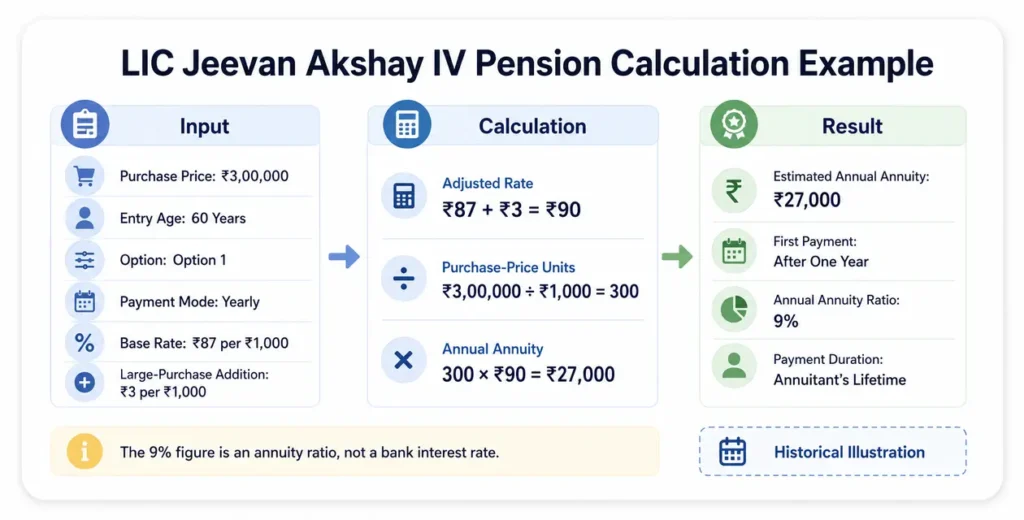
Suppose an annuitant has the following details:
- Purchase price: ₹3,00,000
- Age last birthday: 60 years
- Annuity option: Option 1
- Payment mode: Yearly
- Base rate: ₹87 per ₹1,000
- High-purchase-price addition: ₹3 per ₹1,000
The adjusted annuity rate is:
₹87 + ₹3 = ₹90 per ₹1,000
The purchase price contains 300 units of ₹1,000:
₹3,00,000 ÷ ₹1,000 = 300
The estimated annual annuity is:
300 × ₹90 = ₹27,000 per year
The first annual instalment would become payable one year after purchase.
The annual annuity ratio is:
(₹27,000 ÷ ₹3,00,000) × 100 = 9%
This ratio compares one year’s estimated pension with the purchase price. It is not a bank interest rate, investment yield or guaranteed total return.
Under Option 1, the ₹27,000 annuity would continue while the annuitant remained alive. After death, payments would stop and the purchase price would not be returned.
Comparison with Option 3
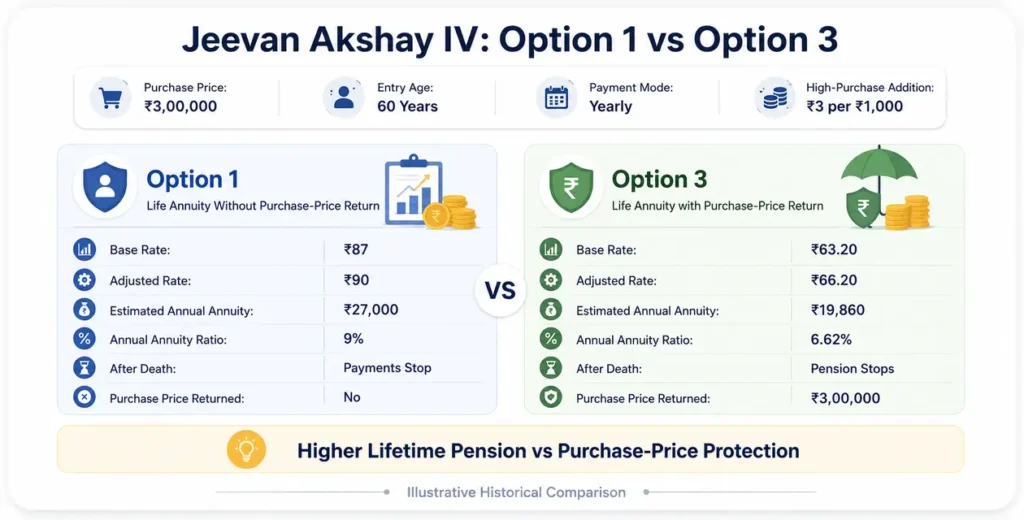
If the same annuitant selected Option 3, the base rate at age 60 would be ₹63.20 per ₹1,000.
After adding the yearly high-purchase-price addition:
₹63.20 + ₹3 = ₹66.20 per ₹1,000
The estimated annual annuity would be:
300 × ₹66.20 = ₹19,860 per year
The annual annuity ratio would be:
(₹19,860 ÷ ₹3,00,000) × 100 = 6.62%
Option 3 produced a lower annual pension, but the ₹3,00,000 purchase price would become payable to the nominee after the annuitant’s death, subject to the policy terms.
This comparison illustrates the trade-off between receiving a higher lifetime annuity and preserving the purchase price for a nominee.
Understanding the Calculator Results
The annual annuity represents the estimated pension payable during one policy year. The periodic instalment represents the estimated amount payable at each monthly, quarterly, half-yearly or yearly interval.
The base rate is the annuity rate before the high-purchase-price addition. The adjusted rate is the rate used after adding any applicable incentive.
The annual annuity ratio compares one year’s estimated pension with the original purchase price. It should not be presented as an interest rate because the annuitant exchanges access to the purchase price for benefits under the selected annuity option.
Under an option without return of purchase price, the total pension ultimately received depends on how long the annuitant survives.
For Option 2, the guaranteed-period value represents scheduled annuity payments during the selected term. It is not a separate lump-sum death benefit. If death occurs during the guaranteed period, only the remaining scheduled instalments continue to the nominee.
For Option 4, the 3% increase is calculated from the original annual annuity. If the starting pension is ₹20,000, the increase remains ₹600 each year. It does not rise through compounding.
For Options 5 and 6, the continuation benefit is payable only to the surviving named spouse under the policy terms.
Main Benefits of Plan 176
The main benefit of Jeevan Akshay-IV was regular lifetime income following a single purchase payment. There was no long accumulation period before the annuity began.
The plan offered six ways to balance personal pension and family protection. Depending on the selected option, it could provide guaranteed payments, return of purchase price, an increasing pension or continuing income for a surviving spouse.
Four payment frequencies allowed the annuity schedule to be aligned with different income requirements. Larger purchase prices also qualified for enhanced historical annuity rates.
No medical examination was required, although acceptable proof of age remained necessary.
These features should be understood in their historical context. They do not mean that Plan 176 remains available or represents a current retirement product.
Surrender, Loan, Paid-Up and Maturity Conditions
The policy did not acquire a paid-up value. Unlike a regular-premium insurance plan, there were no future premiums to discontinue because the complete purchase price was paid at inception.
No surrender value was available. After the initial cooling-off period, the annuitant could not ordinarily terminate the policy and recover the purchase price through surrender.
No policy-loan facility was available. The policy could not be used to borrow against the purchase price.
Plan 176 did not provide a conventional maturity benefit after a fixed term. Its main benefit was annuity income for life or under the selected guaranteed conditions.
Under Option 3, the purchase price was returned after the annuitant’s death. This was a death benefit, not a maturity payment.
These restrictions meant that the purchase price should not be viewed as a bank deposit that could be withdrawn when required.
Cooling-Off Period
The brochure provided a 15-day cooling-off period from the date the policy bond was received. If the policyholder disagreed with its terms and conditions, the policy could be returned during that initial period, subject to the applicable rules.
This cooling-off right should not be confused with surrender. The plan did not provide a continuing surrender value after that stage.
Accuracy and Limitations of LIC Jeevan Akshay IV Plan 176 Calculator
The brochure does not contain complete rates for every age, option and payment frequency. Missing rates should not be guessed or calculated through interpolation.
Automatic brochure rates should be restricted to Options 1 and 3, yearly mode and the exact ages shown in the official table. For other combinations, an official rate must be entered manually.
The calculator provides an illustration based on the information entered. Its periodic amounts, annuity ratios and benefit explanations do not replace the issued policy schedule.
The actual pension and claim benefits remain subject to the policy bond, LIC’s records and the option selected when the contract was issued. The calculator should not be treated as an official quotation, policy statement, financial recommendation or claim decision.
LIC Jeevan Akshay IV and Jeevan Akshay V Are Different
LIC Jeevan Akshay-IV was Plan 176 with UIN 512N234V01. Jeevan Akshay-V was a later version with Plan No. 183 and UIN 512N234V02.
Although the plans had similar names and comparable annuity structures, their historical rates and detailed conditions were not identical.
The UIN should therefore be checked before using any historical rate. A calculator or rate table created for V02 should not be used for a V01 policy. The same precaution applies to Jeevan Akshay-III, VI and VII.
How to Verify an Existing Plan 176 Policy
The policy bond and schedule are the most reliable sources for an existing contract. These documents should show the UIN, purchase price, entry age, selected annuity option, payment frequency, pension instalment and commencement date.
For Option 2, verify whether the guaranteed period was 5, 10, 15 or 20 years. For Options 5 and 6, confirm the named spouse’s details. Nominee information should also be checked under guaranteed-period and return-of-purchase-price options.
If the policy document is unavailable or a death claim must be filed, the relevant LIC servicing branch should be contacted with the policy number and available identity records.
Frequently Asked Questions
What was the entry-age range?
The minimum entry age was 40 years last birthday, and the maximum was 79 years last birthday.
What was the minimum purchase price?
The minimum purchase price was ₹50,000 or the amount required to secure at least ₹3,000 in annual annuity.
Was the purchase price returned after death?
It was returned only under Option 3. Other annuity options provided different post-death benefits.
Could Plan 176 be surrendered?
No surrender value was available under the official brochure’s terms.
Was a policy loan available?
No. LIC Jeevan Akshay-IV did not provide a policy-loan facility.
Did Plan 176 have a maturity benefit?
No conventional maturity benefit was payable. Under Option 3, the purchase price was returned after death as a death benefit.
When did pension payments begin?
The first instalment became payable after one month, three months, six months or one year, depending on the selected payment frequency.
Conclusion
The LIC Jeevan Akshay IV Plan 176 Calculator provides a structured way to estimate historical pension income and understand the benefits of this withdrawn immediate annuity plan. It is particularly useful for comparing a life-only annuity with a return-of-purchase-price annuity, reviewing guaranteed payments and understanding surviving-spouse benefits.

Amit Kushwaha is a financial content creator and SaaS tool developer based in Lucknow, Uttar Pradesh. He has more than seven years of experience creating insurance-related content, online calculators, and practical digital tools for LIC policyholders, insurance buyers, and LIC agents.
Through LICPolicyCalculator.com, he focuses on simplifying complex LIC policy information into easy-to-understand guides and calculators. His work covers LIC premium estimates, maturity calculations, surrender value tools, policy return calculations, term insurance planning, and plan-specific calculator pages.